
Journalist

Ryu Yuna
julia37@ajupress.com
-
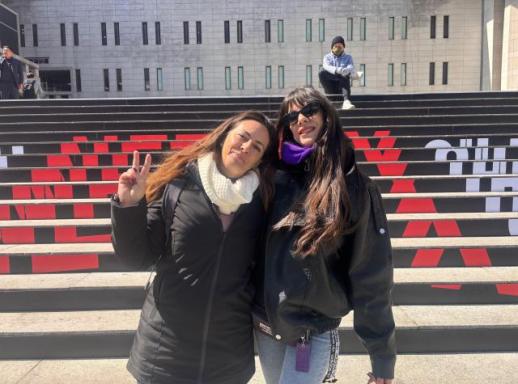 BTS Live D-2: Why ARMY are willing to come - at any cost SEOUL, March 19 (AJP) - Visitors flocking to Seoul from around the world for the BTS comeback concert Saturday are readily paying ever higher prices for flights, accommodation and merchandise, as a measure of the devotion that typifies the BTS fan. Travel costs are surging up to six times their usual levels, fans say. The willingness to absorb the burden reflects more than concert demand, underscoring a deeper dynamic of the BTS-driven “fandom economy,” where spending functions as an expression of loyalty and identity. “They don’t just sell music or tickets. They shape narratives that move people and, increasingly, markets,” said Lambert Zixin Li, professor of Management and Organization at the National University of Singapore. On the ground in Gwanghwamun, the downtown concert venue, overseas fans said rising costs did little to deter them. “I love their songs. The lyrics are so meaningful,” said Christina Coppola from Italy, who traveled with her sister. “They are strong and cool.” For many, the BTS impact runs deep. “They are my motivation for life,” said Desty Konita, a 30-year-old visitor from Indonesia who traveled to Seoul with her four-month-old child. “They work so hard, have no scandals, and remain humble despite their popularity. I really respect that,” she said, adding that she had learned Korean because of BTS. Tan Joo Seng, a professor of strategy and international business at Nanyang Business School, said such attachment reflects the need for meaning in uncertain times. “Being a fan provides individuals with a sense of belonging, identity and shared purpose,” he said. Others pointed to specific songs and long-term fandom as their reason for coming. “I really like V’s solo song ‘Winter Bear,’” said Tanaka Arisa, a 19-year-old from Japan who has followed BTS since high school. Fans in Gwanghwamun said they “had to come” despite higher expenses, viewing the event as a chance to be physically present within a global fandom community. “The scale of BTS’s upcoming concert, with the expected audience of around 260,000, shows how fandom has evolved into a significant economic force,” Tan said. “Superstar fandoms today operate as highly engaged ecosystems that generate value far beyond ticket sales.” According to a 2024 study by Luminate, an entertainment analytics platform, U.S.-based K-pop fans spent 2.4 times more on merchandise in 2023 than general pop fans. Forbes magazine noted that “creators are the new brands,” adding that the relationship between creators and fans is evolving beyond brand loyalty into a meaningful economic community. This shift is often described as the “fandustry,” where fan activity directly drives the success and market value of content. Tan explained that at the core of this system is emotional engagement, noting that modern fandoms are no longer passive audiences but active participants who amplify content, organize communities and sustain demand across digital platforms. This creates what Nanyang Business School professor Tan described as a “multiplier effect,” where each fan interaction generates further economic and cultural impact. The Indonesian fan Desty Konita said that BTS is “number one” in Indonesia and that she promotes the group with her friends. “Even if flight prices are five times higher, it’s still worth it,” Konita said. “It’s even a free concert, and opportunities like this don’t come often.” Some BTS supporters, known as the ARMY, spend up to 50–60 percent of their income on albums, merchandise and related experiences. The economic impact already evident in the data. BTS is estimated to generate around 5.5 trillion won annually, according to the Hyundai Research Institute, accounting for roughly 0.3 percent of South Korea’s GDP. In cities where concerts are held, the events drive spending across airlines, hotels, dining and tourism. The BTS fan app Weverse saw its revenue rise from 31.7 billion won (about $28.3 million) in 2019 to 112.7 billion won in the first half of 2020, accounting for around 38.3 percent of the BTS management company HYBE’s total sales. “Superstars are becoming ‘central banks of attention,’” said Lambert Zixin Li of the National University of Singapore. “When they act or speak, they inject liquidity into specific narratives, rapidly driving demand across products, experiences and even financial assets.” 2026-03-19 17:20:35
 -
 Asian stocks turn lower on Fed inflation warning, oil surge SEOUL, March 19 (AJP) — Asian stock markets opened lower on Thursday as a renewed surge in oil prices driven by escalating Middle East tensions and a more hawkish Federal Reserve outlook weighed on investor sentiment. Israel struck Iran’s South Pars gas field on Wednesday, marking its first attack on the country’s energy infrastructure in retaliation for the killing of senior intelligence and military officials. The escalation sent Brent crude up 6.1 percent to $109.75 per barrel, with Citi warning prices could climb further toward $120. Investor sentiment was also pressured by hawkish signals from the Federal Reserve. The Fed held its benchmark interest rate at 3.50–3.75 percent and refrained from offering forward guidance amid uncertainty stemming from the Middle East conflict. However, markets interpreted its upgraded inflation outlook as a hawkish signal. All three major U.S. stock indexes fell more than 1 percent overnight. The Korean won weakened sharply, with the one-month non-deliverable forward (NDF) rising to 1,508.25 per dollar. In onshore trading, the won fell to 1,500.20 per dollar from a previous close of 1,483.1. Technology heavyweights declined, with Samsung Electronics and SK hynix down around 3 percent and 4 percent, respectively, partially erasing their previous gains of 7.53 percent and 8.87 percent. The declines tracked overnight weakness in global chip stocks, with Nvidia down 0.84 percent and ASML falling 2.45 percent, pushing the Philadelphia Semiconductor Index down 0.53 percent. Losses were broad-based across sectors. Automakers declined, with Hyundai Motor down 3.85 percent to 524,000 won and Kia falling 2.11 percent to 171,400 won. Battery and industrial shares also weakened. LG Energy Solution slipped 2.35 percent to 374,500 won, Samsung C&T fell 2.68 percent to 291,000 won, and SK Square dropped 3.65 percent to 60,700 won. Shipbuilders and defense-related stocks moved lower, with HD Hyundai Heavy Industries down 3.73 percent to 568,000 won and Hanwha Aerospace falling 1.80 percent to 1,365,000 won. Financials traded lower, with KB Financial down 1.36 percent to 152,600 won and Shinhan Financial falling 1.89 percent to 93,200 won. Biopharmaceutical shares also slipped, with Celltrion down 3.34 percent to 202,500 won and Samsung Biologics falling 1.66 percent to 1,599,000 won. Brokerages said near-term volatility may increase, though a recovery remains possible. Han Ji-young, an analyst at Kiwoom Securities, said energy-driven inflation uncertainty has reinforced the Federal Reserve’s hawkish stance. She added that a stabilization in geopolitical conditions could shift markets into a more supportive phase, noting that markets have often rebounded after initial declines during past conflicts. As of 10:07 a.m., the benchmark KOSPI fell 2.72 percent to 5,764.10, while the KOSDAQ declined 1.88 percent to 1,142.52. Japan’s Nikkei 225 dropped 2.59 percent to 53,806.16 in morning trading, as rising energy costs threatened corporate earnings in import-dependent Japan while Fed-driven rate concerns further dampened sentiment. 2026-03-19 10:46:35
 -
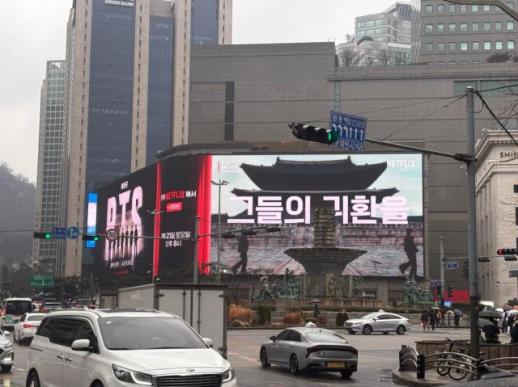 BTS Live D-3: Fan must-have turns sour as light stick prices soar SEOUL, March 18 (AJP) - The soaring price of K-pop light sticks — once a simple symbol of fandom — is fast becoming a flashpoint ahead of the BTS Gwanghwamun comeback concert, as shortages and steep markups leave fans questioning whether the experience is still worth the cost. With the concert just three days away, demand for official light sticks has surged, triggering shortages and driving up resale prices, particularly in tourist-heavy districts in central Seoul such as Myeongdong. At around 3 p.m. on Wednesday, K-MECCA, a K-pop goods store in Myeongdong, was crowded with about 30 foreign visitors browsing merchandise. Light sticks displayed at the entrance drew attention. “I think everyone wants to get the feeling, but these prices are too high,” said Katie Mueller, a visitor in her 30s from Germany. “A lot of fans are younger than me, so it should stay within a reasonable range. I’m not sure if I would want to spend this much.” “The light stick is too expensive,” said Nanako, 18, from Fukuoka. “I can’t afford it. But if I could, I would want to get a light stick and photo cards.” Myeongdong has emerged as a hub for K-pop merchandise sales, with stores targeting foreign tourists who may be less familiar with official pricing. Some stores did not display prices, requiring customers to check at the counter, where prices change with demand. According to data from secondhand platform Bungaejangter, search interest in BTS-related items including “BTS light stick,” “BTS concert” and “BTS tickets” has spiked this month, indicating a simultaneous increase in both concert participation and merchandise demand. As of March, searches for BTS light sticks rose 438 percent from the previous month and 1,764 percent from a year earlier. The trend extends beyond Korea. On Japan’s resale platform Mercari, transactions involving BTS light sticks have also increased, indicating strong overseas demand ahead of the event. Offline demand is also evident. At the K-pop specialty “K-WAVE Zone” inside Shinsegae Duty Free Myeongdong, BTS merchandise sales jumped about 190 percent over the March 13–15 weekend, with March 14 sales more than tripling year-on-year. A staff member said light sticks are currently difficult to secure and that inquiries about BTS goods have been increasing, particularly from Japan. “Today it’s a bit quieter because of the rain,” she said. “Light sticks are not coming in. They’re in short supply.” Analysts warn that excessive price hikes that could damage Korea’s tourism credibility. “This is not just a pricing issue. It’s a matter of trust,” said Lee Hoon, professor of Hanyang University. “When pricing exceeds a certain acceptable range, trust begins to break down.” “If such practices are repeated, it could create a perception that Korean businesses are not trustworthy. Trust is easy to lose but very difficult to rebuild,” he said. He emphasized both private- and public-sector roles in addressing the issue. “Local merchant associations should take the lead, while governments need to establish systems and safeguards to prevent such practices,” he said. Kim Nam-jo, a professor at Hanyang University, said price increases may be natural amid rising demand, but agreed that excessive markups are problematic. Prices should remain within a reasonable range, he said, noting that tourism depends on repeat visits rather than one-time consumption. “Tourism is not a one-off experience. If visitors leave with a negative impression, they may not return, and they won’t recommend it to others.” He warned that such practices could have broader implications beyond individual stores. “What appears to be a local issue can ultimately affect the country’s overall image,” he said. “Short-term pricing strategies do not last. Businesses built on image cannot survive if that image is damaged.” On a different note, Joo Dong-oh, a professor of Kyung Hee University, offered a more nuanced view, saying that if consumers are aware of regular prices yet still choose to pay more, K-pop merchandise can be seen as “an emotional symbol commemorating the BTS concert rather than a simple product.” He added that unless clear illegal practices such as counterfeit sales or price collusion occur, the impact on Korea’s tourism image is likely to be limited. Kim Hong-yu, also of Kyung Hee University, agreed that the surge in K-pop merchandise prices is problematic. “With K-pop’s core fan base is growing beyond Southeast Asia into Europe and North America, this is a particularly sensitive stage,” he said. 2026-03-18 18:08:31
 -
 Asian markets edge up as Strait of Hormuz fears ease SEOUL, March 18 (AJP) - Asian stock markets opened higher Wednesday as concerns over supply chain disruptions involving the Strait of Hormuz eased slightly amid the prolonged Middle East conflict. South Korea's benchmark KOSPI extended its gains from the previous session as improving sentiment toward chipmakers outweighed concerns over volatile oil prices. Market sentiment remained fragile overnight amid rising crude oil prices and the ongoing U.S. Federal Open Market Committee (FOMC) meeting. Bust several reports that oil tankers have begun passing through the strategically important waterway helped ease supply concerns. Kevin Hassett, a White House official said tanker traffic is resuming through the critical chokepoint for roughly one-fifth of the world's oil supply. Geopolitical tensions remain high, however. U.S. President Donald Trump signaled a tougher stance on Iran as the Middle Eastern country continues retaliatory attacks including strikes near the UAE's Fujairah port, an alternative export route. Oil prices rose on the lingering uncertainty. West Texas Intermediate crude gained 3.32 percent to settle at $95.53 per barrel, while Brent crude climbed 3.20 percent to $103.42. At 9:41 a.m., Samsung Electronics surged 5.08 percent to 203,750 won, reclaiming the 200,000-won level for the first time since Feb. 27 before the outbreak of the conflict. SK hynix also rose 3.61 percent to 1,005,000 won, crossing the 1 million-won mark for the first time since the war began. Other chip-related stocks traded higher as well, with SK Square gaining 5.45 percent, Hanmi Semiconductor rising 1.33 percent and Samsung Electro-Mechanics advancing 1.34 percent. The rally followed gains in U.S. chip stocks, led by Micron Technology, which jumped 4.5 percent to a record high ahead of its earnings report, with expectations of a beat further boosting sentiment across the sector and spilling over into Korean equities. In South Korea, Samsung Electronics is holding its annual shareholders' meeting at its headquarters in Suwon, Gyeonggi Province. Key agenda items reportedly include a special dividend worth 1.3 trillion won, along with amendments to its articles of incorporation aimed at strengthening minority shareholder rights. Among other large-cap stocks, Samsung C&T rose 7.51 percent to 300,500 won, and Samsung Life Insurance advanced 12.67 percent to 244,500 won. SK Square climbed 5.96 percent to 622,000 won, and Samsung Biologics gained 2.52 percent to 1,627,000 won. Automakers also traded higher, with Hyundai Motor up 3.93 percent at 542,500 won and Kia advancing 4.24 percent to 174,400 won, and Hyundai Mobis rising 4.12 percent to 429,500 won. In the financial sector, KB Financial Group gained 2.52 percent to 154,500 won and Shinhan Financial Group rose 2.96 percent to 93,900 won. Among other notable movers, Doosan Enerbility added 2.97 percent to 107,500 won, HD Hyundai Electric jumped 4.19 percent to 970,000 won, and Korea Zinc climbed 3.29 percent to 1,665,000 won. The gains were supported by expectations for alternative energy demand as oil prices fluctuated above $100 amid prolonged Middle East tensions. As of 10:13 a.m., the benchmark KOSPI rose 3.72 percent to 5,850.28, and the tech-heavy KOSDAQ gained 1.16 percent to 1,150.17. The Korean won strengthened to 1,487.00 per dollar from the previous close of 1,492.5. Elsewhere in Asia, Tokyo stocks advanced, with the Nikkei 225 gaining 1.38 percent to 54,442.94 as easing concerns over oil supply disruptions prompted bargain buying. Semiconductor-related shares led the gains, tracking overnight strength in the Nasdaq. Advantest surged 4.16 percent to 24,525 yen, and Tokyo Electron rose 1.39 percent to 39,320 yen. Sentiment was further supported by a report from the Mainichi Shimbun that Japan could signal increased imports of U.S. crude at an upcoming summit between Trump and Japanese Prime Minister Sanae Takaichi in Washington, D.C. later this week, easing supply concerns. Hong Kong's Hang Seng Index rose 0.21 percent to 25,923.03. China's Shanghai Composite Index edged up 0.03 percent to 4,051.29. Taiwan's TAIEX also climbed 1.53 percent to 34,355.76 in the morning. 2026-03-18 11:49:08
 -
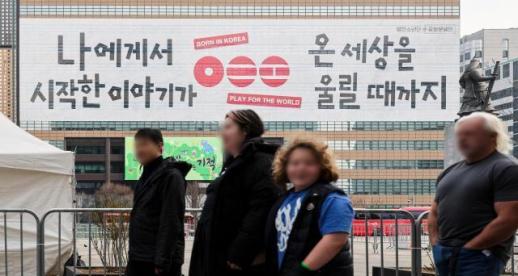 BTS Live D-4: How to navigate Seoul's biggest concert day SEOUL, March 17 (AJP) — The countdown is on. As BTS’s long-awaited comeback concert at Gwanghwamun draws near, both Seoul residents and international visitors are bracing for what could be one of the most crowded days the city has ever seen. Nearly 300,000 people are expected to pack into an area roughly the size of three soccer fields — raising a simple but pressing question: how do you get there, move around and make it through the day? Transport disruptions expected Authorities say major subway stations near the venue — including Gwanghwamun Station (Line 5), City Hall Station (Lines 1 and 2) and Gyeongbokgung Station (Line 3) — will skip stops on the day of the event, with some exits closed to manage crowd flow. Anguk Station (Line 3) may also be shut if congestion intensifies. Above ground, traffic controls will be extensive. Key roads such as Sejong-daero will be closed, and 62 bus routes will be temporarily rerouted. Safety measures ramped up The city is preparing for a massive influx of visitors. Around 6,500 police officers will be deployed across the area, while approximately 2,500 temporary restrooms will be installed near the venue. Real-time updates on transport, safety and facilities will be available through the Seoul Metropolitan Government’s integrated online platform, with multilingual support for foreign visitors. Still, officials acknowledge the day will be long and physically demanding. With access points restricted and nearby buildings limiting entry, even basic needs — finding restrooms or food — could become a challenge. Navigation apps such as KakaoMap will provide live updates on road closures, congestion levels, temporary facilities and first-aid stations. Businesses adapt to the surge Local businesses are already adjusting operations ahead of the concert, introducing pre-orders, delivery alternatives and flexible staffing. A nearby Salady outlet is offering advance orders with delivery to the venue, while a staff member at Subway said group orders can be placed one to two days in advance, though delivery will be limited due to road closures. Convenience store chain CU plans to significantly boost stocks of essentials such as bottled water and kimbap. Starbucks Korea is also preparing for a surge in both domestic and international customers. “We expect a significant increase in visitors and will adjust staffing flexibly to ensure safe and smooth operations,” a company official said. Most stores will remain open until 10 p.m., though some locations near restricted zones will close due to limited access. Tourist areas see early impact The concert’s ripple effects are already visible in tourist districts such as Myeongdong. A currency exchange operator said demand has picked up sharply in recent days, driven mainly by Japanese and Taiwanese visitors arriving ahead of the event. Restaurants slightly removed from the venue are also preparing for increased foot traffic, particularly from foreign tourists. Fan takeaway: plan ahead With transport disruptions, restricted access and massive crowds expected, preparation will be essential: • Expect subway disruptions and station closures • Plan restroom use in advance — queues will be long • Secure food early through takeout or pre-orders • Allow extra time for movement due to road closures and crowd control 2026-03-17 17:28:27
 -
 Asian markets broadly higher, KOSPI led by Nvidia partners SEOUL, March 17 (AJP) — Asian stock markets traded higher Tuesday as easing oil prices and renewed optimism over AI-driven semiconductor demand boosted investor sentiment across the region. All members of the “Magnificent Seven” closed higher overnight. Nvidia rose 1.65 percent, Tesla gained 1.11 percent, Amazon advanced 1.96 percent, Meta Platforms climbed 2.33 percent, Alphabet added 1.09 percent, Microsoft rose 1.11 percent and Apple edged up 1.08 percent. Sentiment was buoyed after Nvidia CEO Jensen Huang projected that demand for its Blackwell and Vera Rubin AI platforms could reach as much as $1 trillion by 2027, reinforcing expectations for sustained semiconductor demand driven by artificial intelligence. The Philadelphia Semiconductor Index rose 1.96 percent, while Micron Technology gained 3.68 percent after announcing plans to build a second semiconductor fabrication facility in Taiwan. Nvidia’s key memory partners also shared the momentum. SK hynix rose 2.26 percent to 996,000 won, approaching the 1 million won mark and the highest level in 11 sessions, while Samsung Electronics gained 3.90 percent to 196,050 won, nearing the 200,000 won level. Also riding the Nvidia wave, Hyundai Motor and Kia said they will expand cooperation with Nvidia in autonomous driving and software-defined vehicles. The companies plan to apply Level 2+ autonomous driving technologies to selected models and aim to extend collaboration toward Level 4 robotaxis. The partnership is also expected to strengthen AI integration, with the group building an end-to-end data and learning system to enhance its autonomous driving capabilities. Reflecting the optimism, Hyundai Motor rose 4.55 percent to 529,000 won and Kia gained 3.58 percent to 167,800 won in morning trading. As of 10:51 a.m., the benchmark KOSPI rose 2.49 percent to 5,688.22, while the tech-heavy KOSDAQ gained 1.07 percent to 1,150.49. Institutions were net buyers, purchasing 180.5 billion won ($135 million), while individuals and foreign investors were net sellers, offloading 109.0 billion won and 58.6 billion won, respectively. Among other heavyweights, SK Square surged 6.05 percent to 596,000 won, HD Hyundai Electric rose 3.87 percent to 940,000 won and Hyundai Mobis gained 3.24 percent to 414,000 won. Internet and biotech stocks also moved higher, with Naver advancing 2.29 percent to 223,000 won, Celltrion climbing 2.75 percent to 205,500 won and Samsung Biologics adding 1.21 percent to 1,587,000 won. Financial shares posted modest gains, with KB Financial rising 0.94 percent to 150,700 won, Shinhan Financial gaining 0.78 percent to 90,700 won and Samsung Life Insurance up 1.65 percent to 215,500 won. Meanwhile, a few stocks bucked the broader trend. Hanwha Aerospace fell 5.42 percent to 1,396,000 won and Mirae Asset Securities slipped 1.41 percent to 69,900 won. The Korean won strengthened to 1,493.20 per dollar from the previous close of 1,497.6 as oil prices eased. Elsewhere in Asia, Japanese equities opened higher with the Nikkei 225 rising 0.21 percent to 53,862.79. Hong Kong’s Hang Seng Index gained 0.79 percent to 26,038.31, China’s Shanghai Composite Index edged up 0.09 percent to 4,088.46 and Taiwan’s TAIEX advanced 1.66 percent to 33,897.30. 2026-03-17 11:31:48
 -
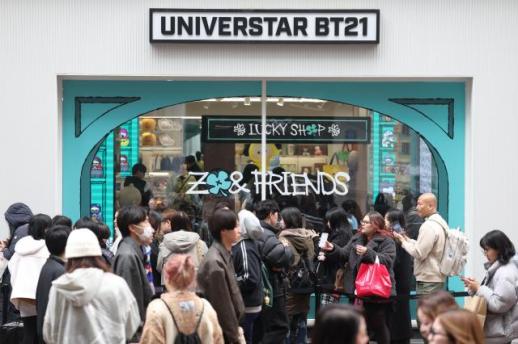 BTS LIVE D-5: 'BTS effect' in force as fans swarm into Seoul SEOUL, March 16 (AJP) - Lotus Buzon bought herself a map of downtown Seoul and, on a trek around the city’s Gwanghwamun area, marked all the public restrooms on it. This, she admits, is not normal for a tourist. But then Buzon, a 42-year-old Filipina, is a BTS fan and she is in South Korea for the group’s comeback concert this Saturday. She is not taking any chances with massive crowds expected. Organizers estimate that as many as 300,000 fans could pack into Gwanghwamun Square, an area of roughly 18,900 square meters — about the size of three soccer fields. “Honestly, my biggest worry is whether I will be able to find a restroom,” she says. Before leaving Manila, Buzon found hotel prices already surging and had to settle for accommodation in Seoul’s Gwanak District, which is a 40-minute drive from the concert venue. “Hotel prices were five times higher than usual, but I booked early so I was able to get a reasonable rate,” she said. “Going to restaurants or cafes that day is out of the question,” she said. “My plan is to go straight from my hotel to the concert and try to leave as early as possible before the crowds.” But she is not complaining. A diehard BTS fan, Buzon pulled out plush toys and keyrings from the BT21 merchandise she had just bought at the LINE Store. “I just bought all of these, so I’m really happy right now,” she said. The Korean retail is enjoying an unexpected BTS-driven tourist boon as fans like Buzon turn their enthusiasm into shopping for Korean goods upon arriving early for the concert. The event is expected to generate significant economic impact. The Korea Culture & Tourism Institute (KCTI) estimates that a BTS concert in South Korea could create up to 1.2 trillion won ($900 million) per event, including indirect effects such as intellectual property (IP) revenue and the global promotion of K-pop. Demand is particularly strong for BT21 merchandise, a character brand created with direct participation from BTS members. Developed by LINE FRIENDS, the character brand was created with direct input from all seven members of the group. LINE FRIENDS has expanded the BT21 brand globally, launching various products and content in markets including South Korea, the United States, Japan, Taiwan, Hong Kong, and Thailand. Ahead of the concert, fans have been visiting LINE FRIENDS Square across Seoul to buy BT21 plush dolls, keyrings, and figurines. “BT21 is a globally popular character IP with new products released regularly each season,” an official at IPX, the digital IP platform company behind LINE FRIENDS and BT21 said. “Recently we launched the BT21 World Voyage collection, featuring travel-themed items such as luggage belts, short-sleeve T-shirts, luggage tags and passport cases.” “Visitor numbers at the LINE Friends Square stores in Myeongdong and Insadong rose more than 30 percent last weekend compared with the previous week, and we expect further increases from Thursday through Sunday,” she said. “We are preparing about 20 percent more stock than usual,” she added. “This includes new items like the BT21 World Voyage collection as well as popular staples such as the Seoul Edition and K Edition, which are especially popular among international tourists.” The central Myeongdong retail district is also expanding related products and promotions to capture the “BTS effect.” Shinsegae Duty Free is operating a “K-Wave Zone” at its Myeongdong branch, offering BTS magazines, puzzles, plush toys and BT21 merchandise. The company said sales of BTS-related goods tend to rise whenever major BTS-related news emerges. Shinsegae Department Store is also joining the push. In collaboration with BTS agency HYBE, it will open a pop-up store at its flagship “The Heritage” building in Myeongdong to mark the release of the group’s new studio album. The space will sell the new album and related merchandise from Friday to April 12. Lotte Department Store will launch a “Welcome Lights” project, illuminating Lotte Town Myeongdong in BTS’s signature color, purple. From Thursday to Sunday, the exterior walls of its main store and the adjacent Avenuel building will be lit in purple from 6 p.m. to 10 p.m. each evening. Lotte Department Store will also hold a “K-Wave Shopping Week” for foreign tourists from Thursday to March 29 at its Myeongdong flagship store, Jamsil branch, and Lotte Outlet Seoul Station branch. Convenience store chains are also preparing for the expected surge in visitors. 7-Eleven Korea plans to increase inventories of ready-to-eat meals, instant noodles, mobile accessories, and batteries by up to tenfold at stores near Gwanghwamun and Jongno, while assigning staff capable of assisting customers in foreign languages. GS25 will display IGIN, a liquor product for which BTS member Jin serves as global ambassador. The chain also plans to stock large quantities of items for fans waiting outdoors, including picnic mats, disposable smartphone chargers, and hand warmers. 2026-03-16 17:23:28
 -
 Asian markets open the third Gulf war week lower SEOUL, March 16 (AJP) — Asian stock markets traded lower Monday as investor sentiment remained fragile with the Iran war entering a third week and the Strait of Hormuz still effectively cut off, keeping energy and security risks at the center of regional trading. Reports that President Donald Trump is pressing U.S. allies and major Asian importers to help reopen the waterway added to the sense of unease. South Korea’s KOSPI swung from early gains into negative territory as bargain hunting in semiconductor heavyweights gave way to profit-taking, underscoring how quickly risk appetite can fade in a market dominated by a handful of large-cap names. At the open, Samsung Electronics rose 0.93 percent and SK hynix gained 2.31 percent, helping lift the benchmark. Defense contractor Hanwha Aerospace and nuclear-related Doosan Enerbility also traded higher in early dealings, reflecting continued investor interest in sectors seen as beneficiaries of geopolitical tension and energy security concerns. The Middle East remained the main external driver. In an interview reported Monday, Trump said countries that depend heavily on oil and gas shipments through Hormuz — including South Korea, Japan, China, Britain and France — should contribute to efforts to secure the strait, while also warning that further action against Iran’s Kharg Island export hub remained possible. Reuters and AP both reported that Washington is pushing partners to take a greater role in reopening the passage. China, meanwhile, has called for a ceasefire and renewed diplomacy. U.S. Treasury Secretary Scott Bessent and Chinese Vice Premier He Lifeng began talks in Paris over the weekend, with the broader geopolitical backdrop likely to weigh on those discussions. Japan is also coming under pressure ahead of Prime Minister Sanae Takaichi’s planned Washington trip this week, though Tokyo has said it is not currently planning an escort mission and that no formal U.S. request has yet been made. Takaichi said Japan is still reviewing its options within its legal framework. The uncertainty weighed on regional equities. In Tokyo, the Nikkei 225 traded at 53,777.47, down 0.08 percent. Hong Kong’s Hang Seng Index slipped 0.10 percent to 25,439.22, China’s Shanghai Composite fell 0.21 percent to 4,086.86, and Taiwan’s TAIEX lost 0.22 percent to 33,327.10. As of 10:49 a.m., the KOSPI was down 0.03 percent at 5,485.74, while the tech-heavy KOSDAQ dropped 1.71 percent to 1,133.24. Earlier in the session, the KOSPI had climbed as much as 1.11 percent to 5,548.04, lifted by gains in Samsung Electronics and SK hynix. Their growing dominance has become increasingly evident. Samsung Electronics and SK hynix accounted for 38.3 percent of the KOSPI’s total market capitalization as of March 13, according to Korea Exchange data cited in local reporting, nearing the 40 percent threshold. That compares with 23.7 percent a year earlier, highlighting the benchmark’s growing concentration in semiconductor leaders. The combined weight of the top 10 listed companies also rose to 51.7 percent from 41.1 percent over the same period. Analysts say the trend reflects expectations for a prolonged AI-driven semiconductor upcycle, as well as a defensive preference for large-cap exporters during periods of geopolitical stress. FnGuide data show the three-month consensus target price for Samsung Electronics at around 251,720 won, implying significant upside from recent trading levels. FnGuide’s company guide also shows broker targets clustered well above current market prices. In early trading, SK hynix rose 3.19 percent to 939,000 won and Samsung Electronics advanced 1.53 percent to 186,300 won. The semiconductor sector’s prominence is also being reflected in the labor market. A Saramin survey of 2,304 adults released Monday showed SK hynix ranked as the most desirable large company to work for, overtaking Samsung Electronics for the first time since the survey began. Local reports said respondents cited the AI-led chip boom and strong compensation as key draws. Defense and energy-linked names outperformed, with Hanwha Aerospace up 0.34 percent at 1,493,000 won and Doosan Enerbility rising 2.35 percent to 109,000 won. Financial stocks were mixed. KB Financial added 1.81 percent to 151,600 won and Mirae Asset Securities gained 3.32 percent to 71,500 won, while Shinhan Financial edged down 0.11 percent to 90,700 won. Among automakers, Kia was flat, Hyundai Motor fell 1.35 percent to 510,000 won, and Hyundai Mobis was little changed. Biotech and platform shares were weaker, with Samsung Biologics down 1.19 percent to 1,573,000 won, Celltrion off 1.70 percent at 202,000 won, and NAVER losing 1.35 percent to 220,000 won. Shipbuilding and heavy industry shares were mostly lower, with HD Hyundai Heavy Industries down 3.02 percent at 578,000 won, HD Hyundai Electric falling 1.51 percent to 915,000 won, and Hanwha Ocean retreating 2.19 percent to 133,900 won as core gas for shipbuilding cut off from Strait Hormuz suspension is expected to disrupt production activities. Currency markets also reflected the nervous tone. The won opened at 1,501.0 per dollar, marking the first breach of the 1,500 level in daytime trading since March 12, 2009, during the global financial crisis. It later pared some of those losses and was trading at 1,496.30 per dollar, compared with the previous session’s close of 1,493.40. 2026-03-16 11:57:43
 -
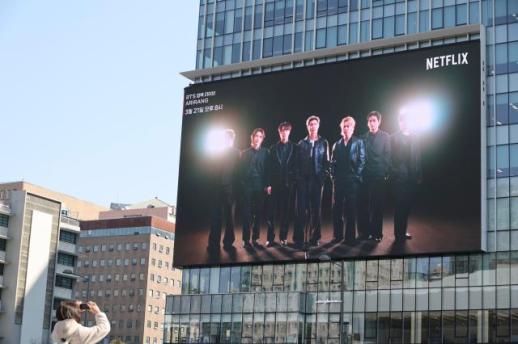 BTS Comeback D-8: Concert economy visible across Gwanghwamun accommodations SEOUL, March 13 (AJP) — Hotel rooms with views overlooking Gwanghwamun Square were the first to sell out and are still sought at steep premiums as foreign fans treat BTS’s upcoming comeback concert as a once-in-a-lifetime event. “Some foreign guests ask if they can rent the hotel’s rooftop pool area to watch the concert. Some even say they’re willing to pay a rental fee as a group,” said Kim Kyllian, a manager at Somerset Palace Seoul near Gwanghwamun. Many guests, he added, are specifically asking whether rooms facing Gwanghwamun Square are still available on the day of the performance. The phenomenon reflects what the global music industry increasingly calls the “concert economy.” Large-scale tours by superstar artists can generate significant spillover spending in host cities — boosting demand for hotels, restaurants, transportation and tourism services. U.S. pop star Taylor Swift’s recent global tour produced such economic effects that analysts coined the term “Swiftonomics.” Swift is estimated to have built a fortune of around $1 billion through touring, music royalties and real estate, with her concerts widely credited for lifting tourism spending in host cities. While on a smaller scale, BTS is generating similar ripples in Seoul. Ahead of the group’s comeback concert scheduled for March 21 at Gwanghwamun Square, accommodation prices around the venue have surged while reservations fill rapidly. According to AJP’s reporting, the average weekend room rate at Lotte Hotel Seoul is typically around 540,000 won, but rises to roughly 960,000 won on the concert date. Shilla Stay Gwanghwamun has climbed from about 270,000 won to 620,000 won, while Koreana Hotel jumped from roughly 320,000 won to about 1.35 million won. At Monthliv Jongno Jonggak Station Hotel Stay, rates increased from around 250,000 won to about 450,000 won. Somerset Palace Seoul was fully booked for March 20 and 21 — the night before and the day of the concert — more than one to two months in advance. “We’ve been receiving booking requests from a wide range of countries, including Japan, North America and South America,” Kylian said. At The Westin Josun Seoul, PR manager Soojin Bae said the hotel is also fully booked, with reservations made well ahead. “Room rates have increased by about 10 to 20 percent,” she said, adding that more than 80 percent of current guests are foreigners, though she noted the surge was not necessarily tied solely to the concert. Demand has spread to nearby districts as well. Hotels in Myeongdong, about a 20-minute walk or 10-minute drive from Gwanghwamun Square, are seeing similar spikes. Room rates at Hotel Thomas jumped from around 310,000 won to roughly 1.09 million won — an increase of more than 250 percent. Even smaller accommodations are feeling the surge. Hana Days Jongno-Gwanghwamun, a two-star hostel near the square known for its modest prices, had only one triple room left two days before the concert, with nightly rates reaching about 530,000 won. A manager at Soo Song Guest House near the venue said some visitors specifically requested rooms facing the square, with Japanese tourists making up a large share of bookings. “We didn’t even realize there was going to be a concert at first,” the manager said. “One day we suddenly became overbooked, and only later we realized that a BTS performance had been announced.” The guesthouse was already fully booked even before the concert date was officially confirmed, the manager added. Although online reservations closed once rooms sold out, inquiries have continued, with roughly five additional groups contacting the guesthouse seeking availability. Hotels in nearby Itaewon, a district popular with international visitors about a 20-minute drive from the venue, are also seeing an influx of foreign guests. A manager at Hamilton Hotel said the number of international customers during the concert period has increased about 40 percent compared with typical levels. At A-One Hotel nearby, standard room rates have risen from about 170,000 won a month ago to around 300,000 won for the concert date. Not all hotels, however, attribute the surge entirely to the BTS event. Officials at Four Seasons Hotel Seoul said most of its rooms had already been booked due to the spring high season, noting that the concert was only one of several factors affecting occupancy. Still, the pattern reflects how large K-pop concerts increasingly ripple beyond the stage. As fans travel across borders to attend performances, demand for accommodation, transportation and local tourism rises around host cities — offering a glimpse of how a single show can generate its own kind of “BTSnomics.” 2026-03-13 17:03:22
 -
 Asian stocks fall as oil tops $100 on Hormuz tensions SEOUL, March 13 (AJP) — Asian stock markets opened lower Friday after oil prices surged above $100 a barrel amid escalating tensions around the Strait of Hormuz, raising concerns about prolonged disruptions to global energy supplies. Investor anxiety intensified after Iran’s Supreme Leader Mojtaba Khamenei vowed to maintain pressure on shipping through the strategic waterway and warned Tehran could open another front in the conflict, stoking fears that the war could drag on and threaten one of the world’s most critical energy routes. The comments sent oil prices sharply higher. U.S. benchmark West Texas Intermediate crude jumped 9.72 percent to $95.73 a barrel, while global benchmark Brent crude settled at $101.26, its highest close since July 2022. U.S. equities fell sharply overnight as energy-driven inflation fears rattled markets. The Dow Jones Industrial Average dropped 1.56 percent to its lowest level of the year, while the S&P 500 fell 1.52 percent and the Nasdaq Composite declined 1.68 percent. Technology shares led the selloff. The Philadelphia Semiconductor Index plunged 3.43 percent as investors priced in potential supply-chain risks linked to Gulf tensions. Major chipmakers also retreated, with Nvidia down 1.53 percent, while Intel and Taiwan Semiconductor Manufacturing Co. fell more than 5 percent and Micron Technology slid over 3 percent. The weakness spilled into Asian trading, including Seoul, where semiconductor heavyweights led early losses. Samsung Electronics fell 2.55 percent to 183,100 won and SK hynix declined 2.58 percent to 906,000 won. Most South Korean shares opened lower as the oil shock rattled investor sentiment. The benchmark KOSPI initially dropped about 3 percent before trimming losses. As of 10:56 a.m., the index was down 1.24 percent at 5,513.87, while the tech-heavy KOSDAQ recovered from early losses to rise 0.62 percent to 1,155.51. Foreign and institutional investors were net sellers, offloading 644.4 billion won ($483 million) and 331.3 billion won worth of shares respectively, while retail investors bought a net 971.1 billion won. Among major stocks, LG Energy Solution slid 4.17 percent to 368,000 won, Hyundai Motor declined 1.73 percent to 512,000 won and Kia lost 2.93 percent to 162,100 won. Samsung Biologics fell 1.85 percent to 1,595,000 won, SK Square dropped 3.79 percent to 533,000 won and HD Hyundai Heavy Industries slipped 1.99 percent to 592,000 won. Naver edged up 0.45 percent to 223,000 won. Doosan Enerbility was the lone major gainer, rising 2.13 percent to 105,700 won. The Korean won weakened toward crisis-era levels, trading at 1,489.40 per dollar. The Bank of Korea warned that prolonged tensions in the Middle East could push up inflation and said it would maintain a cautious, neutral policy stance for now. While some investors speculate the central bank may eventually tighten policy to contain inflationary pressure, others say heightened geopolitical uncertainty makes a near-term rate hike unlikely. Elsewhere in Asia, Japan’s Nikkei 225 slipped 0.81 percent to 54,010.97. Hong Kong’s Hang Seng Index fell 0.48 percent to 25,592.49, while China’s Shanghai Composite Index declined 0.33 percent to 4,115.48. Taiwan’s TAIEX also dropped 0.58 percent to 33,386.04. 2026-03-13 11:15:05