
Journalist

Ryu Yuna
julia37@ajupress.com
-
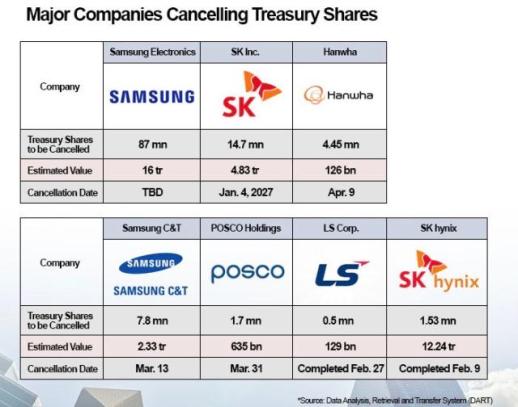 Korean Inc. in a rush to retire shares but risks losing key management tool SEOUL, March 12 (AJP) — South Korea’s largest companies have rushed to retire 36.3 trillion won ($25 billion) worth of treasury shares in the first quarter of 2026 under a new Commercial Act amendment, but analysts warn the mandatory move may do little to improve corporate value while stripping management of a key strategic tool. A string of blue-chip firms including Samsung Electronics, SK hynix and Samsung C&T have unveiled large-scale treasury share cancellations since the revised law took effect, putting share buybacks and retirements at the center of Korea’s market reform drive. Supporters say broader cancellations could help narrow the longstanding “Korea discount” by lifting per-share metrics and strengthening shareholder returns. Critics, however, say the law forces companies to give up assets long used to support management control, fund acquisitions and compensate employees. The third amendment to the Commercial Act, passed by the National Assembly on Feb. 25 and effective from March 6, requires listed companies in principle to cancel treasury shares within a year of acquiring them. Exceptions, including stock-based compensation and employee stock ownership plans, are allowed only with shareholder approval at a general meeting. According to regulatory filings, Samsung Electronics plans to cancel about 87 million treasury shares worth roughly 16 trillion won. SK hynix will retire 15.3 million shares valued at about 12.24 trillion won. Other major firms are following suit. Samsung C&T plans to cancel 7.81 million shares worth about 2.33 trillion won, while SK Inc. will retire 14.69 million shares worth around 4.83 trillion won. POSCO Holdings and LS Corp. have also canceled treasury shares worth about 635.1 billion won and 129.3 billion won, respectively. Canceling treasury shares reduces the number of shares outstanding, which typically boosts earnings per share and book value per share. For that reason, it has long been regarded as a straightforward way to return value to shareholders. But analysts say the effect on corporate value is not automatic. “The idea that fewer shares automatically raise corporate value is too simplistic. Markets have already priced in such factors,” said Shin Hyun-han, a professor at Yonsei University. Kim Dae-jong, a professor at Sejong University, said treasury share retirements can be a more equitable form of shareholder return than dividends because they benefit all shareholders proportionately. Even so, he cautioned that making cancellations mandatory could come at a high cost for companies. “The biggest loss from mandatory cancellations is reduced capital flexibility,” Kim said. “Companies can sell treasury shares to raise cash or use them in M&A deals. Mandatory cancellations remove that option.” Treasury shares have long served as strategic assets for Korean companies, despite being treated as a deduction from equity in accounting terms. In practice, they have functioned as a reserve of capital that can be mobilized for financing, strategic partnerships or management defense. That matters especially in Korea, where treasury shares have at times played a role in reinforcing control structures during corporate restructuring or spin-offs. With forced retirements becoming the norm, those options could narrow, making it harder for controlling shareholders to defend management rights. Shin argued that the broader risk is a decline in management stability. “If management control can be easily challenged, companies may struggle to make long-term plans,” he said. He also warned the rule could backfire by discouraging future buybacks altogether. “If buybacks must ultimately be canceled, companies may avoid them and choose dividends instead,” Shin said, calling the policy “penny wise, pound foolish.” For policymakers, the measure is meant to push listed firms toward stronger shareholder returns and more transparent governance. But for corporate Korea, the new mandate is fast turning treasury shares from a flexible strategic resource into a disappearing one. 2026-03-12 17:50:20
 -
 Asian stocks edge lower on oil supply fears, Hormuz disruption concerns SEOUL, March 12 (AJP) — Asian stock markets traded mostly lower Thursday as investors weighed volatile oil prices and the risk of prolonged shipping disruptions in the Strait of Hormuz despite a coordinated release of strategic crude reserves by major consuming nations. The International Energy Agency (IEA) said Wednesday that its 32 member countries agreed to release 400 million barrels of strategic oil reserves, the largest coordinated drawdown in the agency’s history, to stabilize global energy markets rattled by the war between the United States and Iran. The planned release is more than double the 182.7 million barrels released in two rounds after Russia’s invasion of Ukraine in 2022. South Korea and Japan are also expected to contribute shares from their emergency stockpiles. Still, investor sentiment remained fragile as Iranian attacks on commercial vessels near the Strait of Hormuz and continued threats to shipping routes raised fears of supply disruptions along one of the world’s most critical oil corridors. In Tokyo, the Nikkei 225 fell 1.06 percent to 54,444.13 in morning trading. Hong Kong’s Hang Seng Index slipped 0.39 percent to 25,798.95, while China’s Shanghai Composite Index edged down 0.17 percent to 4,126.61. Taiwan’s TAIEX declined 0.47 percent to 33,952.85. Overnight on Wall Street, semiconductor shares rose after strong earnings from Oracle lifted technology sentiment. Nvidia gained 0.66 percent and Micron Technology advanced 3.86 percent, pushing the Philadelphia Semiconductor Index up 0.63 percent. South Korean chip stocks, however, traded lower as investors remained cautious. Samsung Electronics fell 1.05 percent to 188,000 won, while SK hynix slipped 0.73 percent to 948,000 won. South Korea’s main bourses were volatile ahead of the quarterly “quadruple witching” day, when futures and options contracts on stocks and indexes expire simultaneously, often triggering sharp swings. “Concerns over foreign investor flows during derivatives expiry and continued news surrounding the Strait of Hormuz could limit the market’s upside,” said Han Ji-young, an analyst at Kiwoom Securities, noting that sector-specific divergence is likely in the near term. As of 10:51 a.m., the benchmark KOSPI was down 0.40 percent at 5,587.45, while the tech-heavy KOSDAQ rose 0.68 percent to 1,144.56. Shares were mixed across sectors. Battery maker LG Energy Solution edged up 0.14 percent to 370,000 won, while biotech stocks weakened. Samsung Biologics fell 2.35 percent to 1,618,000 won, and Celltrion declined 1.44 percent to 206,000 won. Defense-related shares gained amid heightened geopolitical tensions. Hanwha Aerospace rose 2.55 percent to 1,446,000 won, while Hanwha Ocean jumped 3.14 percent to 137,800 won. Industrial stocks also advanced, with Doosan Enerbility climbing 2.57 percent to 103,600 won and HD Hyundai Heavy Industries rising 2.03 percent to 602,000 won. Automakers traded mixed. Hyundai Motor slipped 1.32 percent to 523,000 won, while Kia gained 1.30 percent to 164,100 won and Hyundai Mobis fell 2.01 percent to 414,500 won. Financial shares also showed mixed performance. KB Financial dropped 1.32 percent to 149,300 won, while Shinhan Financial rose 0.55 percent to 91,600 won. Among technology stocks, Naver gained 0.45 percent to 223,000 won, while SK Square declined 1.06 percent to 559,000 won. The Korean won weakened against the U.S. dollar, with the greenback rising to 1,477.30 won from the previous session’s 1,466.2 won. 2026-03-12 11:13:10
 -
 Hit song from K-pop anime to be performed live at Oscar night this weekend SEOUL, March 11 (AJP) - "Golden," a song from the soundtrack of Netflix's hit animated film "K-Pop Demon Hunters," will be featured at this year's Academy Awards scheduled to be held in California this weekend. According to the Academy of Motion Picture Arts and Sciences (AMPAS), Audrey Nuna, EJAE and Rei Ami, the voices behind the film's fictional girl group "Huntrix" will perform their song at the 98th Academy Awards at the Dolby Theatre in Hollywood on Sunday. They are expected to captivate audiences with a performance blending traditional Korean dance and live instruments, presenting one of the most striking and memorable moments of Oscar night. The trio also performed live earlier at Britain's annual EE BAFTA Film Awards in London late last month. The 95-minute film, which tells the story of fictional K-pop superstars who possess secret powers to protect their fans from supernatural threats, is competing for the Best Animated Feature Film award, along with five other nominees, "Arco," "Elio," "Little Amélie or the Character of Rain," and "Zootopia 2." "Golden" is also up for Best Original Song. "K-Pop Demon Hunters" won Best Animated Feature at the Golden Globe Awards in January, while its theme song "Golden" won Best Song Written for Visual Media at last month's Grammy Awards, further boosting its Oscar prospects. Adding to this anticipation, the AMPAS posted a message on social media, "HUNTR/X fans, it's time to get your light sticks out!" 2026-03-11 16:27:51
 -
 Asian stocks advance as foreign investors return to Korean chipmakers SEOUL, March 11 (AJP) — Asian stocks opened higher on Wednesday despite mixed signals from Wall Street, as markets remained jittery over conflicting messages from Washington and shifting remarks by U.S. President Donald Trump on the trajectory and duration of the Middle East war. As of 10:55 a.m., South Korea’s benchmark KOSPI rose 3.43 percent to 5,722.17, while the tech-heavy KOSDAQ gained 2.48 percent to 1,165.94. In Tokyo, the benchmark Nikkei 225 climbed 1.92 percent to 55,289.74 in early trading, with semiconductor-related shares attracting buying after strong gains by U.S. chipmakers overnight, led by Intel, AMD and Micron. Shares of NAND flash maker Kioxia Holdings surged 7.23 percent to 21,000 yen. Taiwanese shares also moved higher, with the TAIEX rising 2.03 percent to 33,438.19. In Hong Kong, the Hang Seng Index advanced 0.35 percent to 26,049.87. Foreigners returned to Seoul, buoyed by overnight reward programs from Korea's most influential corporate names. Overseas investors turned net buyers on Tuesday, purchasing 1.034 trillion won ($770 million) worth of shares on the KOSPI market. Most of the inflows were concentrated in semiconductor blue chips. Foreign investors bought 778.9 billion won worth of Samsung Electronics shares and 709.2 billion won of SK hynix, bringing total purchases in the two stocks to more than 1.4 trillion won. The move marked a notable shift after foreigners had dumped more than 20 trillion won worth of Samsung Electronics shares since mid-February, returning to major semiconductor stocks after roughly a month of heavy selling. The buying likely reflects portfolio adjustments ahead of potential U.S. tariff hikes, as well as bargain hunting in semiconductor blue chips that had fallen sharply in recent weeks. Samsung Electronics rose 1.81 percent to 191,300 won, while SK hynix gained 1.49 percent to 952,000 won in Wednesday morning trading. Samsung Electronics said it plans to cancel about 87 million treasury shares — roughly 82.5 percent of its 105.43 million holdings as of end-2025 — in the first half of this year, worth about 15.6 trillion won based on the March 10 closing price. The move is part of its 10 trillion won share buyback program announced in November 2024 to address its valuation discount. Separately, SK Inc., the holding company of SK Group with memory giant SK hynix under its umbrella, decided to cancel about 14.69 million treasury shares, or 80 percent of its holdings, by January next year. The cancellation is valued at roughly 5.1 trillion won based on the latest closing price. Still, it remains too early to conclude that the rebound will be sustained. U.S. stocks ended mixed Tuesday as uncertainty surrounding the Strait of Hormuz resurfaced despite falling oil prices. Remarks by Trump about a possible early ceasefire and discussions among G7 nations about releasing strategic petroleum reserves pushed oil prices lower, but geopolitical risks from the ongoing war remain an overhang for markets. Automakers also advanced, with Hyundai Motor up 2.57 percent to 538,500 won and Kia rising 3.98 percent to 167,400 won. Hyundai Mobis added 2.13 percent to 432,000 won. In the battery sector, LG Energy Solution gained 2.18 percent to 375,000 won. Defense and shipbuilding stocks maintained strength, with Hanwha Aerospace up 1.51 percent to 1,477,000 won, HD Hyundai Heavy Industries rising 3.26 percent to 602,000 won, and HD Hyundai Electric advancing 3.19 percent to 971,000 won. Financial shares rallied as well. KB Financial Group jumped 5.83 percent to 156,000 won, Samsung Life Insurance rose 5.44 percent to 223,000 won, and Shinhan Financial Group gained 3.92 percent to 92,700 won. Among other large caps, Samsung Biologics rose 3.33 percent to 1,645,000 won, SK Square climbed 3.79 percent to 575,000 won, Samsung C&T gained 5.49 percent to 288,000 won, Naver advanced 2.95 percent to 227,000 won, and Korea Zinc rose 4.92 percent to 1,705,000 won. Shares of retail giant Emart rose 4.5 percent to 95,600 won after the company said its board approved a share swap with Shinsegae Food to acquire the remaining 26.91 percent stake and make the food affiliate a wholly owned subsidiary. Shinsegae Food will be delisted following the deal. The Korean won was trading at 1,469.2 per dollar, little changed from the previous close of 1,469.3. 2026-03-11 11:19:01
 -
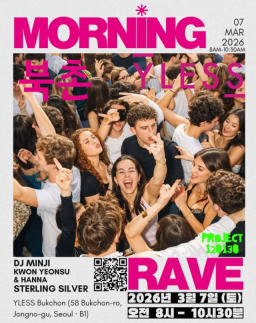 Dancing the morning away in Seoul — alcohol-free SEOUL, March 10 (AJP) — On a quiet Saturday morning in Seoul’s Bukchon hanok village, house music pulses through the narrow alleys long before most cafés open their doors. Instead of the thump of late-night clubbing, the crowd gathers just after sunrise. Some arrive fresh from a weekend run. Others come with coffee in hand. Within minutes, strangers begin dancing together in the crisp morning air. Welcome to Seoul’s newest social ritual: the morning rave. The alcohol-free gatherings reflect how South Korea’s younger generation is reshaping the country’s famously nightlife-heavy social culture. Rather than late-night drinking sessions, a growing number of young people are starting their day with music, coffee and community. “I was wondering how people could wake up so early,” said Antonio Garcia, a 30-year-old resident of Sinchon who discovered the event through social media. “This is my first time joining something like this,” she said. “I’d also like to try other activities, like coffee meetup groups.” The rise of morning raves mirrors a broader shift across Seoul, where interest-based communities — from running crews and book clubs to casual coffee gatherings — are expanding as new ways for strangers to connect through shared hobbies. It also comes as drinking culture begins to soften. According to Samsung Securities, South Korea’s liquor market contracted by more than 5 percent last year, reflecting a growing “healthy pleasure” trend and rising interest in alcohol-free lifestyles. Major beverage companies are already feeling the impact. Lotte Chilsung Beverage’s liquor division posted 28.2 billion won ($21 million) in operating profit last year, down 18.8 percent from a year earlier, while HiteJinro has also reported weaker profitability amid sluggish beer sales. The morning rave has also begun attracting curious visitors from overseas. Geo Martiniano, a San Francisco resident in his 30s, attended the Bukchon event during a brief stopover in Seoul. “I’m actually here for only about 12 hours before flying back to the United States tonight,” he said. “A lot of my friends don’t stay out late for parties anymore. So having a concert like this in the morning is really new.” Despite describing himself as relatively introverted, Martiniano said the format made it easier to meet people. “I usually don’t talk to strangers much,” he said. “But here it feels natural.” Similar social concepts are emerging abroad. In the United States, gatherings known as “Admin Nights” — where people meet in cafés or homes to complete small personal tasks together — have spread widely on social media, often described as a “study hall for adults.” Back in Bukchon, the morning rave taps into a comparable desire for shared experiences without nightlife pressures. “Many running crews stop by to shake off the stress from the workweek,” said Kim Euna, director at Mot Company, which collaborated on organizing the event. “By around 9:30 a.m., you’ll be surprised how hard people are dancing.” The event, held every other week, is jointly organized by K-beauty brand KAHI and global beauty platform YLESS. Each session attracts around 200 participants, with cumulative attendance surpassing 1,000 as of March 7. Inside the venue, the program blends music with lifestyle experiences. Alongside the DJ set and dance floor, visitors can try personal color consultations, quick makeup styling and Korean food tastings. The space is divided into a speaker zone, where music fills the room, and a silent disco area where participants listen through wireless headsets. Kim said the headset format also helps people who arrive alone feel more comfortable. “It makes it easier for people to enjoy themselves even if they come by themselves,” she said. At one point during the event, organizers circulate trays of rice balls topped with beluga caviar and desserts — a nod to KAHI’s premium skincare line Cavi Blue, which features caviar extract. “Like champagne being served in a nightclub, we share caviar around 10 a.m.,” Kim said. “People can dance, taste the caviar and experience the products at the same time.” While traditional raves focus on burning energy late into the night, Kim said the morning version emphasizes starting the day with fresh energy — reflecting a growing focus on wellness among younger consumers. “Alcohol is one of the biggest enemies of healthy skin,” she said. “Replacing alcohol with music and wellness programs fits the lifestyle many young people want now.” The free-entry format also serves as a marketing strategy. The Bukchon venue doubles as a retail space where visitors can explore K-beauty products while enjoying the event. “It allows people to experience the products while they’re already feeling energized,” Kim said. “That kind of experience can create lasting impressions.” The venue has experimented with various cultural programs, including K-pop demonstrations featuring the Saja Boys from the animated series K-pop Demon Hunters and even a kimchi festival. “But the morning rave has received the strongest response so far,” Kim said. “So we’re continuing it more regularly.” Food stalls on the first floor offer simple K-food favorites such as tteokbokki and fish cakes, allowing visitors to experience both K-beauty and Korean street food within Bukchon’s traditional setting. The event draws a notably international crowd. Foreign visitors accounted for 30 to 40 percent of participants at one session two weeks ago, Kim said, although more Korean attendees appeared this time. “We see nearby Bukchon residents coming by,” she said. “Some even show up casually in slippers.” Families visiting Korea have also joined the morning dance floor before sampling Korean snacks together. Another popular attraction is the free personal color analysis and on-site makeup styling, services that remain relatively uncommon outside Korea. Personal color consultations — which analyze skin tone, hair and eye color to identify the most flattering palette — typically cost 100,000 to 300,000 won ($75–$220) in Seoul, with comprehensive sessions sometimes exceeding 500,000 won. The service has become part of the country’s growing beauty tourism industry. According to the Seoul Tourism Organization, overseas visitors spent about 36.4 billion won on beauty services last year, a 231 percent increase from 2019. Anna Fisher, a 24-year-old living in Pyeongtaek, was among those waiting in line. “I woke up at 5 a.m.,” she said with a laugh. “Seoul has things like this that I haven’t seen anywhere else in the world. I love that you can start the day dancing.” She added that Korea’s global beauty reputation also draws visitors. “K-beauty is so big,” she said. “A lot of foreigners come because of that too. It’s pretty neat.” 2026-03-10 11:48:44
 -
 KOSPI recovers to 5,500 as Asian stocks rebound on easing oil fears SEOUL, March 10 (AJP) - Asian stock markets rebounded on Tuesday as oil prices retreated after U.S. President Donald Trump said the conflict in the Middle East is "going to be ended soon," while G7 ministers hinted at a possible release of strategic oil reserves to ease surging prices. South Korea's benchmark KOSPI rebounded to the 5,500 level just a day after a sharp selloff, as investor sentiment improved following Trump's remarks as well as a drop in global oil prices from over US$100 per barrel to around $80. Even a buy-side sidecar kicked in during the early trading session, as the KOSPI rose 6.13 percent to 5,573.55 and the tech-heavy KOSDAQ gained 4.11 percent to 1,147.63 just a few hours after the day's trading began. Foreign and institutional investors led the buying, with net purchases of 1.07 trillion won and 510 billion won, respectively, while individual investors sold a net 1.47 trillion won. Japanese shares also rebounded after a steep selloff the previous day, when the Nikkei 225 recorded its third-largest intraday drop on record. Tokyo's index rose 2.95 percent to 54,287.95 by 10:00 a.m., recovering some of the prior session's losses as falling oil prices and optimism over a possible settlement in the Middle East boosted investor sentiment. Chip-related stocks drove the gains, with Tokyo Electron rising 3.49 percent to 40,280 yen ($268) and Advantest climbing 5.51 percent to 24,135 yen. Taiwanese shares also moved higher, with the TAIEX rising 3.14 percent to 33,118.03 shortly after trading began in Taipei. In Hong Kong, the Hang Seng Index advanced 1.31 percent to 25,740.29. Meanwhile, overnight gains in memory chip stocks on Wall Street lifted Korean semiconductor shares. SanDisk surged 11.64 percent, while Lam Research and Micron Technology rose 5.93 percent and 5.14 percent, respectively. In Seoul, Samsung Electronics gained 9.68 percent to 190,300 won, and SK hynix jumped 11.36 percent to 931,000 won. However, defense and refinery stocks, which had jumped amid geopolitical tensions, retreated after Trump's comments. S-Oil fell 7.51 percent to 118,900 won, and Hanwha Systems dropped 3.63 percent to 156,800 won. Other defense-related stocks also declined, with LIG Nex1 falling 2.51 percent to 776,000 won and Hyundai Rotem slipping 1.16 percent to 213,000 won. Hanwha Aerospace rebounded 2.86 percent to 1,476,000 won after early losses, reflecting a growing divergence among defense stocks as investors increasingly differentiate based on company fundamentals and order momentum. Shares of automakers climbed, as Hyundai Motor added 5.72 percent to 536,000 won and Kia rose 4.76 percent to 160,700 won. Among other heavyweights, Samsung Biologics rose 2.09 percent to 1,612,000 won, LG Energy Solution added 2.78 percent to 369,500 won, and Samsung C&T climbed 3.51 percent to 280,000 won. The won strengthened sharply amid easing oil prices and expectations of an early end to the Middle East conflict, trading around 1,472.70 against the greenback, compared with about 1,494.7 won the previous day. 2026-03-10 11:12:54
 -
 KOSPI swings back up 5% on easing oil prices and Trump comment on war SEOUL, March 10 (AJP) — South Korean shares swung back as sharply as their fall, riding on a rapid retreat in oil prices after the U.S. president vowed the fighting in the Middle East could be “ended soon” and G7 ministers scrambled to take concerted action to ease prices through a possible release of strategic reserves. A sidecar was issued as soon as the opening bell on Tuesday, but unlike the previous morning it was triggered to cool buy-side momentum as both the KOSPI and KOSDAQ soared more than 5 percent, recouping most of the KOSPI’s near 6 percent drop on Monday. A buy-side sidecar is a market stabilization mechanism that temporarily halts program trading for five minutes when KOSPI 200 futures rise more than 5 percent from the reference price and sustain that level for at least one minute. The benchmark KOSPI was up 5.33 percent at 5,534.47 and the KOSDAQ gained 2.61 percent to 1,153.89 as of 9:30 a.m. Foreign investors, who sold more than 3 trillion won ($2.1 billion) worth of shares and institutions more than 1 trillion won the previous day, changed positions with retail investors to become heavy buyers. The volatile swings in Seoul have hinged heavily on oil price movements and remarks from the U.S. president. President Donald Trump said he expects the war in Iran to end “very soon,” but also described it as “the beginning of building a new country,” as the administration offered differing characterizations of how long the operation may last. He also warned Iran could pay an “incalculable” price if its military disrupts oil tankers, as major importers grapple with higher prices since the war began. Speaking to reporters at his Miami-area golf club in his first formal news conference since the U.S. and Israel began strikes on Iran, Trump said he does not expect the war to end next week, but “soon.” His contradictory comments sent mixed signals to oil markets. U.S. benchmark West Texas Intermediate crude was trading at $88.81 a barrel after swinging within roughly a $28 range, while global benchmark Brent crude settled at $90.33 a barrel, sharply below an intraday high of $119.50. Oil prices retreated after finance ministers from the Group of Seven nations said in a joint statement they could release strategic petroleum reserves if needed to address surging prices and potential supply disruptions. Overnight in New York, all three major stock indexes also rose. The Dow Jones Industrial Average gained 0.50 percent, while the S&P 500 and the Nasdaq Composite advanced 0.83 percent and 1.38 percent, respectively. Most major stocks traded higher, with the exception of defense firms Hanwha Aerospace and Hanwha Systems, which fell 2.37 percent and 5.47 percent, respectively. Samsung Electronics rose 8.18 percent to 187,700 won, while SK hynix gained 9.33 percent to 914,000 won. Automakers also advanced, with Hyundai Motor climbing 6.11 percent to 538,000 won and Kia rising 4.89 percent to 160,900 won. Among other heavyweights, LG Energy Solution added 3.76 percent to 373,000 won, while Samsung Biologics gained 3.04 percent to 1,627,000 won and Naver edged up 2.06 percent to 223,000 won. 2026-03-10 09:43:20
 -
 Black Monday hits Asia on oil price surge; Korean won and bonds also crash SEOUL, March 9 (AJP) — Asian stock markets plunged Monday as fears of a prolonged blockade of the Middle East’s key oil shipping route sent crude prices above $100 a barrel, triggering a broad risk-off selloff across the region. South Korean and Japanese shares suffered the steepest losses in early trading as the prospect of disruptions to energy supplies bound for Asia rattled investors. The benchmark KOSPI dropped as much as 8 percent, retreating to the 5,100 level, while Japan’s Nikkei 225 fell 7.13 percent to 51,657.37. Taiwan’s TAIEX declined 5.45 percent to 31,768.90, and Hong Kong’s Hang Seng Index slipped 2.77 percent to 25,044.34. Sell-side sidecar curbs were triggered immediately after the opening bell on both the main KOSPI and secondary KOSDAQ markets. Geopolitical tensions escalated after U.S. President Donald Trump demanded Iran’s “unconditional surrender,” while Tehran named Mojtaba Khamenei, the son of slain supreme leader Ali Khamenei, as the country’s new leader in what analysts saw as a defiant move signaling a prolonged conflict. The prospect of a drawn-out war pushed oil prices sharply higher. West Texas Intermediate (WTI) crude surged more than 16 percent to $107.92 a barrel, while Brent crude climbed over 17 percent to above $108, marking the first time oil prices have exceeded the $100 threshold since July 2022 as of late Sunday trading. The spike followed disruptions around the Strait of Hormuz, a key artery for global oil shipments, prompting oil producers to reduce output. Given South Korea’s heavy dependence on Middle Eastern energy imports, rising oil prices are expected to weigh heavily on the domestic economy. Foreign investors sold 2.15 trillion won ($1.6 billion) worth of shares on the KOSPI, while domestic institutions dumped 1.3 trillion won. Retail investors stepped in as bargain hunters, buying 3.4 trillion won, but decliners still overwhelmed gainers 865 to 62. Utility and fuel-importing companies were among the few survivors. POSCO International and LG International rose 11.87 percent and 7.22 percent, respectively. The Korean won weakened sharply to 1,497.30 per dollar, compared with 1,475.7 won on Friday, approaching the psychologically critical 1,500 level for the first time since March 12, 2009, during the global financial crisis. Panic extended to the bond market. The three-year Korean government bond yield jumped 25 basis points to 3.477 percent, widening the spread to nearly 100 basis points above the Bank of Korea’s policy rate of 2.50 percent. The 10-year government bond yield rose 15.3 basis points to 3.769 percent in morning trading. Leverage in the domestic stock market has reached record levels. According to the Korea Financial Investment Association, outstanding margin loans stood at a record 33.6945 trillion won as of March 5. Margin loans refer to funds borrowed from brokerages by investors to buy stocks and typically rise when expectations for market gains increase. DB Securities said foreign investors had largely sold Korean equities during the Iran crisis but were selectively buying construction stocks linked to the nuclear power theme. The construction sector recorded the highest ratio of cumulative foreign net purchases relative to market capitalization during the period. As of March 6, the ratio stood at 1.20 percent of market capitalization. Foreign investors also increased holdings in Samsung E&A (0.73 percent) and Hyundai Engineering & Construction (0.64 percent). Analysts said the buying reflects expectations that nuclear power could emerge as an alternative energy source during periods of oil price spikes, while the AI-driven surge in electricity demand is likely to boost nuclear energy investments. Korean companies with strengths in both nuclear and construction sectors are also seen as potential beneficiaries of future reconstruction projects in the Middle East once the conflict subsides. Among market heavyweights, Samsung Electronics fell 9.35 percent to 170,600 won, while SK hynix dropped 11.15 percent to 821,000 won. Defense stocks were mixed after early gains. Hanwha Aerospace declined 6.28 percent to 1,388,000 won, while Hanwha Systems rose 2.33 percent to 162,600 won, remaining one of the few gainers in an otherwise broad market decline. LIG Nex1, the developer of the Cheongung-II missile defense system, initially rose about 4.44 percent at the open but later reversed course, falling 3.12 percent to 808,000 won. Automakers also retreated, with Hyundai Motor sliding 10.31 percent to 496,000 won and Kia declining 8.74 percent to 152,400 won. Battery and biotech stocks weakened as well. LG Energy Solution fell 6.23 percent to 354,000 won, while Samsung Biologics slipped 5.29 percent to 1,557,000 won. 2026-03-09 11:53:24
 -
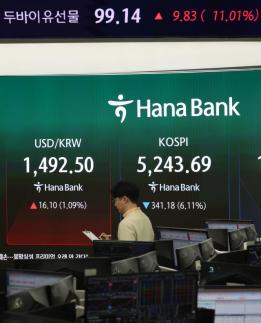 Seoul stocks and won in freefall on oil price surge SEOUL, March 09 (AJP) - South Korean shares extended a freefall Monday as markets entered the second week of the war in Iran, with the conflict widening after Tehran named the son of slain Supreme Leader Ali Khamenei as the country’s new leader — a move seen as defying the United States and Israel and signaling a prolonged confrontation likely to rattle global energy markets. South Korea’s benchmark KOSPI tumbled 6.65 percent to 5,213.61, while the tech-heavy KOSDAQ fell 5.74 percent to 1,088.35 as of 9:01 a.m., pressured by surging oil prices. The won weakened sharply, with the dollar rising to 1,493.10 won. International oil prices surged above the psychologically important $100-per-barrel level for the first time in nearly four years. Defense-related shares were among the few gainers in an otherwise broad market decline. Hanwha Aerospace and Hanwha Systems rose 1.22 percent and 6.04 percent at the open, respectively, while LIG Nex1 — the developer of the Cheongung-II missile defense system — gained about 4.44 percent in early trading after surging roughly 64 percent last week. According to Rep. Yoo Yong-won of the National Defense Committee, about 60 interceptor missiles were launched from two Cheongung-II batteries deployed in the United Arab Emirates, achieving a reported interception rate of around 96 percent. The UAE has also asked Seoul to accelerate deliveries of additional Cheongung-II batteries under an existing contract and supply interceptor missiles ahead of schedule. KOSPI top players became primary targets of institutional selling. Samsung Electronics fell about 7.07 percent as its union moved ahead with a vote on strike. SK hynix also dropped 6.71 percent. Hyundai Motor declined 7.59 percent, while affiliate Kia retreated 7.90 percent in early trading after a recent Bernstein Research report identified Hyundai Motor among automakers most exposed to the widening conflict in Iran. The market turmoil comes as the Middle East war enters its second week. Iran on Sunday named Mojtaba Khamenei, the son of slain Supreme Leader Ali Khamenei, as the country’s new supreme leader after the elder Khamenei was killed along with senior regime figures in U.S.-Israeli airstrikes on Feb. 28. The move widely interpreted as consolidating hardline control in Tehran raised fears that the conflict with the United States and Israel could stretch into a prolonged regional confrontation. 2026-03-09 09:38:31
 -
 Asian markets end first war week edgy, KOSPI most volatile SEOUL, March 6 (AJP) — Asian stock markets wrapped up one of their most volatile weeks in recent years as escalating tensions in the Middle East rattled global financial markets and pushed oil prices higher. The wildest swings were seen in Seoul, where panicky selling and frantic bargain-hunting traded places throughout the four-session, war-dominated week. The benchmark KOSPI closed at 5,584.87, down more than 10 percent from a week earlier before the strikes on Iran and 11 percent below its historic high of 6,347.41 on Feb. 26. In the first two sessions following the outbreak of hostilities, the KOSPI plunged 19 percent, before rebounding roughly 10 percent on Thursday. On Friday, the index barely stayed positive after swinging between 5,381.27 and 5,609.98 during the session. The tech-heavy KOSDAQ fared slightly better, edging up 0.43 percent to close at 1,154.67. Defense shares outperformed as investors bet on rising geopolitical demand. LIG Nex1 jumped 9.31 percent to 834,000 won on expectations for additional orders of missile interceptor systems deployed along Middle Eastern borders near Iran. Hanwha Aerospace rose 7.24 percent to 1,481,000 won, while Hanwha Systems gained 5.37 percent to 158,900 won and Hanwha Ocean climbed 3.77 percent to 126,700 won. Chipmakers, however, were primary targets for profit-taking. Samsung Electronics fell 1.77 percent to 188,200 won, while SK hynix slipped 1.81 percent to 924,000 won. Automakers and battery makers traded higher. Hyundai Motor rose 0.91 percent to 553,000 won, and Kia gained 0.36 percent to 167,000 won. LG Energy Solution added 1.62 percent to 377,500 won, while Samsung SDI jumped 4.59 percent to 410,500 won. Energy-related shares also advanced. Doosan Enerbility surged 8.29 percent to 98,000 won, and HD Hyundai Electric climbed 2.78 percent to 444,000 won. Internet and brokerage stocks posted gains as well. NAVER rose 1.14 percent to 222,500 won, while Mirae Asset Securities advanced 2.91 percent to 67,100 won. Financial shares were mixed. KB Financial slipped 1.07 percent to 147,400 won, Shinhan Financial declined 1.18 percent to 91,800 won, and Samsung Life Insurance fell 1.87 percent to 210,000 won. Among other large caps, Samsung Biologics dipped 0.18 percent to 1,644,000 won, while Samsung C&T dropped 3.24 percent to 283,500 won. SK Square declined 2.30 percent to 553,000 won, and Korea Zinc edged down 0.40 percent to 1,752,000 won. Retail investors dominated trading during the turbulent week, with net purchases totaling 2.95 trillion won ($2 billion). Foreign investors and institutions were net sellers, offloading 1.94 trillion won and 1.11 trillion won, respectively. Elsewhere in Asia, markets showed more moderate swings. Japan’s Nikkei 225 rose 0.62 percent to close at 55,620.84 on Friday, trimming part of the week’s losses. The benchmark index, however, remained down about 4.06 percent over the past five sessions, reflecting persistent caution among investors. China’s Shanghai Composite gained 0.38 percent to 4,124.19 on Friday, but the index still fell roughly 0.66 percent over the past five days, signaling a cautious recovery as investors weighed geopolitical risks and global market volatility. Separately, the Hurun Global Rich List reported that China — including Hong Kong, Macau and Taiwan — once again hosts the world’s largest number of billionaires, with 1,110 out of the global total of 4,020. Rupert Hoogewerf, founder of the Hurun Global Rich List, said the surge was partly driven by global stock market gains and the rapid expansion of artificial intelligence industries, with new billionaires emerging from Chinese AI firms such as MiniMax and Zhipu AI. 2026-03-06 17:32:19