
Journalist

KIM NA YOON
kimnayoon@ajunews.com
-
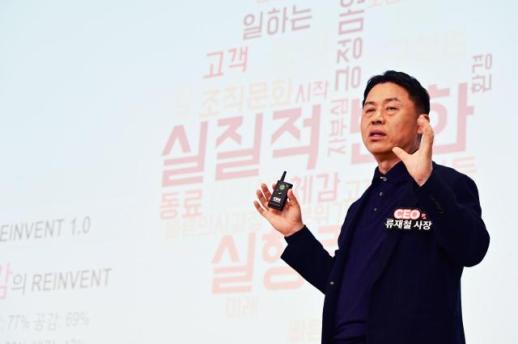 LG Electronics President Ryu Jae-cheol: Daily 1% Progress Creates 40-Fold Advantage Ryu Jae-cheol, President of LG Electronics, emphasized the need to rebuild fundamental competitiveness in quality, cost, and delivery to win against rapidly advancing competitors. On May 10, LG Electronics reported that Ryu made these remarks during his first town hall meeting with all employees at LG Science Park in Magok, Seoul. He urged, "Let’s focus on revealing problems and executing to create a top-tier LG Electronics that grows together with its employees." During the meeting, Ryu redefined LG Electronics' unique working methods and organizational culture innovation campaign as 'Reinvent 2.0' and outlined the direction for change. Having joined the company in 1989 as a researcher at Geumseong's home appliance research institute, Ryu shared his philosophy developed over 37 years, stating, "A daily 1% improvement may seem small, but after a year, it can create a gap of about 40 times. Conversely, a daily 1% decline can lead to a regression of about 1,480 times in a year." He continued, "What we must always remember and practice is to accumulate 1% of change every day. The competitiveness we will build in the future starts with today's 1% improved actions. Let’s achieve small changes and innovations every day." Since 2022, LG Electronics has been promoting the Reinvent campaign, encouraging employees to create enjoyable changes. The company aims to enhance the execution of core values such as growth and communication through the newly established 'Reinvent 2.0' this year, accelerating changes in working methods. Ryu stated, "We need to think about ways to succeed rather than reasons for failure, and we need a new approach that can lead to significant innovations rather than small fixes. I will lead efforts to create an atmosphere where revealing problems is encouraged, starting from the management level." He also discussed the company's performance in the first quarter and the business environment for the remaining quarters, emphasizing the importance of recognizing the realities the company faces from the perspective of revealing problems. "Change is what we do best, and focusing on revealing problems and executing will accelerate the start of Reinvent 2.0," Ryu encouraged employees, adding, "Let’s believe in LG Electronics' innovative DNA and strength, and gather everyone's small changes to transform the future of LG Electronics."* This article has been translated by AI. 2026-05-10 10:48:16
 -
 Samsung, Meta Set for AI Smart Glasses Showdown in Second Half of 2026 The market for artificial intelligence-powered smart glasses, widely seen as a next-generation device after smartphones, is expected to heat up in the second half of the year as Samsung Electronics and Meta prepare competing launches. As AI moves into eyewear, companies are betting on real-time translation, hands-free controls and faster processing of visual information to push “wearable AI” into the mainstream. Industry sources and foreign media reported Sunday that Samsung, working with Google and Qualcomm, is expected to reveal its next AI smart glasses as early as July. Attention is focused on Samsung’s second-half “Galaxy Unpacked” event, scheduled to be held in London, where the company could show the device publicly for the first time. The product is being developed as a three-way effort: Samsung’s hardware, Google’s Android-based wearable operating system and a dedicated Qualcomm chipset. Samsung previously said at an Unpacked event early last year that it would work with Google and Qualcomm to build an extended reality, or XR, ecosystem. Samsung’s glasses are expected to emphasize a lighter, everyday eyewear form rather than a headset-style XR device. Cameras and sensors in the frame are expected to track a user’s gaze, while Google’s generative AI, Gemini, would analyze objects in view or provide real-time interpretation and translation services. The device is also expected to be “screenless,” with no separate display, to keep weight down and focus on an AI assistant and audio functions. Qualcomm’s Snapdragon AR1 chip is expected to serve as the device’s processor, handling complex AI algorithms quickly. The glasses are expected to support immediate interaction without a smartphone connection. The price is expected to range from $379 to $499. Meta, meanwhile, is stepping up its push into South Korea with its Ray-Ban Meta smart glasses. The company recently set July as the launch date for its AI glasses in the country, after strong global demand. It is expected to lead with the second-generation Ray-Ban Meta glasses and also introduce two Oakley Meta series models in a goggle-like design. Unlike Samsung’s expected approach, Meta’s product is described as keeping the look of regular glasses while inserting display lenses and maximizing voice-based “Meta AI” assistant features. Users can listen to music, make calls and capture point-of-view photos. The South Korea models are expected to include Korean-language features and services tailored to local users, as part of a strategy to improve convenience for customers in the country. Both companies are investing heavily in AI smart glasses as they compete for leadership in what they see as a “post-smartphone” market. Smartphones have clear physical limits, while glasses are directly tied to a user’s field of view, making them a strong platform for AI to understand context, the report said. Counterpoint Research said the global AR smart glasses market grew 98% in 2025 from a year earlier. Growth in the second half of last year rose 148% from the same period a year earlier. “AI smart glasses will be a contest over who delivers the most convenient AI user experience,” an industry official was quoted as saying. With Samsung’s ecosystem strength facing Meta’s early technology lead, the official said, the smart glasses market appears to be approaching a turning point.* This article has been translated by AI. 2026-05-04 17:36:19
 -
 Samsung Electronics union quits joint labor front, citing internal conflict A rift among labor unions at Samsung Electronics has become official after a union based in the company’s Device Experience (DX) division decided to leave the joint labor front. Samsung Electronics Union Donghaeng, known as the Donghaeng Union, said May 4 it had formally notified the National Samsung Electronics Union and the Samsung Electronics branch of a cross-company union that their joint bargaining group for 2026 wage talks had ended. Donghaeng said the decision was driven by deepening conflict and a breakdown of trust among the unions. “Our union proposed and requested agenda items for the rights and interests of all members, not just those in a specific area, but your unions have not responded at all,” Donghaeng said in a statement. “You have not even shown a willingness to consult, and our views for the benefit of all members have not been reflected.” According to Samsung’s labor unions, the three unions — the cross-company union, the National Samsung Electronics Union and Donghaeng — formed a joint bargaining group in November to negotiate 2026 wages. After final talks broke down, the group shifted in March into a joint struggle headquarters and announced plans for a general strike on the 21st to press demands including improvements to performance bonuses. Donghaeng is the company’s third union, with about 2,300 members, most of them in the DX division, which handles businesses such as home appliances, smartphones and TVs. Donghaeng said it had faced “continuous attacks and disparagement” and that mutual respect and trust had been “seriously damaged,” citing what it called excessive and malicious language, including being labeled a “company-friendly union.” The union said it had repeatedly sought corrections over disparaging remarks and what it described as one-sided decision-making within the joint struggle headquarters, but saw no improvement and chose to end its participation. The withdrawal is expected to open a new phase in labor-management relations at Samsung Electronics. The joint front had aimed to unify union voices to pressure management, but its cohesion has weakened ahead of the planned strike. The joint struggle headquarters has not issued a separate official response and plans to proceed with the general strike on the 21st. Donghaeng said it will formally notify management of its withdrawal on the 6th and then seek separate bargaining.* This article has been translated by AI. 2026-05-04 16:30:12
 -
 Samsung Names Marketing Chief Lee Won-jin to Lead TV Business in Rare Midyear Shake-Up Samsung Electronics has replaced the head of its TV business in an unusual leadership change outside its typical year-end executive reshuffle. The move comes as global TV demand remains sluggish and profitability continues to weaken, prompting Samsung to push its TV strategy beyond hardware toward content and services. Samsung said on 4일 that Lee Won-jin, president and head of global marketing for its Device eXperience (DX) division, was appointed president and head of the DX division’s Visual Display (VD) Business, while also leading the service business team. Yong Seok-woo, who had led the VD Business, will move to a role as an adviser to the head of the DX division. The reshuffle reflects Samsung’s assessment that the TV business faces more than a temporary earnings slump and that hardware-led growth has reached its limits. Samsung estimated the TV business posted an operating loss in the 600 billion won range in the fourth quarter of last year, then narrowly returned to a 200 billion won profit in the first quarter. Samsung has held the No. 1 spot in the global TV market since 2006, but the company has struggled to translate that lead into strong profits. Samsung has cited intense price competition from Chinese manufacturers as a key factor squeezing margins. Companies such as Hisense and TCL, backed by a large domestic market and government support, have dominated the liquid-crystal display (LCD) market and have recently expanded pressure into large-screen and higher-value segments, including organic light-emitting diode (OLED) TVs. According to market researcher Omdia, Samsung’s global market share stood at 29.1% last year, while TCL and Hisense posted 13.1% and 10.9%, respectively. Samsung has also begun broader restructuring across its home appliance business. The DA Business, which oversees home appliances, recently held a management briefing for employees and outlined future business plans aimed at improving profitability. Since late last month, Samsung has also launched a management review of its Korea business unit, which handles domestic sales and marketing for TVs, home appliances and smartphones. The company is also reported to have decided to exit its China home appliance business, 34 years after entering the market in 1992. First Korean Google vice president signals push to strengthen TV software Lee’s appointment is seen as a sharp break from past leadership in Samsung’s TV unit, as he is a marketing specialist rather than a career engineer. A non-developer leading the VD Business is a rarity, with the last such case dating to Choi Gee-sung in 2007, about 20 years ago. Lee previously served as CEO of Adobe Systems Korea in 2005 and as the first head of Google Korea in 2007. He later became the first Korean to serve as a vice president at Google’s headquarters in 2011, overseeing advertising and services. After joining Samsung in 2014, he was credited as a key figure in expanding the company’s ad-supported free streaming service, Samsung TV Plus, and its Samsung Art Store subscription service for viewing artwork on TV screens. While Samsung’s TV leaders have focused on hardware advances such as higher resolution and larger screens, Lee’s leadership is expected to accelerate a shift toward a platform model that generates recurring revenue through content and service payments on TVs. An industry official said the global TV market has already entered a mature phase, and Samsung is signaling it wants to define the TV not simply as a display device but as a living-room platform centered on content and advertising revenue. The official said the strategy aims to secure sustainable growth by strengthening TV software competitiveness. 2026-05-04 15:13:11
 -
 Samsung Electronics Replaces TV Business Chief, Names Marketing Veteran Lee Won-jin Samsung Electronics has abruptly replaced the head of its TV business. Samsung said May 4 that Lee Won-jin, president and head of global marketing for the Device eXperience (DX) division, was appointed head of the DX division’s Visual Display (VD) Business and will also lead the Service Business Team. Yong Seok-woo, who had led the Visual Display Business, will move to a role as an adviser to the head of the DX division. Samsung described Lee as an expert in content, services and marketing, crediting him with helping build key foundations for Samsung’s TV and mobile services businesses and strengthening global competitiveness. “Based on the business experience and market understanding he has built up, we expect Lee to work to strengthen the competitiveness of the TV business,” Samsung said. Lee is also expected to help lead a turnaround in TV business performance and identify new future growth engines. As adviser to the DX division head, Yong will provide guidance on future technologies across the home appliance business. Samsung said he is expected to play a role in key technology areas such as AI and robotics, drawing on his research and development expertise and business experience. 2026-05-04 09:58:10
 -
 LS Cable & System to Showcase Next-Generation Offshore Infrastructure Tech at OTC 2026 LS Cable & System said Sunday it will take part in OTC 2026, to be held in Houston from May 4-7 (local time), where it will showcase products for offshore infrastructure. OTC is a large exhibition where global offshore energy and plant companies present key technologies across subsea infrastructure. This year’s event, themed “Steering Offshore Energy Innovation Toward the Future,” is expected to bring together energy experts from more than 100 countries and more than 1,000 companies, the company said. LS Cable & System first joined OTC in 2009 as it moved into the market for specialized cables used in subsea and offshore plants, and it has participated every year since, it said. The company said it is accelerating efforts to secure market share with subsea cables and specialized offshore cables. Offshore cables require high durability and stable insulation because they can be exposed for long periods to harsh conditions such as ultraviolet light, salt, seawater and mud. It is also strengthening long-distance transmission capabilities with high-capacity power products, including 525-kilovolt high-voltage direct current, or HVDC, subsea cables and busducts. Working with LS Marine Solution, a subsea construction specialist, the company said it has built an integrated system covering design, production, installation and maintenance. “Offshore infrastructure depends on reliability in extreme environments, long-distance high-capacity transmission technology, and installation experience,” an LS Cable & System official said. “Based on our experience delivering global projects, we will expand orders in the North American market.”* This article has been translated by AI. 2026-05-04 08:45:14
 -
 Samsung Electronics Faces Q2 Cost Risks Despite Chip Boom, Union Bonus Talks and Strike Threat Samsung Electronics posted a first-quarter earnings surprise on the back of a semiconductor upcycle, but it could face major cost risks in the second quarter, including labor-management tensions, industry and financial sources said Saturday. Analysts warn that the union’s unusually large bonus demands and the possibility of a strike could significantly erode chip profits. Market consensus for Samsung’s second-quarter results calls for revenue of 174.4 trillion won and operating profit of 86.8 trillion won, according to the sources. Operating profit at the Device Solutions (DS) division, which runs the chip business, is estimated in the 80 trillion won range — about a 50% increase from the prior quarter’s 53.7 trillion won. How much of that improvement is realized may depend on the outcome of bonus negotiations, which could add costs in the trillions of won. The union is seeking to set aside 15% of annual operating profit for performance bonuses. With some forecasts putting Samsung’s full-year operating profit as high as 350 trillion won, accepting the proposal as-is would push bonus payouts above 50 trillion won. The company has indicated the impact could begin as soon as the second quarter. On an April 30 first-quarter conference call, Samsung said bonus provisions were not reflected in first-quarter results because talks were ongoing, adding that “depending on the outcome of negotiations, whether and how much is reflected could be decided as early as the second quarter.” Because bonus provisions are typically spread across quarters, a deal would likely require recognizing costs of several trillion won each quarter, potentially weighing on results through the second to fourth quarters even if operating profit hits a record. If talks fail, Samsung could face a different kind of cost shock. The union has warned it will launch an 18-day general strike starting May 21. If labor action halts semiconductor production lines, losses of at least 10 trillion won are expected, the report said. Due to the nature of chip manufacturing, even a brief power outage or stoppage can force the disposal of all wafers in process on the affected line. Industry officials also voiced concern that the dispute could undermine longer-term competitiveness as global rivalry intensifies and large-scale investment is needed to secure next-generation technologies such as high-bandwidth memory (HBM) and advanced foundry processes. Lee Jong-hwan, a professor of system semiconductor engineering at Sangmyung University, said the prospect of large strike-related costs is “regrettable” at a time when expectations are rising for a rebound in foundry competitiveness. He said such costs could crowd out research and development funding needed to strengthen the nation’s semiconductor capabilities and weaken long-term growth drivers. * This article has been translated by AI. 2026-05-03 18:03:17
 -
 Samsung Family Completes $12 Trillion Won Inheritance Tax Payment, Expands Public Giving Samsung has finished paying 12 trillion won (about $12 trillion won) in inheritance taxes tied to the estate of late former chairman Lee Kun-hee, completing the payments over five years. The company and the bereaved family have also pursued public initiatives including support for infectious-disease response, pediatric cancer care and major art donations. According to the business community on Saturday, Lee Jae-yong, Samsung Electronics chairman; Hong Ra-hee, honorary director of the Leeum Museum of Art; Lee Boo-jin, president of Hotel Shilla; and Lee Seo-hyun, president of Samsung C&T, reported the inheritance tax to the National Tax Service in April 2021. They used an installment-payment program to pay the tax in six installments over five years. The 12 trillion won levy, assessed on the full estate including stakes in Samsung Electronics and other affiliates as well as real estate, is the largest inheritance tax bill since South Korea’s founding. It is about 50% more than the country’s total inheritance-tax revenue in 2024, which was 8.2 trillion won, and is described as rare globally for a single taxpayer case. When filing the tax report, the family said, “Paying taxes is a natural duty of citizens,” and pledged to follow the process faithfully. Separate from the tax payments, Samsung’s medical support projects are moving ahead. In 2021, Samsung donated 700 billion won to the National Medical Center to expand infectious-disease response infrastructure. Of that, 500 billion won was allocated to build the Central Infectious Disease Hospital, described as South Korea’s first specialized infectious-disease hospital. It is expected to open in 2030 and is to serve as a national hub for treatment of new and high-risk infectious diseases, training and clinical research. A 300 billion won fund donated to Seoul National University Hospital, reflecting Lee Kun-hee’s interest in child care and welfare, is being used for children with cancer and rare diseases. Of the donation, 150 billion won was used for pediatric cancer diagnosis and treatment, 60 billion won for rare-disease treatment and 90 billion won for research infrastructure. More than 23,000 artworks donated to the cultural sector expanded public access to art, the report said. Traditional works including 40 national treasures and 127 treasures were sent to the National Museum of Korea, while works by modern and contemporary artists such as Kim Whanki and Park Sookeun went to the National Museum of Modern and Contemporary Art. At the time, the art community estimated the value of the donated works could reach up to 10 trillion won, calling it an unprecedented collection in both cultural and artistic terms. From 2021 to 2024, the National Museum of Korea, the National Museum of Modern and Contemporary Art and others held 35 traveling exhibitions of the “Lee Kun-hee Collection,” drawing a cumulative 3.5 million visitors, the highest attendance recorded for an art exhibition series in South Korea. Samsung has also used global touring exhibitions as a form of private cultural outreach. The first overseas stop, held at the Smithsonian’s National Museum of Asian Art in Washington in November last year, concluded successfully, the report said. A second exhibition is underway at the Art Institute of Chicago, and another is scheduled to open at the British Museum in October. At a gala dinner in Washington in January, Lee Jae-yong said, “Even amid hardships such as the Korean War, founder Lee Byung-chul and former chairman Lee Kun-hee had a firm will to preserve Korea’s cultural heritage.” He added, “I believe this exhibition will help bring the people of the United States and Korea closer together.” * This article has been translated by AI. 2026-05-03 14:03:18
 -
 LG Electronics Wins 27 Red Dot Design Awards, Including Top Prize for OLED evo W6 LG Electronics said Saturday it won 27 prizes at the Red Dot Design Award 2026, including a top honor. The Red Dot Design Award is considered one of the world’s three major design prizes, along with the iF Design Award and IDEA. LG Electronics also won 26 prizes at the iF Design Award 2026 in February. The company said products recognized then included the LG CLOiD home robot, designed to fit into home environments and interact by responding to facial expressions, voice and gestures, and the LG OLED evo W6 wireless wallpaper TV, about 9 millimeters thick. At this year’s Red Dot awards, the LG OLED evo W6 won the Best of the Best honor. LG Electronics said the TV is about 9 mm thick—about the width of a pencil—and integrates the screen, power unit and speakers to sit flush against a wall in a wallpaper-style design. In home appliances and IT, LG Electronics said judges also praised designs that considered everyday convenience. The recognized products included: △the LG French-door refrigerator, which uses a zero-clearance hinge to minimize the gap between the refrigerator and the wall; △the LG Whisen Objet Collection Cool home air conditioner with a minimalist design; and △the LG Sound Suite home audio system designed to deliver optimized immersive sound. Jeong Uk-jun, head of LG Electronics’ Design Management Center and an executive vice president, said the company will continue developing customer-focused designs that blend naturally into living spaces while improving ease of use.* This article has been translated by AI. 2026-05-03 10:48:00
 -
 Samsung Electronics union sees surge in resignations amid dispute over bonus demands Resignations from a Samsung Electronics labor union are rising, led by members outside the company’s semiconductor division, as complaints grow that the union’s performance-bonus demands favor chip workers. The union has warned of an 18-day general strike starting on the 21st, and a decision to keep dues automatically deducted during the dispute has brought long-simmering grievances into the open. Industry officials said that posts seeking to withdraw from the Samsung Electronics branch of the cross-company union have surged on the union website’s message board. Daily withdrawal requests that had typically stayed below 100 climbed past 500 on April 28 and exceeded 1,000 on April 29, according to the officials. The trend has spread through internal company boards and workplace online communities, where members have posted proof of withdrawal. Departing members said the union has prioritized the interests of workers in the Device Solutions (DS) division, which runs Samsung’s semiconductor business, while ignoring demands from other divisions. About 80% of the union’s members are DS employees, and DS members are also leading the planned strike, the officials said. Ahead of the walkout, the union has demanded that only the DS division receive performance bonuses equal to 15% of operating profit with no cap. It has not presented any conditions for the Device eXperience (DX) division, which has weaker results, the officials said. DX, which handles finished products, saw first-quarter operating profit fall 36% from a year earlier, affected by higher semiconductor prices from DS, the officials said. In that context, critics said the union’s proposal would leave DS employees receiving performance bonuses close to 600 million won per person this year, while DX employees would face the prospect of high-intensity business restructuring without any bonus. Tensions have also risen after the union began recruiting staff for the strike, offering 3 million won in allowances to those who participate for at least 15 days. The union also decided to raise dues for May to 50,000 won from 10,000 won. In addition, the union announced late last month it would shift dues collection to a checkoff system, under which the company deducts dues from monthly pay and transfers them to the union, potentially exposing whether an employee is a member. After those moves became known, posts flooded internal online boards criticizing the dues increase. “It’s hard to accept raising dues when pay will also fall during a strike,” one post said. Another wrote, “DX isn’t even being looked after — why should we raise dues beyond covering leadership legal costs and even pay favors to strike staff?” Still, with DX members making up about 20% of the union, observers said the union is still likely to press ahead with the strike. A Samsung Electronics employee said, “We’re in the same union, but the atmosphere is becoming more divided depending on which division you belong to,” adding, “It’s painful to see the camaraderie and workplace culture built up over years breaking down as conflict within the union deepens.”* This article has been translated by AI. 2026-05-03 10:36:19