
Journalist

Kim Na-yoon
kimnayoon@ajunews.com
-
 LG 2026 OLED TVs win Carbon Trust carbon footprint certification for sixth straight year LG Electronics said Tuesday that its 2026 TV lineup has received three ESG-related certifications in areas including carbon reduction, reduced plastic use and the use of recycled materials. The company said its 2026 OLED TVs recently earned a “carbon footprint” certification from the U.K.-based nonprofit Carbon Trust. LG said it has received the certification for six consecutive years since 2021. Carbon Trust evaluates a product’s carbon dioxide emissions and environmental impact across its full life cycle, from production and distribution to use and disposal, before granting the certification. It also awards a separate “carbon reduction” certification to products that cut emissions compared with previous models in the same class. LG said its 2026 OLED TV G6 models in 83-, 77- and 65-inch sizes received the carbon reduction certification. LG said all of its new OLED models released this year — W6, G6, C6 and B6 — also earned Intertek’s “resource efficiency” certification, which the company said supports the products’ sustainability claims. To receive the certification, products must pass strict reviews covering material-use efficiency — including design for recycling, reduced hazardous substances and ease of repair — as well as energy efficiency and the use of recycled materials, LG said. LG said OLED TVs require fewer parts than LCD TVs because they do not use a separate backlight. By applying lightweight composite fiber materials, LG said it reduced plastic use to about 40% of that used in major-brand LCD TVs of the same size. The company estimated that, for an equivalent number of units, plastic used to make the new OLED TVs would be about 15,000 tons less than for LCD TVs. LG said its premium LCD TV, Micro RGB Evo, also received the resource efficiency certification, citing its energy-efficient design. Lee Choong-hwan, head of LG Electronics’ Display Business Unit and a vice president, said, “LG OLED TVs will focus not only on outstanding picture quality and convenient AI features, but also on innovation from an ESG perspective, to build a sustainable future together with customers.”* This article has been translated by AI. 2026-04-28 10:05:07
 -
 LG Sangrok Foundation to Host Three-Generation Family Walk at Hwadam Forest The LG Sangrok Foundation said April 28 it will host a family invitation event next month, themed “Hwadam Forest Walk for Three Generations,” on May 11 to mark Family Month. The foundation said the program is designed to help families spend time together in nature and talk while walking. “Hwadam” is also the pen name of the late Koo Bon-moo, who created the forest. Hwadam Forest has barrier-free deck paths with gentle slopes across the entire route, allowing access for strollers and wheelchairs, the foundation said. A monorail also operates to help visitors reach areas that are harder to walk. Participating families will be able to visit “Hwadamchae,” a cultural complex featuring exhibits on the forest’s nature and philosophy, take family photos with the forest as a backdrop, and attend an hourly “forest concert,” it said. The event will be free for up to 2,500 people from three-generation families who apply through advance reservations. “Hwadam Forest has aimed to be more than a place to view nature — a place where people stay together and communicate in nature,” an LG Sangrok Foundation official said. The official added the foundation hopes the event will give families “from grandparents to grandchildren” time to walk together and build memories.* This article has been translated by AI. 2026-04-28 10:03:17
 -
 Taihan Cable Wins Offshore Cable Contract for Sinan Solar Power Project Taihan Cable said April 28 it has won a project to supply extra-high-voltage submarine cables for a solar power development in Sinan County, South Jeolla Province. The project will transmit electricity generated at the Sinan Bigeum solar power plant and the Dogo floating solar power plant to the Anjwado substation. Taihan Cable will supply Top Solar Group, the engineering, procurement and construction contractor for the overall plants, with 154kV-class extra-high-voltage submarine cables, joints and related materials, and will also carry out installation. It is the company’s first project carried out in cooperation with its submarine cable installation subsidiary, Daehan Ocean Works. Taihan Cable will manufacture the cables at its Dangjin Submarine Cable Plant 1, while Daehan Ocean Works will transport and lay them. The company said it aims to integrate the full value chain from production to transport and installation to demonstrate its total-solution capabilities and accelerate synergy with the subsidiary. Daehan Ocean Works is a specialized offshore installation firm that Taihan Cable acquired in July last year to strengthen its subsea construction competitiveness. Taihan Cable said it has been securing major projects, including Yeonggwang Nakwol, and is expanding both production and installation capacity. It is building a second submarine cable plant capable of producing 640kV high-voltage direct current (HVDC) submarine cables and is reviewing additional cable-laying vessels. “As this is our first project carried out in cooperation with a subsidiary, we will focus our capabilities to ensure its success,” a company official said. “We will continue to strengthen our position as a total-solution provider in the global submarine cable market.”* This article has been translated by AI. 2026-04-28 09:21:17
 -
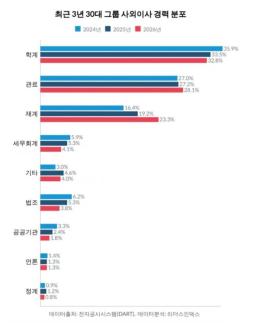 Outside Directors With Big-Business Backgrounds Top 20% at Top 30 Groups, Study Finds The share of outside directors at South Korea’s top 30 conglomerate groups who come from the business community has topped 20% for the first time, while the share of newly appointed female outside directors hit a record high. Leaders Index, a corporate analysis firm, said April 28 it reviewed 847 outside directors at 229 companies that filed business reports among the country’s top 30 groups by assets. It found the business-community share rose the most. Outside directors with business backgrounds increased to 23.3% (197) this year, up from 16.4% (141) in 2024 and 19.2% (163) in 2025. It was the first time the figure exceeded 20% since the survey began. By prior employer, the largest number had careers at Samsung and SK, with 11 each. They were followed by Hana Financial Group and Shinhan Financial Group with 10 each, and Hyundai Motor and LG with seven each. By group, Lotte had the highest share of business-community outside directors: 29 of 59, or 47.5%. At SK, 31 of 80 outside directors, or 38.8%, were from the business community, the largest share within the group. By contrast, Samsung, CJ and Shinsegae groups had high shares of former government officials. At CJ, 21 of 28 outside directors (75%) were from government; at Shinsegae, 13 of 20 (65%); and at Samsung, 33 of 60 (55%). Of the 67 government-background outside directors across the three groups, 20 previously worked at the prosecution, the judiciary or the Fair Trade Commission. Hyundai Motor Group and LG Group had a majority from academia. At Hyundai Motor, 36 of 78 (46.2%) were from academia; at LG, 31 of 42 (73.8%). By specialty, legal and policy was the largest category this year at 28.2% (239). The share in technology and tax has also risen steadily, from 14.8% (127) in 2024 to 15.1% (128) in 2025 and 16.5% (140) in 2026. Women also reached a record share among new outside directors. Of 122 newly appointed outside directors this year, 42 (25.0%) were women. Women accounted for 197 of all 847 outside directors, or 23.2%. Among female outside directors, 42.1% had academic backgrounds, followed by business (26.4%) and government (16.2%).* This article has been translated by AI. 2026-04-28 09:11:55
 -
 Samsung Electronics wins 16 Red Dot Design Awards, including two top honors Samsung Electronics said April 28 it won 16 awards at the 'Red Dot Design Award 2026,' including two of the competition's top honors, known as 'Best of the Best.' The Red Dot Design Award is a major international design prize that began in 1955 under Germany's North Rhine-Westphalia Design Center. Samsung submitted 16 entries in the product design category, and all were recognized. The Best of the Best awards went to the OLED TV 'S95H' and the Bespoke AI laundry appliance series. The S95H was praised for a silver metal frame on the front that makes the ultra-slim OLED screen appear to float above the body. Samsung said the frame blends naturally with a wall, enhancing immersion and giving the set an art-like presence. The Bespoke AI laundry series received top marks for applying a unified design while preserving each product's distinct characteristics. Other winners included the portable screen 'The MovingStyle,' the AI WindFree Combo Pro wall-mounted air conditioner, and the Jet Fit cordless stick vacuum cleaner. Samsung also said products such as the Galaxy Z Fold 7, Galaxy XR and a 5G street radio solution were selected for awards. Mauro Porcini, president and chief design officer for Samsung Electronics' DX division, said the company pursues design that reflects people's identity, emotions and diversity. He said Samsung will continue to focus on design with purpose and meaningful connection beyond basic functionality.* This article has been translated by AI. 2026-04-28 09:00:16
 -
 Samsung Unveils Glasses-Free 32-Inch 3D Spatial Signage Display Samsung Electronics said on the 28th it will launch a new 32-inch glasses-free 3D display called “Spatial Signage.” The next-generation display uses Samsung’s proprietary “3D Plate” technology to create a three-dimensional effect without dedicated 3D glasses, making images appear to have depth as if there were space inside the screen. Samsung expanded the lineup after introducing an 85-inch model earlier this year, adding the 32-inch version to boost visibility for smaller products on display. The existing 85-inch model offers 4K UHD resolution and a screen about 190 centimeters tall, designed to deliver an immersive experience, such as viewing a runway show at a glance. The 32-inch model uses FHD resolution and a 9:16 aspect ratio, enabling realistic 360-degree rotating video that shows products such as shoes and jewelry from the front, sides and back. Despite a slim 49.4-millimeter profile, it delivers a sense of depth and can provide a lifelike viewing experience without physically displaying the product, the company said. Weighing 8.5 kilograms, it is lighter than box-shaped hologram-style 3D displays and is designed for easier installation in tight spaces, including on store shelves, Samsung said. Samsung’s commercial-display software, Samsung VXT, supports remote device management, real-time monitoring, and simpler content creation and operations. The company said it has added a range of new features to VXT to improve usability and operating efficiency across Samsung signage products, including Spatial Signage. A newly added “AI Studio” app allows users to create video content for signage using a single photo, Samsung said. Kim Hyeong-jae, a vice president in Samsung Electronics’ Visual Display Business, said the 32-inch Spatial Signage is designed to deliver an immersive 3D experience in places where large signage is difficult to install. “By building an integrated digital signage ecosystem that combines innovative display products and solutions, we will provide customers with optimal commercial displays,” Kim said.* This article has been translated by AI. 2026-04-28 08:46:38
 -
 LG Innotek, Samsung Electro-Mechanics defy seasonal slump on AI-driven demand LG Innotek and Samsung Electro-Mechanics are posting unusually strong results despite what is typically a seasonal lull for electronics parts makers, helped by an artificial intelligence-driven boost in demand. Steady smartphone camera-module sales and rising shipments of high-value semiconductor substrates used in AI data centers and servers are supporting growth. LG Innotek said in a regulatory filing on 27 that its first-quarter consolidated revenue rose 11.1% from a year earlier to 5.5348 trillion won, the highest ever for a first quarter. Operating profit jumped 136% to 295.3 billion won, beating market expectations. The first quarter is usually considered an off-season because the impact of new smartphone launches fades. This year, the company said demand stayed firm as popularity of the iPhone 17 series, released in September, carried into early 2026, lifting its core camera-module business. The optical solutions division, which accounts for about 80% of revenue, posted 4.6106 trillion won in sales, up 11.4% and a first-quarter record. Growth was not limited to cameras. The package solutions division, which handles semiconductor substrates, reported revenue of 437.1 billion won, up 16% from a year earlier. The company cited surging demand for high-performance substrates such as flip chip ball grid array, or FC-BGA, as global big tech companies expanded AI investment. It said higher-value communications substrates, including RF-SiP, performed strongly, and profitability improved as supplies of advanced substrates used in AI servers and accelerators increased. Samsung Electro-Mechanics, which is set to report earnings on 30, is also expected to benefit from AI-related demand. According to a securities-industry consensus, the company’s first-quarter revenue is estimated at 3.2027 trillion won and operating profit at 295.0 billion won, up 16.7% and 47.1%, respectively, from a year earlier. A key driver is multilayer ceramic capacitors, or MLCCs. The article said an AI server uses 10 to 15 times more MLCCs than a general-purpose server, and unit prices are several times higher, pushing MLCC production lines close to full utilization. FC-BGA, which Samsung Electro-Mechanics has identified as a future growth area, is also expected to contribute more meaningfully as the AI accelerator market expands, accelerating a shift toward higher-value products. Industry watchers said the company could be on track to return to the “1 trillion won club” in annual operating profit starting from this first quarter. An industry official said, “As the AI era takes hold, the seasonal swings in the electronic components industry are being offset,” adding that Korean parts makers, having secured mass-production capacity through early investment, are likely to maintain solid growth for the time being as key partners in the global AI supply chain.* This article has been translated by AI. 2026-04-27 18:37:30
 -
 LG Innotek Posts Record First-Quarter Revenue of 5.53 Trillion Won LG Innotek said Monday its first-quarter operating profit was provisionally tallied at 295.3 billion won, up 136% from a year earlier. Revenue rose 11.1% to 5.5348 trillion won, the company’s highest first-quarter figure on record. The company said demand for mobile camera modules remained solid despite the seasonal off-peak period, while shipments of high value-added semiconductor substrates such as FC-BGA continued to be strong. It added that mobility components, including automotive camera and lighting modules, also posted steady growth and helped lift sales. By business line, the optical solutions unit posted revenue of 4.6106 trillion won, up 11.4% from a year earlier and a first-quarter record, as demand for mobile camera modules increased and automotive camera sales improved quickly. The package solutions unit recorded 437.1 billion won in revenue, up 16%. The company cited strong supply of high value-added communications substrates such as RF-SiP and continued expansion of FC-CSP supply into new applications, including high-performance memory. The mobility solutions unit posted revenue of 487.1 billion won, up 4.2%. The division had an order backlog of 19.2 trillion won as of the end of last year and plans to actively expand new orders this year, led by autonomous driving solutions. LG Innotek said it plans to strengthen its portfolio of high-profit businesses, focusing on expanding the package solutions business, which it described as having strong profitability and growth potential. The company said it aims to raise the package solutions unit’s contribution to operating profit to the level of the optical solutions business within five years. CEO Moon Hyuk-soo said in March that the mobility solutions business would continue to grow as revenue from automotive AP modules begins to materialize in earnest from the fourth quarter. * This article has been translated by AI. 2026-04-27 13:30:15
 -
 LG Electronics to spin off 4 in-house ventures in AI, robotics; offer up to 400 million won in funding LG Electronics said its in-house ventures are preparing to become independent startups, with four teams selected to spin off from the company after developing business-to-business technologies in artificial intelligence, robotics and advanced materials. The company said Monday it recently held a “Studio341 Demo Day” and chose four teams that have met the requirements for a final spin-off. Studio341 is an internal venture program launched in 2023 to carry forward the challenge-and-innovation spirit of GoldStar, LG’s predecessor. The name comes from 341 Yeonji-dong, Busanjin-gu, Busan — GoldStar’s first address. LG Electronics works closely with startup accelerator Bluepoint Partners from selection and mentoring through the spin-off process. This year’s selected teams are: Seka, an AI solution that detects errors in hardware design data; MachineFlow, an enterprise AI coding agent aimed at improving code quality; PreKitchenLab, a kitchen automation robot and operations management B2B solution; and Atomer, a fabless-based design solution for advanced flame-retardant materials. The teams advanced to the final round in July last year after a competition of about 12-to-1, then completed mentoring and passed a final review. The final panel included officials from LG Electronics, startup development specialists and venture capital firms, and assessed business value as well as team composition and capabilities. Depending on the review results, each team will receive up to 400 million won in initial investment, LG Electronics said. The company plans to complete the spin-off procedures in July. LG Electronics said it will continue providing support for a period after the spin-offs to help the startups establish themselves in the market, while also seeking synergies in AI automation solutions, robotics and advanced materials. The first startups spun off in 2024 have been selected for South Korea’s TIPS tech startup support program and the DIPS “super-gap” startup initiative, the company said, and have been recognized for business performance and technology across areas including AI, robotics, materials and platforms. Since last year, LG Electronics has also expanded the program to pursue open innovation with external startups that have solutions aimed at creating new customer experiences. Kang Sung-jin, head of partnerships at LG Electronics, said that as the era of “physical AI” arrives, partnerships among companies with strengths in different technologies and solutions are becoming more important. He said LG Electronics will continue supporting Studio341 spin-offs so they can grow into reliable partners for the company. * This article has been translated by AI. 2026-04-27 10:04:08
 -
 Hanmi Semiconductor Chairman Kwak Dong-shin Buys $2.2 Million in Company Shares Hanmi Semiconductor said in a regulatory filing on the 27th that Chairman Kwak Dong-shin bought 3 billion won ($2.2 million) worth of the company’s shares with his personal funds, carrying out a share-purchase plan disclosed March 30. The purchase price was 315,407 won per share, for a total of 3 billion won. Since 2023, Kwak has bought a combined 56.5 billion won worth of Hanmi Semiconductor shares, raising his stake to 33.57%. The company said Kwak’s continued purchases reflect his confidence in the technology and growth prospects of its TC (thermocompression) bonders in the global market for high-bandwidth memory, or HBM, equipment. Hanmi Semiconductor said it is maintaining its lead in the global market for TC bonders used in HBM production, and is taking the lead in supplying its “TC Bonder 4” to global manufacturers this year as mass production of HBM4 ramps up. By the end of this year, the company plans to launch a “wide TC bonder” to support next-generation HBM production. It said the equipment is designed for next-generation HBM with a significantly expanded die area compared with existing HBM, aimed at meeting rising memory capacity and bandwidth needs tied to next-generation artificial intelligence infrastructure demand. The company also said it plans to release a prototype of a “second-generation hybrid bonder” within this year, targeting the hybrid bonding market expected to see full-scale mass-production adoption in 2029. It said it will begin full operation of a “hybrid bonder factory” in the first half of next year as part of a strategy to secure an early lead in next-generation semiconductor packaging. “This share purchase is a strong expression of Chairman Kwak’s commitment to responsible management,” a Hanmi Semiconductor official said. “As a first mover in the global semiconductor equipment industry, we will achieve sustainable growth.”* This article has been translated by AI. 2026-04-27 09:49:34