
Journalist

Park Ki-rock and Seo Min-ji
kirock@ajunews.com
-
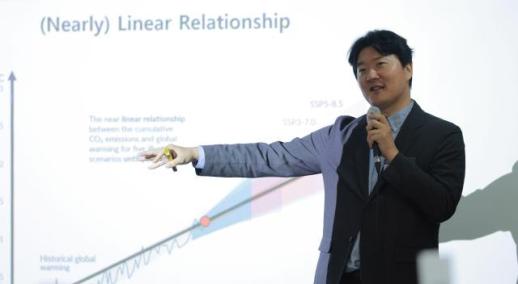 Energy Forum: Middle East shock puts energy security in focus; Korea urged to redesign grid and energy mix Energy supply-chain shocks triggered by war in the Middle East are rattling the global economy and elevating energy security as a key factor in national resilience. Disruptions in crude oil supply and sharp price increases have rippled through inflation, interest rates and exchange rates, quickly affecting household budgets and corporate operations. South Korea, which relies on imports for most of its energy, is among the countries most exposed to external shocks, analysts say. Experts warn the current turmoil is not a temporary price swing but a turning point in which supply-chain instability becomes structural, meaning similar shocks could recur whenever geopolitical tensions flare. That has renewed calls to treat energy security as a top-tier economic strategy and to diversify supply while reshaping the power-generation structure through an “energy mix” that balances renewables, nuclear power and other sources to spread risk and maintain stable supply during crises. At the “2026 Aju Economic Daily 2nd Energy Forum,” hosted by Aju Economic Daily on Tuesday at the Korea Press Center in central Seoul, Kim Hyeong-jun, a chair professor at KAIST’s Moon Soul Graduate School of Future Strategy and Department of AI Futures Studies, said climate change is “not simply an environmental issue but a complex system problem involving energy, water and the economy.” He added, “If we do not change the energy structure, the damage will grow.” Kim said the economic gap widens sharply between limiting temperature rise to within 1.5 degrees Celsius above preindustrial levels and allowing warming to intensify without action. If warming is left unchecked, he said, global damage could reach about $2,300 trillion (about 300 quadrillion won) by 2100, but managing warming at about 1.5 degrees could cut the damage roughly in half. “An era is coming when carbon emissions will be tracked beyond the national level to the corporate level,” Kim said, adding that “a structure is forming in which the cost burden grows if emissions are not reduced.” In the second keynote, Kwak Eun-seop, head of grid planning at Korea Electric Power Corp., said the spread of artificial intelligence is driving a surge in data-center electricity demand, making grid expansion an urgent task. Citing the International Energy Agency, Kwak said global electricity demand is projected to rise from 28,200 terawatt-hours last year to 33,600 TWh by 2030 as the AI industry grows. Over the same period, power consumption by AI data centers is expected to roughly triple. However, shortages in transmission lines, transformers and grid connections are emerging as major bottlenecks, he said. In Texas, he noted, applications waiting for data-center grid connections exceed 150 gigawatts — more than one-fifth of total U.S. peak load — underscoring the strain facing major economies. South Korea faces similar pressures, Kwak said. With the expansion of semiconductors and AI, peak power demand is projected to rise about 28% by 2038, requiring an estimated additional 2.2 gigawatts of supply each year. Demand is concentrated in the Seoul metropolitan area while generation facilities are spread across other regions, worsening regional imbalances. “Building transmission networks typically takes more than 10 years, while new demand such as data centers can surge within two to three years, making mismatches more likely,” Kwak said. He urged parallel mid- to long-term steps, including grid expansion, greater capacity to integrate renewable energy, adoption of virtual power lines (VPL), and development of a more distributed power system. 2026-04-29 16:16:36
 -
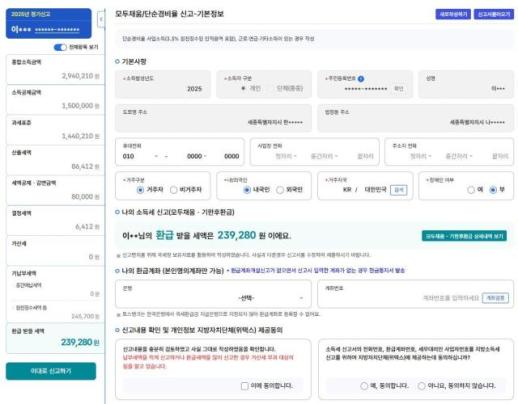 South Korea Tax Agency: 13.33 Million Must File May Income Tax Returns; 2.65 Million Get Automatic Extension The National Tax Service said Tuesday that May is the month to file and pay comprehensive income tax and local income tax, and that individuals with comprehensive income in 2025 must report and pay by May 1. The agency said 13.33 million people are required to file this year. Since April 25, it has been sending filing notices by mobile message, including KakaoTalk, Naver electronic documents and text messages. The filing period runs from May 1 to June 1. Taxpayers subject to the “faithful filing confirmation” requirement must file and pay by June 30. Those who receive mobile notices can file immediately through SonTax or the automated phone system, and Hometax will provide a personalized filing screen after login. The tax agency said it improved convenience by revamping Hometax and SonTax and simplifying the automated phone system. Taxpayers who receive auto-fill notices can complete filing using the “file as is” function, and the phone system will automatically enter contact information and refund account details. The auto-fill service has been expanded to 7.17 million people. Of those, 4.6 million eligible for refunds can receive payments starting June 5 — 25 days earlier than the statutory deadline — if they submit the notice without changes. The agency said it will, for the first time, provide taxpayer-specific tax-saving benefits and reference materials related to tax audits to improve filing accuracy. It also said it will automatically extend the payment deadline to Aug. 31, without a separate application, for 2.65 million small taxpayers, including those in oil price-sensitive industries facing difficulties due to weak domestic demand and high oil prices and interest rates. Returns, however, must still be filed by June 1. When filing comprehensive income tax, taxpayers can also file local income tax in one step, as Hometax automatically links to Wetax. A customized tax guidance service will also be available through the government’s “National Secretary” notification system. * This article has been translated by AI. 2026-04-29 12:07:19
 -
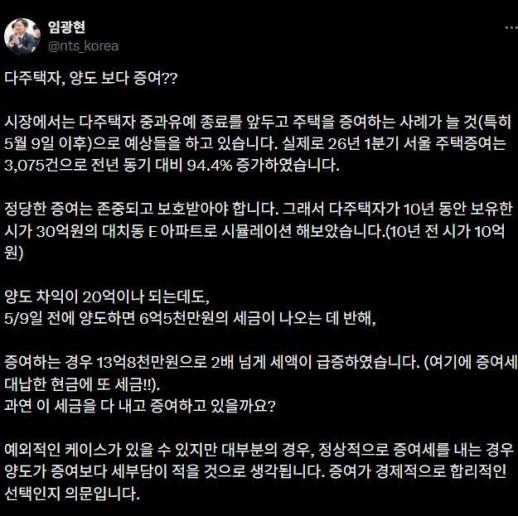 NTS chief warns multi-homeowners gift tax can top capital gains tax as surcharge break ends Lim Gwang-hyeon, commissioner of South Korea’s National Tax Service, warned multi-homeowners not to rush into gifting homes ahead of the end of a temporary suspension of heavier capital gains taxes, saying the tax burden is often higher for gifts than for sales. In posts on X (formerly Twitter) and Facebook on Tuesday, Lim said the market expects more home gifts before the suspension ends, but “when you calculate the actual tax burden, gifting is often more disadvantageous.” He added that people should not consider “schemes” aimed at avoiding taxes. Home gifts in Seoul totaled 3,075 cases in the first quarter of this year, up 94.4% from a year earlier. Lim cited a simulation: For an apartment in Seoul’s Daechi-dong with a market price of 3 billion won that has been held for 10 years and was bought for 1 billion won, a sale before May 9 would generate about 650 million won in taxes. A gift, he said, would result in about 1.38 billion won in taxes — more than double. He also cautioned that if someone else pays the gift tax on the recipient’s behalf, additional taxation may apply. Assuming taxes are paid properly, he said, taxpayers should consider whether gifting is economically reasonable. Lim warned against improper gifting practices, including gifting a home with a loan and then having parents repay it, or undervaluing a property below market price. Such actions could amount to tax evasion, he said, adding that the NTS plans to conduct a full review. In those cases, he said, penalties of up to 40% could be imposed on top of the original tax due. “Tax justice is a very important value,” Lim said, adding that the agency will provide guidance and consultations so taxpayers can make reasonable decisions before the suspension ends. * This article has been translated by AI. 2026-04-29 09:15:18
 -
 More Than Half of South Korea’s Farm, Forestry and Fishing Population Is 65 or Older More than half of South Korea’s farm, forestry and fishing population is now 65 or older, as household sizes continue to shrink rapidly. According to the National Data Policy Agency’s preliminary results of the “2025 Census of Agriculture, Forestry and Fisheries” released on the 28th, the farm, forestry and fishing population totaled 2,576,000 people as of last December, living in 1,276,000 households. That compares with about 2.38 million people and 1.06 million households in the 2020 census — increases of about 196,000 people and 216,000 households. The agency said the rise reflects an expanded statistical scope as more people moved to rural areas and additional administrative records — including farmland ledgers, fisheries registration lists and forestry management databases — were added to the survey coverage. The share of residents ages 65 and older in farm, forestry and fishing households rose to 51.0% in 2025 from 41.9% in 2020, up 9.1 percentage points. That is more than 2.5 times the share in the overall population, which stood at 20.3%. By sector, the elderly share was 51.3% for farm households, 48.2% for fishing households and 47.9% for forestry households. In farm households, the share of working-age residents (15-64) was 45.8% and the share of children (0-14) was 2.9%, down 23.7 percentage points and 7.3 percentage points, respectively, from the overall population. The median age was 65.3, or 18.6 years higher than the national figure. Smaller households also became more common. One-person households accounted for 27.2% in 2025, up from 20.0% in 2020, an increase of 7.2 percentage points. The share of three-person households fell to 11.6% from 14.3%, and four-person households dropped to 7.4% from 11.9%. Two-person households made up 53.8% last year, the largest share, meaning one- and two-person households accounted for more than 80% of all farm, forestry and fishing households. By area, the share living in “dong” neighborhoods rose to 32.4% in 2025 from 27.5% in 2020, while the share in “eup” and “myeon” areas fell to 67.7% from 72.5%. The shift reflects a move toward dong areas, where medical care, transportation and education are generally more accessible than in eup and myeon communities. 2026-04-28 12:10:16
 -
 South Korea to Issue 200 Billion Won in Retail Treasury Bonds in May The Ministry of Economy and Finance said April 28 it plans to issue 200 billion won ($200 billion won) in retail Treasury bonds in May. By maturity, the ministry will offer 5 billion won each in three-year coupon bonds and three-year compound-interest bonds. It will also supply 50 billion won in five-year bonds, 110 billion won in 10-year bonds and 30 billion won in 20-year bonds. Coupon rates will be based on the winning yields for government bonds of the same maturities sold in April. The three-year bond will carry a 3.450% coupon rate, the five-year 3.530%, the 10-year 3.715% and the 20-year 3.610%. Additional rates will be added to the five-year (0.3 percentage points), 10-year (1.05 percentage points) and 20-year (1.3 percentage points) bonds. No additional rate will be applied to the three-year bond, citing recent rate increases and returns on financial products. If held to maturity, the pretax return is expected to be about 10% for the three-year coupon bond and about 11% for the three-year compound-interest bond, about 21% for the five-year bond, about 59% for the 10-year bond and about 161% for the 20-year bond. Subscriptions will run from May 11 to May 15. Individual investors can apply in person or online through Mirae Asset Securities, the selling agent. The minimum subscription is 100,000 won, and the annual purchase limit is 200 million won per person. If total subscriptions are within the issuance cap, investors will receive full allocations. If subscriptions exceed the cap, up to 3 million won will be allocated equally, with the remaining amount distributed in proportion to subscription size. Allocation results will be provided on the next business day after the subscription period ends. In May, investors will also be able to redeem early retail Treasury bonds issued from June 2024 through April 2025. In that case, they will receive only principal and interest based on the coupon rate applied at purchase, and will not receive compound interest including the additional rate or benefits such as separate taxation on interest income.* This article has been translated by AI. 2026-04-28 10:04:04
 -
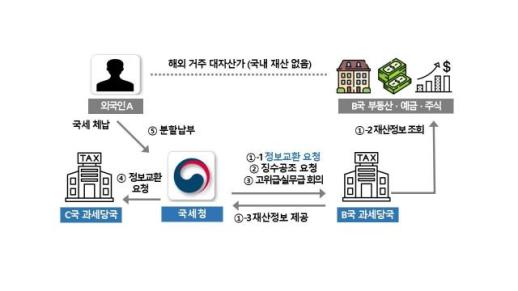 Korea Tax Agency Recovers 33.9 Billion Won in Hidden Overseas Assets From Delinquents The National Tax Service said it has recovered 33.9 billion won in delinquent taxes by strengthening international cooperation against people who hid assets overseas. The agency said dozens of additional cases are still moving through international collection procedures, raising expectations that hundreds of millions of won more could be recovered. According to the NTS on the 27th, since NTS Commissioner Im Gwang-hyeon took office in July last year, the agency has recovered 33.9 billion won in five cases over the past nine months through collection cooperation with tax authorities in three countries. The figure accounts for most of the cumulative results since 2015 — 37.2 billion won across 24 cases — as the agency says international cooperation is now producing tangible collection results. The NTS said it uses two main channels to track overseas assets held by tax delinquents: information exchange and collection cooperation. It identifies overseas accounts and financial assets through automatic exchange of financial information with 119 countries, and obtains information on assets such as real estate through case-by-case requests with 163 countries. When those efforts confirm where a delinquent’s overseas assets are located, the NTS proceeds with collection cooperation by asking the relevant country’s tax authority to carry out compulsory collection. The agency said Korea cannot directly enforce seizures abroad, so local tax authorities conduct attachment and collection on its behalf. In one case, a foreign wealthy individual living overseas who had failed to pay taxes in Korea sold local assets and paid after cooperation with the person’s home-country tax authority began, the NTS said. In another, a foreign professional athlete who had worked in Korea left the country without filing taxes, but paid voluntarily through a representative in Korea after the athlete’s home-country financial account was identified. The NTS also cited a case involving a foreign businessperson who had dispersed and concealed assets across multiple countries. After a third-country financial account was detected and collection cooperation was initiated, the case ended in voluntary payment. For Korean nationals, the agency said it has recovered taxes by tracing accounts of overseas corporations operated under borrowed names and collecting the full deposits, or by using information exchange with countries where delinquents hold permanent residency to seize and collect from overseas accounts. The NTS said it is expanding its methods by directly participating as a creditor in overseas bankruptcy proceedings and by attaching high-end homes abroad. In one case, a delinquent immediately signaled an intent to pay after a luxury home overseas was attached, it said. An NTS official said shifting assets overseas while benefiting in Korea and failing to pay taxes leaves compliant taxpayers feeling deprived, undermines the foundation of public finances, and seriously damages fairness and justice in society. The official said the agency will mobilize all available tax enforcement capacity to respond strictly to malicious delinquents who evade their tax obligations. 2026-04-27 12:04:09
 -
 Park Hong-geun Pushes Voluntary Carbon Market Law, Unified Exchange Park Hong-geun, minister of the Office of Planning and Budget, said on the 27th that the government will move to institutionalize a voluntary carbon market as a key tool for meeting carbon-neutrality goals and will pursue the creation of a unified exchange. Speaking at the launch ceremony for the “Korean-style Voluntary Carbon Market Alliance” at the Korea Chamber of Commerce and Industry, Park said carbon cuts are “no longer a cost but a new business model that raises corporate value.” The government also announced its “Korean-style voluntary carbon market development plan,” focusing on building the institutional framework, expanding trading infrastructure and broadening demand to foster a carbon-market ecosystem. As a legal foundation, it will push to enact a “Voluntary Carbon Market Act.” The bill would include operating a registry institution to manage the full lifecycle of carbon credits — issuance, distribution and retirement — and disclosing evaluation standards to improve transparency and trust. To strengthen fairness and stability in trading, the government plans to establish a dedicated voluntary carbon market exchange. It aims to open the exchange within the Korea Exchange by the end of this year to consolidate dispersed carbon-credit trading and improve convenience through standardization by product category. The government also plans to work with overseas rating agencies to bolster international credibility for traded emissions-reduction results and to expand links with international carbon markets. The newly launched alliance is a public-private governance body bringing together companies, financial institutions and research organizations to connect supply and demand and identify tasks for improving the system. The government said activating the voluntary carbon market is needed to strengthen incentives for emissions cuts in nonregulated areas, including small and medium-sized companies and startups that are not covered by the emissions trading system, or ETS. The ETS currently covers about 70% of national greenhouse gas emissions, but incentives for the remaining 30% are insufficient, it said. Park said the government will provide institutional support so the domestic market can become an Asian hub amid the global expansion of carbon markets, and pledged to build a virtuous cycle in which emissions-cutting performance leads to investment and growth. * This article has been translated by AI. 2026-04-27 11:18:39
 -
 South Korea’s Tax Take Seen Surging Past 400T Won This Year, Possibly 500T Next Year South Korea’s government is facing a pivotal choice in fiscal policy as tax revenue is expected to far exceed earlier projections, reversing several years of shortfalls. After an estimated 25 trillion to 35 trillion won in excess revenue this year, some forecasts say national tax revenue could top 500 trillion won next year, well above the government’s initial outlook. As of the 26th, the Finance and Economy Ministry and other officials estimate this year’s national tax revenue will surpass 400 trillion won and reach about 415 trillion won, sharply higher than earlier projections. In its “2025-2029 National Fiscal Management Plan,” the government had forecast about 390 trillion won for this year and about 412 trillion won for next year, based on a conservative assumption of 4.6% average annual growth. Changing conditions are now forcing a revision. Revenue conditions have improved quickly this year, helped by a semiconductor boom, a strong stock market and a recovery in employment. When the government drafted its first supplementary budget this year, it made a 22.6 trillion won revenue adjustment, a procedure used to revise the budget when tax receipts come in higher or lower than expected. By category, corporate tax revenue was projected to rise by 14.8 trillion won, while the securities transaction tax and the rural special tax were expected to increase by 10.3 trillion won. Earned income tax was also projected to rise by 4.8 trillion won, reflecting broader gains in the tax base. With growth across major tax items now expected to be steeper than previously assumed, some observers say excess revenue this year could exceed the 25 trillion won used to finance the first supplementary budget and reach as much as 35 trillion won. Next year’s increase could be even larger. Using operating profit forecasts that reflect a “semiconductor supercycle” for major companies such as Samsung Electronics (300 trillion won) and SK hynix (198 trillion won), a simple calculation suggests corporate tax revenue from those two firms alone could generate more than 130 trillion won in additional revenue. That has fueled speculation that next year’s national tax revenue could far exceed the 412 trillion won forecast and climb well past 500 trillion won. If the unexpected surge materializes, debate is expected to intensify over how to use the windfall. Some argue it should be used to repay government bonds and strengthen fiscal soundness, saying rapid growth in national debt during years of revenue shortfalls makes this a chance to rebuild fiscal room. Others say the government should play a more active fiscal role during a period of low growth. The government has also stressed the need for spending to strengthen the growth foundation. Park Hong-geun, minister of the Planning and Budget Office, said at a news briefing on the 21st, “To raise the growth rate, the role of fiscal policy is needed,” signaling support for an expansionary stance. With the decline in potential growth becoming entrenched, the government sees fiscal spending as unavoidable for investment in new industries and structural reform. Questions remain about sustainability, however, because the revenue boom may be temporary and tied to a specific industry cycle rather than structural change. Critics note that external uncertainty remains high, including high oil prices and a weak won, and that tax receipts could still swing sharply with corporate earnings. The broad direction of fiscal management is expected to take shape at a National Fiscal Strategy Meeting in June after local elections. Chaired by the president, the meeting sets medium- and long-term fiscal policy and the basic principles for drafting next year’s budget, effectively serving as the government’s fiscal control tower. Officials are also expected to outline a more concrete plan there for how to use excess revenue.* This article has been translated by AI. 2026-04-27 05:03:19
 -
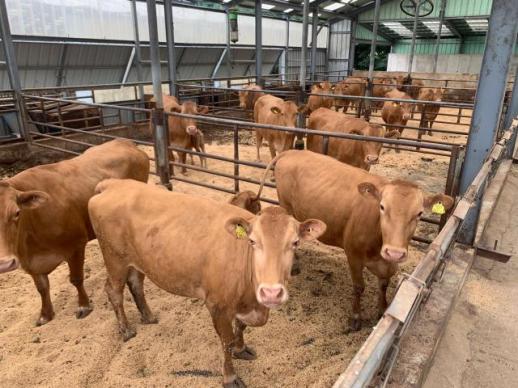 South Korea’s Q1 Livestock Herds Fall; Broiler Chickens Rise Major livestock numbers in South Korea fell in the first quarter of 2026, with broiler chickens the only category to increase, according to a government survey released Thursday. The National Data Center said its “2026 first-quarter livestock trends survey” showed that as of March 1, the combined number of Korean native cattle and beef cattle totaled 3,218,000, down 4.9% from a year earlier. With fewer breeding cows, the number of animals under 1 year old fell 6.9%, those aged 1 to 2 years fell 3.2%, and those 2 years and older fell 4.7%. Dairy cattle totaled 371,000, down 1.7%. With fewer breeding dairy cows, animals under 1 year old fell 5.4% and those 2 years and older fell 1.8%. The pig herd stood at 10,716,000, down 0.7%. Pigs aged 2 to under 4 months fell 3.0%, while some other age groups were little changed, resulting in a mild overall decline. Laying hens totaled 77,747,000, down 0.3%. The agency cited culling tied to outbreaks of highly pathogenic avian influenza, with birds 6 months and older down 5.5%. Duck numbers dropped 15.9% to 5,294,000, as fewer meat ducklings were placed, sharply reducing overall production. By contrast, broiler chickens rose 2.7% to 96,463,000 as chick placements increased. Broilers were up 3.0%, and samgye chickens rose 3.4%, the survey said. 2026-04-24 12:04:26
 -
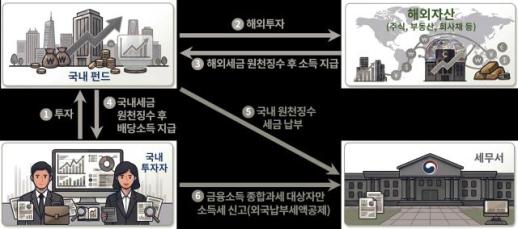 Korea Launches First Tax Credit for Overseas Fund Investors; Must Claim in May Filing 올해부터 펀드를 통한 해외투자에 대한 세액공제 제도가 처음 시행되면서, 해당 투자자는 5월 종합소득세 신고 시 공제 신청 여부를 확인해야 한다. The National Tax Service said on 24일 that a new tax preference for overseas investments made through funds applies for the first time to income attributable to 2025. The measure is intended to encourage overseas investing and diversification. Individuals who invest in qualifying overseas-investment funds may claim a tax credit when filing their comprehensive income tax return. The program is designed to reduce tax burdens at the investment stage and support Korean investors expanding into foreign assets. The agency noted that it is structured as a tax credit, not an income deduction, meaning it reduces calculated tax directly and can provide a larger practical benefit for the same amount. Eligibility is limited. It applies to residents whose combined annual interest and dividend income exceeds 20 million won and who invest in foreign assets through certain products, including: domestically listed ETFs tracking the S&P 500 or Nasdaq 100; domestically listed overseas real estate REIT ETFs; and overseas bond-type public funds established in Korea. The credit is available only when taxable income such as dividends or interest is generated and tax is actually paid overseas. Investors can claim the credit only if they report the fund’s dividend or interest income under comprehensive taxation. It does not apply when a taxpayer has only financial income that is finalized under separate taxation. Investors can confirm with their financial institution or fund manager whether their fund qualifies. The credit applies within a set limit to part of the investment amount and is deducted directly from calculated tax. Not all invested amounts qualify because the cap and other requirements are fixed. The credit is not applied automatically. Taxpayers must select and claim it when filing their comprehensive income tax return. Even if some data provided by financial institutions appears in the Hometax simplified service, investors must verify eligibility and the amount themselves. With the program in its first year, the agency warned that credits could be missed if taxpayers are unaware. The National Tax Service said it will strengthen guidance during the filing period and provide materials to help taxpayers determine eligibility in advance. * This article has been translated by AI. 2026-04-24 12:03:20