
Journalist

LEE KEONHEE
mkmk@ajunews.com
-
 South Korea’s People Power Party Moves to Seek Unification Minister Jeong Dong-young’s Dismissal South Korea’s People Power Party decided to make it party policy to submit a National Assembly motion recommending the dismissal of Unification Minister Jeong Dong-young over his remarks about a “North Korean Kusong nuclear facility.” The party said the comments could damage trust between South Korea and the United States. The party adopted the plan at a lawmakers’ meeting on the 23rd at the National Assembly. Afterward, party leader Jang Dong-hyeok convened a closed-door meeting with People Power Party lawmakers who chair the Assembly’s foreign affairs and unification, defense and intelligence committees. Speaking to reporters after the meeting, Jang said Jeong was committing a “serious act of self-harm” to diplomacy and security by leaking information. “I think this is a matter that warrants impeachment, but we agreed first to submit a dismissal motion as party policy,” he said. Floor leader Song Eon-seok, who had called a day earlier for Jeong to be replaced, again urged his dismissal. Intelligence Committee Chairman Shin Seong-beom said a minister’s remarks carry different weight than comments by private institutions or researchers. “Personally, I think Jeong’s repeated remarks about North Korea’s nuclear program may have raised doubts on the U.S. side,” Shin said. Defense Committee Chairman Seong Il-jong said it was a serious problem that trust in the South Korea-U.S. alliance had been shaken. He said the committee held a full meeting that morning, but the Democratic Party did not attend. “It’s very regrettable. We recessed rather than adjourned so they can still come in,” he said. Jeong rejected the party’s criticism as political and harmful to the national interest. Speaking to reporters at Cheondogyo’s Suun Hall in Seoul’s Jongno district, he said those who stirred the issue likely had their own motives. “It may be entertaining to keep amplifying the controversy, but it will harm the national interest,” he said. Jeong said it was not the first time the United States had limited intelligence sharing on North Korea, but the dispute was being portrayed as an “unprecedented situation.” He also said the place name “Kusong” had been mentioned in a U.S. congressional report. “The essence is that the North Korean nuclear issue is serious,” he said, adding that sanctions, pressure and blockade have not worked and that a shift to dialogue and negotiations is needed.* This article has been translated by AI. 2026-04-23 17:19:13
 -
 Uijeongbu mayoral hopeful Kim Won-gi faces plagiarism allegations over Ph.D. thesis Kim Won-gi, a Democratic Party of Korea preliminary candidate in the Uijeongbu mayoral race in Gyeonggi province, is facing allegations that he plagiarized his Ph.D. dissertation. If the claims are confirmed, they could expand into questions about his qualifications and ethics. According to reporting by Aju Business Daily on Wednesday, Kim’s 2011 doctoral dissertation, submitted to the graduate school of Konyang University, showed a 22% plagiarism rate in the plagiarism-checking program CopyKiller Campus. While direct comparisons with standards from 15 years ago are difficult, recent practice generally treats similarity rates above 20% as grounds for failing a thesis. Aju Business Daily said it compared the dissertation with another Ph.D. dissertation submitted to the same graduate school in 2010 and found multiple similarities under review criteria including research independence, originality of academic contribution, distinction from prior studies and whether the works are substantially identical. The report cited structural similarities in research conditions and the flow of argument, overlap in key theories and concept definitions, repeated use of research design and analytical frameworks, and recurring phrasing and narrative style. It said the number of similar sentences and descriptions raised concerns that the overlap went beyond ordinary citation. It also pointed to survey questions that were largely identical and to some survey items and analysis that were used in the same or similar form without separate notes or source citations. A professor who teaches at a university in Seoul said, “Rules differ by school, but for academic journals it is generally required that the plagiarism rate be under 9%,” adding, “Even considering various circumstances, 22% appears high.” The allegations have fueled debate in parts of academia over whether the dissertation meets the requirements of an independent study. They have also raised questions about whether political parties are adequately checking degrees and research ethics as they vet preliminary candidates for the June 3 local elections, with some warning that superficial screening could lead to repeated controversies. Aju Business Daily said it repeatedly tried to reach Kim’s camp for comment but was unable to make contact.* This article has been translated by AI. 2026-04-23 16:24:21
 -
 People Power Party Faces Internal Calls for Jang Dong-hyeok to Step Down Amid U.S. Trip Controversy Two days after returning from a trip to the United States, People Power Party leader Jang Dong-hyeok is still facing controversy, with some in his party continuing to press—directly and indirectly—for his resignation. Jang has sought to shift attention to the South Korea-U.S. alliance, but the party has struggled to unify and focus its efforts ahead of the June 3 nationwide local elections and other contests. In a Facebook post on April 22, Jang wrote that the United States is asking, “Are you coming with us or not?” He added that saying “thank you” in front while saying “xie xie” behind would “wreck” both the economy and national security. The message was widely read as a warning that a misstep in foreign policy amid a rapidly changing international order could cost South Korea on both fronts. Jang also said that during his U.S. visit, American figures asked, “Why is the South Korean government discriminating against U.S. companies, its ally, and trying to align with Chinese companies?” A day earlier, Jang posted that President Lee Jae-myung was effectively preparing to “decide to break up” with the United States. He also uploaded a photo of President Donald Trump that the White House had posted on social media when the United States captured and transferred Venezuelan President Nicolas Maduro. Inside the party, some lawmakers said they do not understand Jang’s overseas push. A first-term lawmaker said it was unclear how the U.S. trip connected to the local elections or how the delegation was chosen, adding that if many in the organization cannot understand it, Jang should explain rather than vaguely saying he cannot discuss it “as a matter of precedent.” Calls for Jang to take responsibility have also surfaced publicly. Kim Jin-tae, the People Power Party’s candidate for Gangwon governor and the incumbent governor, urged Jang to “resolve what you started” when Jang visited Yangyang County on April 22—remarks that could be interpreted as a demand for Jang to step back or resign. Jang responded by deflecting, saying he did not know what Kim meant by the phrase. Compounding the pressure, the Democratic Party has again hinted it could take all National Assembly standing committee posts in the second half of the parliamentary term. Floor leader Han Byung-do said at a resignation news conference the previous day that allocating committee chairmanships is meant to ensure competition and balance, but if chairmanships are used as a tool for political conflict, the allocation itself becomes meaningless. The remarks were seen as signaling that if he wins another term as floor leader, the party would regroup after the parliamentary by-elections and restart what it calls a “working National Assembly.” Critics inside and outside the People Power Party say the “Jang Dong-hyeok leadership” is now beset by both internal strife and external pressure, with neither steady leadership nor party unity in evidence. The party has struggled to manage a string of conservative figures running as independents in Daegu and Busan, and it has not settled internal debate over calls to field no candidate in Busan Buk-gap. With the June 3 local elections and parliamentary by-elections 42 days away, concerns are growing that the party must concentrate its resources on the campaigns. A political source said those working on the ground in the elections are likely “on edge,” adding that the party appears to remain unsettled despite the looming votes.* This article has been translated by AI. 2026-04-22 18:54:23
 -
 PPP Floor Leader Song Eon-seok Calls for Major Shift in Housing Policy, Urges Unification Minister’s Dismissal Song Eon-seok, floor leader of the People Power Party, on the 22nd took aim at what he called risks tied to the Lee Jae-myung government’s real estate policy and Unification Minister Jeong Dong-young. He urged a fundamental shift in housing policy and called for Jeong’s immediate dismissal. At a news conference at the National Assembly, Song said the government’s efforts to curb housing demand have reduced listings and transactions and produced “various side effects.” He pointed to the period after the government tightened household lending rules in the so-called June 27 measures last year. Over the following nine months, Seoul’s apartment sales price index rose 11.1%, more than double the 4.9% increase in the nine months before the rules were tightened, he said. Over the same period, Seoul’s jeonse supply-demand index and monthly rent price index rose 18.1% and 5.8%, respectively, which he said signaled a sharp deterioration in rental-market indicators. “In a market structure of demand suppression, delayed supply and weakened transactions, we are only seeing adverse effects: higher prices, fewer jeonse leases and heavier monthly rent burdens,” Song said. He added that “balloon effects” were spreading beyond Gangnam to areas such as Dongjak, Seodaemun and Gangseo, and into nearby cities including Gwangmyeong, Seongnam and Hanam. Song called for a major easing of loan restrictions for would-be homeowners without a house, and for withdrawing what he described as signals that fuel instability, including abolishing long-term holding tax deductions and strengthening property holding taxes. He also urged supply measures such as speeding up redevelopment of multi-family homes in central areas and easing regulations in height-restricted zones. The People Power Party said it plans to pursue an expanded supply policy in Seoul if Oh Se-hoon, its candidate for Seoul mayor in the June 3 local elections, wins, aiming to enable groundbreaking for 310,000 housing units in the city by 2031. Song also demanded personnel action against Jeong over remarks about “North Korea’s constituent nuclear facilities.” “A minister should not make uncertain statements based on claims raised in the private sector,” Song said, adding that only officially recognized information should be cited. He said Jeong had ended up acting “not as the Republic of Korea’s unification minister, but like North Korea’s United Front Department minister.” Song called on the government to disclose in detail whether the commander of U.S. Forces Korea and a U.S. assistant secretary of state visited South Korea’s defense and foreign ministries, respectively, to protest Jeong’s remarks. “This issue will not be resolved by blindly defending Minister Jeong,” Song said. “He should be dismissed immediately.” Lawmakers from the People Power Party on the National Assembly’s Foreign Affairs and Unification Committee also held a separate news conference, calling for an emergency committee inquiry, Jeong’s immediate removal, and efforts to restore the South Korea-U.S. alliance and normalize diplomacy and security policy. Rep. Kim Geon, a former diplomat, told reporters afterward that when citing private-sector claims, a minister must be clear, but Jeong spoke as if it were an objective fact. He said imprecision in discussing intelligence was a serious problem. Separately, asked about calls in some quarters for an early floor leader election, Song said the party should focus its strength on key tasks such as nominating candidates for National Assembly by-elections held alongside the local elections. He said he would serve out his term and devote his remaining time to winning the elections.* This article has been translated by AI. 2026-04-22 16:06:25
 -
 PPP Floor Leader Song Eon-seok Visits Fasting Lawmaker Ahn Ho-young, Urges Him to Stop Song Eon-seok, floor leader of the People Power Party, visited Democratic Party lawmaker Ahn Ho-young on the 22nd and urged him to end his hunger strike, saying, “You need to be healthy first. Please get up soon.” Song went with Yoo Sang-beom, the PPP’s senior deputy floor leader for parliamentary operations, to Ahn’s protest site outside the National Assembly, where Ahn has been on a hunger strike for 12 days. Song, looking grim, sat at the site, held Ahn’s hand and spoke with him for about two minutes. Ahn greeted them while lying down, unable to get up. Afterward, Song told reporters he came “as a fellow lawmaker and as the head of a negotiating bloc” to pay a visit and offer encouragement. He said they discussed that Ahn needs to protect his health “to do bigger politics” and to work together on politics that can “set South Korea on the right path.” Ahn began the hunger strike on the 11th, demanding a renewed internal audit into allegations that Rep. Lee Won-taek covered meal expenses during the party’s primary for North Jeolla Province governor. As the strike has continued for more than 10 days, figures from both parties have visited the site. The day before, National Assembly Speaker Woo Won-shik visited and urged Ahn to end the fast.* This article has been translated by AI. 2026-04-22 12:33:19
 -
 Ruling, opposition parties clash at probe hearing; discipline motion and perjury complaints loom Rival parties traded accusations April 21 at the National Assembly’s special committee investigating allegations of politically motivated, fabricated prosecutions under the Yoon Suk Yeol administration, as the dispute widened to include a threatened discipline motion and planned perjury complaints. The committee held a plenary meeting and conducted hearings on prosecutions tied to the West Sea civil servant shooting, alleged manipulation of statistics and alleged false reporting that defamed Yoon Suk Yeol. Democratic Party lawmakers argued prosecutors had become “the private property” of Yoon and pursued investigations with President Lee Jae-myung as their target. People Power Party lawmakers countered that Democrats were treating claims by criminals as unquestionable. Democratic Party lawmaker Yang Bu-nam, speaking about the investigation into the alleged defamation of Yoon, said prosecutors “drew a picture that the president was at the apex of the false reporting and launched a sweeping investigation,” calling it “decisive evidence that the prosecution became Yoon Suk Yeol’s private property.” People Power Party lawmaker Shin Dong-wook said, “Democratic Party lawmakers are turning people who committed crimes into prisoners of conscience, and their claims are being treated like gospel.” The sides also clashed over allegations that the Ministry of Land, Infrastructure and Transport manipulated housing statistics under the Moon Jae-in government. A ministry official appearing as a reference witness said that during a Board of Audit and Inspection review after the Yoon government took office, the official “was shown other people’s Q&A sheets and led through a process that induced answers agreeing with them.” People Power Party lawmaker Na Kyung-won pushed back, citing a social media chat among Korea Real Estate Board employees that included messages such as “Do it well to suit BH (the Blue House) tastes,” and said, “It’s all there about manipulating home-price statistics, and now you’re calling it a fabricated investigation and a pressured audit?” Democratic Party lawmaker Lee Ju-hee said she would introduce a motion to discipline Shin, accusing him of disrupting proceedings “with shouting and harsh language” despite warnings from the chair. Shin responded that the committee was not operating normally on matters such as procedure and selecting witnesses, and said he was trying to ensure it functioned properly “even if that means disrupting proceedings.” Later the same day, People Power Party members of the committee held a news conference and said they would file perjury complaints against National Intelligence Service Director Lee Jong-seok and five others. Rep. Kim Hyung-dong said they had “blatantly denied even facts recognized by final court rulings” and “misled” the committee by portraying existing evidence as if it did not exist, calling it “clear false testimony” and “a serious criminal act that deceives the public.”* This article has been translated by AI. 2026-04-21 21:30:21
 -
 Jung Dae-cheol calls North Korea’s ‘two states’ claim anti-Korean, anti-historical Jung Dae-cheol, chairman of the Korea Constitutional Association, a group of former lawmakers, on April 21 criticized North Korea’s claim of an “hostile two states” approach, calling it “an anti-Korean, anti-historical theory that denies the Korean people.” Speaking at a unification forum at Heungsadan headquarters in Seoul, Jung said the “two states” line overturns Kim Il Sung and Kim Jong Il’s asserted rationale for unification and their claim of “one Korean people.” He said it also contradicts past inter-Korean agreements, including outcomes from inter-Korean summits. Jung described the idea as a “permanent division theory,” arguing that the Korean people are “a real concept” that has maintained a shared identity and cannot be sustained or discarded by political declaration. He said the peninsula has a historical record of living as a unified state for at least 1,300 years. Jung said Kim Jong Un, chairman of North Korea’s State Affairs Commission, may have advanced the hostile two-states line because it has become difficult to beat South Korea in system competition. He said Kim may believe peaceful unification is impossible and only unification by force is feasible, or may have concluded that improving inter-Korean relations does not benefit North Korea. Jung also said North Korea could be seeking gains by sharpening inter-Korean confrontation within a “new Cold War” structure centered on South Korea-U.S.-Japan versus North Korea-China-Russia. Jung urged the South Korean government to pursue a broad policy response guided by principles he listed as firmness, indivisibility, consistency and noncompromise. He said Seoul should lead unification discourse centered on freedom, peace and a national community, and reaffirm the government’s commitment to peaceful unification. He warned that repeated small clashes could expand into a larger war, and said military confrontations should be avoided and deterred. He called for South Korea, the United States and Japan to share information and expand South Korea-U.S. combined exercises to help prevent clashes or war. Jung also urged efforts that can emphasize the goal of integration and shared identity for North Korean residents. He said the government should continue to announce plans for humanitarian aid to North Korea and repeatedly stress to the international community South Korea’s sense of responsibility for North Korean residents.* This article has been translated by AI. 2026-04-21 20:39:18
 -
 People Power Party Pledges Free City Buses for Seniors 70 and Older South Korea’s People Power Party said it will push to make city buses free in part for seniors ages 70 and older, and to introduce a locally tailored ride-sharing system dubbed “rural Uber” in areas with few or no taxis. The party also plans to expand transit rebates by raising K-Pass refund rates. Party leader Jang Dong-hyeok announced the mobility welfare package at the National Assembly on the 21st, describing mobility as a universal right and pledging to ensure seniors and young people are not left out. The party’s first priority is a city-bus free-fare policy for those 70 and older. Jang said pilot programs would begin next year in regions where People Power Party candidates win local executive posts in the upcoming local elections, with a later expansion nationwide. He said the central government would provide support “at a reasonable level” so local governments are not left to shoulder the costs alone. Based on population estimates, the party said nationwide adoption would require about 530 billion won. It said limiting free rides during commuting hours could ease fiscal pressure and crowding, while partial national funding would help keep the burden on local governments manageable. Policy chief Jeong Jeom-sik cited Daejeon, which has offered free city buses to residents 70 and older since September 2023. He said the city has spent an additional 13.3 billion won a year beyond its existing bus-deficit subsidies, an increase of about 11% that he described as within a local government’s capacity. The “rural Uber” plan would build a platform with participation from youth startups and local mobility firms, allowing qualified residents to use their private vehicles to provide ride-sharing services. The party said it would target areas with “transportation gaps” where bus or taxi service is lacking, aiming to improve mobility for people with limited transportation options, including older adults and pregnant women. Jang said the party would require a priority-call function for vulnerable riders and set rules covering safety, security and fares. He said it would seek revisions to the Passenger Transport Service Act and push to designate special regulatory zones for mobility services in transportation-gap areas. The party also said it will raise K-Pass refund rates, focusing on young people. It aims to lift the maximum refund rate from the current 20% (basic) and 30% (youth) to 30% and 50%, respectively. It also plans to expand refund rates to as high as 83% for low-income young people and 75% for households with multiple children, saying the changes would boost real income while helping cut greenhouse-gas emissions.* This article has been translated by AI. 2026-04-21 17:57:20
 -
 Seoul Mayor Oh Se-hoon says Jang Dong-hyuk is a liability, urges broader conservative appeal Seoul Mayor Oh Se-hoon said Tuesday that candidates heading into the election want the party to take a unified approach, arguing that it will help to embrace both conservatives and centrists. Oh made the remarks on KBS radio's "Jeongyeok Sisa," saying he could not avoid noting that party leader Jang Dong-hyuk has become a burden for candidates. Oh pointed to Jang's reported instruction to look into lawmaker Jin Jong-oh after Jin said he would support Han Dong-hoon, who has declared his bid in a by-election. Oh said the party must show through actions and words that it has sincerely reflected since the declaration of martial law and will work to ensure it never happens again. On Jang's 8-day, 10-night trip to the United States, Oh said the party leadership has entered a phase with little to do, but added that candidates are under intense pressure day by day and have not been told how the trip would help in the local elections or what meetings and talks took place. Oh said the outlook for the June 3 local elections is unfavorable because the People Power Party's approval ratings are low. Still, he said he could benefit from an incumbency advantage, citing results over the past five years including a lower unemployment rate, a higher ranking in city competitiveness and improved air quality. After Democratic Party Seoul mayoral candidate Jung Won-oh said his campaign would set up an "Oh Se-hoon 10-year judgment headquarters" to evaluate the city administration, Oh said Seoul has done a lot while managing its finances carefully and has instead reduced debt. "I'd welcome them taking a close look and judging," he said. Oh also criticized Jung, saying he would be unable to oppose the president even on matters that would harm Seoul residents. Oh added that a Seoul mayoral candidate should state a position on the long-term holding deduction tied to real estate capital gains tax, but said Jung has remained silent.* This article has been translated by AI. 2026-04-21 13:54:21
 -
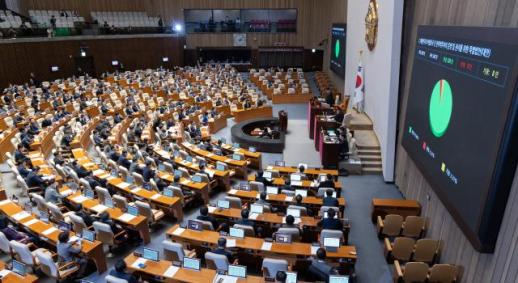 Nat'l Assembly passes bill to implement investment pledges under trade deal with US SEOUL, March 12 (AJP) - A bill outlining South Korea's massive investment pledges to the U.S. was passed at a plenary session in the National Assembly on Thursday. Of the 242 lawmakers present, 226 voted in favor, eight against and another eight abstained, clearing the way for South Korea's pledges to invest US$350 billion in the U.S. as part of a broader trade deal reached between the two countries last fall. The bill would provide a legal framework to establish a fund for implementing bilateral agreements with the U.S., along with investment pledges that include $150 billion for shipbuilding and $200 billion for other key strategic sectors such as semiconductors, critical minerals, energy, and artificial intelligence. The bill's passage with bipartisan support comes just months after U.S. President Donald Trump threatened in January to raise reciprocal tariffs on South Korea from 15 percent back to 25 percent, complaining about delays in Seoul's legislative process for the trade deal. But much still remains to be worked out, and it may be a long and tough road ahead before details are finalized through further negotiations, as things become complicated after the U.S. Supreme Court struck down Trump's sweeping global tariffs policy late last month. 2026-03-12 17:06:30