

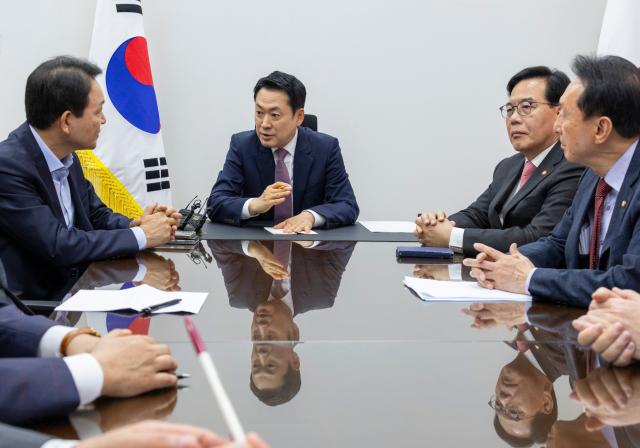
People Power Party leader Jang Dong-hyeok, second from left, and floor leader Song Eon-seok meet with chairs of relevant National Assembly committees on the 23rd to discuss controversy involving Unification Minister Jeong Dong-young. [Photo=Yonhap]
South Korea’s People Power Party decided to make it party policy to submit a National Assembly motion recommending the dismissal of Unification Minister Jeong Dong-young over his remarks about a “North Korean Kusong nuclear facility.” The party said the comments could damage trust between South Korea and the United States.
The party adopted the plan at a lawmakers’ meeting on the 23rd at the National Assembly. Afterward, party leader Jang Dong-hyeok convened a closed-door meeting with People Power Party lawmakers who chair the Assembly’s foreign affairs and unification, defense and intelligence committees.
Speaking to reporters after the meeting, Jang said Jeong was committing a “serious act of self-harm” to diplomacy and security by leaking information. “I think this is a matter that warrants impeachment, but we agreed first to submit a dismissal motion as party policy,” he said.
Floor leader Song Eon-seok, who had called a day earlier for Jeong to be replaced, again urged his dismissal. Intelligence Committee Chairman Shin Seong-beom said a minister’s remarks carry different weight than comments by private institutions or researchers. “Personally, I think Jeong’s repeated remarks about North Korea’s nuclear program may have raised doubts on the U.S. side,” Shin said.
Defense Committee Chairman Seong Il-jong said it was a serious problem that trust in the South Korea-U.S. alliance had been shaken. He said the committee held a full meeting that morning, but the Democratic Party did not attend. “It’s very regrettable. We recessed rather than adjourned so they can still come in,” he said.
Jeong rejected the party’s criticism as political and harmful to the national interest. Speaking to reporters at Cheondogyo’s Suun Hall in Seoul’s Jongno district, he said those who stirred the issue likely had their own motives. “It may be entertaining to keep amplifying the controversy, but it will harm the national interest,” he said.
Jeong said it was not the first time the United States had limited intelligence sharing on North Korea, but the dispute was being portrayed as an “unprecedented situation.” He also said the place name “Kusong” had been mentioned in a U.S. congressional report. “The essence is that the North Korean nuclear issue is serious,” he said, adding that sanctions, pressure and blockade have not worked and that a shift to dialogue and negotiations is needed.
The party adopted the plan at a lawmakers’ meeting on the 23rd at the National Assembly. Afterward, party leader Jang Dong-hyeok convened a closed-door meeting with People Power Party lawmakers who chair the Assembly’s foreign affairs and unification, defense and intelligence committees.
Speaking to reporters after the meeting, Jang said Jeong was committing a “serious act of self-harm” to diplomacy and security by leaking information. “I think this is a matter that warrants impeachment, but we agreed first to submit a dismissal motion as party policy,” he said.
Floor leader Song Eon-seok, who had called a day earlier for Jeong to be replaced, again urged his dismissal. Intelligence Committee Chairman Shin Seong-beom said a minister’s remarks carry different weight than comments by private institutions or researchers. “Personally, I think Jeong’s repeated remarks about North Korea’s nuclear program may have raised doubts on the U.S. side,” Shin said.
Defense Committee Chairman Seong Il-jong said it was a serious problem that trust in the South Korea-U.S. alliance had been shaken. He said the committee held a full meeting that morning, but the Democratic Party did not attend. “It’s very regrettable. We recessed rather than adjourned so they can still come in,” he said.
Jeong rejected the party’s criticism as political and harmful to the national interest. Speaking to reporters at Cheondogyo’s Suun Hall in Seoul’s Jongno district, he said those who stirred the issue likely had their own motives. “It may be entertaining to keep amplifying the controversy, but it will harm the national interest,” he said.
Jeong said it was not the first time the United States had limited intelligence sharing on North Korea, but the dispute was being portrayed as an “unprecedented situation.” He also said the place name “Kusong” had been mentioned in a U.S. congressional report. “The essence is that the North Korean nuclear issue is serious,” he said, adding that sanctions, pressure and blockade have not worked and that a shift to dialogue and negotiations is needed.
* This article has been translated by AI.
Copyright ⓒ Aju Press All rights reserved.