
Journalist

Lee Nak-yeon
nakk@ajunews.com
-
 Hanwha Ocean Bonus Move Spurs Subcontractor Unions to Press Other Shipbuilders Hanwha Ocean’s decision to pay subcontractor workers bonuses at the same rate as its direct employees — in the 400% range — is raising pressure across South Korea’s shipbuilding industry. The move is being praised as a step toward narrowing the gap between prime contractors and subcontractors. But it is also fueling concerns that it could disrupt established bargaining practices. Because shipbuilding is highly cyclical, pledges to match bonus rates could become a financial burden during downturns. Industry officials said Feb. 12 that demands are spreading to “match bonus payout rates” between prime contractors and subcontractors. Four subcontractor branches of the Korean Metal Workers’ Union — Geoje-Tongyeong-Goseong Shipbuilding Subcontractors Branch, Jeonnam Shipbuilding Subcontractors Branch, Hyundai Heavy Industries In-House Subcontractors Branch and Weliv Branch — held a news conference at the National Assembly last month, arguing that subcontractor bonuses are far smaller than the average for regular employees and calling for broader adoption of equal bonus rates. The union said Hanwha Ocean’s announcement that it would pay the same bonus rate to in-house partner-company employees “reflects a long-standing demand at worksites and is an entirely natural decision.” It said HD Hyundai Heavy Industries and Samsung Heavy Industries, which it described as benefiting from a shipbuilding boom, should also improve performance compensation for subcontractor workers. The union said that while regular employees at prime contractors receive year-end bonuses worth tens of millions of won, subcontractor workers typically receive only a few million won. The shipbuilding industry’s top three companies have posted sharply improving results. Last year, the combined operating profit of South Korea’s “big three” shipbuilders was close to 6 trillion won. HD Korea Shipbuilding & Offshore Engineering, the intermediate holding company for HD Hyundai Group’s shipbuilding business, reported operating profit of 3.9045 trillion won, up 172.3% from a year earlier. Hanwha Ocean and Samsung Heavy Industries posted operating profit of 1.1091 trillion won and 862.2 billion won, respectively. Combined revenue for the three companies also topped 50 trillion won. Companies say stronger earnings do not automatically justify larger bonuses. They point to the industry’s volatility, where profitability can swing sharply with the order cycle. During the prolonged downturn that began in the mid-2010s and lasted nearly a decade, Daewoo Shipbuilding & Marine Engineering was sold to Hanwha Group, and other shipbuilders also faced existential pressure. Rivals have reacted with unease to Hanwha Ocean’s decision. HD Hyundai Heavy Industries has postponed subcontractor bonus payments that had been planned for December to February. It plans to pay its direct employees bonuses of about 800% this month. HD Hyundai’s total bonus payout is far larger than Hanwha Ocean’s, meaning labor costs could rise significantly if a standard takes hold requiring equal bonus rates for prime contractors and subcontractors. Samsung Heavy Industries has also faced renewed controversy over bonuses. It has paid the same bonus rate to prime contractors and subcontractors, but the amount varies by years of service, and the overall bonus level is the lowest among the big three shipbuilders, the union has said. Lee Byeong Hun, a sociology professor at Chung-Ang University, said Hanwha Ocean’s case has had a positive impact on the labor market as management and regular employees moved to improve pay, treatment and bonuses for partner-company workers. He added that, especially after the Yellow Envelope Act takes effect, demands led by subcontractor unions are likely to intensify.* This article has been translated by AI. 2026-02-13 05:03:25
 -
 Hanwha Ocean to Pay 400% Bonus to Both Direct and Subcontracted Workers, Stirring Cost Concerns Hanwha Ocean, which posted an earnings surprise last year, will pay a performance bonus of about 400% of monthly base pay to both its direct employees and subcontracted workers. The move is effectively a first in South Korea’s shipbuilding industry to narrow the compensation gap between prime contractors and subcontractors. Supporters say it aligns with the Lee Jae Myung administration’s “equal pay for work of equal value” agenda, though critics warn it could add to cost pressures across manufacturing. According to reporting by Aju Business Daily on Wednesday, Hanwha Ocean decided to pay a performance bonus equal to 400% of monthly base pay for last year. It is the highest level since the company’s launch. The bonuses are to be paid in full just before the Lunar New Year holiday. The decision closely tracks the government’s labor policy direction. President Lee has repeatedly stressed the need to reduce wage gaps in industrial workplaces based on the principle of “equal pay for work of equal value.” After Hanwha Ocean set the policy to pay the same bonus to prime and subcontracted workers, Lee disclosed the plan during a Ministry of Employment and Labor briefing, saying, “It seems important to create a desirable corporate culture.” Prime Minister Kim Min Seok later visited Hanwha Ocean’s Seoul office last month and signed a labor-management cooperation agreement. In 2024, Hanwha Ocean’s regular employees received performance bonuses equal to 150% of base pay, while workers at partner firms received 75%, a wide gap. Last year, the company posted more than 1 trillion won in operating profit, helping lay the groundwork for equal bonus payments. In shipbuilding, subcontracted workers account for more than 60% of the total production workforce. Partner firms handle 70% to 80% of ship construction processes, but the compensation gap between prime contractors and subcontractors has continued to widen, critics say. Many in the industry view Hanwha Ocean’s decision as a potential step toward easing the two-tier labor structure common in shipbuilding and other manufacturing sites. With a shortage of skilled workers persisting despite a boom in orders, broader profit-sharing could help reduce worker outflows and attract new hires, analysts say. Still, concerns are growing that the move will increase costs for manufacturers. If equal compensation between prime contractors and subcontractors becomes a precedent, similar demands could spread to other industries. Another concern is the full implementation next month of the so-called Yellow Envelope Act, revisions to Articles 2 and 3 of the Trade Union and Labor Relations Adjustment Act. The law requires prime contractors to bargain directly with subcontractor unions when the prime contractor exercises substantial control over subcontracted workers’ working conditions. “Performance bonuses inevitably vary depending on each company’s results and financial conditions,” an industry official said. “If the Hanwha Ocean case is accepted like a new standard, it could lead to higher labor costs across manufacturing.” 2026-02-13 05:03:00
 -
 Hanwha Ocean to Pay 400% Bonus to Both Contractors and Subcontractors Hanwha Ocean will pay a 400% performance bonus to both its direct employees and subcontracted workers, a rare move among major shipbuilders to apply the same high rate across prime and subcontract workforces. The decision is drawing attention as a potential step toward “equal pay for equal work” on the shop floor. According to Ajunews reporting on Wednesday, Hanwha Ocean decided to pay last year’s performance bonus at 400% of monthly base pay, its highest level since the company’s launch. The bonuses are scheduled to be paid in full on Thursday. The move is seen as reflecting improved results during the shipbuilding upcycle and a push to more directly reward contributions at production sites. The shipbuilding industry has long faced criticism that subcontracted workers handle about 60% of production processes but receive significantly lower welfare benefits and bonuses than direct employees. Hanwha Ocean said late last year it would pay the same performance bonus to both groups as part of labor-management cooperation. In 2024, Hanwha Ocean employees received bonuses equal to 150% of base pay, while workers at partner firms received 75%. Under the new plan, both direct and subcontracted workers will receive the same bonus rate. Industry observers said the decision could help ease the sector’s dual labor structure. With a shortage of skilled workers persisting during the boom, broader profit-sharing could help curb worker outflows and encourage new hiring. Samsung Heavy Industries has previously paid the same bonus rate to prime and subcontract workers, but the amounts were relatively limited, making Hanwha Ocean’s decision stand out, analysts said. The move also complicates calculations across the industry, as it could fuel demands for larger bonuses at shipbuilders already in conflict this year with subcontractor unions over bonus negotiations. Another pressure point is the planned March implementation of the so-called Yellow Envelope Act, revisions to Articles 2 and 3 of the Trade Union and Labor Relations Adjustment Act. The bill calls for prime contractors to negotiate directly with subcontractor unions when the prime contractor exercises substantial control over subcontract workers’ conditions. Against that backdrop, HD Hyundai Heavy Industries postponed performance bonuses for subcontracted workers that had been slated for payment in December to February. By contrast, it plans to pay its direct employees performance bonuses of about 800% this month. Analysts also said Samsung Heavy Industries faces growing pressure over bonus levels. While it pays the same bonus rate to prime and subcontract workers, it differentiates payments by years of service, and its overall bonus level is known to be the lowest among the three major shipbuilders. “Combined with labor issues such as the Yellow Envelope Act, Hanwha Ocean’s move has become even more symbolic,” a shipbuilding industry official said. “In reality, compensation levels inevitably vary depending on each company’s performance and financial conditions, but one company’s decision can be treated as an industrywide benchmark, creating a significant burden.” 2026-02-12 19:36:00
 -
 POSCO Wins KR Certification for Homegrown Naval Ship Steel, a First in South Korea POSCO said it has set a new milestone for South Korea’s defense industry by developing materials technology for naval ships. The company said Thursday it has developed high-ductility steel and ballistic steel for warships for the first time in South Korea and received certification in January from the Korean Register (KR). POSCO said the certification followed a full process covering steel development, weldability verification and securing protective performance for naval vessels. POSCO said its newly developed high-ductility steel improves elongation by more than 35% compared with conventional thick plate used in shipbuilding. In warship collision simulations, the company said, shock absorption improved by about 58%. POSCO said the material is designed to maximize deformation and minimize damage in collisions with other vessels or floating objects, improving survivability. POSCO also said it developed ballistic steel that reduces thickness by about 30% compared with conventional shipbuilding thick plate. The company said the steel can be applied to areas such as the bridge, radar and zones where advanced weapons systems are concentrated to protect against external threats. POSCO said the lighter upper structure can also improve resistance to hull shaking and contribute to better stability. POSCO said it conducted joint research for several years led by its Technical Research Laboratories, with production, quality and marketing teams working in a “One Team” structure. The company said it expects the results to support expanded South Korean defense exports and entry into the global naval ship market. POSCO linked the development to the group’s future-industry strategy. POSCO Group Chairman Chang In-hwa said in a New Year’s address that the group should “strengthen market leadership and optimize the profit structure by completing a product portfolio essential to future industries.”* This article has been translated by AI. 2026-02-12 09:36:00
 -
 South Korea's HMM posts sharp earnings drop on falling freight rates SEOUL, February 11 (AJP) - HMM, South Korea’s largest shipping firm, reported a sharp decline in operating profit for 2025, falling nearly 60 percent from a year earlier as weaker freight rates and excess vessel supply weighed on its earnings. In a regulatory filing Wednesday, the company reported consolidated operating profit of 1.46 trillion won ($1.1 billion), down 58.4 percent from the previous year. Revenue declined 6.9 percent to 10.89 trillion won, while net profit reached 1.88 trillion won. The operating margin stood at 13.4 percent. While many global carriers slipped into losses in the fourth quarter amid seasonal slowdowns and weak freight conditions, HMM said its operating profit rose 6.9 percent from the previous quarter. Freight rates fell across major routes last year as container shipping capacity expanded while global trade softened, partly reflecting U.S. protectionist tariff policies, the company said. The Shanghai Containerized Freight Index averaged 1,581 points in 2025, down 37 percent from the previous year’s average of 2,506. Rates on HMM’s key routes recorded steep declines, including drops of 49 percent on services to the U.S. West Coast and Europe, and 42 percent on U.S. East Coast routes. The company also cited rising trade tensions and uncertainty over environmental regulations as factors likely to prompt route adjustments and fleet redeployments across the industry this year. "To navigate market volatility, we plan to expand its service network and strengthen eco-friendly shipping operations," a company official said. * This article, published by Aju Business Daily, was translated by AI and edited by AJP. 2026-02-11 16:39:50
 -
 Samsung Heavy secures $351 million container ship deal SEOUL, February 11 (AJP) - Samsung Heavy Industries said Wednesday it has secured an order worth 468.6 billion won ($351 million) from an Africa-based shipping company to build two container ships. In a regulatory filing, the company said the vessels are scheduled for delivery by May 2028. With the latest contract, Samsung Heavy’s total orders for the year have reached $1.2 billion across seven vessels, equivalent to about 9 percent of its annual order target of $13.9 billion. The orders include two liquefied natural gas carriers, two ethane carriers, two container ships and one crude oil tanker. A company official said global fleet renewal demand is expected to remain firm, particularly for aging container ships in the 8,000- to 13,000-TEU range. "We will continue pursuing orders that prioritize profitability and leverage its competitiveness in eco-friendly ship technologies," the official said. * This article, published by Aju Business Daily, was translated by AI and edited by AJP. 2026-02-11 13:59:36
 -
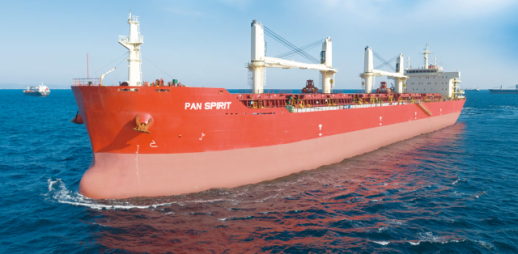 Pan Ocean Q4 2025 Operating Profit Rises 18.8% to 130.4 Billion Won Pan Ocean said in a regulatory filing on Tuesday that its fourth-quarter 2025 revenue fell 11.9% from a year earlier to 1.4763 trillion won, while operating profit rose 18.8% to 130.4 billion won. The company said operating profit in its core dry-bulk business held at about last year’s level as global uncertainty increased market volatility. Operating profit in its container business declined and was weaker overall due to falling freight rates. Pan Ocean said its expanded non-bulk businesses helped offset the weakness. Operating profit in its liquefied natural gas business jumped 160% from a year earlier as it began generating full earnings after deliveries of newbuild vessels were completed. Its tanker business also posted solid profit growth in the 8% range, supported by favorable market conditions despite a smaller fleet after selling two aging ships. For 2025, Pan Ocean reported consolidated revenue of 5.4329 trillion won, up 5.3% from the previous year, and operating profit of 491.9 billion won, up 4.4%. Compared with the prior quarter, revenue rose 16.3% and operating profit increased 4.2%. To boost shareholder value, Pan Ocean said it set a consolidated dividend payout ratio of 26.6% and will raise the total dividend by 25% from a year earlier. The company said its board set last year’s dividend at 150 won per share and plans to include it in the agenda for approval of financial statements at its annual shareholders meeting scheduled for March 27. Pan Ocean also disclosed new capital spending and acquisitions aimed at improving profitability. The company said it will build two new ships to expand its dry-bulk fleet and strengthen competitiveness, and will add 10 used very large crude carriers from SK Shipping linked to long-term cargo transport contracts. “Despite continued external uncertainty, we were able to deliver solid results by building a stable business portfolio,” a Pan Ocean official said. The official said the company will keep strengthening its ability to respond to market changes and expand its portfolio to secure competitiveness and stable profitability. 2026-02-11 12:48:00
 -
Samsung Heavy Wins $351 Million Order for Two Container Ships Samsung Heavy Industries said in a regulatory filing Tuesday that it has won an order worth 468.6 billion won (US$351 million) from an Africa-based shipping company to build two container ships. The vessels are scheduled to be delivered in stages by May 2028. With the deal, Samsung Heavy said its year-to-date orders total seven ships worth $1.2 billion, meeting 9% of its annual target of $13.9 billion. By type, the orders include two liquefied natural gas carriers, two ethane carriers, two container ships and one crude oil tanker. A company official said replacement demand is expected to remain steady for 8,000- to 13,000-TEU container ships, where aging vessels make up a large share. The official said Samsung Heavy will focus on profitability-driven orders backed by its eco-friendly technology competitiveness.* This article has been translated by AI. 2026-02-11 11:19:04
-
 HJ Shipbuilding wins $260 million order for two container ships SEOUL, February 11 (AJP) - South Korea's HJ Shipbuilding has secured a 353.2 billion won ($260 million) contract from a European shipowner to build two eco-friendly container ships with a capacity of 10,100 twenty-foot equivalent units (TEU). The order marks the first time the company will construct container ships exceeding 10,000 TEU at its main Yeongdo shipyard in Busan. The vessels will incorporate a newly developed hull form and fuel-efficient design aimed at reducing greenhouse gas emissions, the company said. To comply with international environmental standards, the ships will be equipped with exhaust gas cleaning systems, or scrubbers, and optimized for energy-efficient operations. In recent years, the shipbuilder has focused on developing mid-sized, environmentally friendly container vessels to secure new orders and strengthen competitiveness in the sector. Vessels delivered since the company resumed merchant ship construction in 2021 — starting with a 5,500-TEU order and including HMM’s 9,000-TEU methanol-powered ships — were designed to fit within Yeongdo’s dock limits. Chief Executive Yoo Sang-cheol said in a press release that the company’s experience and technical expertise in overcoming physical constraints enabled it to move into the 10,000-TEU-plus segment. “We will deliver high-quality ships on schedule to repay the shipowner’s trust and further strengthen our reputation in the mid- to large-sized eco-friendly container ship market,” Yoo said. * This article, published by Aju Business Daily, was translated by AI and edited by AJP. 2026-02-11 11:02:40
 -
 HD Hyundai Heavy Industries posts best results since 2012, expands push into Middle East HD Hyundai Heavy Industries, benefiting from a shipbuilding upcycle, said it has returned to annual operating profit above 2 trillion won for the first time in 13 years, helped by an order strategy focused on high-value vessels. The company said it plans to widen its global footprint this year, extending moves in the United States and India to the Middle East to strengthen its position in shipbuilding and offshore markets. In a regulatory filing on Sunday, HD Hyundai Heavy Industries reported consolidated 2025 revenue of 17.5806 trillion won, up 21.4% from a year earlier. Operating profit surged 188.9% to 2.0375 trillion won. It was the first time operating profit exceeded 2 trillion won since 2012, during the industry’s peak boom. The company attributed the improvement to a focus on high-value ship types, including liquefied natural gas carriers, ultra-large container ships and eco-friendly, high-efficiency vessels. In the fourth quarter, LNG carriers accounted for 48.4% of revenue, down slightly from the previous quarter, while the share of liquefied petroleum gas and ammonia carriers (VLAC) rose to 32.2%, offsetting the decline. More than 80% of total merchant-ship revenue came from high-value gas carriers, it said. Building on the results, HD Hyundai Heavy Industries said it will broaden management activity this year to the Middle East, following efforts to expand overseas operations through cooperation on U.S. maintenance, repair and overhaul work and plans to establish a shipyard in India. It said it is also moving ahead with a plan to enter the Middle East directly by setting up a joint-venture shipyard. The company’s push reflects expectations of continued large orders from Middle Eastern countries amid energy transition and rising defense demand, the report said. The region is seeing growing demand for both LNG-related vessels and offshore plants. HD Hyundai Heavy Industries said it will seek orders by leveraging its experience and technical competitiveness in building high-value ships. It has also joined the Middle East’s largest defense exhibition in Saudi Arabia and has entered the competition for Saudi Arabia’s next frigate program, the report said. A key pillar of the Middle East strategy is the IMI (International Maritime Industries) joint-venture shipyard being built by HD Korea Shipbuilding & Offshore Engineering, HD Hyundai’s intermediate shipbuilding holding company, with Saudi partners near Jubail in the King Salman Maritime Industrial Complex. IMI is targeting completion this year. “HD Hyundai Heavy Industries is expanding its portfolio beyond merchant ships into special-purpose vessels and defense,” an industry official said. “Once IMI begins full operations in the second half of this year, it will have a base to respond directly to demand for high-value ships and offshore plants in the Middle East, bringing major change.”* This article has been translated by AI. 2026-02-09 18:03:40