
Journalist

Lee nakyeong
nakk@ajunews.com
-
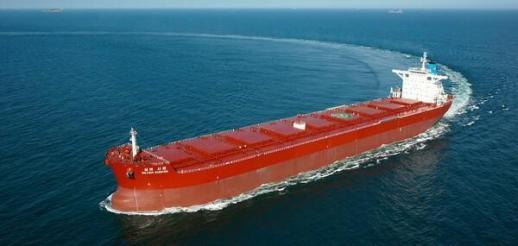 Janggeum Maritime to Hand Over 50% Stake to MSC, Reshaping VLCC Tanker Market Janggeum Maritime is moving to set up a joint management structure with MSC, the world’s largest shipping company. According to the shipping industry on the 20th, Janggeum Maritime recently signed a preliminary investment agreement to transfer more than 50% of its stake to MSC and begin joint management. Under the structure, MSC and Janggeum Shipping will each hold 50%, and the two sides will jointly run the company. Led by Vice Chairman Jeong Ga-hyeon, the son of Janggeum Shipping Chairman Jeong Tae-soon, Janggeum Maritime is a key affiliate responsible for the group’s tanker business. It has rapidly expanded its presence in the VLCC market through aggressive vessel purchases. The industry estimates Janggeum Shipping owns one out of every four VLCCs worldwide, and some analyses say it operates about 40% of the world’s VLCCs that are available for service. MSC’s move is widely seen as a strategic push to expand beyond its container-focused business into crude oil transport. MSC ranks No. 1 in the container ship market with about a 21% share by capacity. Industry officials said the transaction could go beyond a simple equity investment. With the top container carrier moving more directly into tankers, they expect shifts in freight-rate bargaining power and supply coordination in the VLCC market. The deal still requires approvals from regulators in multiple countries. Authorities in Greece and Cyprus have begun reviews, and the transaction must also clear competition scrutiny in major jurisdictions, including South Korea. Whether the deal could raise monopoly concerns as market power grows is expected to be a central issue.* This article has been translated by AI. 2026-03-20 14:03:10
 -
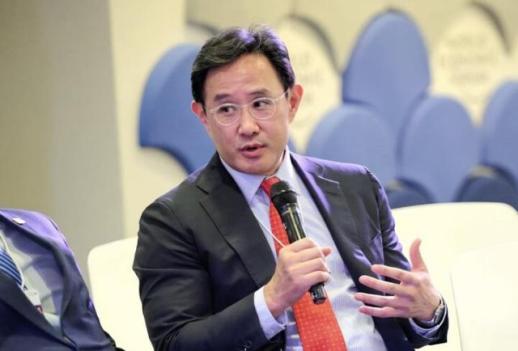 South Korea’s NPS Withholds Vote on Korea Zinc Chairman Choi’s Board Reappointment The National Pension Service, seen as a swing voter in Korea Zinc’s management-control dispute, has decided not to exercise its voting rights on a proposal to reappoint Chairman Choi Yun-beom as an inside director. The NPS fund’s Stewardship Responsibility Committee said on the 20th it made the decision at its fifth meeting the previous day, ahead of Korea Zinc’s shareholders meeting on the 24th. The committee decided not to vote on the company-backed director nominees Choi Yun-beom, Hwang Deok-nam and Park Byeong-uk. It also decided to vote against the election of audit committee members Kim Bo-young and Lee Min-ho. The NPS said the decision reflected that the nominees fall under those with a record of damaging corporate value or infringing on shareholder rights. On proposals to elect directors through cumulative voting — “Election of five directors” and “Election of six directors” — it decided to vote in favor. For voting rights allocated through cumulative voting, the NPS said it will split its votes evenly by proposal sponsor: half for candidates proposed by Young Poong, YPC and Korea Corporate Investment Holdings — Choi Yeon-seok (outside non-executive director), Choi Byeong-il and Lee Seon-suk (outside directors) — and half for Walter Field McLellan (outside non-executive director), proposed by Crucible JV. The NPS holds 5.20% of Korea Zinc and has been viewed as a key swing vote in the proxy fight. Choi and the Young Poong-MBK alliance are each reported to have secured friendly stakes of around 40%. In response, Korea Zinc said it respects the NPS’s “strategic direction” in exercising voting rights and will use the outcome as momentum for the company’s continued growth. Korea Zinc said the NPS recommended approval for most agenda items, including amendments to the articles of incorporation supported by the board and approval of the financial statements. It added that the NPS showed strong support by exercising half of its cumulative-voting rights for the Crucible JV nominee, which the company said carries symbolic meaning tied to its U.S. smelter project. The company said the decision reflects recognition that the U.S. smelter construction being pursued by current management and the board is significant for growth, corporate value and shareholder value, and described the NPS decision as balanced and neutral, taking into account factors including greater board diversity.* This article has been translated by AI. 2026-03-20 09:15:16
 -
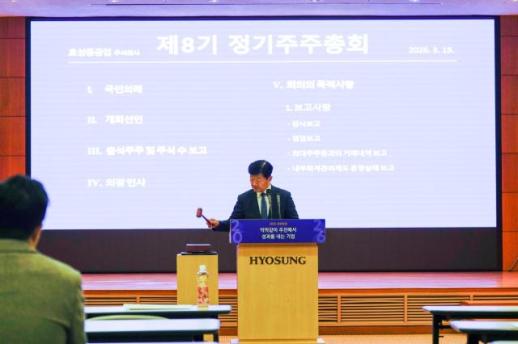 Hanwha Ocean, Hyosung Heavy Industries and Iljin Electric tout North America demand at annual meetings Hanwha Ocean, Hyosung Heavy Industries and Iljin Electric held annual shareholders meetings on March 19, outlining growth plans centered on North America and signaling expectations for more orders. Some agenda items were voted down, however, as the National Pension Service opposed proposals at several meetings, highlighting governance as a variable. Hanwha Ocean held its 26th annual meeting at Geoje Ocean Plaza and approved the reappointment of CEO Kim Hee-cheol as an inside director. Kim, who took office in September 2024, will lead the company for another three years. Kim is credited with driving a turnaround and restructuring after taking the lead on acquiring Philly Shipyard in the United States. The company also said its ability to respond to MASGA, a Korea-U.S. shipbuilding cooperation project, has strengthened. Hanwha Ocean posted an operating profit of 237.9 billion won in 2024, returning to the black. Last year, it reported operating profit of 1.1676 trillion won, up 391% from a year earlier. Kim said the company will focus on renewable energy. Hanwha Ocean created an energy plant division and previously signed an engineering, procurement and construction contract for the Sinan Ui offshore wind project. It is also pursuing construction and deployment of a wind turbine installation vessel. At Hyosung Heavy’s meeting, CEO Woo Tae-hee pointed to expanding demand for power infrastructure and expressed confidence in global growth. With investment rising in data centers and power grids, he said a transformer supply shortage is continuing and related orders are expected to keep increasing. “We strengthened order competitiveness and customer trust and expanded our presence in global markets,” Woo said. “Uncertainty remains this year, including global economic volatility, but we will further strengthen quality standards and production management capabilities and focus on improving the stability of global production bases and supply-chain operations.” Shareholders rejected a proposal to amend the company’s articles of incorporation to revise director qualification requirements. A proposal to appoint outside director Park Jong-bae was also scrapped. The industry attributed the outcome in part to the National Pension Service exercising voting rights under its stewardship code. The report said institutional investors have been more active in exercising shareholder rights as the government emphasizes a “value-up” policy, and the pension fund’s standards have become stricter. The National Pension Service has also voted against director appointments at meetings of Hyosung TNC, Iljin Electric and Lotte Chilsung Beverage. At Iljin Electric, the National Pension Service opposed the reappointment of CEO Yoo Sang-seok as an inside director and the appointment of outside director Cho Woong-ki, but both proposals passed. Iljin Electric will shift from a co-CEO structure under Hwang Soo and Yoo to a single-CEO system led by Yoo. LG Display also held its annual meeting and presented plans to upgrade its business structure and improve profitability. CEO Jeong Cheol-dong said the company will “maximize the results of upgrading our business structure and prepare future growth engines through cost innovation and securing technologies with a competitive edge.” LG Display said it has shifted its business toward organic light-emitting diode displays and posted operating profit of 517 billion won last year, returning to the black for the first time in four years. OLED’s share of sales rose to 61% last year from 32% in 2020, the company said.* This article has been translated by AI. 2026-03-19 18:36:47
 -
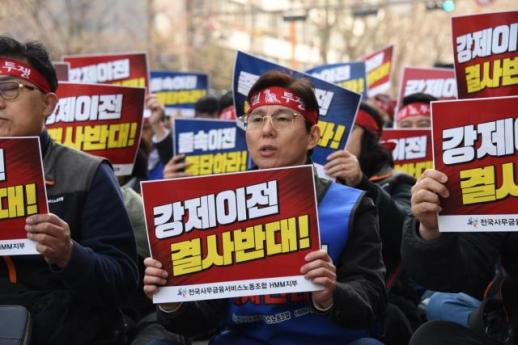 HMM Office Workers Union Calls Busan Headquarters Move Rushed, Plans Rally Near Blue House HMM’s office workers union has continued rallies outside the company’s Yeouido headquarters, reiterating opposition to a planned relocation of the headquarters to Busan. The HMM branch of the National Office and Financial Services Union said it held a second rally March 16, following an all-member rally March 11, calling for a halt to what it described as a rushed move and for guarantees of autonomous management at a private company. According to the industry on March 19, the union’s statement demanded an immediate stop to the relocation, opposition to any forced move, an end to unfair labor practices and protection of management autonomy. Branch chief Jeong Seong-cheol said in remarks that the Ministry of Oceans and Fisheries was pushing the relocation despite knowing there were legal issues, accusing the government of acting irresponsibly. Jeong also criticized the company’s leadership, saying management was staying silent despite recognizing the move’s unfairness and the expected drop in efficiency. He called it an evasion of responsibility and a lack of qualifications, and warned of legal action and accountability if the plan continues. Lee Nam-hyeon, vice chairman of the union, said the relocation could bring economic losses and weaken shipping competitiveness. He disputed the government’s argument that proximity to ports is decisive, saying global shipping hubs such as London and Singapore grew because of “shipping finance,” not ports. He added that HMM needs to maintain close cooperation in Seoul, where finance is developed, to protect its capabilities. The union said it plans a large rally near the Blue House on April 2 and will step up its campaign after the second rally.* This article has been translated by AI. 2026-03-19 17:54:07
 -
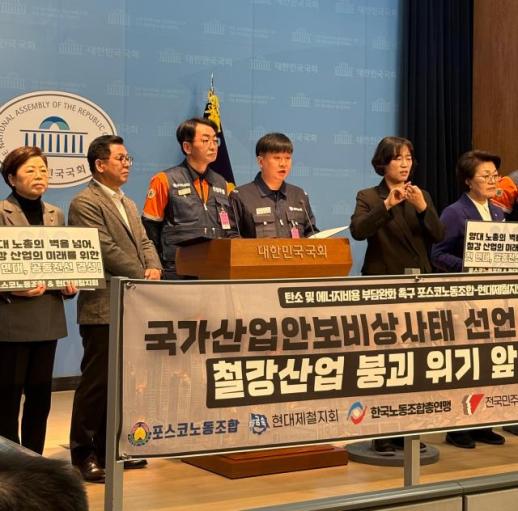 POSCO, Hyundai Steel unions urge relief on power and carbon costs, warn of industry crisis "South Korea’s steel industry is standing on the edge of a cliff. This is not a simple downturn. It is a national industrial security emergency." Labor unions at POSCO and Hyundai Steel held a joint news conference March 19 at the National Assembly press center, urging the government to ease the burden of industrial electricity rates and carbon-related costs. The unions called for measures including relief on industrial power bills, improvements to the carbon emissions-permit system and expanded financial and infrastructure support for shifting to cleaner processes such as hydrogen-based steelmaking. Kim Seong-ho, chair of the POSCO union under the FKTU-affiliated Korea Metal Workers’ Federation, said the industry is being squeezed by sharply worsening profitability, stronger protectionism in advanced economies and what he described as astronomical carbon-emissions costs. He said the government should step in with practical support. Kim said it was the first time in POSCO’s 57-year history that its union had joined Hyundai Steel in a coordinated response, underscoring the severity of the crisis. Song Jae-man, head of Hyundai Steel’s Pohang branch under the KCTU-affiliated Korean Metal Workers’ Union, said industrial electricity rates have risen about 85% over the past five years while steel output has dropped sharply, pushing the industry to its limits. He said plant downsizing and job insecurity are becoming reality and are weighing on local economies. The unions also cited added pressure from war risk involving Iran, saying the steel industry relies heavily on imported raw materials, making it vulnerable to higher oil prices and exchange-rate swings. A union official said even a small rise in the exchange rate can sharply increase fixed-cost burdens, and that weak market conditions combined with energy costs have pushed worksites to the brink. On the government’s recently announced electricity-rate overhaul, the unions said steelmaking is a continuous, 24-hour process and could be hit harder by higher nighttime rates than helped by lower daytime rates, limiting any real relief. Lawmakers attending the event included Rep. Lee Sang-hwi of the People Power Party, Rep. Kwon Hyang-yeop of the Democratic Party and independent lawmaker Kim Jong-min, who voiced support for a joint response to the steel industry’s challenges. 2026-03-19 13:27:20
 -
 Solus Advanced Materials Opens New OLED Plant in Iksan, Doubling Capacity Solus Advanced Materials has built a new production base for organic light-emitting diode, or OLED, materials in Iksan, North Jeolla Province, as it moves to strengthen its OLED business. The company said March 19 that it held a completion ceremony a day earlier in Hamyeol, Iksan, with CEO Kim Tae-hyung and other executives and employees, along with North Jeolla Vice Gov. for Economic Affairs Kim Jong-hoon and Iksan Mayor Jeong Heon-yul. The Hamyeol plant is a new production site created by relocating and expanding the company’s existing Iksan facility. It will serve as an integrated hub producing both OLED emissive materials (organic materials) and non-emissive materials (polymer materials). Built on a 19,969-square-meter (6,050-pyeong) site in the Hamyeol Agro-Industrial Complex, the facility includes utility, synthesis and purification buildings, as well as offices. The company completed construction last month and, after receiving required approvals, began full-scale production this month. Solus Advanced Materials said it plans to improve both efficiency and quality competitiveness by consolidating production of emissive and non-emissive materials at one site, aiming to create synergies between R&D and mass production and expand its presence in the global OLED materials market. With expanded capacity, the company expects to accelerate mass production of a wider range of OLED materials. It said “Green PH,” which it expects to be highly profitable, is slated to enter full-scale mass production in the second half of this year. The company also plans to begin mass-production supply next quarter of thin-film encapsulation, or TFE, a non-emissive material. The company said it will also step up development of new materials in line with global industry trends, including materials for artificial intelligence semiconductors and automotive batteries, to secure future growth engines and strengthen competitiveness in new markets. “Hamyeol’s integrated OLED production base is a key manufacturing hub that will take Solus Advanced Materials’ OLED materials competitiveness to the next level,” Kim said. “We will secure market leadership by expanding R&D and production capabilities for high value-added materials and further strengthen our competitiveness in the global OLED materials market.” 2026-03-19 09:30:21
 -
 GS Caltex Launches CCU~S Carbon-Reduction Education Campaign, Unveils Hands-On Kit GS Caltex said on the 19th it is launching the “CCU~S (Kkuus) Campaign,” a carbon-reduction education initiative for future generations, and unveiling an educational creative teaching tool called the “Kkuus Kit (CCUS KIT).” The kit, the centerpiece of the campaign, is designed to make CCUS — carbon dioxide capture, utilization and storage — easier for children to understand by reinterpreting the concept at their level. The GS Caltex kit uses a playful, child-friendly theme, comparing “farts” to carbon in the air. It turns the process of capturing gas and using it as nutrients to grow plants into a game-like activity. The company said the kit is intended to help children naturally grasp the idea of a circular economy, in which carbon is collected and either reused as a useful material or stored safely. GS Caltex said it plans to link online and offline communications to broaden public engagement with the campaign. It will distribute the kit by lottery to applicants through the campaign page on its official blog, Media Hub, so members of the public can try it firsthand. The company also released a video made in collaboration with science creator “Gwedo,” explaining the scientific principles behind CCUS with humor. A GS Caltex official said the company will continue expanding low-carbon new businesses while creating social value through new forms of creative communication. The official added that GS Caltex will aim to become “a respected 100-year company” based on sustainable growth. * This article has been translated by AI. 2026-03-19 08:36:18
 -
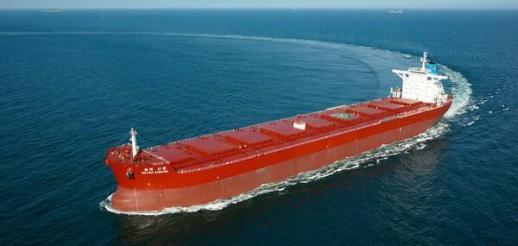 Janggeum Shipping Emerges as Key VLCC Player as War Roils Tanker Market Middle East-driven war fallout is jolting global shipping markets, and South Korea’s Janggeum Shipping is being cited as a quiet winner. The privately held company is little known at home, but industry watchers say it has become a core player in the tanker market, led by very large crude carriers, or VLCCs, and is generating daily earnings in the hundreds of millions of won. Industry sources said March 17 that Janggeum Shipping has recently been securing about $500,000 a day in charter fees for VLCCs, or about 750 million won. That is about 10 times last year’s average, as freight rates that jumped after the war have flowed directly into profits. The gains did not come by chance. Before the war intensified, Janggeum Shipping, through its tanker unit Janggeum Maritime, moved aggressively to secure VLCCs. Ship data firm VesselsValue said Janggeum Maritime has completed about 30 VLCC transactions so far this year. With those deals, the VLCCs it operates have risen to more than 100 ships, about 12% of the estimated global VLCC fleet of 880. Janggeum Maritime is led by Chung Ga-hyun, vice chairman and son of Janggeum Shipping Chairman Chung Tae-soon. Chung Ga-hyun owns 100% of Janggeum Maritime, which the industry views as a key growth pillar for the group. Analysts say a shift toward a tanker-heavy portfolio and early investment have put management to the test, with this shipping cycle offering evidence of results. The article said the war’s impact has also lifted earnings as the Strait of Hormuz was blocked, turning Janggeum’s VLCCs into floating crude storage. With onshore storage reaching its limits, refiners have increasingly chartered tankers as temporary storage, it said. The strategy has drawn attention abroad. Bloomberg recently highlighted Janggeum Shipping’s tanker buildup and profit structure, calling it “one of the smartest beneficiaries” amid turmoil in global energy markets. Bloomberg said Janggeum Shipping amassed large crude tankers before the war and, as a result, has emerged as one of the biggest winners from the disruption. It also said early fleet deployment and aggressive investment have shaken up the global tanker market. Janggeum Maritime’s rapid growth is also being watched for what it could mean for governance. As fleet size and profitability expand, the unit could become central to a future succession structure, the article said. The broader shift in emphasis from containers to bulk and tankers is also expected to accelerate alongside second-generation management. “One industry boom at Janggeum Shipping is not just a simple wartime windfall, but the result of a generational transition and a shift in business structure coming together,” a shipping industry official was quoted as saying. “On top of a strategy that quietly expanded the fleet, the second generation’s execution is emerging as a variable that can reshape the global shipping market.”* This article has been translated by AI. 2026-03-17 18:03:21
 -
 Korea Zinc’s indium draws U.S. attention as quantum computing material Korea Zinc, the only producer of the strategic mineral indium in South Korea, is drawing attention as indium gains prominence as a key material for the fast-growing quantum computing industry. With competition intensifying over next-generation technologies tied to quantum computing, industry officials say Korea Zinc’s stable indium output is positioning it as an important partner in advanced-industry supply chains, including those linked to South Korea and the United States. According to the industry on March 17, quantum computers use quantum mechanics — including superposition and entanglement — to perform complex calculations far faster than conventional computers. As the quantum computing sector enters a growth phase, indium’s strategic value has risen. Academic sources say indium is needed to make connectors for QPU (quantum processing unit) chipsets, which serve as the “brain” of quantum computers. Indium phosphide (InP) is also cited as a key material for producing photonic integrated circuits (PIC). Demand for indium is likely to increase as quantum computers improve and move closer to commercialization. The United States, home to many advanced technology companies, is working at the national level to advance quantum computing. In November 2025, the U.S. Department of Energy said it would provide $625 million to support next-generation research programs at the National Quantum Information Science Research Centers (NQISRC). The U.S. has also supported quantum technology research systematically since enacting the National Quantum Initiative Act in 2018. As the industry develops, securing stable supplies of key materials is increasingly seen as central to competitiveness and economic security. Indium is used not only in quantum computing but also widely in displays, touchscreens, thin-film solar power systems and advanced semiconductors. With indium’s importance growing, Korea Zinc has also come into focus. The company produces 99.999% high-purity indium using what it calls rare-metal concentration and recovery technology based on an integrated zinc, lead and copper process. After Chairman Choi Yun-beom took office, Korea Zinc raised indium output to about 90 to 100 metric tons a year. It produced 97 tons in 2025. Korea Zinc’s role in the U.S. indium supply chain is significant. According to the U.S. Geological Survey, South Korea ranked No. 1 in indium exports to the United States from 2020 to 2023, accounting for 29% of U.S. indium imports over that period. Given that Korea Zinc is the only indium producer in South Korea, the company effectively serves as a key partner supporting U.S. supply chains for advanced industries. “Indium is a critical mineral whose strategic importance is being highlighted not only in displays and semiconductors but also recently in the quantum computing industry,” a Korea Zinc official said. “As the only indium producer in South Korea, Korea Zinc will fulfill its role and responsibility as a backbone industry, based on world-class rare-metal recovery technology.”* This article has been translated by AI. 2026-03-17 17:37:38
 -
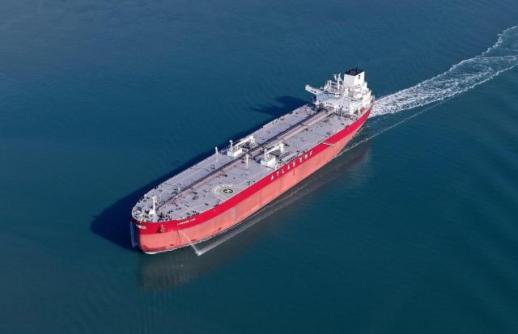 Daehan Shipbuilding Wins $1.3 Billion Won Order for One Suezmax Crude Oil Tanker Daehan Shipbuilding said it is continuing a strong run of new orders since the start of the year. The company said Tuesday it signed a shipbuilding contract on March 16 with an Oceania-based shipping company to build one Suezmax-class crude oil tanker worth about 130 billion won. Including the latest deal, Daehan Shipbuilding said it has won orders for a total of nine vessels so far this year, surpassing 82% of its annual order target. The customer first signed with Daehan Shipbuilding in 2023 and has placed additional orders each year since then, the company said. It described the latest order as an example of turning global geopolitical risks into business opportunities, as rising tensions in the Middle East, including Iran, have pushed ships onto longer detour routes and sharply increased crude transport distances. Daehan Shipbuilding said that trend is driving demand and prices higher for Suezmax tankers, which are suited to long-haul operations, and is supporting new orders for the company, which it said has strong competitiveness in the segment. "The fact that an existing customer returns every year shows the market fully recognizes our shipbuilding capabilities and premium value," a Daehan Shipbuilding official said. The official added that demand for high-efficiency Suezmax vessels is expected to rise amid recent Middle East-driven changes in logistics conditions, making it possible to reach the company’s annual order goal early. 2026-03-17 11:48:16