

Journalist

Kim Ki-eung
qortjgus0602@ajunews.com
-
 Sendbird Demonstrates AI-Powered Customer Support at AWS Summit 2026 "I will recommend outfits A, B, and C based on your preferences." At the Sendbird booth during the AWS Summit Seoul 2026 held on May 21 at COEX, an AI stylist immediately began suggesting products as soon as attendees accessed the fashion shopping mall-themed live demo screen. The AI proposed various styles based on customer preferences and previous purchase history, explaining which situations each outfit would suit. When a reporter inputted, "I want to dress more casually," the AI adjusted its recommendations accordingly. Sendbird is a global AI communication company that provides enterprise chat and consultation solutions. Recently, it has focused on developing 'AI agent' technology that goes beyond simple chatbots to remember customer context over the long term and perform actual tasks. At this AWS Summit, the company showcased scenarios where AI handles reservations, exchanges, rebookings, and connects consultations in hotel, airline, and e-commerce environments. One of the standout features was the 'memory-enabled AI.' All conversations and actions with customers are stored in a memory format, allowing seamless continuation even when switching channels. If a shopping inquiry starts in a messenger and transitions to a voice call, the AI retains the previous conversation details, eliminating the need for customers to repeat themselves. During the live demonstration, the AI processed a product exchange request. It recognized the order history and previous inquiries, identified the reason for the exchange, and then connected the customer via voice call to provide pickup schedules and estimated delivery times. If complex issues or refund requests arose, the AI would connect the customer to a human representative. However, unlike traditional customer service, there is no need to explain the situation from the beginning, as the AI summarizes the entire conversation for the representative. This functionality leverages AWS cloud technology. Voice connections and representative integration are operated on AWS Connect, designed to ensure a smooth transition between AI and human representatives within a single workflow. The core of this technology is the 'Cross-Channel AI Memory,' which maintains customer context across messaging and voice channels. Similar processes were demonstrated in hotel and airline scenarios. In the hotel demo, the AI recommended rooms and restaurants based on the customer's stay history, family composition, and preferences, even handling reservations. In the airline demo, when a flight delay occurred, the AI proactively suggested alternative flights and managed seat reassignments and compensation notifications. Sendbird believes that AI is evolving beyond simple response-based chatbots to perform actual operational tasks. Lee Sang-hee, CEO of Sendbird Korea, stated during a keynote session the previous day, "The future competition in AI will not be about who creates the smartest AI, but rather who can continuously remember and connect customer relationships and contexts." Real-world implementations are increasing. According to Sendbird, Hanssem has integrated AI customer support into its order, delivery, and installation inquiries, automating over 90% of customer inquiries. Coupang Eats is also operating an AI-based customer support system. Sendbird plans to expand its AI communication infrastructure to enable companies to build their own brand-based AI concierges.* This article has been translated by AI. 2026-05-21 09:51:34
 -
 AI Insights: Companies Struggle to Implement Chatbots Effectively “Many companies expect that adopting artificial intelligence (AI) will lead to immediate operational innovation, but the reality on the ground presents entirely different challenges,” said Yang Young-mo, CEO of Redbrick, while discussing the current atmosphere surrounding corporate AI transformation (AX) projects. The surge in generative AI has led to a rapid increase in the implementation of chatbots, document summarization, and report automation systems. However, unexpected limitations are frequently emerging during actual usage. Yang noted that it is common to hear that “AI has been implemented, but employees are not using it effectively.” He explained that initial evaluations often focus on the performance and accuracy of AI models. However, in real work environments, operational factors such as integration with existing systems, data management frameworks, and permission issues become significantly more important. In practice, AI often clashes with existing workflows. One company established a generative AI-based support system, but its utilization fell short of expectations. The system failed to integrate smoothly with ERP (Enterprise Resource Planning), collaboration tools, and internal systems, leading employees to perceive it as an additional program rather than a seamless part of their workflow. Issues with document management systems are also a recurring problem. Instances arise where the latest documents are mixed with outdated materials, or where different departments have varying management standards, causing AI to generate responses based on obsolete data. Yang emphasized that “in corporate AI, what matters is not just simple accuracy, but also the operational structure that includes the data being used for responses and whether access permissions are properly reflected.” Yang identified the shift towards a ‘multi-LLM’ (Large Language Model) environment, where companies utilize multiple AI models simultaneously, as a new challenge. Marketing teams may use SaaS-based AI, development teams may opt for open-source models, and customer service teams may employ separate AI solutions, leading to a diverse range of AI applications. However, there remains a lack of systems for integrated management. He warned that “from a corporate perspective, it may become difficult to track which organization is using what data with which AI,” adding that in a multi-LLM environment, data control, security policies, and cost management must all be considered. This trend is particularly pronounced in industries like finance, manufacturing, and public sectors, where security and operational stability are critical. Recently, there has been an increase in requests for not just AI implementation, but also for data integration structures, permission management systems, and operational governance design. Yang pointed out one of the biggest misconceptions among companies is approaching AI solely as a technology project. He stated, “If AI is implemented without organizing internal data structures, workflows, and approval systems, problems will inevitably arise during the operational phase. AX is not just about adding AI functions; it is more about redesigning the entire corporate operational structure.” He concluded, “In the future, corporate AI competitiveness will likely hinge not on who introduces the most advanced models, but on how reliably and consistently AI can be operated within actual workflows.”* This article has been translated by AI. 2026-05-21 07:27:00
 -
 AI Insights: Redbrick's Yang Young-mo on the Importance of Operations in AI Implementation "The competitive standard for corporate AI is no longer which model to use, but how safely and consistently it can be operated in actual work environments," said Yang Young-mo, CEO of Redbrick. He explained that the early phase of generative AI focused on the performance of large language models (LLMs), but the emphasis has now shifted to the operational structure, which includes internal data, permissions, and security systems as key components of AI competitiveness. Yang noted, "Initially, many questions revolved around 'which model to use,' but now there are far more operational questions such as 'Can we securely connect to our company data?' and 'How can we reflect departmental permissions?' Companies are beginning to view AI not just as a productivity tool but as an integral part of their operational infrastructure." Redbrick, a startup specializing in generative AI-based content engines, offers AI solutions that support data and workflow automation for businesses and institutions through its proprietary 'Redbrick AI Engine.' The platform can generate content for games, education, and marketing with simple text inputs, and it integrates with internal documents and collaboration tools to assist with knowledge searches, document creation, and report drafting. The enterprise solution, 'Redbrick AI Enterprise,' is available in both on-premises and cloud versions, ensuring secure handling of sensitive information through end-to-end encrypted inference structures. As of 2025, the company surpassed 10 million cumulative users and was selected for the UAE's Mubadala sovereign wealth fund startup incubation program, 'HUB71.' Yang observed that corporate AI transformation (AX) projects are moving beyond simple chatbot implementations to the establishment of 'AI operational systems.' He explained that in practice, the structure of data, permission systems, and the redesign of work processes have become more critical than the performance of AI models. "In demo environments, AI appears to work well, but in actual corporate settings, documents are scattered across various systems, and both current and historical data are mixed. The complexity of the permission system means that simply attaching a model does not complete the AX process," he said. As a result, Redbrick is expanding its focus from being just an AI solutions provider to becoming a 'corporate AI infrastructure platform' company. The core strategy involves securely connecting internal company data, operating AI agents tailored to departmental needs, and creating a structure for integrated management of data access permissions, costs, and logs. Yang emphasized that the 'Front Deployment Engineer (FDE)' approach is becoming a significant trend in the global AI market. This method involves deeply engaging with clients' actual work environments to collaboratively define problems, rapidly implement solutions on the AI platform, and then enhance product features. He stated, "While past system integration projects were centered on requirements-based construction, FDE focuses on discovering problems together with clients on-site and accumulating them as repeatable platform features. Redbrick aims to be an AI engineering partner that designs AX transformations alongside our clients, not just a construction firm." Another notable change is the shift of companies toward a 'Multi-LLM' operational system, where multiple AI models are used concurrently. This shift is driven by the varying costs, speeds, and inference capabilities required for different tasks, making it challenging to handle all operations with a single model. Yang remarked, "For simple summarization or classification, lightweight models are more efficient, while high-performance models are better suited for complex analysis or decision support. Ultimately, how AI is managed on an operational structure will become more important than the models themselves." Looking ahead, Redbrick plans to focus on building an 'AI operational environment' that integrates AI infrastructure, knowledge-based AI, collaborative AI workspaces, AI workflow automation systems, and security, permission, and governance functions into a single corporate AI platform. Yang concluded, "The corporate AI market will quickly transition from the experimental stage to actual operational implementation. Redbrick aims to grow as a platform company that helps organizations operate AI safely as an integral part of their work infrastructure, beyond mere usage."* This article has been translated by AI. 2026-05-20 20:22:17
 -
 Hancom Transitions to Sovereign Agentic OS, Phasing Out Legacy Brand Hancom, a pioneering software company, has announced the retirement of its 36-year-old brand "Hangul and Computer" and its identity as a traditional office software provider. The company is transitioning to become a Sovereign Agentic Operating System (OS) firm based on artificial intelligence (AI). On May 19, Hancom held a strategy presentation titled "Hancom: The Shift" at the Fairmont Hotel in Yeouido, Seoul, where it unveiled its AI business achievements and new corporate vision. Kim Yeon-soo, CEO of Hancom, stated, "As of today, Hancom is officially transitioning to a Sovereign Agentic OS company. We have demonstrated our shift to an AI company through our results, and now we will take it a step further." The company has changed its name from "Hangul and Computer" to "Hancom" to reflect its expanded business scope, which now includes data, AI agents, and global markets. The previous name no longer encapsulates the current vision. Hancom will cease the release of traditional software packages with the launch of "Hancom Office 2024." Instead, it plans to shift to a platform structure that updates AI features in real time. Kim emphasized, "We cannot keep pace with the speed of AI evolution through annual product releases. Hancom's core business is not document tool manufacturing but AI technology development." The Sovereign Agentic OS is an AI operating platform that integrates and controls internal company data, external AI models, and existing work systems within a single environment. This approach aims to respond to market changes that emphasize the evolution of AI agents capable of performing tasks autonomously and the importance of data sovereignty and security. For the first time, Hancom also disclosed its AI business performance. Last year, its standalone revenue reached 175.3 billion won, a 10.2% increase from the previous year, marking its highest performance to date. Of the total revenue increase of 16.2 billion won, approximately 8.9 billion won, or 54.6%, came from the AI package business. This year, the share of AI business is expanding even more rapidly. In the first quarter, AI revenue reached 5.2 billion won, accounting for 11.2% of total revenue. Hancom stated, "We are already a company generating profits from AI." Hancom has established a customer base of approximately 200,000 organizations, including 14,000 public and government agencies, 40,000 educational institutions, and 140,000 private companies, which it views as a key asset for expanding its AI business. Among its B2B customers, the adoption rate of AI packages was 4.2% in the first quarter of this year. The company believes this customer base will also serve as a strength in the emerging Agentic OS market. Since existing customers have already entrusted sensitive document data and work environments to Hancom's platform, the new AI agent services are expected to be quickly adopted. Hancom is also targeting the European market, focusing on data sovereignty regulations such as the General Data Protection Regulation (GDPR) and the EU AI Act. The company plans to expand collaborations with local IT and public sector firms in Europe.* This article has been translated by AI. 2026-05-19 16:06:56
 -
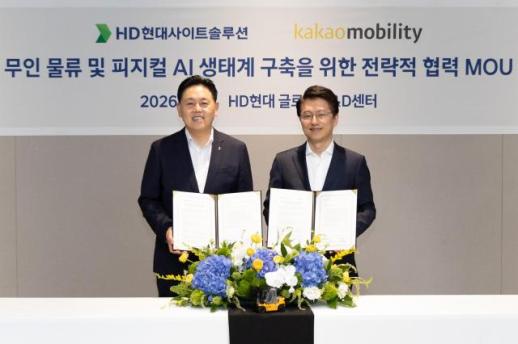 Kakao Mobility and HD Hyundai Site Solutions Expand Collaboration on Physical AI in Logistics Kakao Mobility is partnering with HD Hyundai Site Solutions to expand the Physical AI ecosystem focused on logistics operations. On May 19, Kakao Mobility announced that it has signed a strategic memorandum of understanding (MOU) with HD Hyundai Site Solutions to build a next-generation unmanned logistics and Physical AI ecosystem. The two companies plan to jointly promote automation and unmanned operations across logistics sites in line with the industry's shift from hardware-centric automation to software-based operational systems. Physical AI combines digital AI with physical equipment in the real world to perform actual tasks. The market for this technology is rapidly expanding, particularly in areas such as robotics, autonomous driving, and smart logistics. In this collaboration, Kakao Mobility will handle platform capabilities, including integrated control of heterogeneous mobile units and transport management systems (TMS). HD Hyundai Site Solutions will provide technology for unmanned autonomous industrial vehicles (forklifts) and logistics control solutions. The companies aim to jointly pursue platform integration and technology proof of concept (PoC) in logistics, utilizing data collected during the validation process to identify new business models and global expansion opportunities. Kakao Mobility intends to extend its operational experience from existing robot delivery and valet parking services into the industrial logistics sector. The strategy includes creating an environment where various industrial vehicles can be integrated and operated on a single platform, thereby broadening the application of Physical AI. Specifically, the focus will be on establishing a "seamless operational optimization environment" that connects the entire logistics process, from order receipt to middle-mile transportation and internal warehouse operations. The company expects this will reduce data silos and delays caused by system separations in existing logistics operations. Ryu Geung-seon, CEO of Kakao Mobility, stated, "This collaboration marks a significant starting point for Kakao Mobility to expand its integrated capabilities for heterogeneous mobile units into industrial settings. By combining Kakao Mobility's software capabilities with HD Hyundai Site Solutions' industrial vehicle and logistics solution expertise, we will enhance the logistics AX model and continuously expand the application of Physical AI technology."* This article has been translated by AI. 2026-05-19 15:16:43
 -
 Think Big, Start Small, Scale Fast: Strategies for AI Adoption As 2025 passed, the questions surrounding AI for South Korean companies fundamentally changed. The focus shifted from "Should we adopt AI?" to "How can we operate it efficiently?" According to the McKinsey Global AI Survey (2025), 88% of companies worldwide are utilizing AI in at least one business function. However, behind these impressive figures lies a harsh reality. Only one-third of companies have scaled AI across their entire organization, while the remaining two-thirds remain stuck in the experimental or pilot phase. Gartner has warned that by the end of 2025, 30% of generative AI projects will be abandoned after the proof of concept (PoC) stage, with actual abandonment rates exceeding this prediction. This phenomenon is referred to as "AI pilot fatigue." The essence of the question has now changed. It is no longer about whether to adopt AI, but rather about how to operate it efficiently to enhance productivity and reduce costs. Many companies fail to implement AI or stop at the PoC stage not due to technological issues, but because of a lack of strategy and execution methodology. Through my experience with various companies' AI transitions, I have identified a clear principle: Think big, start small, and scale fast. The first step in AI transformation should begin not with technology, but with business. The question should be, "Where can we apply AI to create the most value for our business?" rather than "Which AI model should we use?" This involves identifying business outcome-driven areas and conducting feasibility analyses. Companies should first pinpoint AI applications linked to clear performance indicators such as revenue growth, cost reduction, risk mitigation, and enhanced customer experience. Decision-making should start from a return on investment (ROI) perspective, rather than technical curiosity or trends. Thinking big is not merely optimism. It involves strategic thinking about how AI will reshape our business model and operations in three to five years, and then working backward to determine what actions to take now. In a rapidly changing environment, making large upfront investments and following lengthy development cycles is the most dangerous approach in the AI era. Define minimum viable products or minimally operable agents for individual tasks and validate them in real work environments within short cycles. A minimally operable agent is not just a simple demo; it is a functioning AI agent that operates in real work settings and delivers measurable results. Lessons learned from small failures become assets for future expansions. Once performance is proven in individual tasks, the key is to rapidly disseminate these successes throughout the organization. However, many companies fail at this stage by attempting to simply copy and paste successful PoCs. Rapid scaling means building an AI platform that considers common environments, internal work processes, and the organization and its employees simultaneously. According to S&P Global Market Intelligence (2025), the percentage of companies that abandoned AI initiatives surged from 17% in 2024 to 42% by mid-2025. Those companies did not just lose their investments; the real loss was the time gap that occurred while competitors improved productivity through AI. Companies that successfully enter the operational phase of AI will widen their gap in productivity and cost structure compared to competitors. While rivals are stuck in repeating PoCs, those already on the operational track are preparing for the next phase. The conclusion is clear. Think big to envision the overall business outcomes first. Start small to validate minimally operable agents. Then, embed rapid scaling across the organization, focusing on platforms, processes, and employees. The foundation of this journey lies in process definition and AI-ready data, and its execution should be accelerated through strategic collaboration with AI specialists. AI transformation is not a technological issue but a matter of strategy and execution. The clock is ticking even now. Time is money.* This article has been translated by AI. 2026-05-19 14:30:39
 -
 Hancom Offers Up to 50 Million Won for Employees Innovating with AI Hancom has announced a special reward of up to 50 million won for employees who achieve significant work innovations using artificial intelligence (AI). This initiative goes beyond merely distributing generative AI tools; it aims to accelerate the company's overall AI transformation (AX) by providing performance bonuses and additional recognition for employees who successfully integrate AI into their work processes. In an interview with Aju Economy at Hancom's headquarters in Seongnam, CISO Park Sang-hyung stated, "AX is not just about introducing AI tools; it represents a fundamental change in how organizations operate in the AI era. The key is to redefine how much work we delegate to AI and what roles and responsibilities we retain for ourselves." Hancom is currently implementing a growth structure for AX that includes three stages: AI Crew, AX Challenger, and AX Champion. The first stage, AI Crew, allows anyone to freely share their AI experiences. The second stage, AX Challenger, involves executing actual work innovation projects. The final stage, AX Champion, is awarded to employees who demonstrate outstanding AX results. Hancom provides AX Champions with a special bonus of 50 million won and additional recognition in performance evaluations. This approach is considered unusual in the industry as it integrates AI usage experience into the organizational culture and evaluation system rather than treating it as a mere internal event. Park, who joined Hancom in 2013 as an infrastructure architect and later became a cloud architect, took on the role of CISO this year. Previously focused on designing the scalability and connectivity of infrastructure, he now also designs security and control structures suitable for the AI era. He explained, "While the core challenge used to be how to connect systems and make processes flexible, the focus has now shifted to how to securely control those connections. In the AX environment, the priority is not to restrict AI adoption but to create a structure that allows for its safe utilization." At the end of last year, Hancom declared a company-wide AX initiative, signaling a shift from its traditional image as an office software provider to a specialized AX company. This direction aims to redesign the entire organizational workflow and role structure around AI. Park identified the main difference between digital transformation (DX) and AX as the "delegation of roles." He stated, "DX was about digitizing tasks previously handled manually to reduce errors and increase speed, while AX involves negotiating how much authority and responsibility can be safely transferred to AI within that DX environment." He added, "We are currently in a transitional phase. There is still no complete societal consensus on how much decision-making and execution authority we can grant to AI. Ultimately, identifying the points where human intervention is essential is a key challenge for companies." Within Hancom, AI is evolving from a simple assistive tool to a fundamental change in work processes. Initially, all employees were provided with the same AI chatbot environment, but now each department is developing AI agent structures tailored to their specific work characteristics. The implementation process has not been easy. Park noted, "When we began reviewing tools, various departments were already actively using over 100 different AI tools. We believed that enforcing uniform control could lead to backlash from employees and issues with unauthorized external AI services." As a result, Hancom opted for a hybrid strategy centered on actual business needs rather than a top-down approach. This involved first surveying employee demands and then concurrently evaluating functionality, security, cost, and corporate stability. He remarked, "The entire process from survey to actual implementation took only a month, as we recognized the importance of speed in the AI domain and made quick decisions." "Finance Team Also Reviews Code"—AI Innovation Spreads Beyond Development Roles Departments have adopted different approaches. The finance department focused on designing verification structures to reduce errors, prioritizing data accuracy to prevent AI from generating arbitrary outputs. In contrast, the content team approached the task by pre-designing prompts and execution structures to quickly produce desired outcomes. Notably, changes in non-development roles have been significant. Park stated, "Tasks that previously required requests to the IT department are now being implemented directly by operational staff using AI agents. Currently, even employees in the HR and finance teams are considering which APIs to connect and how to structure workflows while reviewing code screens." During Hancom's internal AX presentation event, known as AX Day, a case was shared where an HR team employee implemented an automated seating arrangement system using generative AI. This employee, lacking prior development experience, learned the necessary skills through extensive interaction with AI and completed the implementation without assistance from a separate development team. Hancom is also systematically documenting employees' AX experiences through the "AX Practice Process," which has now accumulated over 750 cases. This documentation goes beyond simply stating, "AI was used"; it details how employees analyzed their work, what data they utilized, and the trials and errors they encountered throughout the process. For instance, the documentation includes how a task that previously took 10 hours was reduced to under one hour after the introduction of an AI agent, along with potential future automation expansions. Park emphasized, "We are not just improving productivity; we are accumulating the experience of utilizing AI as a colleague as an organizational asset. When employees in one team begin to achieve results with AX, it naturally influences other teams. Ultimately, AX is a cultural issue." He concluded, "What matters is not which AI tools we use, but how we redefine work in the AI era. Hancom is experimenting and validating AX internally to create a new organizational culture for the AI age."* This article has been translated by AI. 2026-05-19 11:56:58
 -
 Kakao Avoids Strike Crisis as Labor Mediation Deadline Extended Kakao's labor and management have temporarily averted a strike crisis by extending the mediation deadline with the labor committee amid disputes over wages and performance compensation. However, concerns remain about potential chain strikes as some affiliates have experienced mediation breakdowns. According to industry sources on May 19, Kakao's labor and management agreed to extend the mediation deadline during a session facilitated by the Gyeonggi Provincial Labor Relations Commission the previous day. The meeting, which began at 4:30 PM, concluded around 10 PM. If both parties reach an agreement, the deadline can be extended by up to 10 days from the date of the mediation request. The second mediation deadline is set for May 27. Kakao's labor union has been negotiating with management over the performance compensation structure and wage increases but declared a breakdown in talks after failing to reach an agreement. In addition to Kakao, unions from four subsidiaries, including Kakao Enterprise and Kakao Pay, have also requested mediation from the Gyeonggi Provincial Labor Relations Commission. Notably, some affiliates decided to halt mediation before Kakao's headquarters. The labor unions of DK Tech and XL Games conducted mediation on the same day but ultimately did not reach an agreement. A halt in mediation is determined when significant differences between labor and management make it difficult to achieve an agreement through further discussions. As a result, these unions have gained the authority to initiate strike actions, such as strikes or work slowdowns, following a vote among their members. The two sides have reportedly disagreed over the funding for performance bonuses and the design of the compensation system. Industry observers note that SK Hynix's recent decision to allocate 10% of its operating profit for performance bonuses may have influenced the demands of Kakao's labor union. With the extension of the mediation deadline, Kakao's headquarters has temporarily avoided a crisis. If the union proceeds to strike after the mediation halt, it would mark the first strike at Kakao's headquarters. The union has announced plans for a rally on May 20 at Pangyo Station in Seongnam, Gyeonggi Province. Industry insiders are watching closely to see if the union will escalate pressure on management during future negotiations. A Kakao representative stated, "The mediation deadline was extended by mutual agreement between labor and management, and we will continue to strive for a smooth resolution."* This article has been translated by AI. 2026-05-19 09:00:47
 -
 Krafton's Subnautica 2 Surpasses 2 Million Sales in 12 Hours Krafton's creative studio Unknown Worlds has launched its new title, 'Subnautica 2,' which is experiencing global success. Krafton announced on May 15 that 'Subnautica 2' surpassed 2 million in cumulative sales just 12 hours after its early access release. The game recorded a peak concurrent player count of 651,000 across Steam, Epic Games Store, and Xbox platforms. Of this, Steam alone accounted for a peak of 467,000 concurrent players. Initial player feedback has been positive, with Steam user reviews rated as 'very positive.' The game also met high expectations, having accumulated 5 million wishlists prior to its launch. Previously, 'Subnautica 2' achieved 1 million sales on its early access launch day and reached the top of the global revenue rankings on Steam. User reviews highlight several key features, including realistic underwater visuals powered by Unreal Engine 5, the series' first four-player co-op multiplayer, a survival and crafting system, and immersive storytelling. 'Subnautica 2' is the official sequel to the acclaimed 'Subnautica' series, known for its marine survival genre. Set on an alien planet, it utilizes Unreal Engine 5 graphics to vividly portray an unknown marine ecosystem. Additionally, for the first time in the series, it supports up to four players in cooperative gameplay, allowing users to strategize survival and share exploration achievements. Jin-hyung Lee, CEO of Krafton, stated, "The early access release is the first step in responding to our players' support. We will continue to listen to user feedback and work together to complete the game."* This article has been translated by AI. 2026-05-15 21:54:25
 -
 KakaoTalk Expands Message Reaction Feature, Supports 114 Types Kakao has significantly enhanced the message reaction feature and revamped user convenience functions through a regular update to KakaoTalk. On May 15, Kakao announced the expansion of its existing reaction feature and the introduction of new functionalities, including improvements to open chat and call features. The core of this update is the enhancement of the reaction feature. Users can now leave up to 30 different reactions on KakaoTalk message bubbles, with the total number of reaction types increasing to 114. Notably, the range of mini emoticons that users can utilize as reactions has been broadened. Users can now tap on reactions left by others, even if they do not own those mini emoticons, allowing for a more natural and diverse expression of emotions during conversations. The emoticon store has also been revamped. The 'Emoticons' menu under the More tab now includes new and popular sections, making it easier for users to explore a variety of emoticon products and the latest trends. Users can save their favorite items using the 'like' feature, and enhanced search functionality allows them to quickly view popular styles and emoticon rankings. Improvements have also been made to the open chat feature. Users can now reply to specific comments, facilitating a more natural flow of conversation. Additionally, a new 'Call' folder has been added at the top of the chat tab, where users can view recent call records for voice and video calls in one place. KakaoTalk's regular updates typically occur on a monthly basis. The new features are available in KakaoTalk version 26.4.0 and above.* This article has been translated by AI. 2026-05-15 10:15:41