

Journalist

SHIN DONGKUN
sdk6425@ajunews.com
-
 HD Hyundai Heavy Industries shares jump on icebreaker, generator orders HD Hyundai Heavy Industries shares rose on April 22 after the company reported back-to-back large orders. According to the Korea Exchange, the stock was trading at 624,000 won as of 2:22 p.m., up about 8.33% from the previous session. The company said it won a 514.8 billion won contract from the Swedish Maritime Administration to build one dedicated icebreaking vessel. The ship will be 126 meters long with a displacement of 15,000 tons, and will have PC4-class icebreaking capability and an electric propulsion system. Delivery is scheduled by 2029. The high-spec vessel can continuously break through about 1 to 1.2 meters of ice to secure shipping lanes and will be deployed in polar operations, including the Baltic Sea. The win was seen as demonstrating the company’s technical competitiveness in a market where Nordic shipbuilders have been strong. The company also disclosed that it signed a 627.1 billion won contract the same day with U.S.-based Aperion Energy Group to supply engine generators. The deal is equivalent to 3.57% of revenue, with a contract period running through 2030. The equipment will be used for power plant construction projects in the United States, under milestone-based payments that include a 20% advance payment. Market participants said the expanded order book across shipbuilding and energy equipment supports efforts to diversify the company’s business portfolio. * This article has been translated by AI. 2026-04-22 14:30:15
 -
 Korea Private Equity Council Chief Backs Tighter Rules, Warns Against Disadvantaging Local Firms Public sentiment toward private equity funds, or PEFs, has turned sharply negative since last year, with criticism increasingly framing them as “predatory capital.” The Homeplus controversy has added to the backlash, and the government has moved to tighten regulation of the sector. Industry officials warn that rules could undermine the foundation Korea’s PEF market has built over two decades. Others say the sector must strengthen accountability and rebuild trust to ensure its role in corporate restructuring and industrial reorganization is properly recognized. Park Byeong-geon, chairman of the Private Equity Fund Council and CEO of Daishin Private Equity, met with Aju Economic Daily on the 20th. He said he broadly agrees with tougher oversight but warned against regulatory imbalance with foreign managers, while urging socially responsible investing, or SRI, to support long-term returns and restore confidence. “I agree with tighter rules, but there must be no reverse discrimination” Park said he shares “consensus” with the government and ruling party’s push to strengthen PEF regulation “in the big picture,” but added that the industry needs to weigh in on details. “The most important principle is that there should be no reverse discrimination compared with foreign managers,” he said, stressing that the goal is not to block competition but to ensure “fair competition under the same rules.” He said regulation could curb investment activity by domestic managers if it ends up favoring overseas firms. “In the process of applying certain regulations to the market, a structure could form in which domestic managers are disadvantaged and foreign managers gain a windfall,” Park said, calling that an outcome that could run counter to policy intent. Park also warned that if compliance requires excessive disclosure of trade secrets, local firms could lose competitiveness. He said disclosure of key information during fund operations could put domestic managers at a disadvantage in bidding for deals or lead to talent losses to foreign rivals. He said Korea’s PEF market was formed in the mid-2000s under government leadership, as concerns grew about protecting domestic investors and preventing an outflow of national wealth amid rising foreign capital inflows. Since then, he said, a local ecosystem has taken root, supported by domestic institutional investors such as the National Pension Service and mutual aid associations. “PEFs backed by domestic capital have a structure that must consider domestic stakeholders such as pension funds, while managers centered on foreign capital inevitably prioritize the interests of their home-country investors,” Park said. “If homegrown PEFs grow properly, positive effects can flow back to domestic investors and the broader industrial base.” “PEFs will be a key pillar of the National Growth Fund” Park said that despite the poor public perception, domestic PEFs have played a meaningful role and that leveraging those strengths can help Korea’s industrial development. He said domestic PEFs can also work effectively with policy finance initiatives the current government is emphasizing. “Policy funds such as the National Growth Fund require venture capital and PEFs to play roles together,” Park said. “If venture firms identify early-stage companies, PEFs should supply large-scale capital at the growth stage to support scale-ups.” He said some promising startups, including in AI, seek overseas funding at the scale-up stage because of a domestic investment gap. That, he said, can increase financing burdens and lead to growth and returns flowing abroad. Park said PEFs, with experience executing large investments, can play a central role in the National Growth Fund. He said about 70% of PEF investment goes to small and midsize companies, and 40% to 50% to technology companies, adding that the industry will mobilize its capabilities accordingly. He said the National Growth Fund is expected to channel capital across key national industries including artificial intelligence, semiconductors, biotech, aerospace and defense. If such an investment ecosystem takes hold, he said, it could become an important foundation for Korea’s push to join the ranks of advanced economies. “The National Growth Fund is not simply a supply of capital, but a policy to strengthen the entire growth stage of Korean industry,” Park said, adding that the PEF industry is ready to contribute. “Social responsibility is performance” Park emphasized the need for socially responsible investing to restore long-term trust after major controversies in the private equity industry. He also argued that SRI can support returns. “Comparing the returns of general funds and funds that consider ESG, the performance of funds that consider ESG is actually higher,” Park said. “The existing perception that social responsibility conflicts with profitability needs to be reconsidered.” He said overseas markets, including Europe, already show data supporting the performance of responsible investing, and predicted a similar trend could emerge in Korea within three to five years given private equity’s long-term investment horizon. “Socially responsible investing is morally right, but it does not necessarily move in inverse proportion to profitability,” he said, adding that the industry will continue to strengthen such investment. Industry data in Korea also point in that direction, he said. According to the industry, employment at companies backed by PEFs rose an average 9.1% a year, well above the overall market average in the 4% range. Wages increased an average 9.3% a year, above the national average in the 3% range, and the share of regular workers was about 94%, indicating stronger job stability. Park attributed the trend to policy and market shifts. He said government regulation is also providing incentives that consider environmental and social factors, and consumers are increasingly assigning higher brand value to companies that demonstrate responsibility, which he said can support corporate value and returns over the long term. Park said 251 institutions in Korea participate in the stewardship code, including 75 PEFs, the largest participation by sector. He said that reflects continued emphasis by major institutional investors, including the National Pension Service, on responsible investment and stewardship code implementation. He added that the industry plans to further strengthen self-regulation and responsible investment in line with efforts to advance the code, including what he described as “Stewardship Code Season 2” presented by National Pension Service Chairman Kim Seong-ju. “There will be no repeat of the Homeplus incident” Park also underscored private equity’s economic role. He said PEFs account for more than half of Korea’s M&A market, and annual investment totals about 30 trillion won, far exceeding venture investment. He said the industry has invested a cumulative roughly $57 billion in high-risk, high-growth sectors such as AI, semiconductors and renewable energy, serving as a “risk absorber” in areas difficult to fund with public resources alone. He added that research and development investment and capital expenditures have increased an average 16% and 10% a year, respectively, strengthening long-term growth foundations. Park said self-regulation and greater transparency are needed. “Ultimately, the goal is to compete on equal terms with foreign managers while establishing ourselves as responsible investors that contribute to the Korean economy,” he said. “We must ensure something like Homeplus never happens again,” Park said. “In particular, homegrown PEFs have a very strong will to prevent any recurrence.” 2026-04-22 13:47:25
 -
 PEF Council Chair Park Byeong-geon Says Group Aims to Launch Industry Association in Second Half The private equity fund (PEF) industry’s biggest issue this year is launching an industry association. The sector is working to convert the existing PEF council into a formal association, with a target of launching in the second half of the year. The move is aimed at unifying the industry’s policy-response channel as financial authorities tighten regulation. Park Byeong-geon, chairman of the private equity council, said he is confident the association can be launched within the year. “Views cannot match 100% on the transition, but a large number of member firms agree with the purpose,” he said. Park said an association would have broad impact across the industry by strengthening its role as a single window for conveying the sector’s views to policymakers. He said the group would speak up “so that reverse discrimination does not occur” against domestic managers compared with overseas firms during the process of introducing new rules. He also cited stronger self-regulation as a reason for the push. “The industry’s own self-regulation must also go hand in hand,” Park said, adding that firms should strengthen internal controls and help establish sound market order to prevent a repeat of cases such as the Homeplus incident. Park said the association would also seek to improve the industry’s image. He said perceptions of private equity have been shaped more negatively than warranted and that its positive roles — including corporate restructuring, growth support and industrial reorganization — have not been sufficiently recognized. He added that buying struggling companies, improving their fundamentals and transferring them to more suitable investors can play a meaningful economic role and should be properly evaluated. Park said the group also plans to more actively publicize results related to expanding socially responsible investment. “The PEF industry is already carrying out various socially responsible investment activities, but they tend to be undervalued,” he said, adding that the industry will use related data to more clearly communicate its contributions. “We will work to launch the association within the second half of this year,” Park said. “We will strive for private equity to take root as a sound member of the Korean economy.” * This article has been translated by AI. 2026-04-22 13:46:32
 -
 Hanwha Asset Management Highlights Investment Strategy for Korea Manufacturing Amid Supply Chain Shift Hanwha Asset Management said it held an investment strategy seminar to assess opportunities in South Korean manufacturing as global supply chains are reshaped. The firm said Tuesday it hosted the two-day seminar, titled “The New Cold War Era and the Revival of Korean Manufacturing,” starting Monday at The Plaza Hotel. The seminar was planned as supply chains are being rapidly reorganized amid U.S.-China tensions and rising geopolitical strains. Hanwha Asset Management said South Korea has built competitiveness across manufacturing, including semiconductors, power equipment, nuclear power, defense and shipbuilding, and is emerging as a key partner to help fill gaps in U.S. manufacturing. As a product aligned with that trend, the firm highlighted the Hanwha K-Manufacturing Core PLUS Fund. It is structured to focus on semiconductors, power and energy, which it said are expected to benefit from expanding AI infrastructure, as well as strategic industries such as defense, robotics and biotech. Since its launch in March, the fund has posted a 14.62% return in about a month. “As global companies reduce their dependence on China, the strategic value of Korean manufacturing is becoming more prominent,” Vice President Choi Young-jin said. “It is moving beyond a simple cyclical rebound and entering a phase of structural growth.” * This article has been translated by AI. 2026-04-22 13:45:45
 -
 STX Green Logistics Shares Slide 13% on Guarantee Dispute, Late Disclosure Warning STX Green Logistics shares fell more than 13% in early trading as investor sentiment weakened on a legal dispute tied to an STX affiliate guarantee and a Korea Exchange warning over a delayed disclosure. According to the Korea Exchange, STX Green Logistics was trading at 5,180 won as of 10:29 a.m. on the 22nd, down 810 won, or 13.52%, from the previous session. The stock extended losses from the opening. The biggest drag appeared to be legal risk surrounding the group structure, raising concerns that contingent liabilities across the broader STX group could materialize. The company disclosed that it provided 185.7 billion won in debt guarantees for borrowings by STX, a related party of its largest shareholder, from Nov. 29, 2023, to Nov. 30, 2024. It said STX Green Logistics was created through a spin-off from STX on Sept. 1, 2023, and that under the Commercial Act it shares joint and several repayment responsibility with STX, the surviving company, for debts incurred before the split. At the same time, STX Green Logistics filed a lawsuit at the Seoul Southern District Court against the Korea Development Bank seeking confirmation of nonexistence of debt. The suit asks the court to rule that no guarantee obligation exists in connection with an STX-related joint and several guarantee agreement signed on Nov. 28, 2024. Disclosure risk added to the pressure. The Korea Exchange notified STX Green Logistics of a preliminary designation as an unfaithful disclosure company, citing that it disclosed a Nov. 20, 2023, decision on providing a debt guarantee to another party only on April 20 this year, about two years late. Under KOSPI market disclosure rules, the exchange said the delay amounts to a failure to disclose. * This article has been translated by AI. 2026-04-22 10:45:44
 -
 DS Investment & Securities Raises SGC Energy Target on Data Center, Power Outlook DS Investment & Securities on Tuesday maintained its “buy” rating on SGC Energy and raised its target price to 83,000 won, citing expectations for a normalization in power-generation earnings and expansion of its data center business. Ahn Ju-won, a researcher at DS Investment & Securities, said SGC Energy posted first-quarter revenue of 612.0 billion won and operating profit of 35.6 billion won, down 1.0% and up 102.7% from a year earlier, respectively. He said higher winter electricity demand lifted the system marginal price, or SMP, slightly boosting generation revenue, while the generation operating margin recovered to 6.7%, helping overall profitability return to normal levels. The generation margin was about 2.2% in the first quarter of last year. The construction segment delivered steady results as plant project progress improved, with an operating margin of 5.9%. The glass business, however, saw both revenue and profit slow due to weaker consumption of alcoholic beverages and drinks, he said. Looking ahead, Ahn said rising oil prices tied to tensions in the Middle East could push SMP higher and accelerate gains in the generation business. He noted the average SMP was 107 won in the first quarter but had risen to 119 won as of April. He added that while WTI has fallen from its peak, it remains in the $80 range, suggesting SMP could stay elevated. DS Investment & Securities forecast this year’s operating profit in the generation segment at 146.2 billion won, a sharp increase from a year earlier, with an operating margin of about 14.8%. The construction business is expected to sustain stable growth as orders expand, led by semiconductor and pharmaceutical-bio projects. Ahn also pointed to the data center business as a mid- to long-term growth driver. He said annual profit of about 100.0 billion won is expected from data center leasing income starting in 2028. The plan calls for a total capacity of 300 megawatts, and the operating timeline for the first 40 megawatts has been confirmed. He said demand is rising quickly as global companies expand AI investment in South Korea, and the second phase is expected to take shape between late this year and early next year. * This article has been translated by AI. 2026-04-22 08:15:18
 -
 Mobis Shares Slide 12% After Being Named an Unfaithful Disclosure Company Shares of KOSDAQ-listed Mobis fell sharply in intraday trading after the company was designated an unfaithful disclosure company, a sanction tied directly to investor trust and seen as weighing on sentiment. As of 1:55 p.m. on the 21st, Mobis was trading at 4,955 won, down 685 won, or 12.15%, from the previous session. The Korea Exchange said the day before that it had designated Mobis as an unfaithful disclosure company for reversing a disclosure. The case involved the termination or cancellation of a stock transfer agreement that would have entailed a change in the company’s largest shareholder. Mobis first disclosed the matter on Dec. 2 last year, then filed a reversal disclosure on Jan. 26 this year, prompting controversy over the reliability of its disclosures. After a designation notice on Feb. 25, the exchange finalized the unfaithful disclosure designation on the 21st. The company received 5.0 penalty points and a 4 million won fine for the disclosure violation. The penalty points were initially set at 6.0, but 1.0 point was replaced with a monetary penalty. Mobis operates in computer programming and systems integration and management. Revenue at the end of last year totaled 5,097.70 million won, little changed from the end of 2024 at 5,026.43 million won. Operating losses widened to 2,935.21 million won at the end of last year, compared with 2,393.80 million won at the end of 2024 and 2,133.50 million won at the end of 2023. Net profit also remained in the red, with a net loss of 1,052.60 million won at the end of last year. * This article has been translated by AI. 2026-04-21 14:12:44
 -
 South Korea to Allow Single-Stock Leveraged ETFs, With Listings Expected in May South Korea will introduce high-risk exchange-traded funds that concentrate on a single stock, expanding investor choice by easing product-structure limits that were tighter than in overseas markets. Regulators said investor-protection measures will be strengthened at the same time. The Financial Services Commission said April 21 that the Cabinet approved an amendment to the Enforcement Decree of the Financial Investment Services and Capital Markets Act allowing single-stock leveraged ETFs. The amendment will be promulgated and take effect April 28, and after related rules are updated, single-stock leveraged ETFs are expected to be listed in the domestic market as early as May 22. The change allows the launch of single-stock-based ETFs and exchange-traded notes, which had not been permitted. Under previous diversification requirements, the weight of any one stock was capped at 30%, but the limit will be expanded to 100%, enabling products that effectively invest in a single name. The cap on risk-assessed exposure tied to price moves will also be allowed up to 200% of total assets, making it possible to design leveraged and inverse products of up to about plus or minus two times. Single-stock ETFs based on major domestic shares with sufficient market capitalization, trading volume and derivatives-market stability — including Samsung Electronics and SK hynix — are expected to be introduced first. The revision also lays groundwork for a wider range of strategy products, including covered-call ETFs. Separately, through revisions to Korea Exchange rules, if an underlying stock is suspended from trading or delisted, the related ETF or ETN will also be suspended or delisted. The FSC said the overhaul is intended to narrow regulatory gaps with overseas-listed ETFs, curb capital outflows and strengthen the competitiveness of South Korea’s ETF market. Single-stock ETFs are already traded in markets including the United States and Hong Kong, and South Korean investors have been investing in such products abroad. Citing the higher risks, financial authorities said investor safeguards will be significantly reinforced. For single-stock leveraged and inverse products, investors will be required to complete an additional hour of advanced training on top of the existing one-hour pre-education requirement. The program will include a pre-assessment and tools such as quizzes and checklists to test understanding of leverage effects, negative compounding effects and tracking-difference risks. Authorities will also apply a 10 million won minimum deposit requirement to both domestically and overseas-listed products, and require product names to clearly state the structure, using terms such as “single-stock” and “leveraged/inverse” rather than simply “ETF.” An FSC official said, “Single-stock leveraged ETF products, unlike general products, have unique price structures and risk factors,” and urged investors to pay close attention to leverage and negative compounding effects and to invest responsibly within their ability to absorb losses. 2026-04-21 11:36:08
 -
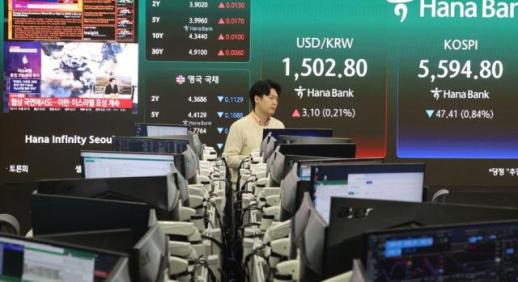 Foreign investors dumped nearly 20 trillion in South Korean stocks last month SEOUL, March 27 (AJP) - Foreign investors offloaded nearly 20 trillion Korean won (US$12.98 billion) worth of South Korean shares last month, extending their selling streak to a second consecutive month, according to data released by the Financial Supervisory Service on Friday. Foreign investors net sold 19.56 trillion won worth of shares - including 19.31 trillion won on the benchmark KOSPI and 239 billion won on the junior KOSDAQ - resulting in a net outflow of 12.13 trillion won in February. They instead shifted toward bonds, snapping up 7.43 trillion won worth for a fourth consecutive month. As of the end of February, foreign investors held 2,026 trillion won worth of listed stocks here, accounting for about 32.6 percent of the market. By country, the U.S. led with 838.19 trillion or 41.4 percent of total foreign holdings, followed by Europe at 31.8 percent, Asia at 13.8 percent and the Middle East at 1.8 percent. Foreign holdings of local bonds, meanwhile, continued to grow, rising 6.8 trillion won from the previous month to 337.3 trillion won, accounting for 12 percent of the total. 2026-03-27 09:01:51
 -
 Samsung Electronics becomes first South Korean company to hit $1 trillion market cap SEOUL, February 26 (AJP) - Samsung Electronics has become the first South Korean company to reach a market capitalization of over US$1 trillion. As of Thursday's market close, Samsung Electronics' market value was tallied at $1.03 trillion. Only 13 companies worldwide have market caps of $1 trillion or more. The milestone lifted the electronics giant to No. 12 globally in terms of market value, surpassing supermarket chain Walmart and pharmaceutical company Eli Lilly. In Asia, it ranks third behind TSMC (No. 6) and Saudi Aramco (No. 7). Shares of Samsung Electronics surged 7.13 percent or 14,500 won from the previous session to close at 218,000 won, pushing its global ranking up two spots to No. 12 in a single day. The rise appeared to be buoyed by earlier news that Nvidia reported a record fourth-quarter revenue of $68.13 billion. Meanwhile, domestic rival SK hynix's market cap stood at $532.2 billion, ranking No. 21 globally. 2026-02-26 16:40:02