

Journalist

SHIN DONGKUN
sdk6425@ajunews.com
-
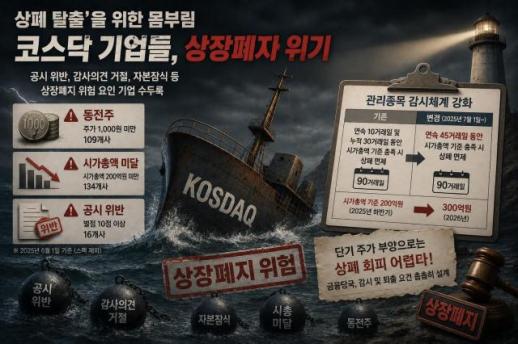 Delisting Risks Rise for KOSDAQ Companies Amid Stricter Regulations The struggle to avoid delisting is not limited to penny stocks. Numerous companies on the KOSDAQ market face risks of delisting due to violations of disclosure regulations, rejected audit opinions, and capital erosion. The traditional method of temporarily boosting stock prices to evade crises is becoming increasingly difficult as financial authorities tighten monitoring and delisting criteria. According to the Korea Exchange, starting in the second half of this year, the monitoring system for management-designated stocks will be strengthened. Previously, companies designated as management stocks could avoid delisting if they met market capitalization criteria (200 billion won this half-year and 300 billion won next year) for 10 consecutive trading days or a cumulative total of 30 trading days within 90 trading days. However, under the new rules, companies must meet the market capitalization criteria for 45 consecutive trading days to avoid delisting. This means that even temporary stock price increases due to favorable news could still lead to delisting risks. For instance, ABPROBIO, a KOSDAQ-listed company, was designated as a management stock in March due to a capital erosion rate of 61.8%. In response, the company has initiated measures to bolster its capital, including a 90% capital reduction, a rights offering, and the issuance of convertible bonds. Despite these efforts, its stock price fluctuates around 1,000 won, keeping its market capitalization at approximately 32 billion won. If the company's value deteriorates further, maintaining its listing could become increasingly challenging. Similarly, companies like DAP and Iwon CompoTech have been newly designated as management stocks this year due to capital erosion rates exceeding 50%. Iwon CompoTech's stock price is currently at 1,552 won, with a market capitalization of 12.4 billion won, raising concerns about its ability to meet the strengthened market capitalization criteria. DAP's stock price and market capitalization stand at 1,883 won and 41.7 billion won, respectively, which meet this year's listing maintenance requirements, but the increase to 300 billion won next year leaves little room for error. As the criteria for delisting-related penalties have been tightened, the company with the highest accumulated penalty points is Coas, with 42 points. Coas was designated as an unreliable disclosure company after being found to have delayed disclosures or provided inaccurate information during the acquisition of stocks from Iwha Electric, Etron, and EID last October. If it receives additional penalty points, it could be subject to delisting review. DawanSys follows closely behind with 23 accumulated penalty points. The company is currently suspended from trading due to a delisting cause stemming from a rejected audit opinion on its financial statements last year. Its revenue dropped by over 70% compared to the previous year, and its operating losses exceeded 100 billion won. Additionally, the termination of a contract for supplying electric trains to Korail has heightened concerns about its operational normalization. Even if issues related to audit opinions are resolved in the future, the burden of accumulated penalty points remains a concern. Industry experts believe that the recent reforms to the delisting system will not only introduce new criteria but also mark the beginning of a serious effort to address struggling companies. Lee Geon-jae, a researcher at IBK Investment & Securities, stated, "While more than 90 companies are newly listed on the KOSDAQ market each year, the number of companies being delisted is less than half. We need to address the structural issues of unprofitable companies that have not resolved problems such as poor business performance, lack of communication with investors, and capital erosion to achieve qualitative improvement in the KOSDAQ market."* This article has been translated by AI. 2026-06-02 16:27:00
 -
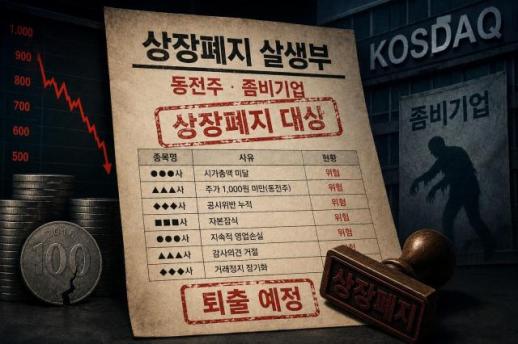 July Marks Critical Month for KOSDAQ as Delisting Risks Rise for 200 Companies The critical month of July is approaching, bringing with it a strengthened delisting system for KOSDAQ companies. Starting July 1, the new regulations will intensify efforts to weed out underperforming firms. Currently, over 200 companies are at risk of delisting due to factors such as insufficient market capitalization, penny stock status, and repeated disclosure violations. According to financial authorities, the enhanced delisting criteria will take effect on July 1. Companies with a market capitalization below 20 billion won, stocks priced under 1,000 won, or those accumulating 10 or more penalty points for disclosure violations (down from the previous threshold of 15 points) will be targeted for delisting. As of July 1, among the 1,822 KOSDAQ-listed companies (excluding SPACs), 134 have a market capitalization below 20 billion won, and 109 are classified as penny stocks. After excluding duplicates, approximately 203 companies are expected to fall into the potential delisting category. In addition to market capitalization criteria, many companies are also facing challenges due to disclosure violations. Currently, 70 KOSDAQ companies have been penalized under exchange management standards, with 16 of them accumulating 10 or more penalty points. The company with the highest penalty points is Coas, with a total of 42 points, followed by Daewon Sys with 23 points, CCS with 22.5 points, and Korea Union Pharma with over 21 points. Concerns about financial stability are also rising, as three KOSDAQ companies have been newly designated as management issues this year due to capital impairment rates exceeding 50%: AB Pro Bio, Iwon Compo Tech, and DAP. Market analysts predict that if delistings begin in July, the impact on retail shareholders could be significant. As of the end of last year, there were approximately 2.63 million retail investors holding shares in companies with a market capitalization below 20 billion won and classified as penny stocks. Some of these companies have thousands of individual investors, raising concerns that many will suffer losses if delistings occur. A securities industry representative stated, "The authorities aim to eliminate companies that have only maintained their listings while increasing investor losses." However, given the high proportion of retail investors in the KOSDAQ market, it is essential to establish protective measures for minority shareholders during the delisting process.* This article has been translated by AI. 2026-06-02 16:21:00
 -
 A-Ritz, South Korea's First REIT, Faces Delisting Amid Two-Day Plunge South Korea's first real estate investment trust (REIT), A-Ritz, is experiencing a significant decline as it approaches delisting, with its stock plummeting for two consecutive trading days during special trading sessions.As of 1 p.m. on June 1, A-Ritz shares were trading at 805 won, down 293 won (26.68%) from the previous trading day. The stock had already dropped 64.92% to close at 1,098 won on the first day of special trading on May 29, and it continued to show a decline of over 20% on the following day. Compared to the last trading day before the special trading resumed on May 28, when the stock closed at 3,130 won, A-Ritz's share price has fallen by more than 74% in just two days.A-Ritz has been undergoing delisting procedures due to failing to meet listing requirements, specifically reporting revenues of less than 5 billion won. The Korea Exchange decided to delist the company after a review by the Securities Listing Committee in August of last year.Following the delisting decision, the company filed for a suspension of the delisting's effectiveness, temporarily halting the special trading. However, on May 21, the court dismissed this request, allowing the delisting process to resume.Despite the ongoing delisting process, A-Ritz is pursuing a senior residence development project in Daegu. The company announced last month that it would extend the maturity of a bridge loan worth 28.56 billion won for the senior residence development project in Dongin-dong, Jung-gu, Daegu, by 24 months. Industry insiders suggest that the development project, initiated in a region with significant unsold inventory, has faced setbacks, contributing to A-Ritz's poor performance and serving as one of the reasons for its impending delisting.Special trading sessions provide investors in stocks slated for delisting with a final opportunity to trade. Typically, there are no price limits during these sessions, leading to increased volatility in stock prices.* This article has been translated by AI. 2026-06-01 13:12:00
 -
 Hyundai Motor Securities Upgrades Hanol BioPharma's Target Price on IMVT-1402 Reassessment Hyundai Motor Securities maintained its "buy" rating for Hanol BioPharma on June 1 and raised its target price from 85,000 won to 93,000 won. This adjustment is based on a reassessment of the pipeline's value following the clinical performance of the FcRn therapeutic IMVT-1402. Research analyst Kim Hyun-seok stated, "Considering the limited competition in the market and the efficacy of the clinical data, the company is significantly undervalued." Hyundai Motor Securities analyzed that the key indications for IMVT-1402, including thyroid eye disease (TED) and treatment-resistant rheumatoid arthritis (D2T RA), target patient groups that do not respond to existing therapies, highlighting a substantial unmet medical need. Kim noted, "In particular, the D2T RA registration trial achieved impressive efficacy rates of 72.7% for ACR20, 54.5% for ACR50, and 35.8% for ACR70 among patients who failed two or more advanced treatments. This is comparable to the existing first-line TNF-α inhibitors and even exceeds the results of JAK inhibitors used as second-line treatments." Consequently, there is potential for FcRn inhibitors to replace existing therapies for certain patient groups. Kim added, "The gap in corporate value compared to competitors is excessive. When compared to the market capitalization of global FcRn therapeutic competitor Azenex, Hanol BioPharma is currently undervalued."* This article has been translated by AI. 2026-06-01 09:18:00
 -
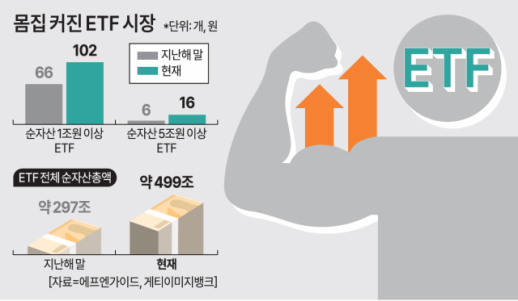 Surge in ETF Market: 100 Funds Exceed 1 Trillion Won in Assets The domestic exchange-traded fund (ETF) market continues its rapid growth, with the number of funds exceeding 1 trillion won in total assets under management (AUM) surpassing 100 for the first time. This surge is attributed to a booming stock market and significant inflows of capital from both individual and institutional investors. According to fund evaluation firm FnGuide, as of May 28, there are 102 domestic ETFs with AUM exceeding 1 trillion won, up from 66 at the end of last year, marking an increase of 36 funds in just six months. The rise of large-scale ETFs is also notable. The number of ETFs with AUM exceeding 5 trillion won has increased from six at the end of last year to 16 currently. This growth is driven by index ETFs representing the domestic stock market, as well as those linked to major U.S. indices and sectors like semiconductors and dividends. The overall size of the ETF market is expanding rapidly, with total AUM nearing 500 trillion won, reaching record levels. Analysts attribute this growth to the increasing preference for ETFs among domestic investors, coupled with a rising stock market. The top-performing ETFs have also shown remarkable growth. The KODEX 200, the leading ETF, has seen its AUM increase by over 16 trillion won compared to the end of last year, while the second-ranked TIGER U.S. S&P 500 has grown by more than 5 trillion won. Notably, the third-ranked TIGER Semiconductor TOP10 has seen its AUM surge from 2.83 trillion won to 14.54 trillion won, more than a fivefold increase, thanks to strong semiconductor stocks. The simultaneous bullish trends in domestic and international stock markets this year have been identified as key factors in the expansion of the ETF market. The KOSPI index has recorded significant gains since the beginning of the year, while the U.S. stock market has also maintained a strong upward trend, leading to increased capital inflows into both domestic and foreign equity ETFs. Recently, high-risk, high-reward products based on single stocks have also gained popularity, further broadening the ETF market. The newly listed Samsung Electronics and SK Hynix single-stock leveraged ETFs from Samsung Asset Management quickly surpassed 1 trillion won in AUM shortly after their launch, joining the '1 trillion club.' Industry experts expect the growth of the ETF market to continue in the near future. The proportion of ETF investments through retirement and personal pension accounts is steadily increasing, and more investors are utilizing ETFs as long-term investment vehicles. A financial industry official stated, "The influx of capital due to the rising stock market and the expansion of pension funds are rapidly increasing the size of the ETF market. As various products continue to be launched, the number of large-scale ETFs will keep growing."* This article has been translated by AI. 2026-05-31 17:39:00
 -
 Korean Stock Market Surges Amid Legal Reforms and Global Trends Over the past year, South Korea's economy has faced significant external pressures, including U.S. tariff pressures, conflicts in the Middle East, high exchange rates, and supply chain uncertainties. However, the market has reacted unexpectedly. Once dubbed 'Parkspi,' the Korean stock market has emerged as one of the hottest markets globally, attracting renewed foreign investment. According to the financial investment industry on May 31, the KOSPI index, which stood at around 2,700 when President Lee Jae-myung's administration began last June, has surpassed 8,000 within a year. This nearly threefold increase is unmatched among major global stock markets. During his presidential campaign, Lee promised a 'KOSPI 5,000 era' as a key economic pledge. Since then, his administration has strengthened the fiduciary duties of directors and expanded cumulative voting through amendments to the Commercial Act. Other measures include mandating the buyback of treasury shares, promoting separate taxation on dividend income, and pressuring low PBR companies to improve. The Korea Exchange has also accelerated efforts to enhance market quality by tightening delisting criteria and expelling underperforming companies. In September of last year, President Lee visited the New York Stock Exchange to communicate his commitment to reforming South Korea's capital markets to foreign investors. The government has also intensified penalties for stock manipulation and insider trading. President Lee stated publicly, "I will show stock manipulators what it means to face ruin," emphasizing a tough stance against such practices. These policy changes have translated into market performance. Foreign investors have shown strong buying interest amid expectations of resolving the Korea discount. Another driving force behind the stock market's rebound has been the sectors of AI and semiconductors. As global competition in AI investment heats up, demand for high-bandwidth memory (HBM) has surged, leading to a rapid recovery in the semiconductor industry, particularly for Samsung Electronics and SK Hynix. While shipbuilding, defense, and nuclear power stocks led the market in the first half of the year, AI and semiconductors have taken the lead in the latter half. The government is also pushing for a special law to strengthen and support the semiconductor industry, alongside initiatives like the National Growth Fund to foster the AI sector. As the market's status evolves, the financial landscape is also changing. Once dominated by banks, the financial industry is seeing securities firms emerge as key players. With a surge in trading volumes and investment banking revenues, major securities firms are accelerating efforts to enhance their competitiveness to match global investment banks. Industry experts suggest that domestic securities firms are at a turning point, evolving beyond simple brokerage services to become global investment banks. Concerns remain, however. The rapid rise in stock prices has sparked fears of an AI bubble and discussions about overheating. Additionally, U.S. interest rate policies, geopolitical risks in the Middle East, and fluctuations in the semiconductor cycle continue to pose uncertainties. Nonetheless, the market is increasingly focused on the fact that this upward trend signifies a fundamental shift in the structure of South Korea's capital markets. An industry insider remarked, "Historically, the Korean stock market has always been discounted in the global arena, but now, policies, industries, and capital flows are changing simultaneously. The Korean stock market is rising to the ranks of global central markets."* This article has been translated by AI. 2026-05-31 16:24:00
 -
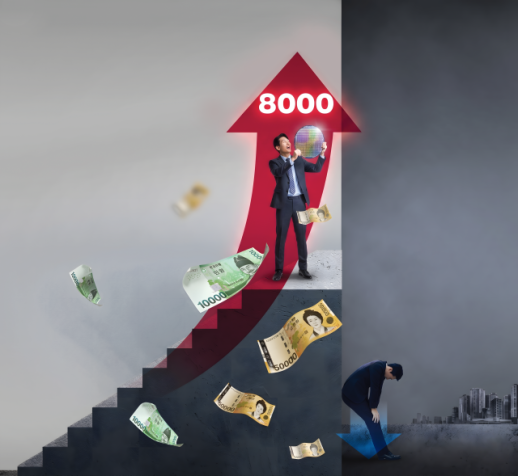 KOSPI Hits Record 8,228.70, But Many Stocks Remain Stagnant On May 27, the KOSPI index reached a record high of 8,228.70. Despite this unprecedented bull market, only 75 stocks saw gains that day, while 826 stocks either fell or remained unchanged. This means that 92% of the listed companies on the KOSDAQ were left behind, leading to complaints from investors like, "The KOSPI is at 8,000, but my stocks aren't rising." Since last year, there has been a noticeable concentration of funds in specific stocks, creating distortions and illusions in the market. While the index continues to set new records, many investors do not feel the upward momentum. This concentration also leads to a 'bandwagon' effect, where funds rapidly flow into certain stocks, such as semiconductors, exacerbating market volatility. "Index at 8,000, My Stocks in the Red" According to the Korea Exchange, the KOSPI surpassed the 8,200 mark on May 28, setting a new all-time high. Just earlier this month, the index was below 7,000, but it surged over 1,600 points in just a month, driven by gains in semiconductor and artificial intelligence (AI) stocks. However, the overall performance of the market remained lackluster. Statistics reveal the disparity. On May 27, when the KOSPI hit its peak, only 75 stocks recorded gains. This indicates that a small number of stocks were responsible for the index's rise. The increase in prices of major stocks like Samsung Electronics and SK Hynix gave the illusion of a booming market. Expanding the timeframe, from May 4 to May 27, the KOSPI rose from 6,598.87 to 8,228.70, yet only 140 stocks increased in value, while 778 stocks declined. The average gain for the rising stocks was 21.7%, while the average loss for the declining stocks was 13.87%. Since the outbreak of the Middle East conflict in March until May 27, only 171 stocks had increased in value. The trend of concentration is evident when examining the KOSPI index's performance across different sectors. Among 24 sectors, only six recorded gains: electrical and electronics (44.69%), manufacturing (30.63%), insurance (25.42%), retail (12.40%), IT services (10.09%), and finance (10.02%). Notably, the electrical and electronics sector's growth rate was 1.8 times higher than the KOSPI's overall increase of 24.70%. In contrast, 18 sectors, including construction (-18.06%), paper and wood (-16.67%), and machinery and equipment (-13.29%), experienced declines. Additionally, the KOSPI 50 (36.58%), KOSPI 100 (33.04%), and KOSPI 200 (30.91%) showed higher growth rates, indicating that the upward trend is primarily concentrated in large-cap stocks. Market analysts suggest that excessive capital concentration in leading stocks, such as Samsung Electronics and SK Hynix, particularly in AI semiconductors and power infrastructure, is distorting the overall market. The recent surge in global AI investments and expectations for increased demand for high-bandwidth memory (HBM) have led to a concentration of investor funds in large-cap semiconductor stocks. Since the outbreak of the Middle East conflict in March, funds have increasingly flowed into globally competitive large technology stocks, while small and mid-cap growth stocks and domestic stocks have been relatively neglected, widening the gap between perceived market conditions and the index. "Concentration is a Typical Phenomenon in the Later Stages of a Bubble" Interpretations of this concentration phenomenon vary. Some analysts believe that the surge in AI-related semiconductors will last for 2 to 3 years, making the concentration of funds in specific sectors a natural occurrence. A securities industry insider explained, "Since half of the KOSPI market capitalization is made up of large-cap semiconductor stocks, it is natural for their prices to rise and for funds to follow." However, others argue that the current concentration resembles typical patterns seen in the later stages of a bubble. Lee Eun-taek, a researcher at KB Securities, recently noted in a report that the current semiconductor-driven market is showing trends similar to past bubble phases. According to the report, during the 1929 U.S. stock market bubble, funds were concentrated in new technology consumer goods companies like aviation, telephony, and radio. Similar concentration was observed in the early 1970s with the 'Nifty Fifty' and during the 2000 dot-com bubble, where a few key growth stocks accounted for most of the market returns. Particularly, just before the collapse of the dot-com bubble in 1999, the U.S. stock market exhibited extreme polarization, with funds heavily concentrated in the information technology (IT) sector. The researcher stated, "In the later stages of a bubble rally, the concentration of leading stocks tends to strengthen, and a reduction in concentration may signal not a 'welcome spread' but rather a precursor to a bubble collapse." Applying this analysis to the second quarter of this year, concerns about the Korean stock market are growing. An analysis of relative returns compared to the KOSPI revealed that the IT sector has surged 31 percentage points above the market average, solidifying its dominance. In contrast, most other industries, excluding IT, remained in negative territory. The healthcare sector recorded a -61 percentage point performance compared to the KOSPI average, while utilities (-57 percentage points), telecommunications services (-54 percentage points), and consumer staples (-46 percentage points) also faced significant declines.* This article has been translated by AI. 2026-05-29 07:54:00
 -
 LG Energy Solution Shares Surge 11% After $1.6 Billion ESS Supply Deal LG Energy Solution's shares have surged following the announcement of a significant energy storage system (ESS) battery supply contract with a major U.S. energy company. As of 10 a.m. on May 28, LG Energy Solution's stock was trading at 425,500 won, up 42,000 won (10.95%) from the previous trading day, according to the Korea Exchange. The company announced it has signed a contract with DTE Energy, Michigan's largest integrated energy company, for the supply of ESS batteries totaling 6 gigawatt-hours (GWh). The contract is valued at $1.6 billion (approximately 2.4 trillion won). DTE Energy, headquartered in Detroit, Michigan, plans to use this contract to support eight key power grid projects, including the Oracle AI data center project being developed in Saline Township, Michigan. With growing expectations for the North American ESS market driven by the expansion of AI data centers and increasing demand for renewable energy, investors have reacted positively to LG Energy Solution securing a major utility customer. Analysts suggest that the production of these batteries will primarily take place at the company's facility in Holland, Michigan, enhancing its local supply chain competitiveness.* This article has been translated by AI. 2026-05-28 10:27:53
 -
LG Energy Solution Shares Surge 11% on $1.6 Billion ESS Supply Deal LG Energy Solution's shares have surged following the announcement of a significant energy storage system (ESS) battery supply contract with a major U.S. energy company. As of 10 a.m. on May 28, LG Energy Solution's stock was trading at 425,500 won, up 42,000 won (10.95%) from the previous trading day, according to the Korea Exchange. The company revealed that it has signed a contract with DTE Energy, Michigan's largest integrated energy company, for the supply of ESS batteries totaling 6 gigawatt-hours (GWh). The contract is valued at $1.6 billion (approximately 2.4 trillion won). DTE Energy, headquartered in Detroit, Michigan, plans to use this contract to support eight key power grid projects, including the Oracle AI data center project being developed in Saline Township, Michigan. With increasing demand for AI data centers and renewable energy integration, there is growing optimism about the North American ESS market. Investors view LG Energy Solution's acquisition of a large utility customer positively. Notably, the supply will be produced primarily at the company's facility in Holland, Michigan, enhancing its local supply chain competitiveness.* This article has been translated by AI. 2026-05-28 10:27:34
-
LG Energy Solution Shares Surge 11% Following $1.6 Billion ESS Supply Deal LG Energy Solution's shares have surged following the announcement of a substantial energy storage system (ESS) battery supply contract with a major U.S. energy company. As of 10 a.m. on the Korean Exchange, LG Energy Solution's stock rose by 42,000 won (10.95%) to 425,500 won compared to the previous trading day. The company announced that it has signed a contract with DTE Energy, Michigan's largest integrated energy company, for the supply of ESS batteries totaling 6 gigawatt-hours (GWh). The contract is valued at $1.6 billion (approximately 2.4 trillion won). DTE Energy, based in Detroit, Michigan, is a large power and energy company. The contract will support eight key power grid projects, including the Oracle AI data center project being developed in Saline Township, Michigan. With growing demand for AI data centers and renewable energy integration, expectations for growth in the North American ESS market are rising. Investors view LG Energy Solution's acquisition of a major utility customer positively. Notably, the supply will be produced primarily at the company's manufacturing facility in Holland, Michigan, enhancing its local supply chain competitiveness.* This article has been translated by AI. 2026-05-28 10:27:23