

Journalist

Shin Dong-kyun
sdk6425@ajunews.com
-
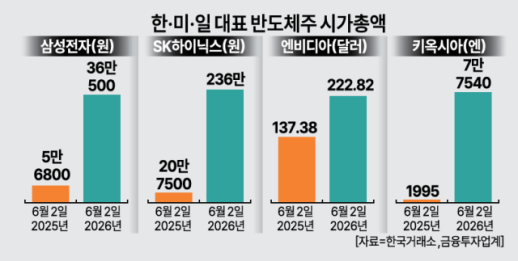 Kioxia Surpasses Toyota, Nvidia Outpaces Apple as Semiconductor Sector Reshapes Market Caps in Korea, U.S., and Japan Artificial intelligence (AI) is transforming the market capitalization landscape of stock exchanges in the U.S., South Korea, and Japan. Previously dominated by smartphone, internet platform, and automotive companies, the market is now led by AI semiconductor and memory firms. In the U.S., Nvidia has overtaken Apple to become the world's largest company, while in South Korea, Samsung Electronics and SK Hynix are driving stock market gains. In Japan, memory manufacturer Kioxia Holdings is challenging Toyota Motor Corporation, climbing to the upper echelons of market capitalization. According to the Korea Exchange, the KOSPI index reached 8,801.49 as of June 2, marking a 226.1% increase from a year earlier when it stood at 2,698.97. The surge in demand for AI semiconductors has propelled Samsung Electronics and SK Hynix, with their stock prices soaring by 534.7% and 1,037.3%, respectively, significantly outpacing the KOSPI's overall growth. As of June 2, these two companies accounted for approximately 52% of the KOSPI's market capitalization. With the focus on AI benefiting the semiconductor sector, the status of these companies in the South Korean stock market has risen significantly. Once regarded primarily as a smartphone-centric IT company, Samsung Electronics has emerged as a key beneficiary of the expanding demand for memory semiconductors in the AI era. Recently, it has entered the top 10 global market capitalization rankings, competing with major tech giants. SK Hynix's transformation is even more dramatic. As a key supplier of high-bandwidth memory (HBM) to Nvidia, it is now considered one of the biggest beneficiaries of the AI era. Analysts note that the company has shifted from being heavily influenced by the DRAM market to becoming a central player in AI infrastructure expansion. Just two years ago, SK Hynix was far outside the top 100 in global market capitalization but has recently climbed to 12th place, joining the ranks of leading global technology firms. The positive outlook for the semiconductor sector is also boosting expectations for the South Korean stock market. Global investment bank Goldman Sachs recently raised its 12-month target for the KOSPI from 9,000 to 12,000, citing a longer-than-expected favorable semiconductor environment and improved corporate profit forecasts. This adjustment comes less than a month after the target was increased from 8,000 to 9,000. While Samsung Electronics and SK Hynix lead the South Korean market, Nvidia is effectively dominating the U.S. market. Nvidia's market capitalization recently surpassed $5.2 trillion, making it the world's largest company. In 2017, Nvidia's market cap was approximately $117 billion, accounting for just 3.4% of the total market cap of the seven major U.S. tech companies (M7). However, by virtually monopolizing the market for AI training graphics processing units (GPUs), Nvidia's value has skyrocketed. It now represents 22.5% of the total M7 market capitalization, a significant increase of about 6.6 times over nine years. This shift underscores how AI has completely altered the power dynamics of the U.S. stock market. In Japan, AI is also shaking up the stock market landscape. The spotlight is on Kioxia Holdings, a NAND flash memory company. For a long time, Japan's stock market has been dominated by automotive and industrial firms, with Toyota Motor Corporation symbolizing Japanese manufacturing and holding the top market cap. However, Kioxia's recent stock surge has disrupted this status quo. The company's shares recently rose by over 7%, pushing its market cap past 45 trillion yen at one point, allowing it to surpass Toyota and become the second-largest publicly traded company in Japan. Just a year ago, Kioxia was ranked 169th in market capitalization. Market analysts believe that the changes brought about by AI in the stock market are unlikely to be temporary. Kim Young-geun, a researcher at Mirae Asset Securities, stated, "Kioxia is reducing its sensitivity to economic fluctuations by increasing its revenue share from data centers and establishing a stable profit structure through a disciplined supply strategy. This change will positively impact the entire memory sector." He maintained target prices for Samsung Electronics and SK Hynix at 550,000 won and 3,800,000 won, respectively. 2026-06-04 18:15:00
 -
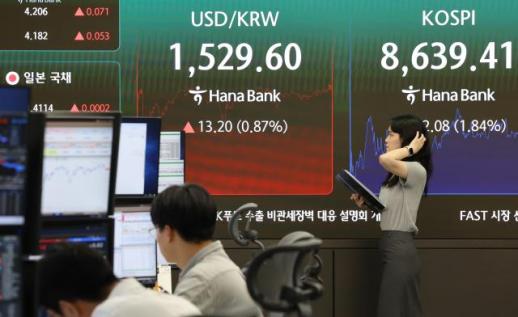 Wonik IPS Hits Upper Limit as Semiconductor Sector Sees Rotation Wonik IPS reached its upper limit today as buying interest shifted to semiconductor materials and equipment stocks, which had been relatively overlooked, following a pause in large-cap semiconductor stocks. According to the Korea Exchange, Wonik IPS traded at 127,200 won, up 29,300 won (29.93%) from the previous session, hitting the upper limit. Market analysts noted that the recent declines in shares of major semiconductor companies, Samsung Electronics and SK Hynix, which fell 2.50% and 2.63% respectively, prompted investors to seek opportunities in semiconductor equipment stocks. Wonik IPS, a provider of semiconductor front-end equipment, is benefiting from expectations of increased investment in memory and advanced processes driven by artificial intelligence (AI). The rotation within the semiconductor sector today saw a focus on front-end equipment stocks, which had previously experienced limited price increases. Analysts suggest that the recent pullback in major semiconductor stocks, which had been leading the market, has led to a rotation within the sector. Lee Kyung-min, a researcher at Daishin Securities, stated, "The KOSPI is experiencing weakness due to profit-taking amid accumulated gains, but sector rotations are occurring, reducing the extent of declines. As large-cap leaders take a breather, there is a noticeable shift in demand towards previously overlooked stocks."* This article has been translated by AI. 2026-06-04 16:54:00
 -
 Samsung C&T Hits Record High of 565,000 Won Amid Rising Investor Sentiment Samsung C&T reached an intraday high of 565,000 won, setting a new record. This surge is attributed to rising equity values of major affiliates and expectations for increased shareholder returns. According to the Korea Exchange, as of 2:25 PM on June 4, Samsung C&T was trading at 537,000 won, up 10.61% (51,500 won) from the previous trading day. The stock peaked at 565,000 won during the session. The recent upward trend has been steep. Samsung C&T rose 8.26% on May 29, followed by increases of 5.20% on June 1, 6.70% on June 2, and 10.61% on June 4, totaling over a 34% increase in the last five trading days. Based on intraday highs, the stock has surged more than 40% during this period. Samsung C&T is recognized as a significantly undervalued holding company, owning stakes in key affiliates such as Samsung Electronics, Samsung Biologics, and Samsung Life Insurance. Analysts have been raising their target prices for the stock. SK Securities increased its target price from 480,000 won to 590,000 won while maintaining a 'buy' rating. Choi Kwan-soon, an analyst at SK Securities, noted, "The net asset value (NAV) of Samsung C&T has increased by 75.4 trillion won compared to the end of last year. The stock prices of Samsung Electronics and Samsung Life Insurance have risen by 196.9% and 204.6%, respectively, and the net debt on a standalone basis decreased by 972.7 billion won in the first quarter of this year." Currently, Samsung C&T's equity value is estimated at approximately 165 trillion won, with Samsung Electronics accounting for 64.5% of this value, followed by Samsung Biologics at 16.5% and Samsung Life Insurance at 11.3%. Choi added, "Considering the growth in the high-tech sector and the long-term potential of energy projects and small modular reactors (SMRs), there is a high possibility of improving cash flow. Attention should be paid not only to the increase in equity value but also to the improvement in the company's operational performance." Expectations for increased shareholder returns are also supporting the stock price. SK Securities forecasts that Samsung C&T's dividend per share (DPS) will rise by 25% year-on-year to around 3,500 won this year. Earlier, Samsung C&T announced a shareholder return policy in February, raising the minimum dividend per share to 2,500 won for the next two years and committing to redistribute 60-70% of the dividend income received from its affiliates. The dividend income primarily comes from Samsung Electronics, Samsung Life Insurance, Samsung SDS, and Samsung E&A, with an estimated 90% originating from Samsung Electronics and Samsung Life Insurance.* This article has been translated by AI. 2026-06-04 14:39:00
 -
 KOSPI Recovers Above 8700 Amid Heavy Foreign Selling The KOSPI index rebounded from an early drop, recovering above the 8700 mark. Despite over 5 trillion won in foreign selling pressuring the index, substantial buying by retail and institutional investors provided support. As of 1:25 p.m. on June 4, the KOSPI was down 96.62 points (-1.10%) at 8704.87, having previously fallen to 8577.30 during the session. In the main market, retail and institutional investors recorded net purchases of 4.06 trillion won and 1.33 trillion won, respectively, while foreign investors sold off 5.51 trillion won to realize profits. Large-cap stocks showed mixed performance. Samsung C&T surged by 12.05%, while SK Square rose by 1.41%. Conversely, Samsung Life (-12.19%), Samsung Electronics preferred shares (-3.89%), LG Energy Solution (-3.84%), Samsung Electro-Mechanics (-3.31%), Hyundai Motor (-3.02%), SK Hynix (-2.80%), HD Hyundai Heavy Industries (-2.67%), and Samsung Electronics (-0.55%) faced declines. The KOSDAQ index, at the same time, rose by 33.24 points (3.24%) to 1059.27. In the KOSDAQ market, institutional and foreign investors net bought 233.9 billion won and 24.1 billion won, respectively, while retail investors net sold 250.7 billion won. Among the top KOSDAQ stocks, gainers outnumbered losers. JUSUNG Engineering surged by 25.70%, followed by Rino Technology (7.65%), Samchundang Pharmaceutical (5.63%), EcoPro (3.61%), HLB (1.92%), EcoPro BM (1.52%), Kolon TissueGene (1.48%), and Peptron (1.48%). In contrast, Rainbow Robotics (-4.85%) and Alteogen (-1.12%) saw declines.* This article has been translated by AI. 2026-06-04 13:33:00
 -
KOSPI Drops Over 2% Amid Foreign Sell-Off, KOSDAQ Rises More Than 3% The KOSPI index has fallen over 2% due to a significant sell-off by foreign investors. In contrast, the KOSDAQ index has risen more than 3%, showing a starkly different trend. As of 11:15 a.m. on June 4, the KOSPI was down 224.19 points (-2.55%) at 8,577.30, according to the Korea Exchange. While individual investors purchased a net 3.72 trillion won and institutions bought a net 320.3 billion won, foreign investors led the decline with a net sell-off of 4.15 trillion won. Most of the top stocks by market capitalization on the KOSPI are experiencing losses. Notable declines include Samsung Life (-11.77%), LG Energy Solution (-5.76%), Samsung Electro-Mechanics (-5.41%), Hyundai Motor (-4.66%), Samsung Electronics preferred shares (-4.21%), SK Hynix (-3.88%), Samsung Electronics (-2.57%), and HD Hyundai Heavy Industries (-2.23%). However, Samsung C&T has shown strength with a gain of 7.11%. Meanwhile, the KOSDAQ index has risen 31.77 points (3.10%) to 1,057.80 at the same time. In the KOSDAQ market, institutions and foreign investors purchased a net 182 billion won and 21.1 billion won, respectively, while individual investors sold a net 194.3 billion won. In the KOSDAQ, most of the top stocks are on the rise. Significant gains include JUSUNG Engineering (26.71%), Rino Technology (7.22%), Samchundang Pharmaceutical (3.81%), EcoPro (1.80%), and HLB (1.73%). Conversely, Rainbow Robotics (-6.55%), Alteogen (-2.10%), Kolon TissueGene (-0.83%), and Peptron (-0.55%) are experiencing declines. EcoPro BM remains stable.* This article has been translated by AI. 2026-06-04 11:24:00
-
 LG Electronics Shares Plunge 15% Amid Profit-Taking After Recent Surge LG Electronics is experiencing a sharp decline in its stock price during early trading. This drop is attributed to profit-taking following a surge of over 80% in the company's stock over the past two weeks. As of 10:05 a.m. on June 4, LG Electronics shares were trading at 334,250 won, down 14.84% from the previous trading day, according to the Korea Exchange. The stock price skyrocketed from 181,000 won on May 20 to 392,500 won on June 2, marking an increase of approximately 117%. During this period, the stock hit its daily upper limit three times on May 21, May 29, and June 1. Market analysts suggest that the recent surge in stock prices has led to increased profit-taking, resulting in a concentration of short-term selling. Given that the stock price has more than doubled in a short time, more investors are likely to cash in on their profits. Meanwhile, international credit rating agency S&P upgraded LG Electronics' credit rating from BBB to BBB+ on June 2. S&P cited the company's solid growth in its core business, reduction in debt, and improvement in financial structure as reasons for the upgrade. The agency also anticipates that LG Electronics will maintain stable performance over the next two years through enhanced competitiveness in premium appliances and expansion into subscription and B2B markets.* This article has been translated by AI. 2026-06-04 10:12:00
 -
 KOSPI Shows Mixed Performance Amid U.S. Market Decline and Currency Pressure The New York Stock Exchange experienced a broad decline due to renewed geopolitical risks in the Middle East and instability in the private credit market, leading to increased risk aversion among investors. As a result, the domestic stock market is expected to show volatility in early trading, influenced by the U.S. market's adjustment and rising won-dollar exchange rates. According to the financial investment industry on June 4, the Dow Jones Industrial Average fell by 1.21% on June 3 (local time), while the S&P 500 and Nasdaq dropped by 0.74% and 0.89%, respectively. Although semiconductor stocks remained relatively resilient, the ongoing military tensions between the U.S. and Iran, along with issues surrounding private loan fund redemptions, have led to an increase in risk premiums across the financial markets. Additionally, after a recent rally, profit-taking pressures have intensified. Despite the existing upward trend centered on semiconductors, the domestic market is experiencing increased short-term volatility due to external factors. Notably, the KOSPI has shown significant fluctuations in intraday highs and lows, with perceived volatility outweighing directional trends. As of 8:25 a.m., sector performance showed clear differentiation. Large-cap semiconductor stocks were under pressure, with Samsung Electronics down 1.11% at 356,500 won and SK Hynix falling 2.67% to 2,297,000 won. Other companies like SK Square (-3.19%) and Samsung Electro-Mechanics (-1.88%) also contributed to the index's downward pressure. The automotive sector also faced notable declines, with Hyundai Motor dropping 3.43% to 704,000 won and Hyundai Mobis plunging 5.14%, marking the largest drop in the sector. This trend is interpreted as a reflection of concerns over global economic slowdown and supply-demand pressures. Conversely, some sectors showed relative strength. LG Energy Solution rose 2.71%, indicating differentiation within the secondary battery sector, while HD Hyundai Heavy Industries surged 4.01%, leading gains in the shipbuilding industry. This is seen as a result of positive order momentum and expectations for the industry. The financial and holding sectors generally exhibited weakness, with Samsung Life Insurance (-2.81%) and Samsung C&T (-1.75%) declining, reflecting a tendency to avoid riskier assets. Overall, while the KOSPI maintains a long-term upward trend centered on semiconductors, short-term fluctuations driven by macroeconomic variables from the U.S., exchange rates, and sector-specific supply-demand imbalances are expected to persist, leading to a volatile market environment. Han Ji-young, a researcher at Kiwoom Securities, stated, "The concentration on leading semiconductor stocks will continue, making high volatility unavoidable for the time being. However, it is reassuring to note that patterns of the market reducing losses toward the end of the trading day are frequently observed, indicating that the support for leading stocks remains strong." 2026-06-04 08:36:00
 -
 Hanwha Investment & Securities Raises Samsung Heavy Industries Target Price to 44,000 Won 한국투자증권은 4일 삼성중공업의 목표가를 기존 대비 2.3% 올린 4만4000원으로 제시하고 투자의견 '매수'를 유지했다. 부유식 액화천연가스 생산설비(FLNG) 수주 확대와 부유식 데이터센터(FDC) 사업 진전 등을 반영했다. 강경태 한국투자증권 연구원은 삼성중공업이 지난 2일 북미 선주로부터 해양생산설비 1기를 수주하면서 해양플랜트 수주잔고 내 FLNG(LNG-FPSO) 4기를 확보하게 됐다고 설명했다. 이번 프로젝트는 미국 델핀 미드스트림의 델핀 FLNG 사업으로 추정되며, 삼성중공업은 이를 통해 올해 해양플랜트 수주 목표 82억달러의 40.1%를 달성했다. 강 연구원은 델핀 프로젝트의 LNG 장기 구매계약자 확보와 금융조달이 상당 부분 완료된 만큼 올해 하반기 델핀 2호기 발주도 예정대로 진행될 것으로 전망했다. 삼성중공업이 해당 프로젝트의 FEED(기본설계)를 수행하고 있어 추가 수주 가능성이 높다는 평가다. 이에 따라 한국투자증권은 삼성중공업의 2027년과 2028년 영업이익 추정치를 각각 3.6%, 1.4% 상향 조정했다. 이번 델핀 FLNG 1호기 계약금액이 28억8000만달러, 적용 환율이 1503원으로 기존 추정치(20억달러·1400원)를 크게 웃돌면서 해양플랜트 매출 전망이 개선됐기 때문이다. 강 연구원은 "상선 수주는 연간 목표의 85.7%를 이미 달성할 정도로 순조롭고, 그리스 선주 캐피탈(Capital)과의 양해각서(MOU)를 통해 부유식 데이터센터 건조 사업도 진전되고 있다"며 "FLNG 시장 지배력과 신규 사업 성장성을 감안하면 현재 밸류에이션은 여전히 매력적"이라고 평가했다.* This article has been translated by AI. 2026-06-04 08:27:00
 -
 Goldman Sachs Raises KOSPI Target to 12,000, Citing Semiconductor Boom ◆Ajou Economic Key News ▷Goldman Sachs Raises KOSPI Target to 12,000, Citing Semiconductor Boom - Goldman Sachs has raised its 12-month target for the KOSPI index from 9,000 to 12,000, citing a boom in AI semiconductors and improved corporate earnings. - The firm assesses that there is approximately a 36% upside potential based on the current index, reinforcing its optimism about the South Korean stock market. - The AI semiconductor supply chain, led by Samsung Electronics and SK Hynix, is driving the rise of the Korean stock market, with South Korea and Taiwan identified as key drivers of the Asian market rally. - Goldman Sachs analyzed that the South Korean stock market has shown relative resilience against energy price shocks due to geopolitical risks in the Middle East. - However, the firm warned of increased risks of short-term overheating and corrections due to the influx of leveraged ETF funds and concentration in AI semiconductor stocks. ◆Major Reports from Previous Trading Day Meritz Securities: "Hyundai Mobis Expected to Benefit from Atlas Production... Target Price Up" - Meritz Securities has raised its target price for Hyundai Mobis to 900,000 won, maintaining a 'Buy' rating, reflecting the growth potential of its actuator business for the humanoid robot Atlas. - Hyundai Mobis plans to establish a local production base in the U.S. for the Atlas actuators, having acquired technology from Boston Dynamics, with revenue recognition expected to begin in 2027. - The company is expected to expand its business scope beyond actuators to include sensors and controllers, aiming to become a key supplier of core components for robots. - Meritz Securities anticipates that if Hyundai Mobis achieves its actuator production target of 350,000 units by 2028, it will generate 525 billion won in related revenue and 157.5 billion won in EBITDA. ◆Major Announcements After Market Close (June 3) ▷ S&P Upgrades LG Electronics' Credit Rating to BBB+ ◆Fund Trends (As of June 1, Excluding ETFs) Domestic Equity: -113.8 billion won Overseas Equity: -57.9 billion won ◆Key Schedule for Today (Thursday) South Korea - Foreign Exchange Reserves (May) United States - Layoff Numbers (May), Non-Farm Productivity (Q1), Unit Labor Costs (Q1) * This article has been translated by AI. 2026-06-04 07:21:00
 -
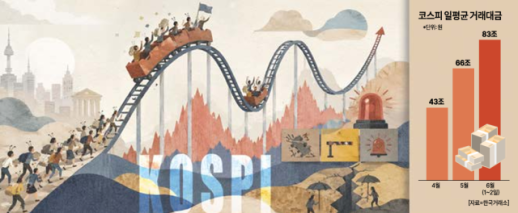 KOSPI Surpasses 8,800 Amid Surge in Trading Volume and Market Volatility The KOSPI index has surpassed the 8,800 mark, reflecting unprecedented strength in the domestic stock market, accompanied by a significant increase in trading volume and heightened market volatility. A surge of funds from individual investors is driving the market upward, but signs of overheating are becoming evident, with mechanisms like sidecars and circuit breakers being activated to mitigate volatility. According to the Korea Exchange, the average daily trading volume in the securities market for June 1-2 was approximately 83 trillion won. This figure is nearly double the average daily trading volume of 43 trillion won recorded in April, before the current upward trend began. The buying momentum, primarily driven by individual investors, is contributing to both the increase in trading volume and the rise in stock prices. While foreign investors have been net sellers for 18 consecutive trading days, totaling 60 trillion won, individual investors have stepped in with about 47 trillion won in net purchases, supporting the index. Market analysts attribute the recent surge in stock prices to a fear of missing out (FOMO) among investors. However, the rapid increase in trading volume and volatility is raising concerns. Recently, the KOSPI has experienced dramatic fluctuations, with intraday swings of several hundred points. The average difference between intraday highs and lows this month has reached 409 points, significantly up from 306 points last month and 134 points in April. The activation of sidecars, a key indicator of market volatility, has surged this year, with a total of 20 activations in the KOSPI market, marking the first time in six months that sidecars have been triggered consecutively. This is only six activations short of the annual record of 26 set during the global financial crisis in 2008. Circuit breakers, which temporarily halt all trading, have also been activated twice. This marks the first time since the COVID-19 pandemic in 2020 that circuit breakers have been triggered twice in a single month. The use of volatility mitigation devices (VI) to ease sharp fluctuations in individual stocks is also on the rise. The KOSPI 200 Volatility Index (VKOSPI), often referred to as Korea's fear index, remains at elevated levels. On June 2, the VKOSPI peaked at 75.42 and has exceeded 75 for three consecutive trading days. Analysts warn that if volatility continues to expand, potential market shocks could lead to larger-than-expected declines. Despite the recent increase in volatility, analysts do not interpret it as a signal of an impending downturn. Cho Chang-min, a researcher at Hyundai Motor Securities, noted, "This year, the average VKOSPI has exceeded 50 points, reaching an all-time high, but unlike in the past, we are seeing both rising indices and increasing volatility simultaneously. Typically, in a bull market, volatility tends to decrease, but we are currently experiencing an unusual market driven by liquidity and investor sentiment." He added, "The current market is more akin to a trend with high volatility rather than a crisis phase. While volatility is increasing during the price rise, the price-to-earnings ratio remains at a historical low of 7.77, suggesting that a return to average valuations could enable the KOSPI to reach 10,000 points."* This article has been translated by AI. 2026-06-03 17:45:00