
Journalist

Yoo Na-hyun · Kim Yeon-jae
shooting@ajupress.com
-
 APFF 2026 probes why Korean finance sector fails to move beyond home turf SEOUL, March 25 (AJP) -South Korea’s manufacturers and pop culture have gone global, but its financial industry still struggles to move beyond home turf — a gap that took center stage at the 2026 Asia-Pacific Financial Forum in Seoul on Wednesday. Hosted by Aju Business Daily and ABC, this year's forum held at The Plaza Hotel asked “In the AI era, why has Korean finance yet to cross borders?” The event sought to diagnose the structural limitations holding back Korea’s financial industry and to explore how its role and competitiveness should be redefined in the age of artificial intelligence. Now in its 19th year, the APFF has established itself as a platform for discussing strategies to help Korean finance grow beyond its home market. The forum brought together leading experts from South Korea and abroad for a series of high-level lectures and discussions. Agustín Carstens, former general manager of the Bank for International Settlements (BIS), delivered the keynote speech titled, “Why K-industry is global, but K-finance remains local,” focusing on the challenges facing Korea’s financial sector and its future potential. 2026-03-25 13:37:14
 -
 South Koreans told to join energy-saving campaign SEOUL, March 24 (AJP)-Leaving cars behind once a week and tightening garbage supply are emerging as everyday inconveniences for South Koreans, as prolonged Gulf tensions begin to disrupt factories. The government on Tuesday rolled out nationwide energy-saving measures, urging both public and private sectors to cut consumption as supply uncertainties deepen. A voluntary five-day vehicle rotation system was introduced for private cars, alongside 12 practical guidelines — from using public transport to maintaining indoor temperatures and switching to high-efficiency appliances. In the public sector, authorities will strengthen inspections of the mandatory vehicle rotation system already in place. Institutions that fail to comply may face warnings and other administrative measures. The government also called on the private sector to participate voluntarily. The move comes as energy supply uncertainties have increased due to instability in the Middle East. The same factors have also disrupted naphtha imports, prompting domestic petrochemical companies to cut production and worsening raw material supply conditions. At a plastic film manufacturing plant in Ansan, Gyeonggi Province, some production lines have been halted due to unstable polyethylene supply. Several companies have also reduced their workforce as operational pressures mount. The impact is beginning to reach everyday life. Companies supplying government-designated garbage bags have warned of delays in production and deliveries due to raw material shortages, while signs of supply disruptions are emerging in retail markets. The government said it will continue to closely monitor the energy supply situation and stressed the need for public participation in conservation efforts. 2026-03-24 16:44:25
 -
 High schoolers sit for nationwide test to gauge their academic levels SEOUL, March 24 (AJP) - Over a million high school students nationwide took a test to assess their levels of academic achievement. According to the Seoul Metropolitan Office of Education, some 1.22 million students from 1,948 high schools across 17 metropolitan and provincial cities sat for the test on Tuesday. The nationwide test is conducted several times a year in a format similar to the annual university entrance exam later in the year, often considered a life-deciding test in a country where admission to a prestigious university is a key factor to success. First introduced in 2002 to reduce reliance on private crammers, the test is intended to help students prepare for university admission. 2026-03-24 15:38:59
 -
 Korea joins Puppy Day with adoption push SEOUL, March 23 (AJP) - From social media feeds filled with wagging tails to corporate campaigns backing animal welfare, South Korea joined the global celebration of National Puppy Day on Sunday, highlighting a growing culture of pet companionship — and responsibility. Established in 2006 by U.S. pet lifestyle expert Colleen Paige, the day has evolved into an international campaign promoting the protection of abandoned dogs and encouraging adoption. Pet owners around the world took part online using the hashtag #NationalPuppyDay. In Korea, companies joined the movement with a mix of donations and awareness campaigns. Pet food maker Royal Canin said it donated 10 tons of tailored food for abandoned animals to shelters nationwide. Fashion brand Hazzys launched an “Adopt, Don’t Shop” campaign to promote adoption over purchasing pets. Convenience store chain CU added a lighter touch, introducing a “custom beer” service that prints customers’ pet photos on cans — blending pet culture with everyday consumption. The surge in participation reflects a broader shift. South Korea is now home to an estimated 15 million pet owners, as animals increasingly take on the role of family members. With that growth, however, comes rising concern over abandonment and ethical ownership. National Puppy Day is gaining traction not just as a celebration, but as a reminder — that behind every viral puppy photo is a longer-term commitment, and for many animals, a second chance still depends on it. 2026-03-23 17:43:01
 -
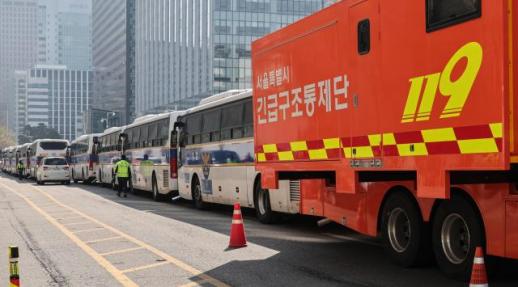 BTS Live: Special forces, police, firefighters in action SEOUL, March 21 (AJP) - Large numbers of police and fire personnel have been deployed across central Seoul ahead of a performance by BTS, with security and safety measures stepped up in the Gwanghwamun area. Police have positioned riot units and traffic officers around Gwanghwamun Square, implementing vehicle restrictions and managing pedestrian flow in parts of the area. Special police units have also been deployed on site to prepare for any emergencies. Fire authorities have stationed fire trucks and emergency medical teams nearby, maintaining a rapid response posture. On the day of the event, roads in the Gwanghwamun area are under traffic control, while boarding and alighting are restricted at nearby subway stations including City Hall, Gyeongbokgung and Gwanghwamun, with some trains passing through without stopping. Notices informing the public of traffic controls and viewing guidelines have been posted throughout the area, with citizens and tourists advised to use public transportation and take alternative routes. 2026-03-21 20:39:18
 -
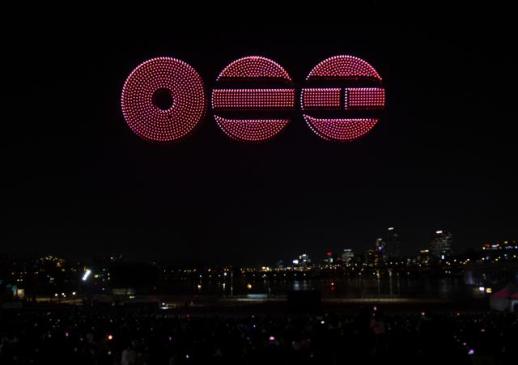 BTS Live: Seoul rehearses for comeback show with own digital and drone spectacle SEOUL, March 21 (AJP) -The city did not wait for the real show. On the eve of BTS’s comeback show Friday, Seoul became the stage itself — a vast, breathing amphitheater where sky, stone and river moved in sync to a rhythm already familiar to millions. Above Gwanghwamun, the night opened like a screen. Drones gathered in disciplined silence before bursting into motion, sketching constellations that resolved into faces, logos, fragments of memory. Nearly 2,000 points of light hovered and turned, then dissolved again, as if the sky were thinking out loud. Fountains rose in timed arcs, catching light and music — “SWIM” first, then “Body to Body” — the title tracks from the album released just hours earlier. Water became choreography. Light became pulse. The square, long a place of history and assembly, shifted into something fluid, almost weightless. Tourists stopped mid-step. Citizens who had crossed the plaza a thousand times found themselves looking up, phones forgotten in their hands. Then the first screams came — not of panic, but of recognition. Along the Han River, the reaction rippled outward. At Ttukseom Hangang Park, the crowd had already begun its own concert. Light sticks — thousands of them — flickered in synchronized waves, turning the riverbank into a field of moving stars. When the music reached them, people did not hesitate. They danced where they stood: teenagers, office workers, visitors who had arrived curious and found themselves converted. Back at the city’s historic core, Seoul staged a quieter, more improbable conversation. Media facades washed over the old gates — Gwanghwamun, Sungnyemun — their surfaces carrying images that belonged unmistakably to the present. Digital color clung to wood and stone shaped by centuries. The effect was not collision, but layering: heritage holding the projection steady, technology giving it motion. For a moment, the past did not recede. It absorbed. This was the rehearsal before the spectacle — a city testing its voice before the main performance. Not confined to a single venue, but distributed across landmarks, riverbanks and sky, the pre-event unfolded as a networked celebration, where tradition, technology and fandom met without hierarchy. By midnight, Seoul had already crossed the threshold. The concert had yet to begin. But the city — lit, singing, and unmistakably alive — had already started. 2026-03-21 10:30:22
 -
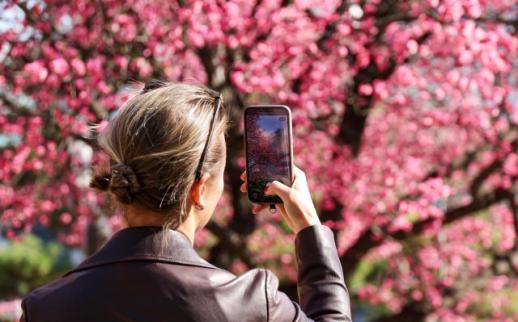 Flowers bloom in Seoul Buddhist temple as vernal equinox nears SEOUL, March 19 (AJP) - Spring flowers bloomed at Bongeunsa Temple in Seoul’s Gangnam District on Thursday, drawing visitors a day ahead of the seasonal marker Chunbun, the vernal equinox. Plum trees with red and white blossoms, and cherry flowers colored the temple grounds, offering a gentle sign of the changing season. Visitors paused to take photos or slowed their steps, enjoying the early spring atmosphere. Chunbun marks the day when daytime and nighttime are of equal length, after which daylight hours gradually become longer than the night. 2026-03-19 17:28:45
 -
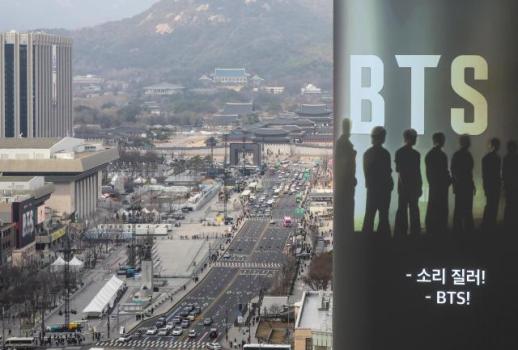 BTS Live D-3: Stage is shaping up fast SEOUL, March 18 (AJP) - The mega stage for BTS comeback show at Gwanghwamun Square is quickly taking shape, even under rain on Wednesday. Roads around Gwanghwamun will be closed on the day of the performance, and access to nearby subway stations will also be limited. Boarding and alighting will be suspended at City Hall Station on Lines 1 and 2, Gyeongbokgung Station on Line 3, and Gwanghwamun Station on Line 5. Major cultural facilities near Gwanghwamun, including Gyeongbokgung Palace and the National Palace Museum of Korea, will be temporarily closed. Meanwhile, about 20 major landmarks across Seoul are set to be illuminated in purple to mark the performance. 2026-03-18 17:55:21
 -
 BTS Live D-3: Seoul turning purple with fans in BTS color pouring in SEOUL, March 18 (AJP) -Seoul is turning purple as fans adorned in the color pour into the capital with three days to go before the Gwanghwamun performance. Central districts including Gwanghwamun Square and Myeongdong are seeing a steady influx of visitors, many gathering near the concert venue or exploring nearby streets in anticipation of the event. In Myeongdong, a BTS merchandise shop was packed with fans purchasing albums and official goods, offering an early glimpse of the commercial momentum surrounding the comeback. “March is usually a slow season, but we’re seeing a clear increase in foreign visitors ahead of the concert,” a staff member at the shop said, adding that new albums will be prominently displayed in line with the band’s March 20 release. Around Gwanghwamun, fans were spotted taking photos, scouting the venue and soaking in the atmosphere ahead of what is expected to be one of the largest K-pop events in recent years. The BTS performance will take place at Gwanghwamun Square at 8 p.m. on March 20 and will be livestreamed globally via Netflix. 2026-03-18 17:26:02
 -
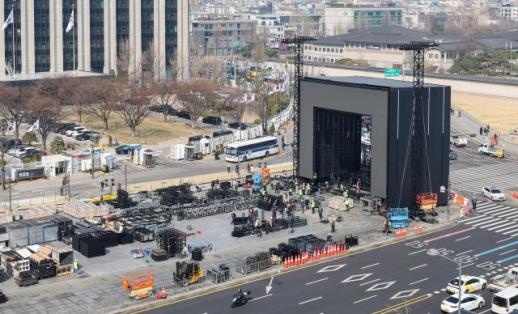 BTS Live D-4: Gwanghwamun transforming into a mega open-air stage SEOUL, March 17 (AJP) -Seoul is turning its historic heart into a carefully controlled arena as nearly 260,000 fans are expected to gather for BTS’s return concert at Gwanghwamun on March 21. At the center of the plan is a transformation of open city streets into a “stadium-style” venue. Thirty-one official entry gates—stretching from the west (W1–W15) to the east (E1–E16)—will funnel crowds into designated zones, preventing dangerous overcrowding in one of the capital’s busiest districts. Security begins early. From 7 a.m., every gate will be equipped with metal detectors to screen bags and block hazardous items. Even those who enter earlier will face additional handheld scanning—an uncommon level of scrutiny for a public concert, reflecting heightened global security concerns. Beyond the square, the city itself bends to the event. Major arteries including Sejong-daero will be shut for up to 33 hours, with nearby roads closing in phases throughout the day. Police will deploy 6,500 personnel across crowd control, traffic management and counterterrorism units. The result is a rare moment when a pop concert reshapes urban space—turning Gwanghwamun from a civic landmark into a tightly managed live venue, built not with walls, but with people, planning and precision. 2026-03-17 16:25:55