
Journalist

Ryu So-hyun
sohyun@ajunews.com
-
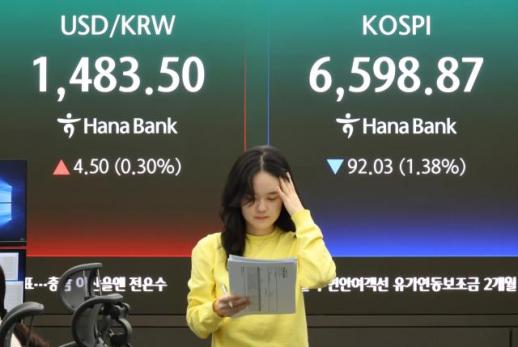 KOSPI Seen Pausing After Rally as Earnings Support, Event Risk Looms Next week’s South Korean stock market is expected to extend its upward trend on easing Middle East geopolitical concerns and stronger corporate earnings, though analysts warned that short-term volatility could rise as investors digest major events. After the KOSPI pushed past its previous peak, some see a near-term pause in the rally. According to the Korea Exchange on May 1, the KOSPI fell 92.03 points, or 1.38%, in the previous session to close at 6,598.87. Over the four trading days from April 27 to 30, the KOSPI rose 1.90% while the Kosdaq fell 0.95%. This week, expectations of easing geopolitical tensions combined with solid earnings to support gains. With hopes for U.S.-Iran talks intact, global markets largely took a breather, but South Korean shares stayed firm, led by IT and industrials, extending a record-high rally. Rising profit estimates, especially for semiconductors and other IT names, helped drive the benchmark higher. Continued foreign inflows lifted the KOSPI above 6,700, and South Korea’s stock market capitalization climbed to eighth in the world, surpassing the United Kingdom. The Kosdaq lagged amid the impact of some biotech-related events. Cho Chang-min, a researcher at Hyundai Motor Securities, said the KOSPI has “overcome war risk” and continued higher after breaking above its prior peak. He said the combination of rising prices and a falling price-to-earnings ratio suggests earnings forecasts are improving faster than prices are recovering. “As long as earnings continue to pull prices higher, there is room for further gains after the breakout,” he said. For next week, analysts said the market may face bigger swings even if the broader uptrend holds. With major events such as the U.S. Federal Open Market Committee meeting and earnings reports from big tech companies wrapping up, markets are expected to move into a phase of digesting new information. A rebound in oil prices and a hawkish monetary-policy stance could weigh on sentiment. Still, expanding investment in artificial intelligence infrastructure and improving earnings are expected to provide support. Analysts also said expectations for an end to the war could help sentiment ahead of the expiration of the U.S. War Powers Act deadline. At the same time, a cluster of global market holidays — May 4 (China, Japan and the U.K.), May 5 (South Korea, China and Japan) and May 6 (Japan) — could thin trading, while profit-taking may add to a short-term pause. Analysts said leadership could remain with semiconductors and industrials, while investors should also watch for possible rotation into consumer-related shares. Kang Jin-hyuk, a researcher at Shinhan Investment Corp., said inbound demand is expected as Japan’s Golden Week runs from April 29 to May 6 and China’s Labor Day holiday runs from May 1 to 5. He said investors should check whether strong earnings momentum continues in consumer sectors such as hotels and leisure, cosmetics, and retail. * This article has been translated by AI. 2026-05-01 06:33:18
 -
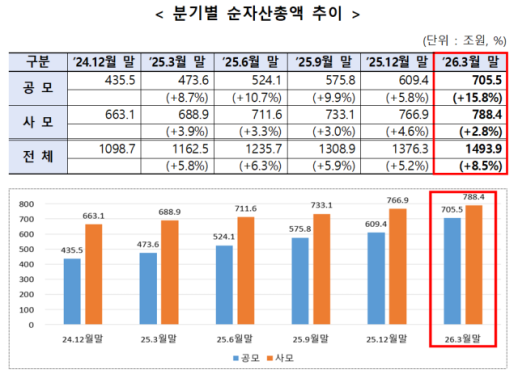 Korea Fund Assets Near 1,500 Trillion Won in Q1 as Stock Funds and ETFs Surge South Korea’s fund market expanded sharply in the first quarter, with total net assets nearing 1,500 trillion won as inflows concentrated in equity funds and money market funds, and exchange-traded funds posted strong growth. The Korea Financial Investment Association said Thursday in its “2026 first-quarter fund market trends” report that total net assets for public and private funds stood at 1,493.9 trillion won at the end of March, up 117.6 trillion won, or 8.5%, from 1,376.3 trillion won the previous quarter. The quarterly growth rate accelerated from 6.3% in the second quarter of last year, 5.9% in the third and 5.2% in the fourth. Both public and private funds increased. Public funds rose to 705.5 trillion won, up 96.1 trillion won, or 15.8%, from the prior quarter. Private funds climbed to 788.4 trillion won, up 21.5 trillion won, or 2.8%. By category, net assets increased across most types, with bond funds the exception, falling 3.9 trillion won. Equity funds posted the largest gain, rising 56.0 trillion won, followed by money market funds, or MMFs, up 34.5 trillion won, and derivatives funds, up 10.2 trillion won. Public-fund growth was led by equity funds and MMFs, while private funds grew mainly in MMFs and special-asset funds. Net inflows also showed a tilt toward equity funds and MMFs. Total funds recorded net inflows of 85.4 trillion won in the quarter, while bond funds alone saw net outflows of 2.5 trillion won. Public funds took in 72.3 trillion won and private funds 13.1 trillion won. By investment region, domestically focused funds drew 73.2 trillion won and overseas funds 12.1 trillion won. By type, net inflows went to equity funds at 32.9 trillion won, MMFs at 32.7 trillion won, derivatives funds at 7.5 trillion won and mixed funds at 4.4 trillion won. Public funds attracted money mainly into equity funds and MMFs, while private funds saw inflows centered on MMFs and mixed-asset funds. The share of domestically focused funds also increased. As of the end of March, domestic-investment funds held net assets of 976.1 trillion won, up 103.9 trillion won, or 11.9%, accounting for 65.3% of the total. Overseas-investment funds rose 13.7 trillion won, or 2.7%, to 517.8 trillion won, lowering their share to 34.7%. Domestic equity funds climbed to 177.8 trillion won, a 41.5% jump from 125.6 trillion won the previous quarter, helping drive overall market growth. Overseas funds posted more modest gains, led by equity and special-asset funds. ETF growth was particularly strong. ETF net assets totaled 360.7 trillion won at the end of March, up 63.6 trillion won, or 21.4%, from 297.1 trillion won the previous quarter. Within ETFs, equity products accounted for the largest share at 58.2%, followed by derivatives at 21.3% and bond ETFs at 14.6%. Net assets in public funds excluding ETFs rose to 344.7 trillion won, up 32.5 trillion won, or 10.4%. Public funds accounted for 47.2% of total fund assets, up 2.9 percentage points from the previous quarter, narrowing the gap with private funds. * This article has been translated by AI. 2026-04-30 15:42:19
 -
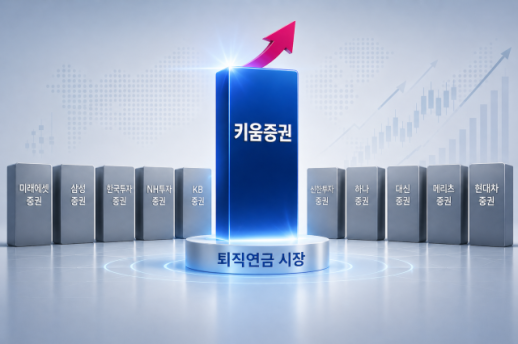 Kiwoom Securities Nears Launch of Retirement Pension Business Kiwoom Securities is preparing to enter South Korea’s retirement pension business, with market watchers saying its large base of individual investors could help it build a stronger presence in the pension market. Attention is also focused on whether a new player could accelerate a so-called “money move” — a shift of retirement pension assets toward securities firms — in a market that has grown to about 500 trillion won. According to the financial investment industry on Wednesday, Kiwoom completed registration with the Financial Services Commission earlier this month as a retirement pension provider and is preparing to launch services in June. The firm is building systems and refining its product lineup ahead of a full market entry. Kiwoom has also reorganized internally, forming a pension business team of about 30 people within its wealth management division. The team is led by Managing Director Pyo Young-dae, a retirement pension specialist who worked more than 15 years at Mirae Asset Securities and has led preparations since a task force was created in 2024. Kiwoom’s goal is to break into the top five by market share. As of the end of the first quarter, retirement pension assets at securities firms were led by Mirae Asset Securities with 42.4411 trillion won, followed by Samsung Securities (23.2681 trillion won), Korea Investment & Securities (22.5945 trillion won), Hyundai Motor Securities (18.8552 trillion won), NH Investment & Securities (10.7541 trillion won) and KB Securities (8.8981 trillion won). Reaching the top five would require securing at least 10 trillion won in assets. The market widely cites Kiwoom’s retail strength as its biggest advantage. The firm has held the No. 1 retail market share for 21 consecutive years and is seen as competitive in digital platforms centered on its mobile trading system. Analysts also say cost efficiency and pricing competitiveness through non-face-to-face channels could help it attract customers early. But the firm also faces clear constraints. The retirement pension market still relies heavily on corporate contracts and in-person sales. With a limited offline sales network, Kiwoom could be at a disadvantage versus larger rivals in defined benefit (DB) and defined contribution (DC) plans. Taking that structure into account, Kiwoom plans to focus first on individual retirement pensions, or IRPs. The strategy is to quickly expand contact with individual customers through IRPs, then gradually broaden into DC and DB offerings while building an integrated pension solution. Its product approach also emphasizes online distribution. Kiwoom plans to offer online-only products at low cost to reduce fee burdens and strengthen a structure that allows customers to select and manage products on its platform. It also aims to build an integrated wealth management platform linking retirement pensions with pension savings and individual savings accounts, or ISAs, providing services across the life cycle from contributions and management to withdrawals. Some in the market expect Kiwoom’s entry to speed up the shift of assets from banks to securities firms. According to the Financial Supervisory Service’s Integrated Pension Portal, total retirement pension assets stood at 501.4 trillion won at the end of last year, up 16.1% from 431.7 trillion won a year earlier. Over the same period, the securities industry’s share rose to 26.5% from 24.3%, while banks’ share edged down to 52.4% from 52.9%. * This article has been translated by AI. 2026-04-30 15:13:28
 -
 Sanil Electric shares jump more than 20% on $33.9 million U.S. data center transformer deal Sanil Electric shares surged more than 20% after the company disclosed a large transformer supply contract with U.S. energy company Bloom Energy for data centers. According to the Korea Exchange, Sanil Electric was trading at 275,000 won as of 2 p.m. on Wednesday, up 54,000 won, or 24.43%, from the previous session. The stock rose as high as 281,500 won intraday, marking a record high. The rally followed a filing that Sanil Electric signed a 50.3 billion won contract at 12:50 p.m. to supply transformers for U.S. data centers. Buying accelerated immediately after the disclosure. The contract equals 10.02% of the company’s 2025 revenue of 501.9 billion won. The contract period runs from April 24 to March 29, 2027. The contract amount was listed as $33.875 million, converted using the exchange rate on the contract date of 1,484.20 won per dollar. Sanil Electric, founded in 1994, is a transformer specialist. Transformers and reactors accounted for 97.4% of its revenue last year. Lee Min-jae, an analyst at NH Investment & Securities, said demand for transformers is expected to rise as demand for renewable energy expands following the U.S.-Iran war. He said Sanil Electric has a product lineup capable of supplying transformers suited to all voltage levels in power grids built around renewable energy, and has secured a stable customer base and profitability, making profit growth possible as sales expand. * This article has been translated by AI. 2026-04-30 14:18:31
 -
 Doosan Robotics shares jump 14% on expectations of Nvidia collaboration Doosan Robotics surged more than 14% in early trading on Thursday as investors bet on potential cooperation with Nvidia. According to the Korea Exchange, shares of Doosan Robotics were trading at 116,600 won as of 9:15 a.m., up 14,400 won, or 14.09%, from the previous session. The rally appeared to be driven by news that Madison Huang, senior director of product marketing for Omniverse · Robotics and the eldest daughter of Nvidia CEO Jensen Huang, visited Doosan Robotics’ Innovation Center in Seongnam, Gyeonggi Province, the previous day. The two sides discussed technology cooperation in so-called physical artificial intelligence. Madison Huang met with Doosan Robotics CEO Kim Min-pyo to explore ways to integrate Nvidia’s AI and robotics ecosystem into intelligent robot solutions and the development of industrial humanoids. They also discussed linking Doosan Robotics’ robot execution software under development, the ‘agentic robot operating system,’ with Nvidia’s AI and robotics simulation and training infrastructure. The companies said they plan to pursue a robot execution platform that can be deployed at industrial sites. Doosan Robotics said its agentic robot operating system is designed to let AI recognize work environments, optimize movement paths and support precise tasks. The company is working to advance the system by building robot-AI interfaces, developing standard robot-control protocols, connecting specialized task models and applying technical guardrails for safety control. The company plans to roll out intelligent robot solutions using the agentic robot operating system in 2027, followed by an industrial humanoid product in 2028. It is also considering unveiling collaboration results with Nvidia at major exhibitions, including CES in 2027. * This article has been translated by AI. 2026-04-30 09:37:42
 -
 Kiwoom Securities Q1 Net Profit Jumps 103% to 477.4 Billion Won on Trading Surge Kiwoom Securities said its first-quarter net profit more than doubled from a year earlier, helped by a sharp rise in stock market trading value. The company said Thursday that consolidated net profit for the first quarter of 2026 totaled 477.4 billion won, up 102.6% from 235.6 billion won a year earlier. Consolidated operating profit rose 90.9% to 621.2 billion won. On a separate basis, net profit came to 443.2 billion won and operating profit to 534.8 billion won, up 92.4% and 81.0%, respectively. Total equity stood at 6.2994 trillion won, a 25.6% increase from a year earlier. The brokerage business led the gains. Stock commission revenue in the quarter rose 120.8% to 311.5 billion won, as average daily trading value in the domestic market climbed to 27.8 trillion won from 8.8 trillion won a year earlier, more than tripling amid a stronger market. The asset management business also grew. Management profit and dividend and distribution income increased 58.9% to 155.7 billion won, and client assets under management rose 43.4% to 21.8 trillion won. In investment banking, Kiwoom built results mainly in the debt capital markets. It ranked fourth in domestic bond lead management in the first quarter and took part in major deals involving POSCO Future M, LS Cable, SK, Shinsegae and LG Energy Solution. It also worked on equity capital markets transactions, including rights offerings for Amicogen and Raonpeople, and arranged acquisition financing. For the previous quarter, the company posted consolidated net profit of 246.9 billion won and operating profit of 345.6 billion won in the fourth quarter of 2025. For the full year last year, it reported net profit of 1.115 trillion won and operating profit of 1.4882 trillion won. Kiwoom said it plans to announce a midterm corporate value enhancement plan in the first half of this year. It also aims to expand its outstanding balance of short-term notes from 1.2 trillion won to 3 trillion won by year-end and plans to launch retirement pension services (DB, DC and IRP) in June. As part of shareholder returns, the company has continued to buy back and retire its own shares, and said it held no treasury shares as of the end of March this year. * This article has been translated by AI. 2026-04-30 09:18:32
 -
 Daol Investment Raises Doosan Bobcat Target Price 23% on U.S., Europe Growth Daol Investment & Securities said Wednesday it raised its target price for Doosan Bobcat to 100,000 won from 81,000 won, a 23% increase, citing simultaneous growth in the U.S. and European markets and improving earnings. It maintained a “buy” rating. Choi Kwang-sik, an analyst at Daol Investment & Securities, said the U.S. market was solid in the first quarter, as it was for peers, while Europe posted growth. He said the firm raised its fair value estimate after results beat guidance and as it expects the market recovery cycle to continue over the next two years. Doosan Bobcat reported first-quarter consolidated revenue of 2.2473 trillion won and operating profit of 207.0 billion won, topping market expectations. The operating margin recovered to the high-7% range even excluding one-off factors, supported by price increases and cost controls, the report said. By region, both the U.S. and Europe expanded. The company had expected a U.S. decline this year after factoring in front-loaded demand tied to tariff effects, but sales instead rose 3%. The EMEA region, covering Europe, the Middle East and Africa, grew 18%, helping drive the improvement. By product, compact construction equipment and industrial vehicles posted $1.211 billion and $223 million, respectively, maintaining steady performance. The portable power business, where some shipments were deferred, is expected to be reflected in second-quarter results. The company also implemented additional price increases to offset the burden of steel and aluminum tariffs. Choi said low dealer inventories were another positive factor, adding that if retail demand continues to recover this year, the second half could outperform the first and signal entry into a recovery cycle. Daol also said the stock remains undervalued. Doosan Bobcat’s price-to-earnings ratio is about 13 times for 2026 and 10 times for 2027, below global peers’ 20 to 30 times. If the company maintains a 40% shareholder return ratio this year, the dividend yield is expected to be about 3.1%. * This article has been translated by AI. 2026-04-30 09:00:19
 -
 Korea’s ETF Copycat Problem Persists as New-Product Protections Go Unused Exchange-traded fund (ETF) protections designed to curb a flood of look-alike products are effectively not working, with usage either extremely limited or nonexistent for years, according to the financial investment industry. Critics say the lack of effective safeguards has helped fuel the spread of so-called “copycat” products in the ETF market. <Related article, Page 4> As of Tuesday, South Korea operates three index and product protection programs, but their use is virtually nil, industry officials said. The Korea Exchange’s “ETP New Product Protection Program” and the Korea Financial Investment Association’s “exclusive right to use a new product” have not been applied even once since 2020. Both are intended to give a financial investment firm that develops an innovative new product the right to sell it exclusively for a set period. Applications for the Korea Exchange program stopped after the “Samsung KRX Gold Spot ETN,” listed in November 2019. The association’s exclusive-use right has not been applied since October 2019, when Mirae Asset Daewoo (now Mirae Asset Securities) was granted five months of exclusivity for a “structured range equity-linked bond (ELB).” The Korea Exchange’s “index priority use right” (formerly an exclusive-use right) is used more often, but the industry says its impact is limited. The program allows exclusive use for three or six months based on factors such as index differentiation, but once the period ends there is no way to prevent similar indexes from entering the market. With multiple safeguards operating in name only, the ETF market’s copycat problem is worsening. South Korea now has 1,099 ETF products with total net assets of 431 trillion won. But products tracking the same index or using similar strategies continue to proliferate, repeatedly driving overheated competition. In many cases, an ETF is treated as distinct even if it changes only a small part of its portfolio holdings or weights. Operators of the programs say it has become harder to judge the “originality” required for protection. A Korea Exchange official said theme-based ETFs are often prepared by multiple asset managers around the same time to reflect investor demand and market issues, adding that it is difficult to find a clear reason to prevent only one firm from offering a given theme product. Asset managers, however, argue the structure ultimately favors large firms. Even if a small or midsize manager opens a niche with a distinctive ETF, a bigger competitor can launch a similar product and dominate using greater financial resources and distribution networks. “When smaller firms target a niche and launch a product, the pattern repeats: once it looks promising, a large firm follows and pushes it with scale,” an asset management industry official said. * This article has been translated by AI. 2026-04-29 18:26:44
 -
 Aju IB Investment Shares Slide Nearly 20% After Majority Owner Plans Block Trade Aju IB Investment shares fell nearly 20% in intraday trading after news that its majority owner plans a block trade, raising concerns about a large supply of shares hitting the market and a reduced controlling stake. According to the Korea Exchange, Aju IB Investment was trading at 14,980 won as of 10:02 a.m. on Tuesday, down 3,720 won, or 19.89%, from the previous session. Aju, the company’s largest shareholder, said in a regulatory filing the previous day that it plans to sell 8,480,178 shares of Aju IB Investment, equal to a 7% stake, through an after-hours block trade. Aju’s ownership would fall to 53.37% from 60.54%. The Korea Institute of Science and Technology is the second-largest shareholder with a 7.15% stake, and Aju would remain the largest shareholder after the sale. The sale price was set at 18,700 won per share, with the transaction scheduled to run from May 28 to June 26, about a month. The total deal value is expected to be about 158.6 billion won. Aju said the purpose of the transaction is to “secure strategic investment funds and support Aju IB Investment’s investments.” Aju IB Investment was founded in 1974 as Korea Technology Advancement Co. and changed to its current name in 2008. As South Korea’s first venture capital firm, it began expanding new-technology investments in earnest after 2001 by forming investment funds. As of the end of last year, it had cumulatively formed a total of 55 VC investment funds with 2.1523 trillion won and 11 private equity funds with 1.6889 trillion won, for a combined 3.8412 trillion won. * This article has been translated by AI. 2026-04-29 10:29:19
 -
 Hyundai Rotem Shares Jump 8% on Poland K2 Tank Local Production Deal Hyundai Rotem shares surged more than 8% for a second straight session after the company said it signed a cooperation agreement tied to local production of K2 tanks in Poland. As of 9:43 a.m., Hyundai Rotem was trading at 265,500 won, up 21,000 won (8.59%) from the previous session, according to the Korea Exchange. The stock rose 5.84% a day earlier. Hyundai Rotem said Tuesday it signed a local production and maintenance cooperation agreement with Bumar-Labedy, a defense company under Poland’s state-run defense group PGZ, covering the Polish-version K2 tank (K2PL) and an armored recovery vehicle. The company said the agreement sets out specific execution measures for a core project under the second implementation contract for Poland’s K2 tanks signed in August last year, and is expected to support efforts to expand defense orders in Europe by building a local production base. With major European countries increasingly seeking local production in defense procurement, Hyundai Rotem plans to use Poland as a production hub for K2 tanks to pursue additional orders. The company said local production of related equipment, including a combat engineering vehicle and an armored bridge-layer, will be discussed in stages. Lee Jaekwang, an analyst at LS Securities, said he expects the stock to rise on increased new defense-export orders rather than further gains in profitability. He said the company appears to be aiming to boost K2 exports by using production hubs in Europe-Poland, Latin America-Peru and the Middle East-Iraq. * This article has been translated by AI. 2026-04-29 09:57:07