

Journalist

Chang Seong-won
sotg813@ajunews.com
-
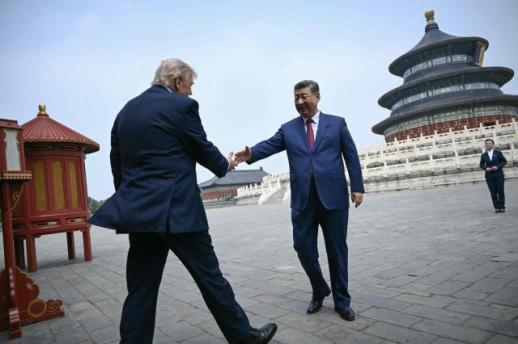 Trump and Xi Arrive at Temple of Heaven After Summit U.S. President Donald Trump and Chinese President Xi Jinping arrived at the Temple of Heaven after concluding their summit at the Great Hall of the People on May 14, according to China’s state broadcaster CCTV. Following their meeting, which lasted from 10:15 a.m. to approximately 12:30 p.m., the two leaders toured the Temple of Heaven and are scheduled to attend a state dinner in the evening. The Temple of Heaven is a sacred site where emperors historically offered sacrifices to the heavens, symbolizing the connection between celestial order and earthly governance. This visit holds significance as it marks a departure from Trump’s first visit to China in 2017, when he was invited to the Forbidden City. Analysts suggest that this invitation to the Temple of Heaven is rich in meaning, allowing China to showcase not only the grandeur of its ancient imperial history but also to convey its cultural depth to President Trump. Additionally, agriculture is a key agenda item for this visit, enhancing the significance of the Temple of Heaven, a place historically associated with prayers for abundant harvests. Observers believe that President Trump may naturally discuss increasing purchases of U.S. soybeans, grains, and meats during this visit. The Temple of Heaven also holds special significance in U.S.-China relations. According to the Singapore-based United Daily News, former President Richard Nixon visited the Temple of Heaven during his historic trip to China in 1972, becoming the first sitting U.S. president to do so. Henry Kissinger, the former U.S. Secretary of State known as a long-time friend of the Chinese people, has visited the site more than ten times, reflecting its importance in diplomatic history.* This article has been translated by AI. 2026-05-14 15:44:42
 -
 Trump Arrives in Beijing for Summit with Xi Jinping During his visit to China, President Donald Trump arrived at the Great Hall of the People in Beijing for a summit, where he was welcomed by Chinese President Xi Jinping. According to reports from AFP and other news agencies, Trump arrived at the venue around 10 a.m. local time, shaking hands with Xi before reviewing a guard of honor from the People's Liberation Army. Following the arrival ceremony, Trump is scheduled to hold talks with Xi at the Great Hall and participate in a dinner hosted by the Chinese leader at 6 p.m. On the final day of his visit tomorrow, Trump is expected to engage in a photo session, enjoy tea time, and have lunch with Xi.* This article has been translated by AI. 2026-05-14 12:51:44
 -
 China confirms Trump's visit to Beijing later this week SEOUL, May 11 (AJP) - U.S. President Donald Trump will make a state visit to China this week at the invitation of Chinese President Xi Jinping, the country's Foreign Ministry said on Monday. The announcement came a day after the White House said Trump is scheduled to arrive in Beijing on Wednesday ahead of a summit with Xi Jinping the following day. His trip will mark the first visit to China by a U.S. president in nearly a decade. The last such visit was also made by Trump during his first term in 2017. The leaders of the world's two largest economies are expected to discuss a range of issues, including efforts to stabilize energy supplies and reopen the Strait of Hormuz amid the prolonged conflict in the Middle East. Trade and tariffs are among the key topics in their talks after the two countries clashed last year over steep tariffs, semiconductor technology, and restrictions on rare earth exports. It remains to be seen whether the two sides will be able to mend ties and resolve their disputes. North Korea's nuclear program is not officially on the agenda, but it is expected to come up during the talks, with Trump likely to seek cooperation from Xi on the issue. Although the White House said there are no plans for a meeting between Trump and North Korean leader Kim Jong-un, the possibility of an impromptu encounter has not been completely ruled out. Meanwhile, Trump will visit Temple of Heaven, a UNESCO World Heritage site in Beijing, together with Xi on Thursday and is also scheduled to attend a bilateral tea meeting and a working lunch with Xi on the final day of his visit, according to the White House. 2026-05-11 16:14:15
 -
Trump to Visit China from May 13 to 15 at Xi Jinping's Invitation President Donald Trump will make a state visit to China from May 13 to 15 at the invitation of Chinese President Xi Jinping, the Chinese Foreign Ministry announced on May 11. The White House also confirmed on May 10 that Trump will visit China during this period. According to the announcement, Trump is scheduled to arrive in Beijing on the evening of May 13, hold a bilateral summit with President Xi on May 14, and tour the Temple of Heaven in Beijing before attending a state dinner. On the final day of his visit, May 15, Trump plans to have a private tea time and a working lunch with Xi, the White House stated. Ahead of the US-China summit, senior trade representatives from both countries are expected to meet in South Korea on May 13. U.S. Treasury Secretary Scott Vezent announced on his X (formerly Twitter) account that he will visit Japan and South Korea for a series of meetings ahead of Trump's historic summit with Xi in Beijing. Vezent is scheduled to visit Japan on May 12 and South Korea on May 13, where he will meet with Chinese Vice Premier He Lifeng. 2026-05-11 10:24:16
-
 First Korea-France Job Fair to be Held After Macron's Visit The "Career Forum 2026 (Forum Emploi 2026)," a leading recruitment and networking event connecting talent and businesses in the Korea-France business community, will take place on the 27th and 29th in Seoul and Busan, respectively. This year’s event is particularly notable as it follows French President Emmanuel Macron's visit to Korea last month and marks the first time it will be held in Busan. Organized by the French Chamber of Commerce in Korea (FKCCI), the event serves as a platform for recruitment, networking, and career development, providing job seekers and experienced professionals seeking new opportunities in Korea with access to French and global companies. The Seoul event on the 27th will be held at the Korea Chamber of Commerce and Industry (KCCI) International Conference Center, featuring participation from various French and major European companies, including Accor Ambassador, Allianz, Capital Recruitment, Danone Group, De'Longhi, the French-Korean Chamber of Commerce (FKCCI), PwC Mazars, Geodis Korea, Grand Mercure Ambassador Hotel, IT Concept, Louis Vuitton Korea, Luxury Business Group, Orano Korea, Promosalons, Richemont, Sofitel Ambassador Seoul, Thales Korea, Ambassador Seoul Pullman Hotel, Veolia Korea, and Yondera by Aptero. The Busan event on the 29th will take place at the Busan National University Law School, aiming to connect local students and professionals with global companies and provide new opportunities to explore careers within the Korea-France business ecosystem. This event is supported by key institutions and partners, including the French Embassy in Korea, KCCI, Busan National University, French Alumni Day, and the Korea Chamber of Commerce. Currently, registration for both events in Seoul and Busan is ongoing. Individuals and companies interested in attending can apply through the FKCCI website. Participants will have the opportunity to meet recruiters directly, explore career opportunities, and engage in industry-specific conferences and practical workshops to enhance their job skills. Participating companies will benefit from attracting top talent, enhancing their visibility and brand image, and building relationships with universities while supporting academic and economic exchanges between the two countries. This event is receiving significant attention as it follows the recent summit between President Macron and President Lee Jae-myung, where both leaders expressed their commitment to increasing the employment scale of investment companies to 80,000 over the next decade and striving for a new era of human exchange involving 1 million people. Founded in 1986, FKCCI is celebrating its 40th anniversary this year and has been a leading institution in promoting business cooperation between Korea and France, currently boasting over 475 member companies. FKCCI has ranked third in revenue among foreign chambers of commerce in Korea and sixth among French overseas chambers of commerce worldwide for two consecutive years as of 2024, enhancing its presence in Korea. * This article has been translated by AI. 2026-05-11 03:22:02
 -
 Trump Hints at Ending Iran Conflict Before China Visit President Donald Trump indicated the possibility of concluding peace negotiations with Iran ahead of his upcoming visit to China. However, significant differences remain on key issues such as Iran's nuclear program and the reopening of the Strait of Hormuz, leaving the timeline for a potential agreement uncertain. On May 6, during a White House event, Trump told reporters, "Iran cannot and will not have nuclear weapons," adding that they have agreed on several points. He noted, "We had very good discussions with Iran over the last 24 hours, and the chances of an agreement are very high." Reports from CNN and Axios suggest that the U.S. and Iran are discussing a memorandum of understanding (MOU) to end hostilities. The one-page MOU reportedly includes a temporary halt to Iran's nuclear enrichment, the lifting of U.S. sanctions, and a gradual easing of maritime blockades. In an interview with PBS, Trump mentioned that the agreement would likely involve the transfer of Iran's enriched uranium to the U.S. and a halt to operations at Iran's underground nuclear facilities. He expressed optimism about reaching an agreement before his trip to China on May 14-15, stating, "It is possible that we will have an agreement before I leave for China." Axios reported that the White House hopes to finalize negotiations with Iran before Trump's visit. Fox News anchor Bret Baier noted that Trump anticipated a week to reach an agreement, reflecting a cautious optimism. Daniel Shapiro, former U.S. ambassador to Israel, remarked that Trump has a strong incentive to conclude the conflict before his China visit. He warned that if the war continues, Trump may find himself seeking Xi Jinping's help to persuade Iran to accept U.S. conditions. Iran: 'Just a U.S. wishful thinking' Despite Trump's emphasis on progress, he warned that if Iran does not agree, military action would resume. On social media platform Truth Social, he stated, "If they do not agree, bombing will start, and sadly, it will be at a much higher level and intensity than before." Additionally, the U.S. continues to maintain its maritime blockade against Iran despite the ongoing peace negotiations. The U.S. Central Command reported enforcing a blockade on the oil tanker Hasna, which was heading to an Iranian port. Iran remains defiant, having implemented new maritime regulations requiring all vessels passing through the Strait of Hormuz to obtain prior permission. This raises questions about whether key issues like the reopening of the Strait and the nuclear program can be resolved even if negotiations resume. On social media platform X (formerly Twitter), Ebrahim Raisi, spokesperson for Iran's National Security Committee, dismissed reports of nearing an agreement, stating that U.S. hopes for a swift resolution are unrealistic. Mohammad Bagher Ghalibaf, the Speaker of Iran's Parliament, also denied claims of progress in negotiations. Grant Rumley, a researcher at the Washington Institute for Near East Policy, noted that while the Trump administration believes a peace agreement is possible, history shows that negotiations often collapse at the last minute for various reasons.* This article has been translated by AI. 2026-05-07 21:31:57
 -
 Trump Aides Worry Jet Fuel Spike From Middle East War Could Hurt GOP in Midterms President Donald Trump’s aides have begun voicing concern about a sharp rise in jet fuel prices tied to the Middle East war, The Wall Street Journal reported Tuesday, citing sources. The spike could become a political liability for Republicans ahead of the midterm elections in early November, the report said. Chris Sununu, a Republican who leads Airlines for America, has warned Trump administration officials in recent weeks — including White House National Economic Council Director Kevin Hassett — about the economic fallout from elevated jet fuel costs, the sources said. Trump’s advisers also fear the price surge could damage Republicans politically and want the war to end quickly, the sources said. With global oil and jet fuel prices climbing because of the war, consumers heading into the summer travel season face higher costs, potentially fueling negative views of Trump and the GOP, the report said. In an NPR/PBS/Marist poll conducted April 27-30 among 1,322 U.S. adults (margin of error plus or minus 3.1 percentage points), 63% said the Trump administration bears significant responsibility for rising oil prices. Eight in 10 respondents said higher oil prices are increasing their financial burden. Reuters reported jet fuel prices rose from about $85 to $90 before the war to roughly $150 to $200 recently. The U.S. Department of Transportation said U.S. scheduled airlines spent $5.06 billion on jet fuel in March, up 56.4% from the prior month and 30.4% from a year earlier. Spirit Airlines, a major U.S. low-cost carrier, announced on May 2 that it would shut down, citing rising costs and other pressures. Higher fuel costs are also pushing up ticket prices. The U.S. Airline Survey Association said the average U.S. round-trip airfare in March was $570, up 21% from a year earlier. The Journal said Trump, who had initially dismissed the oil-price rise as “a very small cost” to eliminate Iran’s nuclear weapons, is now moving quickly to end the war. Sununu said administration officials are starting to recognize the economic consequences of the conflict. “Because of this, they’re trying to end the war as quickly as possible,” he said. Sununu cautioned it could take months for oil prices to return to prewar levels, and said even if the war ends immediately, airfares are likely to remain high through the fall. Trump said in an interview with PBS that a deal to end the war with Iran could be reached before his planned trip to China on the 14th and 15th, signaling the possibility of a swift agreement.* This article has been translated by AI. 2026-05-07 15:34:35
 -
 Israel Strikes Lebanon Again During Ceasefire, Raising Stakes for U.S.-Iran Talks Israel carried out another large-scale airstrike on Lebanon during a ceasefire, resuming clashes that could complicate emerging U.S.-Iran talks on ending the war. On May 6 (local time), Reuters and Al Jazeera reported that Israeli Prime Minister Benjamin Netanyahu and Defense Minister Israel Katz said in a statement that Israel had struck Lebanon. The reports said Israel used fighter jets and armed drones to hit Hezbollah’s elite Radwan force in southern and eastern Lebanon, with at least 13 people reported killed. Hezbollah said it retaliated against Israeli forces using armed drones. The strike came during a ceasefire between Israel and Lebanon. Under U.S. and other mediation, the sides observed a 10-day truce from April 17 to 26 and then agreed to an additional three-week ceasefire from April 26 to May 17. Still, Israel carried out airstrikes on Lebanon on May 2 and May 5, and the violence has continued. The latest attack is also expected to affect U.S.-Iran negotiations that are now seen as within reach. Hezbollah is part of the Iran-aligned “Axis of Resistance,” and Iran’s conditions presented to the United States include an end to Israeli hostile actions against Lebanon. As clashes between Israel and Lebanon intensify, the prospects for a U.S.-Iran deal appear to diminish, and Netanyahu has voiced opposition to the talks. Reuters said, “As Iran and the United States were saying they were getting closer to end-of-war talks, the strike is threatening the ceasefire agreement that had halted Israel’s airstrikes on Lebanon.” Analysts also said the ceasefire-era speculation about a possible summit between Lebanese President Joseph Aoun and Netanyahu has become less likely. Atlantic Council researcher Nicholas Blanford told Al Jazeera, “The image of President Aoun shaking hands with Netanyahu would have a very negative impact in Lebanon.” Clashes between Israel and Lebanon began after Hezbollah resumed attacks on Israel on March 2, shortly after the outbreak of the Iran war. Lebanon’s Health Ministry says Israeli attacks have killed about 2,700 people in Lebanon and displaced 1.2 million. Israel has said 17 soldiers and two civilians have been killed.* This article has been translated by AI. 2026-05-07 11:21:07
 -
 WSJ: Trump Wants Iran War Deal Before China Trip, May Resume Strikes if No Accord An analysis says President Donald Trump wants to reach an agreement to end the war with Iran before his planned May 14-15 visit to China. If no deal is reached even after the trip, Trump could again turn to military action, the reports said. The Wall Street Journal reported Tuesday, citing Daniel Shapiro, a former U.S. ambassador to Israel, that the longer the war drags on, the more China’s leverage grows in other U.S.-China negotiations. “Trump has a strong incentive to wrap up the war before next week’s China visit,” Shapiro said. If the war continues, he said, Trump would arrive in China “in the position of a supplicant,” asking Xi Jinping to help pressure Iran to accept Trump’s terms. Shapiro added that the ongoing Middle East war weakens U.S. deterrence against China in the Indo-Pacific and helps Xi’s effort to portray the United States as unstable while casting China as a responsible, mature power. Shapiro said that if the war ends, Trump can focus on the economic deals he cares about most. He added that Iran understands that dynamic, giving Tehran some negotiating leverage to extract a certain level of agreement. CNN also reported, citing sources, that if Trump visits China without concluding talks to end the war with Iran, it would hand Beijing an advantage. A Chinese source told CNN that Trump wants to visit China after resolving the Iran issue to project strength. In an interview Tuesday with PBS, Trump said a deal with Iran could be reached before his China trip. Asked whether it would be finished before he leaves next week, he replied, “It’s possible.” But Trump suggested he could resume military action if no agreement is reached. “We’re going to have to bomb them again like crazy,” he said. Axios also reported Tuesday, citing U.S. officials, that Trump could consider renewed military action if negotiations with Iran do not produce an agreement by the end of his China visit. The report said that if talks still fail after Trump’s China trip, his incentive to negotiate could weaken, potentially leading him to intensify pressure on Iran in a way aimed at China. The Chinese source told CNN that if Trump attacks Iran after the China visit, it could make it appear China abandoned Iran. The source added that Trump is “very smart” and, rather than striking China directly, first brought down Venezuela and is now targeting Iran — moves the source described as effectively clipping China’s wings in those regions.* This article has been translated by AI. 2026-05-07 09:37:17
 -
 Trump Says Tariffs Aren’t High Enough, Signals Push for Additional Duties President Donald Trump said current tariff levels are not high enough, openly signaling interest in additional duties as large-scale refunds are set to begin next week following a U.S. Supreme Court ruling that invalidated his administration’s “reciprocal” tariffs. The Trump administration is expected to use this week’s hearings under Section 301 of the Trade Act to press ahead with what it has described as “alternative tariffs.” According to CBS and other outlets, Trump told a White House Small Business Summit held during U.S. Small Business Week on May 4 (local time) that while people had said they were thankful for tariffs, “I think those tariffs are actually not high enough.” He added that the administration is reviewing alternative tariffs and said, “Refunding tariffs is really terrible.” The remarks came after the Supreme Court in February struck down reciprocal tariffs and other duties the administration had imposed under the International Emergency Economic Powers Act, or IEEPA. Reuters, citing a statement from U.S. Customs and Border Protection, reported that the refund process is expected to begin May 12. CBP estimates it collected about $166 billion in IEEPA-based tariffs from 330,000 importers, suggesting refunds could be substantial. CBS, citing CBP data, reported that as of April 26 more than 11 million refund claims had been filed. As the administration looks beyond IEEPA, the Office of the U.S. Trade Representative is preparing tariffs under Section 301 and plans hearings May 5-8 involving 16 countries, including South Korea and China, on issues tied to overproduction. After the reciprocal-tariff ruling, the administration imposed a 10% global tariff, and since March USTR has launched Section 301 investigations of major trading partners over overproduction and forced labor. Section 301 allows the United States to respond to foreign policies and practices deemed unfair and harmful to U.S. trade. USTR is expected to complete its investigation by July 24, and it is widely expected the administration will impose tariffs on countries where it finds practices it considers unfair. Still, with public sentiment souring amid high prices linked to tariff policy, concerns are also emerging within the Republican Party ahead of this year’s midterm elections. Small businesses, with limited leverage to negotiate prices, are seen as especially vulnerable because they may struggle to pass higher costs on to consumers. Rep. Max Miller, R-Ohio, said, “This tariff policy is not working for them (small businesses),” adding, “Overall, it is not having a positive effect. Overall, it is a negative effect.” CBS also reported that Ford, a major U.S. automaker, has asked the Trump administration not to introduce additional tariffs beyond those already in place.* This article has been translated by AI. 2026-05-05 16:39:14