
Journalist

박세진
swatchsjp@ajunews.com
-
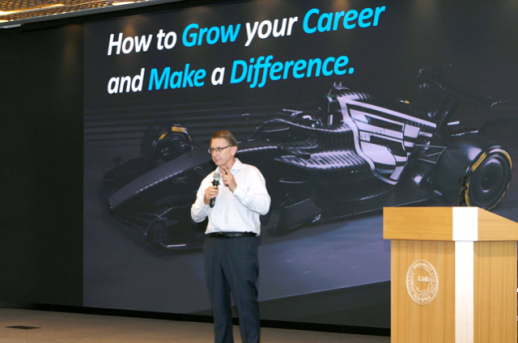 GMTCK president emphasizes passion and leadership at Kookmin University lecture SEOUL, May 12 (AJP) - Brian McMurray, president of GM Technical Center Korea, delivered a special lecture at Kookmin University on the importance of passion-driven career strategies and leadership in a rapidly changing industrial landscape, the university said Thursday. Speaking to students at the university's academic conference hall on May 7, McMurray addressed the theme of how to grow a career and make a difference. He shared personal insights from his journey as an engineer and executive across seven countries, encouraging students to design their careers based on individual values. McMurray highlighted that following one's passion provides the resilience necessary to overcome professional challenges. He noted that as companies increase investment in artificial intelligence, young professionals face both new risks and opportunities. He urged students to maintain a mindset of continuous learning and inquiry to remain competitive in an increasingly automated job market. The president also discussed the necessity of organizational cultures that embrace failure as a prerequisite for innovation. McMurray cited the "No Watermelons" campaign at GMTCK, an initiative designed to encourage employees to share problems openly rather than hiding them under a green exterior of feigned success. He further cautioned against the potential for misunderstandings in text-based communication, advocating for direct dialogue and empathy. "Leadership is about inspiring trust and providing inspiration rather than relying on titles or backgrounds," McMurray said. He explained that technical competence must be paired with an attitude that respects and fosters the growth of others. The session concluded with a question-and-answer segment covering career concerns and the global industrial environment. McMurray advised students to challenge themselves without fear of making mistakes and to strive toward making a positive impact on the world. The event marked the 665th installment of the Kookmin University Thursday Lecture series, a regular credit course that has hosted approximately 670 prominent figures from politics, science, and the arts over the past 30 years. Previous speakers include former South Korean President Roh Moo-hyun and film director Park Chan-wook. 2026-05-12 15:28:04
 -
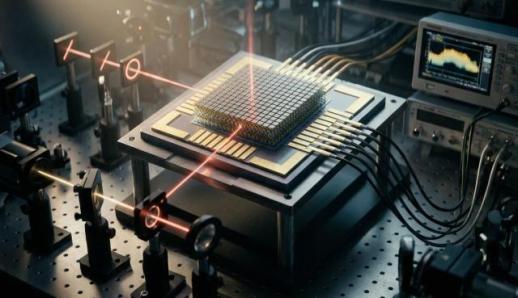 KAIST researchers develop self-adjusting light sensor to improve autonomous driving safety SEOUL, May 12 (AJP) - Researchers at the Korea Advanced Institute of Science and Technology developed a sensor capable of adjusting its own response to light to overcome the limitations of current autonomous driving vision systems, the prominent institute said Tuesday. Standard image sensors primarily detect light brightness, which can make it difficult for autonomous vehicles to distinguish between objects with similar reflectivity, such as water and asphalt at night. The new "self-reconfigurable" sensor array instead utilizes polarization, which is the direction in which light vibrates, to identify the surface structure and orientation of objects. Korea Advanced Institute of Science and Technology (KAIST) Professor Seo Jun-ki and his team in the Department of Chemical and Biomolecular Engineering used a combination of tellurium and rhenium disulfide to create a specialized structure. This arrangement allows the sensor to change its operational state based on incoming light waves without requiring external electrical signals. The team employed a precise manufacturing process called epitaxial atomic layer deposition to stack these materials at the atomic level. This method ensures the crystal structures align correctly, providing higher stability and more reliable performance compared to existing 2D material layering techniques. This technology is designed for in-sensor computing, where the device processes visual data directly rather than sending it to a separate processor. In laboratory tests, the system achieved over 95 percent accuracy in recognizing moving objects while maintaining high energy efficiency. "This research presents a new foundation for artificial intelligence vision technology that can secure richer visual information by using polarization," Professor Seo said. He noted that the technology is expected to play a significant role in developing low-power AI systems for autonomous driving and medical diagnostics. Researchers Wenxuan Zhu and Kim Chang-hwan participated as lead authors of the study. The findings were published in the journal Nature Sensors on April 14, 2026. (Reference Information) Journal/Source: Nature Sensors Title: Self-reconfigurable polarization perception in dual-anisotropy heterostructures for high-dimensional in-sensor computing Link/DOI: https://bit.ly/4dkdYHE 2026-05-12 15:07:00
 -
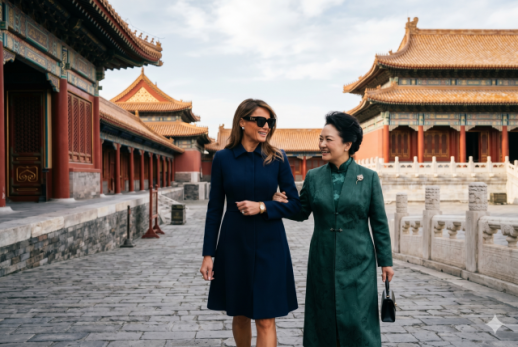 ASIA INSIGHT: Soprano and model to anchor fragile US-China Summit SEOUL, May 12 (AJP) - In November 2017, inside the amber-hued silence of the Forbidden City, Donald Trump handed a tablet computer to Xi Jinping and Peng Liyuan. On the screen, a small, blonde girl sang a folk song and recited ancient poetry in Mandarin. The girl was Arabella Kushner, the American president’s granddaughter. As she watched the video, Peng—a woman whose own soprano voice once stirred the nationalist fervor of a billion people—beamed with the practiced appreciation of a fellow artist. Xi famously graded the child’s performance an A-plus. It was a moment of hyper-stylized intimacy, a calculated exchange of cultural capital that did more to stabilize the volatile superpower rapport than a dozen white papers on trade deficits ever could. As the two leaders prepare to descend upon Beijing tomorrow, the global focus has naturally settled on the hard metrics of power. The world is watching the price of Iranian light crude, the export quotas for rare earth minerals, and the existential race for artificial intelligence. Yet the true temperature of the summit is taken in the quiet spaces between the spouses. In this high-stakes theater, Melania Trump and Peng Liyuan are not merely sidecar figures. They are the primary civilizational solvent of the summit. Their rapport is not born of a shared political ideology, but of a shared, professionalized visibility that functions as the only remaining warmth in a relationship that has otherwise turned to ice. There is a structural symmetry to these two women that defies their vastly different origins. Peng is a creature of the stage, a former major general in the People’s Liberation Army whose pre-marriage career as a famous singer made her a household name across China. She understands that in Beijing, performance is synonymous with policy. Melania Trump spent her career as a high-fashion model, a profession that demands the mastery of the silent gaze and the use of attire as a form of non-verbal communication. Both are artists of the image. They understand that in a world of clashing empires, the aesthetic is often the only remaining bridge when the language of diplomacy fails. While their husbands frequently lapse into the language of zero-sum competition, the first ladies have established a parallel track of high-culture rapport. They share a fundamental understanding of the power of the frame. During past encounters, they have leaned into this mutual discipline, using silence as a diplomatic tool. They are the velvet architecture that masks the brutalist edges of the negotiations, presenting a united, elegant front while their husbands calculate the cost of steel and sovereignty. The decision to host the Trumps at the Temple of Heaven this May is less a gesture of hospitality and more a tactical exercise in sacred geography. For half a millennium, Chinese emperors walked these grounds not as masters, but as supplicants, performing rigid ceremonies to prove they were worthy of the sky’s favor. The very stones are a map of a lost humility—the circular altars reaching for a heaven that demanded order in exchange for rain and peace. Today, however, that cosmological humility has been replaced by a transactional ego. By granting the Trumps access to these restricted inner sanctums, Xi Jinping is effectively staging a modern coronation for his guest. It is a masterful deployment of imperial flattery, treating the American president as a visiting monarch to distract from the cold realities of semiconductor export bans and regional containment. Within this gilded trap, the chemistry between Peng and Melania becomes a strategic necessity. As the men retreat into the shadows of the Hall of Prayer for Good Harvests to haggle over the Strait of Hormuz and deep-learning models, the first ladies must maintain the necessary fiction of civilizational friendship. They act as human shields against the friction of two colliding systems. If Peng can project an aura of maternal stability and Melania can offer her signature, statuesque poise, they provide the "managed" element of managed competition. They signal to the markets—and to anxious neighbors in Seoul—that even if the men are ready to burn the house down, the women are still tending to the furniture. When the final tea is poured and the cameras are shuttered, the stones of the Circular Mound Altar will remain, indifferent to the transactional egos of the men who walked upon them. We are left with the haunting realization that while empires are built on the cold logic of trade and territory, they are often preserved by the discipline of those who know how to stand still. In the calculated silence of the spouses, we find a fleeting, fragile peace—a reminder that the most sophisticated weaponry of the century may not be a missile or a microchip, but the quiet, impeccable maintenance of the mask. 2026-05-12 13:32:13
 -
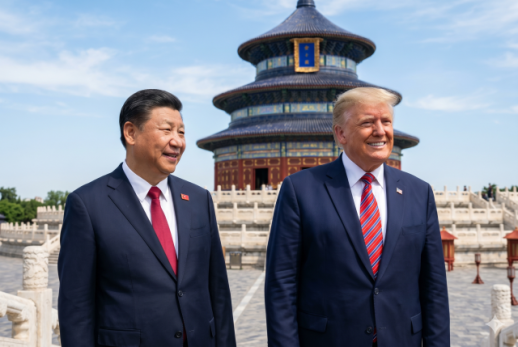 ASIA INSIGHT: Xi Jinping crafts imperial mirage at Temple of Heaven The meeting between the world’s two most powerful men is less a diplomatic summit than a calculated ritual of psychological capture. SEOUL, May 12 (AJP) - In a quiet corner of the Treasury Department, the steel plates have been etched with a flourish that feels more like a royal decree than a bureaucratic necessity. For the first time in the history of the American Republic, the currency carries the aggressive, looping signature of the man in the Oval Office. Combined with the twenty-two-foot gilded monuments rising on Florida golf courses and the promise of a presidential seal embossed on every United States passport, the aesthetic shift is unmistakable. Donald Trump does not merely want to lead a government. He wants to embody a state. Xi Jinping has spent a lifetime studying the semiotics of power, and he knows exactly who is stepping off Air Force One on Wednesday. He understands that while a president is constrained by courts and congresses, an emperor is moved by something far more primal, which is the recognition of his own divinity. When the two leaders meet for the summit on May thirteen, fourteen, and fifteen, the world will be told of trade quotas, semiconductor sovereignty, and the cooling of the Iranian theater. The true business of the week, however, will take place on the ancient, circular stones of the Tiantan, universally known as the Temple of Heaven. By choosing this site over the sterile, socialist-realist halls of the Great Hall of the People, Xi is not merely hosting a summit. He is conducting a coronation. The Temple of Heaven is the literal axis where the Son of Heaven once mediated between the celestial and the terrestrial. Built in fourteen twenty, it was the site where the emperor would process from the Forbidden City to fast, pray, and offer sacrifices during the winter solstice. The architecture is a map of a rigid, cosmic hierarchy. The northern walls are rounded to mimic the sky, while the southern walls are square to represent the earth. To walk these grounds is to walk the boundary of the known world. The irony of the Temple of Heaven is that the rituals performed there were historically a desperate plea for order in a time of chaos. The emperor offered sacrifices because he feared the drought, the famine, and the loss of his mandate. He went there to be humble before the heavens. Today, as the world teeters on the edge of a fundamental divorce between the two largest economies, the pageantry in Beijing serves an entirely opposite purpose. It is a grand, gilded attempt to mask the fact that the old global order is dying, utilized by two men who view the mandate of heaven not as something to be earned through prayer, but as something to be seized through brute transaction. When the American delegation arrives, it will bring more than just state department officials. Chief executives from Apple, Nvidia, Boeing, and Exxon are expected to flank the president, transforming this diplomatic mission into a high-stakes corporate parley. They are traveling to Beijing because the architecture of the future is currently fractured. The United States maintains a tight grip on the advanced microprocessors that serve as the brains for the next generation of artificial intelligence and humanoid robotics. China, conversely, processes roughly 90 percent of the world’s rare earth minerals, effectively holding the lifeblood of modern hardware hostage. This is the opening chapter of an artificial intelligence cold war, and it is a distinctly modern standoff being waged inside a fifteenth-century courtyard. The negotiations over this technological frontier are inextricably linked to the physical wars currently draining the global economy. As the conflict involving Iran enters its third month, China has quietly stepped into the unlikely role of Middle Eastern peacemaker. Beijing cannot afford the disruption of prolonged hostilities. Surging oil prices have driven up the cost of petrochemicals, raising production costs by 20 percent for some Chinese manufacturers who are already battling a sluggish domestic economy and high unemployment. Xi needs Washington to recognize China's leverage over Tehran. He is likely hoping that if he can nudge Iranian officials back to the negotiating table and stabilize the Strait of Hormuz, Trump will reconsider the aggressive trade probes and chip export bans currently strangling Chinese technology firms. Trump arrives with his own domestic vulnerabilities that demand a grand bargain. The American agricultural sector has been battered by retaliatory Chinese tariffs, and securing a massive purchase of soybeans and pork is essential for pacifying his political base in key voting states. Furthermore, the Supreme Court recently curbed his unilateral tariff powers, meaning he must secure concessions through sheer diplomatic force rather than executive fiat. Xi knows that a man who sees his own name on a dollar bill is susceptible to the lure of a historic deal. By elevating Trump to the status of a fellow Son of Heaven, Xi creates a space where the brutal, zero-sum realities of global trade can be reimagined as a simple agreement between two titans. For those of us in the rest of Asia, this is a profoundly precarious moment. We are watching two men negotiate the fate of the twenty-first century across an ancient altar. From Seoul, the view is one of existential anxiety. Our semiconductor sovereignty and our regional security are the bargaining chips in a ritual designed to satiate the egos of two men who believe they are the authors of history. The won-dollar pressure is already mounting as markets anticipate an agreement that might favor personal prestige over structural stability. If the price of semiconductor access is a banquet in a restricted palace, Xi Jinping is more than willing to pay it, leaving allied nations to navigate the fallout. As the sun sets over the blue-tiled roofs of the Hall of Prayer for Good Harvests, the reality will remain long after the motorcades have departed. A signature on a dollar bill does not make a man an emperor, and a dinner in a restricted palace does not resolve a superpower rivalry. We are witnessing the birth of a new, imperial era of diplomacy, one where the theater of power is so overwhelmingly loud that it threatens to drown out the silent, crumbling foundations of the world it seeks to govern. In the end, the mandate of heaven is never truly given to any nation. It is only borrowed, and the interest is ultimately paid in the stability of the nations left standing outside the temple walls. 2026-05-12 10:34:03
 -
 Bibi releases special single Bumpa on May 20 SEOUL, May 11 (AJP) - South Korean singer-songwriter Kim Hyung-seo, known professionally as Bibi, will release a special single titled Bumpa on May 20. The upcoming track serves as her first musical release in exactly one year since her second studio album debuted in May 2025. Kim Hyung-seo is a prominent soloist in South Korea recognized for her distinct vocal style and narrative-driven songwriting. Since her debut, she has maintained a high degree of creative autonomy, frequently overseeing the production, lyrics, and composition of her entire discography. According to her agency Feel Ghood Music, the artist personally handled the writing and production for the new single. The song was first performed during her solo concert in March 2023, where the live version generated immediate demand for an official digital release. The agency stated that the studio version has been reimagined as a summer track with a new band arrangement. While the original performance featured Afrobeats elements, the new version emphasizes a more vibrant and energetic sound through live instrumentation. This release follows the commercial success of her 2025 album Eve: Romance and previous hits such as Bam Yang Gang and BIBI Vengeance. The singer-songwriter first gained international attention for her ability to blend R&B, hip-hop, and pop elements with unconventional storytelling. Bumpa will be available on all major music streaming platforms starting at 6:00 p.m. (0900 GMT) on May 20. 2026-05-11 16:25:44
 -
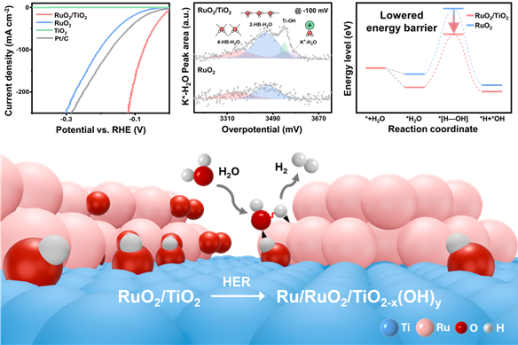 Kookmin University researchers develop high-efficiency catalyst for hydrogen production SEOUL, May 11 (AJP) - A research team at Kookmin University has developed a new heterostructure catalyst that significantly improves the efficiency of hydrogen production in alkaline water electrolysis. The team, led by Professor Lee Chan-woo of the Department of Chemistry, identified the specific mechanism that allows the catalyst to accelerate the water-splitting process, the university said Monday. The research focuses on Anion Exchange Membrane Water Electrolysis (AEMWE), a next-generation technology that operates in alkaline environments to reduce reliance on expensive precious metal catalysts and corrosion-resistant parts. While promising, these systems are often limited by a slow initial step where water molecules must be broken down to create hydrogen intermediates, leading to higher energy consumption and lower efficiency. To address this bottleneck, the team engineered a catalyst by forming ruthenium oxide nanoparticles approximately 2 nanometers in size onto a 25-nanometer titania support. During the electrochemical process, the catalyst surface reconfigures itself into an active interface that attracts water molecules and lowers the energy barrier required to break their chemical bonds. Test results showed that the new catalyst required an overpotential of only 6.6 millivolts to reach a standard current density. This performance significantly outperforms commercial platinum catalysts, which require 43 millivolts, and standalone ruthenium oxide, which requires 79 millivolts. The mass activity of the new material was found to be approximately 6.4 times higher than that of standard platinum-on-carbon catalysts. The study utilized real-time spectroscopy and theoretical calculations to track water molecules and hydrogen intermediates during the actual reaction. This allowed the team to confirm that the titania interface directly facilitates the cutting of oxygen-hydrogen bonds. The researchers found that the ruthenium and titania work together, with the interface handling water activation while the ruthenium handles the formation of hydrogen molecules. "This research is significant because we developed a high-activity catalyst while simultaneously observing how the interface activates water molecules under actual operating conditions," Professor Lee Chan-woo said. "Based on the principle of cooperative hydrogen formation at the ruthenium-titania interface, we can suggest design strategies for high-efficiency catalysts applicable to next-generation electrolysis systems." The study was supported by the Ministry of Science and ICT and was published in the international journal Carbon Energy. (Reference Information) Journal/Source: Carbon Energy Title: Ruthenium-Titania Interface-Mediated Water Activation for High Turnover Frequency in Alkaline Hydrogen Evolution Link/DOI: https://doi.org/10.1002/cey2.518 2026-05-11 14:58:02
 -
 Fifty Fifty announces June 1 comeback with new mini-album SEOUL, May 11 (AJP) - South Korean girl group Fifty Fifty will return with a new mini-album on June 1, marking the quintet's first release in seven months. The agency Attrakt announced the comeback on Monday, confirming the release of the group's fourth mini-album. The new project, titled Imperfect-I'mperfect, conveys a message that one is perfect even if incomplete. It follows the digital single Too Much Part 1. which was released in November 2025. Fifty Fifty underwent a major reorganization in September 2024, transitioning into a five-member group centered on original member Keena. The current lineup includes Keena, Chanelle Moon, Yewon, Hana, and Athena. The group has seen significant international success recently, particularly with the track Pookie which became a viral challenge last year. Their digital single Skittlez also reached the Billboard Pop Airplay chart in the United States. A promotional poster released by the agency shows the five members holding hands in a forest setting with matching hairstyles. The mini-album Imperfect-I'mperfect is set for release on June 1. 2026-05-11 11:28:00
 -
 KAIST researchers develop stable high-frequency signal technology for 6G and space exploration SEOUL, May 11 (AJP) - Researchers in South Korea have developed a method to generate ultra-stable high-frequency signals using miniature optical chips to improve the reliability of 6G communications and deep-space exploration. The Korea Advanced Institute of Science and Technology said Monday, May 11, 2026. The Korea Advanced Institute of Science and Technology (KAIST) research team, led by Professor Kim Jung-won and Professor Lee Han-seok, used a technology called a micro-comb to produce millimeter-wave signals in the 30 to 300 GHz range. While these high frequencies are necessary for next-generation sensing and radar, they typically suffer from increased noise and instability as the frequency rises. To address this, the researchers synchronized the micro-comb with a precise optical reference signal to ensure consistency over long periods. This process achieved a frequency stability level of 10-18, representing a level of precision where signal fluctuations are almost non-existent over time. The study also utilized a physical state known as a perfect soliton crystal to maintain low noise while extending the signal to higher frequency bands. This approach allowed for a timing precision of 3 femtoseconds, or three quadrillionths of a second, which reduces errors in high-speed data transmission. The technology is expected to enhance data reliability in 6G networks and improve the accuracy of radars used in autonomous driving and defense. It may also facilitate high-resolution astronomical observations, such as the synchronization of signals for black hole research. "This research is significant because it raises the performance of micro-comb-based signal sources to the world's highest level and expands them to high-frequency bands," Professor Kim Jung-won said. He added that the team is currently working to reach frequencies above 300 GHz. Researcher An Chang-min and Professor Kim Jung-won served as lead authors for the studies, which were published in the journals Laser & Photonics Reviews and Optica. (Reference Information) Journal/Source: Laser & Photonics Reviews / Optica Title: Optical-to-microcomb stability transfer for ultrastable timing and microwave/millimeter-wave generation DOI: 10.1002/lpor.71135 Title: Preserving ultralow timing jitter in microcombs with repetition-rate multiplication via perfect soliton crystal formation DOI: 10.1364/OPTICA.581054 2026-05-11 11:00:59
 -
 K-pop girl band BABYMONSTER adds seats for Seoul concert after tickets sell out SEOUL, May 08 (AJP) - K-pop girl band BABYMONSTER will open additional seats for its upcoming Seoul concert series after tickets for the original three-day run sold out immediately upon release. The move aims to accommodate a surge in demand from fans following the group's recent musical comeback. YG Entertainment reported that the 2026-27 BABYMONSTER World Tour Choom in Seoul saw an explosive response during both pre-sale and general ticketing windows. The agency noted that the members themselves expressed a desire to perform for a larger audience after tickets for all three sessions were exhausted. The additional seating will include general admission, restricted-view seats, and a limited quantity of sound-check passes. Fans can purchase these tickets starting at 8:00 p.m. (1100 GMT) on June 13 through NOL Ticket. The concerts are scheduled to take place at the Jamsil Indoor Gymnasium in South Korea from June 26 to June 28. This leg of the world tour comes on the heels of the group's third mini-album release on May 4. The new album features four tracks, including the title song Choom as well as Moon, I Like It, and Locked In. The release has received a positive reception for its diverse genres and unique production style. 2026-05-08 17:51:21
 -
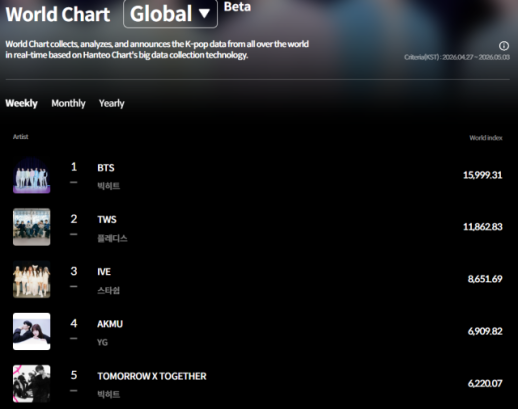 Hybe artists BTS, TWX and ILLIT sweep music charts in China, Japan and US SEOUL, May 08 (AJP) - Hybe artists swept the top positions in international music rankings for the final week of April, securing the first through third spots in China, Japan, and the United States. According to data released by Hanteo Chart on May 8, South Korean acts including BTS, TWS, and ILLIT led the charts in these major global markets. The results demonstrate the broad reach of the South Korean entertainment conglomerate across different regions and sub-labels. The data suggests that both veteran artists and newer groups from the company are maintaining high levels of engagement with international audiences. In the China category for the period between April 27 and May 3, BTS claimed first place with the track Arirang, recording a total index score of 34,575.44. Tomorrow X Together followed in second place with a score of 27,119.46, while Kortis took the third position. All three of the top-ranking artists in China are managed by Big Hit Music, a prominent subsidiary under the Hybe umbrella. The group TWS led the rankings in Japan with the song No Tragedy, earning a total index score of 25,773.27. BTS and ILLIT followed in second and third place respectively, completing a clean sweep of the Japanese chart by Hybe-affiliated groups. In the United States, the girl group ILLIT secured the first position with the song Mamihlapinatapai, achieving a total index score of 12,692.11. BTS occupied the second spot in the American rankings, while Tomorrow X Together finished in third place. While BTS and Tomorrow X Together are part of Big Hit Music, ILLIT is managed by Belift Lab, another subsidiary within the Hybe corporate structure. Hanteo Chart utilizes big data technology to collect and analyze real-time K-pop information including physical album sales, digital performance, and social portal engagement. These regional breakdowns are released every Friday to track the global footprint of South Korean artists. 2026-05-08 17:18:45