SEOUL, January 29 (AJP) - Researchers have overcome a major technical hurdle in micro-LED technology by developing a high-efficiency red micro-LED that enables ultra-high-resolution imagery for virtual and augmented reality devices. The new technology significantly improves power efficiency and achieves a pixel density of 1,700 pixels per inch, bringing wearable displays closer to mimicking real-world visual clarity.
The Korea Advanced Institute of Science and Technology (KAIST) announced on January 28 that a research team led by Professor Kim Sang-hyun from the School of Electrical Engineering developed the display. The project was a collaborative effort with Professor Keum Dae-myeong of Inha University and industry partners QSI and Raontech. The resulting display offers a resolution three to four times higher than current smartphone screens, reaching a level described as near-realistic for virtual reality (VR) and augmented reality (AR) applications.
Micro-LEDs are next-generation displays where individual sub-millimeter LEDs emit their own light, offering superior brightness and lifespan compared to Organic Light Emitting Diodes (OLEDs). However, the technology has faced two primary challenges: the rapid loss of efficiency in red pixels as they shrink in size, and the difficulty of transferring millions of tiny LEDs onto a circuit board without defects.
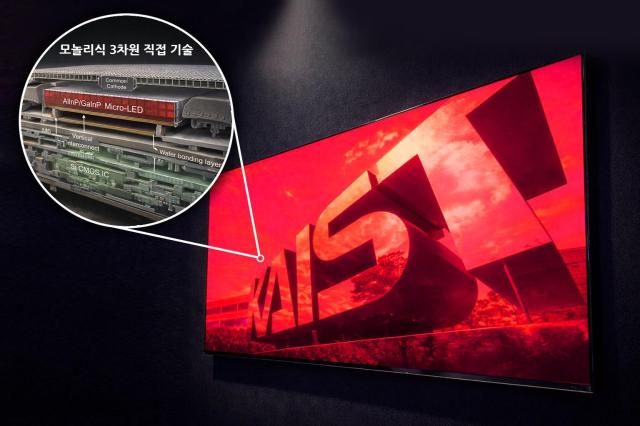
To address the efficiency issue, the team utilized a quantum well structure using aluminum indium phosphide and gallium indium phosphide (AlInP/GaInP). This structure acts as an energy barrier that prevents electrons from leaking out, trapping them in the light-emitting space. This allows the red pixels to remain bright and efficient even at extremely small scales.
For the manufacturing process, the researchers moved away from the traditional pick-and-place method, which involves moving LEDs individually and often results in alignment errors. Instead, they employed monolithic 3-D integration, a technique where the LED layers are stacked directly onto the driving circuit. This method reduces alignment errors to the nanometer level and allows for a more stable production of ultra-high-resolution screens. The team also established low-temperature processing techniques to ensure the underlying silicon circuits were not damaged by heat during the LED integration.
The successful demonstration of a functional display using these high-resolution red micro-LEDs is considered a significant milestone. The technology is expected to be used in AR and VR smart glasses, automotive head-up displays, and various wearable devices where high pixel density is required to eliminate the visible graininess of digital images.
"This research has solved the long-standing problems of red pixel efficiency and driving circuit integration in the micro-LED field," Professor Kim Sang-hyun said. "We will continue to develop this into a next-generation display technology that is ready for commercialization."
The study, led by Dr. Park Ju-hyeok from the KAIST Institute for Information Technology Convergence, was supported by the National Research Foundation of Korea.

Copyright ⓒ Aju Press All rights reserved.