
Journalist

Choe Chong-dae
swatchsjp@ajunews.com
-
 Data science reveals how a 500-year Joseon Dynasty was brought to knees by own elites SEOUL, April 01 (AJP) - After surviving five centuries of invasions and internal coups, the Joseon Dynasty’s ultimate undoing was a systemic collapse of fairness that data scientists have now mapped for the first time. By analyzing 14,600 officials across the "Lee" regime's 500-year history, a joint research team from the Korea Advanced Institute of Science and Technology (KAIST) and Hong Kong universities has pinpointed exactly how power hoarding by a few elite families broke the state's back. The study, led by Professor Park Ju-yong of the KAIST Graduate School of Culture Technology, used complex systems science to track the Total Success Index (TSI). This metric measured an official’s achievement by combining their rank with their length of service. The data shows that for 400 years, the dynasty remained remarkably resilient because its civil service system maintained a level of merit-based social mobility. Even the bloody 1453 Gyeyu Jeongnan coup—which saw Grand Prince Su-yang seize the throne from his nephew, King Dan-jong—appears in the data as a localized shock rather than a systemic failure. The researchers' network analysis shows power shifting between royal factions, such as those surrounding Prince An-pyeong, but the broader bureaucratic machinery remained functional. The secret to the dynasty's final collapse was found in the data from the 19th century. The maps show a sudden, sharp stratification where a handful of clans, such as the Andong Kim and Pungyang Cho, effectively hijacked the state. By monopolizing the civil service exams and high-ranking offices through influence rather than talent, these families destroyed the meritocracy that had sustained the Lee family's rule for half a millennium. "The data proves that the fall of Joseon wasn't just a series of unfortunate events, but a structural death spiral," said Professor Park Ju-yong. "When the mechanism for fair recruitment broke, the foundation of the entire nation gave way." The research team, which included first author Dr. Choi Dong-hyuk, plans to use these digital humanities tools to compare South Korea's historical bureaucracy with other global empires to see if similar patterns of elite capture predicted their downfall as well. (Reference Information) Journal/Source: Physica A: Statistical Mechanics and Its Applications Title: Total Success Index and the Longitudinal Dynamics of Bureaucratic Stratification in Joseon Korea Link/DOI: https://doi.org/10.1016/j.physa.2026.131353 2026-04-01 16:22:44
 -
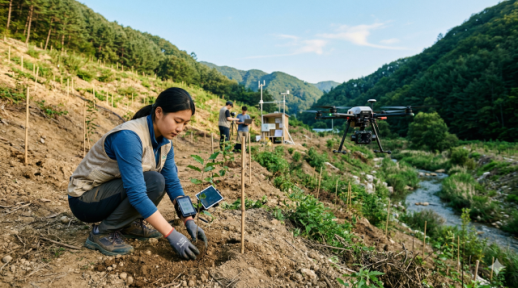 Kookmin University researchers to develop carbon absorption ecosystem restoration technology SEOUL, April 01 (AJP) - Researchers at Kookmin University have launched a new project to develop ecosystem restoration and management technologies designed to mitigate climate change and increase carbon sinks, the university said Monday. The new project is part of South Korea's government initiative designed to strengthen the country's natural environment restoration capability. The research team, led by Professor Im Chol-hee and Professor Lee Chang-bae from the Department of Forest Environmental Systems, was selected for a new initiative under the South Korean Ministry of Environment’s environmental technology development program. KMU will specifically focus on the carbon sink enhancement category of the project. Following recent amendments to the Natural Environment Conservation Act, South Korea has introduced new systems for the natural environment restoration industry. The government plans to invest in the development of restoration technologies over the next five years to help the industry expand and stabilize. KMU will receive approximately 3.5 billion won in funding over the five-year period. The research team aims to integrate artificial intelligence, drones, and advanced sensing technologies with soil and biotechnology. The project will move through several stages, from initial technical development to practical on-site demonstrations. The Korea Adaptation Center for Climate Change, various universities, registered restoration companies, and AI specialists will collaborate on the study to ensure the practical application of the new technologies. "It is highly significant that we are developing ecosystem restoration technology centered on carbon sinks, which is one of our university's primary strengths," said Professor Im Chol-hee. "We intend to take the lead in developing world-class technology by cooperating with both domestic industries and leading global institutions." The initiative aligns with the university's KMU VISION 2035: EDGE strategy, which focuses on environmental, social, and governance (ESG) values. Kookmin University is currently home to approximately 23,000 students across its undergraduate and graduate programs (Source: Kookmin University official website). 2026-04-01 15:57:12
 -
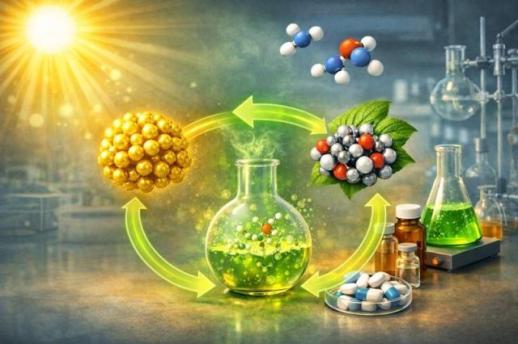 South Korean researchers use light and air to make medicine ingredients SEOUL, March 30 (AJP) - A research team in South Korea has developed a way to produce essential pharmaceutical raw materials using only sunlight and ambient air, potentially slashing carbon emissions in the chemical industry. This breakthrough simplifies the manufacturing of complex drugs by replacing traditional, waste-heavy chemical processes with a sustainable loop that relies on natural elements. The Korea Advanced Institute of Science and Technology (KAIST) announced on March 30, 2026, that a team led by Professor Han Sang-woo of the Department of Chemistry successfully combined two different types of catalysts into a single system. The method integrates a solid silver-based catalyst with a liquid organic photocatalyst known as DDQ. In traditional chemical manufacturing, companies often have to choose between catalysts that are precise but disposable and those that are reusable but less efficient. The KAIST team bypassed this trade-off by creating a system where the two catalysts work together to drive reactions that were previously difficult to sustain. The researchers used this hybrid platform to create amines, which serve as the primary building blocks for various medicines. By relying on sunlight and air rather than harsh chemical additives or high-pressure environments, the process produces almost no waste other than water. Existing organic photocatalytic methods often require additional chemicals to reset the catalyst after each use, or they suffer from slow reaction speeds when exposed to oxygen. To solve this, the team designed a circular loop where the byproducts of the reaction naturally reactivate the catalysts. Sunlight provides the energy to start the reaction, while oxygen from the air acts as the agent that "recharges" the catalysts for the next cycle. This allows the system to run continuously without the need for constant chemical intervention. To prevent the two different catalyst types from interfering with each other, the researchers added lithium perchlorate (LiClO4). This additive stabilizes the silver particles and the organic molecules, ensuring the system remains active for longer periods. "This study is the first case of successfully applying inorganic photochemical loop technology to precision organic synthesis," Professor Han Sang-woo said. "By merging the advantages of different catalytic systems, we have made a significant step toward reducing the carbon footprint of the chemical industry." Professor Han Sang-woo noted that the breakthrough provides a new way to manufacture high-value compounds like pharmaceutical ingredients through more sustainable methods. The study, with KAIST researcher Baek Jin-uk as the lead author, appeared in the Journal of the American Chemical Society (JACS) on March 18, 2026. (Reference Information) Journal/Source: Journal of the American Chemical Society Title: Merger of heterogeneous and homogeneous photocatalysis for arene C–H Amination Link/DOI: https://doi.org/10.1021/jacs.5c20824 2026-03-30 16:56:43
 -
 Uzbekistan and Tajikistan cement alliance during presidential summit SEOUL, March 27 (AJP) - The President of Uzbekistan, Shavkat Mirziyoyev, hosted President Emomali Rahmon of Tajikistan for a landmark state visit on March 26 and 27, 2026, marking a significant transition in regional diplomacy, the Embassy of Uzbekistan in Seoul said Friday. The visit featured the first meeting of the Supreme Interstate Council, a new high-level body designed to move the relationship beyond occasional cooperation and into a permanent, systemic alliance. During the talks, President Mirziyoyev and President Rahmon signed a Joint Statement on Deepening Strategic Partnership and Allied Relations. This agreement builds on the 2024 Treaty on Allied Relations and effectively signals that the two nations have moved past previous regional friction to focus on full-scale integration. The economic goals set during the summit are centered on doubling bilateral trade. After trade reached nearly 912 million dollars by the end of 2025, the leaders officially endorsed a roadmap to reach 2 billion dollars by 2030. To hit this target, the governments are fast-tracking the Oybek-Fotekhobod border trade zone and introducing digital "E-Permit" systems to reduce the bureaucracy that often slows down regional cargo transport. A highlight of the visit was a ceremony to launch 10 major joint projects. These include new textile plants in Tajikistan, furniture and leather factories, and expanded household appliance production. Within Uzbekistan, new facilities for dairy, fruit juice, and metal briquettes are being established in the Andijan, Fergana, and Surkhandarya regions. The visit also featured several cultural and symbolic milestones, including the opening of a new building for the Tajikistan Embassy in Tashkent and the naming of a street in the New Tashkent district after the city of Dushanbe. The leaders also attended a joint concert at the International Forums Palace, emphasizing the shared heritage of the two peoples. The two presidents discussed a five-year program to support the large diaspora communities living in both countries, focusing on education and scientific exchanges. A comprehensive roadmap has been commissioned to ensure that the industrial, energy, and security agreements reached this week are implemented over the next three years. 2026-03-27 22:46:40
 -
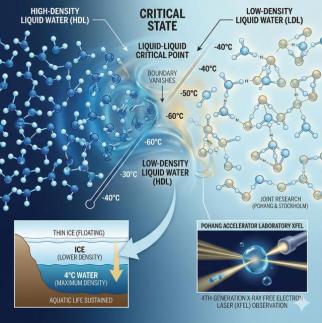 Joint team unlocks engine of water anomalies as supercooled mystery dissolves SEOUL, March 27 (AJP) - Water remains the only liquid on Earth that grows lighter as it freezes, a strange physical defiance that prevents the planet’s oceans and lakes from freezing into solid blocks of ice. By capturing the elusive liquid-liquid critical point of supercooled water, a joint research effort has finally explained the 4-degree density anomaly that has served as a biological necessity for life for millennia. The discovery provides the first experimental proof that water fluctuates between two distinct liquid states, effectively solving a thirty-year mystery that had split the scientific community. This breakthrough represents a fundamental shift in molecular physics, opening a new door for research into everything from climate patterns to the preservation of biological tissues and the fundamental stability of proteins. Ministry of Science and ICT said Friday that the results, published in the journal Science, were the product of a decade-long partnership between a team led by Kim Kyung-hwan at the Pohang University of Science and Technology and a team led by Anders Nilsson at Stockholm University. To reach this conclusion, the researchers had to peer into "No Man's Land," a temperature range between minus 40 and minus 70 degrees Celsius where water was long considered unobservable. In this extreme environment, water typically crystallizes into ice so rapidly that its liquid properties vanish in an instant. The joint team utilized the fourth-generation X-ray Free Electron Laser at the Pohang Accelerator Laboratory to bypass this barrier. The facility generates light billions of times brighter than the sun, allowing the researchers to capture molecular movement in a millionth of a second. By spraying microscopic droplets into a vacuum and using a laser to melt ice into liquid for a fleeting moment, the team pinpointed the critical point near minus 60 degrees Celsius. This is the exact coordinate where the distinction between high-density and low-density liquid phases vanishes. The existence of these two phases explains why water reaches its heaviest state at 4 degrees Celsius before expanding, a quirk that ensures ice floats and warmer water remains at the bottom to shelter aquatic ecosystems. "When temperature reaches minus 45 degrees, water freezes faster than any available measurement method could previously track," Kim Kyung-hwan said during a briefing at the ministry in Sejong. "This has been called 'No Man's Land' because it was considered experimentally inaccessible. We have challenged this for ten years with persistence, and currently, our team is the only one in the world capable of measuring this region," the professor added. The roadmap to the announcement began in 2017 when the researchers first proved they could measure unfrozen water below the freezing threshold. In 2020, the team confirmed that two different liquid phases coexist at minus 70 degrees. While the findings provide a definitive answer to a historical mystery, the work serves as a starting point for further precision in how Seoul and international partners map the most essential substance in the universe. The current data carries a margin of error of 8 degrees, which the researchers intend to refine in a new round of experiments scheduled for May at the facility. Yu Sun-ju, the first author of the study and a doctoral candidate at the university, noted that achieving something never done before was incredibly difficult. "I realized how incredibly difficult it is to achieve something no one else has done," the researcher said. The experimental results provide the necessary evidence to settle the debate over the liquid-liquid critical point of water. 2026-03-27 10:35:24
 -
 Uzbekistan's business climate signals decoupling from historical stagnation as demand surges SEOUL, March 26 (AJP) - The Center for Economic Research and Reforms in Uzbekistan reported Wednesday that the national business climate reached 65 points in February 2026, an 11-point increase over the previous year. This shift signals a significant decoupling from historical stagnation, marking a fundamental transition in how the private sector navigates the regional economy. The acceleration aligns with a broader macroeconomic surge shown by data from the Statistics Agency of Uzbekistan. The country's GDP growth reached 6.0 percent in 2025 according to World Bank estimates, supported by record gold export revenues and a 10.5 percent growth in fixed asset investments. The February data marks a shift in private sector sentiment, as the composite index for expectations climbed 13 points to 81. This optimism is anchored by expansion in the real economy. 19 percent of enterprises reported increasing their workforce, up from 12 percent a year earlier. These developments suggest that Uzbekistan is moving into a high-velocity growth cycle, where domestic demand is becoming a primary engine. Agriculture has emerged as the vanguard of this expansion, with its sectoral index jumping 29 points to 73. This growth is reinforced by structural shifts, including a zero VAT rate for most agricultural producers that took effect in January 2026. Approximately 52 percent of agricultural entrepreneurs now report rising demand, up from 35 percent in early 2025. This reflects the success of new export corridors and an increase in domestic processing capacity. In the services and construction sectors, indices rose to 61 and 69 points, respectively. Construction activity has remained resilient, with the sector expanding by 14.2 percent throughout 2025. This is mirrored in the labor market, where 27 percent of construction firms expanded their payrolls. The industrial sector, while growing more moderately at 67 points, continues to benefit from a stabilization in energy supply. National utility reforms aim to commission 6.7 GW of new power capacity by the end of 2026, a move that has already led to a decline in the number of firms citing electricity shortages as a barrier to growth. Geopolitical and fiscal stability have supported these figures. Inflation in Uzbekistan was recorded at 8.8 percent over 2025, which provided a more predictable environment for the 61 percent of surveyed entrepreneurs who reported an absence of operational constraints. This is an improvement from the 57 percent recorded just one month prior. The survey highlights emerging friction points as the economy matures. While concerns regarding credit and logistics have receded, entrepreneurs are increasingly citing the cost of land resources and a 7 percent indexation of land and property taxes as rising challenges. Furthermore, tax reforms introduced in early 2026, including a move toward turnover-based taxation for smaller entities, represent a shift in the fiscal landscape. 2026-03-26 15:31:20
 -
 KAIST researchers solve solar cell dilemma by achieving 25% efficiency and long-term stability SEOUL, March 24 (AJP) - Researchers at the Korea Advanced Institute of Science and Technology (KAIST) have addressed a long-standing trade-off in solar technology where increasing energy efficiency often leads to a shorter lifespan. The team succeeded in developing a high-efficiency perovskite solar cell that maintains performance over time by precisely controlling the internal structure of a protective surface layer. KAIST announced Tuesday that a joint research team led by Distinguished Professor Seo Jang-won from the Department of Chemical and Biomolecular Engineering and the Korea Research Institute of Chemical Technology (KRICT) developed a design for a two-dimensional (2D) protective film. This technology simultaneously enhances both the power conversion efficiency and the operational reliability of the cells. Perovskite solar cells are considered the next generation of high-efficiency photovoltaics due to their low production costs. However, their tendency to degrade when exposed to heat, humidity, or prolonged sunlight has remained a significant barrier to commercial use. To combat this, researchers typically apply a 2D layer on top of the primary 3D perovskite structure to reduce surface defects, but these layers often lack the structural integrity needed for long-term durability. The research team introduced a more robust 2D structure known as the Dion-Jabocson (DJ) phase. In this configuration, organic molecules act like strong adhesive, binding the perovskite layers tightly together. By carefully adjusting heat treatment temperatures and timing, the researchers were able to control the "n-value," or the number of stacked layers within the film, to create a more organized and stable internal arrangement. This precise control allowed for smoother charge movement, which boosted the cell's efficiency. The team confirmed through experiments that the structural rearrangement at the interface during heat treatment is what allows the 2D film to be customized for maximum performance. This process also ensures that the manufacturing results are highly reproducible. The resulting solar cells achieved a power conversion efficiency of 25.56 percent. Furthermore, the devices maintained high performance levels even under extreme testing conditions of 85 degrees Celsius and 85 percent relative humidity. The researchers also confirmed that the technology is effective when applied to large-area modules, signaling strong potential for mass production. "This study demonstrates that the conventional dilemma of choosing between efficiency and longevity can be solved through the structural design of a surface protective film," said Distinguished Professor Seo Jang-won. He added that because the technology remains stable despite minor changes in processing conditions, it will be highly beneficial for large-scale commercial manufacturing. The study, co-authored by KAIST doctoral student Lee Jae-hee and KRICT researcher Moon Chan-su, was published in the journal Joule on February 24, 2026. 2026-03-24 16:21:56
 -
 S. Korean broadcaster wins final copyright suit against China's video platform Bilibili SEOUL, March 23 (AJP) - South Korean broadcaster MBC has secured a final victory in its high-stakes copyright infringement suit against the Chinese video-sharing platform Bilibili, the company said Monday. The Jiangsu High People's Court delivered a definitive blow to the digital "safe harbor" defense long utilized by Chinese tech giants, signaling a critical shift in how Beijing enforces international intellectual property standards for foreign content providers. By significantly increasing damages in this final appeal, the court established that a platform's duty of care scales with its commercial influence and the sophistication of its recommendation algorithms. The ruling marks a long-awaited turning point for foreign entities that have historically struggled to find functional legal recourse within the Chinese judicial system. Based in Shanghai, Bilibili is one of China’s most influential video-sharing platforms, often described as a hybrid of YouTube and Netflix with a heavy focus on anime, gaming, and "user-generated content." By the end of 2025, the platform averaged 366 million monthly active users, making it a central hub for young Chinese consumers and a dominant force in the region's digital economy. Unlike other online video platforms where South Korean dramas and films are the primary focus, Bilibili serves as the preeminent source for South Korean music programs, variety entertainment shows, and celebrity-driven content. These broadcasts are typically uploaded to the platform within one or two hours of their original airing in Seoul, complete with sophisticated Chinese subtitles provided by "fansub" groups. This near-simultaneous piracy undercuts the commercial viability of legitimate licensing deals and streaming rights, creating a systemic drain on the industry. The scale of the crisis is underscored by data from Park Young-soon, a lawmaker from South Korea's Democratic Party, who noted that trademark infringements in China surged from 977 in 2017 to a peak of 3,457 in 2020. While 2021 saw 2,922 recorded cases, the systemic nature of the problem remains evident. According to Park Young-soon, China accounts for 63.4 percent of all overseas intellectual property disputes involving South Korean companies. Despite this overwhelming volume, government support for affected firms has remained relatively modest, with only 65 cases receiving state assistance in 2021. The case originated in 2021 when MBC filed for damages after discovering thousands of unauthorized clips circulating on the platform for extended periods. Although a lower court initially recognized the infringement, the broadcaster appealed because the awarded damages failed to reflect the actual commercial value of the content or the platform’s role in its spread. In its final judgment, the Jiangsu High People's Court pivoted, ruling that the platform's failure to act despite the obvious "commercial value and high recognition" of the MBC library constituted a form of contributory infringement. This hardening of the Chinese judiciary aligns with broader trends observed in recent years. In 2024 alone, Chinese courts awarded approximately 120 million dollars in punitive damages across 18 major cases, reflecting an intensified effort to align domestic enforcement with international standards like the Berne Convention and TRIPs Agreement. The court has signaled that the sheer scale of a platform now dictates a higher duty of care. Beijing appears increasingly willing to treat large-scale digital platforms not as passive hosts, but as active distributors responsible for the legality of the traffic they monetize. An official from MBC stated that the ruling makes it clear that platforms can no longer evade responsibility while exercising substantial influence over content distribution and reaping immense profits. The broadcaster confirmed it will continue to pursue aggressive legal action against any overseas platforms that facilitate the unauthorized distribution of its content, regardless of the format. The judgment is final and takes immediate effect under China’s two-instance trial system. 2026-03-23 15:30:55
 -
 Kookmin University holds industry seminar on robot skin research SEOUL, March 23 (AJP) - The Robot Functional Skin and Hyper-Sensory Research Center at Kookmin University (KMU) held a meeting with 16 participating companies on March 17 at the JW Marriott Dongdaemun Square to share first-year research outcomes. The center, led by Professor Lim Si-hyung of the KMU Department of Mechanical Engineering, operates as part of the Engineering Research Center (ERC) project supported by the National Research Foundation of Korea. The project involves 10 professors from KMU, Seoul National University, Ulsan National Institute of Science and Technology (UNIST), Gachon University, and Kumoh National Institute of Technology. Research focuses on developing functional skins and sensory systems that allow robots to operate in extreme environments involving high temperatures, humidity, and corrosion. The center aims to overcome the limitations of current robotic systems, which rely heavily on visual sensors, by developing non-visual recognition platforms and durable surface materials. The seminar provided a forum for partner companies, including SOS Lab and Nexensor, to discuss technical difficulties and industry needs. Participants agreed to establish a cooperation system to identify joint research projects beyond the current scope of the ERC mandate. "Close exchange with industry is essential to complete next-generation robot technology that performs precise missions even in extreme environments," Center Director Lim Si-hyung said. "We will continue to hold regular meetings to reflect corporate needs in our research and develop effective original technologies." 2026-03-23 14:04:56
 -
 Kim Hyo-joo captures Founders Cup title to reclaim throne after 11 years SEOUL, March 23 (AJP) - Kim Hyo-joo secured her eighth career LPGA Tour title on Sunday, winning the Fortinet Founders Cup at Sharon Heights Golf and Country Club in California. The 30-year-old South Korean finished the tournament at 16-under 272, holding off a late challenge from world number two Nelly Korda to win by a single stroke. The victory marks a historic return to the winner's circle for Kim at an event she first conquered as a rookie in 2015. By reclaiming the title 11 years later, she demonstrated a rare longevity in the professional ranks, earning $450,000 from the 3-million-dollar purse. The win follows her most recent triumph at the Ford Championship in March 2025. Kim entered the final round in Menlo Park, California, with a commanding five-stroke lead. However, the closing 18 holes proved to be a test of endurance as she carded a 1-over 73, featuring four birdies and five bogeys. This uncharacteristic turbulence allowed Korda to narrow the gap significantly, briefly threatening the lead after the turn. The tension peaked at the par-3 17th, where Korda recorded a costly bogey to give Kim a two-shot cushion heading into the final hole. Despite a closing bogey on the 18th, Kim finalized the wire-to-wire victory, marking the third consecutive season in which she has recorded at least one LPGA win. Kim’s career has been defined by clinical precision and early brilliance. She first made history as a 19-year-old non-member at the 2014 Evian Championship, where she opened with a 10-under 61—the lowest round ever recorded in a major championship at the time. She eventually defeated Hall of Famer Karrie Webb to secure her first major title. Since officially joining the LPGA Tour in 2015, Kim has amassed 22 worldwide victories, including 14 on the KLPGA and 8 on the LPGA. Known for possessing one of the most fluid swings in the game, she has consistently ranked among the world’s elite, finishing in the top ten of the season-ending money list in both 2023 and 2025. Beyond individual accolades, Kim has served as a cornerstone of South Korean international golf. She represented the Republic of Korea at both the Tokyo and Paris Olympic Games and led the national team to victory at the 2025 Hanwha LIFEPLUS International Crown. Kim will travel to Arizona next week to defend her title at the Ford Championship. Currently ranked eighth in the world, she has resurgent form, suggesting she remains a primary contender as the tour approaches the major championship season. Kim becomes the first player this season to lead a tournament from the first round through the final putt. 2026-03-23 10:54:42