

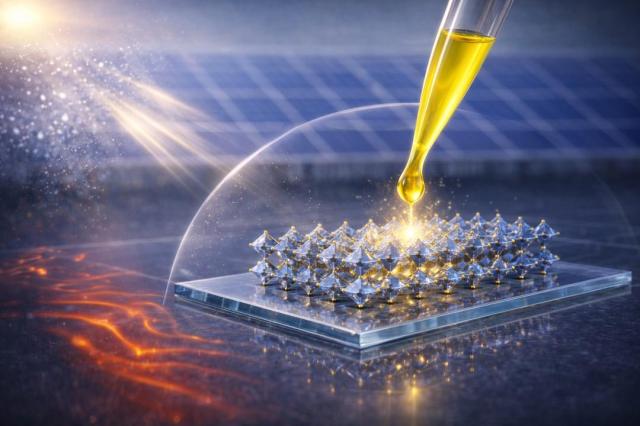
SEOUL, March 24 (AJP) - Researchers at the Korea Advanced Institute of Science and Technology (KAIST) have addressed a long-standing trade-off in solar technology where increasing energy efficiency often leads to a shorter lifespan. The team succeeded in developing a high-efficiency perovskite solar cell that maintains performance over time by precisely controlling the internal structure of a protective surface layer.
KAIST announced Tuesday that a joint research team led by Distinguished Professor Seo Jang-won from the Department of Chemical and Biomolecular Engineering and the Korea Research Institute of Chemical Technology (KRICT) developed a design for a two-dimensional (2D) protective film. This technology simultaneously enhances both the power conversion efficiency and the operational reliability of the cells.
Perovskite solar cells are considered the next generation of high-efficiency photovoltaics due to their low production costs. However, their tendency to degrade when exposed to heat, humidity, or prolonged sunlight has remained a significant barrier to commercial use. To combat this, researchers typically apply a 2D layer on top of the primary 3D perovskite structure to reduce surface defects, but these layers often lack the structural integrity needed for long-term durability.
The research team introduced a more robust 2D structure known as the Dion-Jabocson (DJ) phase. In this configuration, organic molecules act like strong adhesive, binding the perovskite layers tightly together. By carefully adjusting heat treatment temperatures and timing, the researchers were able to control the "n-value," or the number of stacked layers within the film, to create a more organized and stable internal arrangement.
This precise control allowed for smoother charge movement, which boosted the cell's efficiency. The team confirmed through experiments that the structural rearrangement at the interface during heat treatment is what allows the 2D film to be customized for maximum performance. This process also ensures that the manufacturing results are highly reproducible.
The resulting solar cells achieved a power conversion efficiency of 25.56 percent. Furthermore, the devices maintained high performance levels even under extreme testing conditions of 85 degrees Celsius and 85 percent relative humidity. The researchers also confirmed that the technology is effective when applied to large-area modules, signaling strong potential for mass production.
"This study demonstrates that the conventional dilemma of choosing between efficiency and longevity can be solved through the structural design of a surface protective film," said Distinguished Professor Seo Jang-won. He added that because the technology remains stable despite minor changes in processing conditions, it will be highly beneficial for large-scale commercial manufacturing.
The study, co-authored by KAIST doctoral student Lee Jae-hee and KRICT researcher Moon Chan-su, was published in the journal Joule on February 24, 2026.

Copyright ⓒ Aju Press All rights reserved.
