
Journalist

SONG YOONSEO
sys0303@ajunews.com
-
 ST Pharm Shares Rebound After Early Profit-Taking Despite Strong Q1 Results ST Pharm, which recently posted strong earnings, fell early on profit-taking but later rebounded. According to the Korea Exchange, ST Pharm was trading at 168,400 won as of 1:16 p.m. on the 28th, up 0.54% from the previous session. The stock had slid as much as 3.34% intraday to 161,900 won before recovering. In a filing the previous day, the company said preliminary first-quarter consolidated revenue rose 27.7% from a year earlier to 67.0 billion won, while operating profit surged 1,024.6% to 11.5 billion won. Revenue came in slightly below market expectations, but operating profit beat forecasts by more than 30%, prompting brokerages to maintain or raise target prices. Kim Seon-a, an analyst at Hana Securities, said, “In the first half of this year, we will confirm second-quarter earnings growth, and in the second half there will be many events as well as earnings growth through the fourth quarter.” She maintained her target price of 210,000 won and reiterated a “buy” rating. Lee Ji-su, an analyst at Daol Investment & Securities, cited multiple second-half research and development catalysts, including “an imminent PDUFA approval for olezarsen (severe hypertriglyceridemia), phase 3 for pelacarsen, and topline results for STP0404 (AIDS).” She said she was raising her fair value estimate to 210,000 won to reflect “mid- to long-term profitability leverage from CMO growth and improved yields.” Ha Hyeon-su, an analyst at Yuanta Securities, also raised his target price to 200,000 won, saying the company appears to be entering a stable growth phase as the share of commercialized project CDMO in total revenue increases.* This article has been translated by AI. 2026-04-28 13:24:31
 -
 ABL Bio Shares Slide After Bile Duct Cancer Drug Misses Overall Survival Endpoint Shares of ABL Bio fell sharply early Tuesday after news that its subsidiary’s bile duct cancer drug candidate “tovecimig” failed to meet the overall survival (OS) endpoint in a Phase 2/3 trial. According to the Korea Exchange, ABL Bio was trading at 137,400 won as of 10:20 a.m., down 35,300 won, or 20.44%, from the previous session. The move followed an announcement by ABL Bio’s U.S. unit, Compass Therapeutics, which said on April 27 local time that it released trial results comparing a combination of tovecimig and the chemotherapy drug paclitaxel with monotherapy. Compass said the treatment group’s OS did not achieve statistical significance. The company said the outcome was affected because more than half of patients in the control group, 54%, switched to the study drug during treatment. Kim Min-jung, an analyst at DS Investment &u0026 Securities, wrote in a report Tuesday that when objective response rate (ORR) data were previously disclosed, the U.S. Food and Drug Administration asked Compass Therapeutics to provide final median overall survival (mOS) data from the Phase 2/3 trial. “Because the requested mOS data failed to achieve statistical superiority, it will not be easy to obtain U.S. FDA approval,” Kim said. Kim added, however, that the impact on ABL Bio’s corporate value would be “very limited,” citing the small number of patients in the bile duct cancer market and a short median progression-free survival (mPFS) of about 4.7 months, which limits treatment duration and commercial potential. Meritz Securities analyst Kim Jun-young said that if the drug does not receive a review designation, the company’s projected possibility of a Prescription Drug User Fee Act (PDUFA) decision in the second half of 2027 would diminish, with a potential delay to the first half of 2028. He also said there is a possibility regulators could require additional confirmatory trials. Kim said tovecimig’s new-drug value is estimated at 178.9 billion won, limiting the overall impact, and added that key investment points remain intact, including the scalability of the BBB shuttle-based Grabody B platform and the potential for technology transfer of ABL111, which he said is producing positive clinical results. He said investors should watch for additional technology-transfer opportunities and momentum from ABL111 trials.* This article has been translated by AI. 2026-04-28 10:35:35
 -
 Daishin Securities Keeps Hanwha Ocean Target at 164,000 Won on Merchant Ship Gains Daishin Securities on Monday said Hanwha Ocean’s merchant ship business is expected to drive overall profit growth, keeping its target price at 164,000 won and its “buy” rating. In a report, Daishin analyst Lee Jin-yi said the merchant ship division is “showing operating leverage” as it repeatedly builds high-margin, high-priced vessels and improves production efficiency. Lee said Hanwha Ocean posted first-quarter revenue of 3.2099 trillion won, up 2.1% from a year earlier, and operating profit of 441.1 billion won, up 70.6%. He said profit at the merchant ship division rose sharply “without one-off factors.” He cited earlier deliveries from repeat-build effects and cost reductions as key drivers, adding that performance bonuses were decided to be reflected as a one-time year-end item, the same as last year. Lee said revenue recognition is expanding in earnest for high-priced orders won since 2023, and the company is maintaining a structure in which the share of high-margin prices centered on liquefied natural gas carriers, or LNGCs, is increasing. He said LNGC revenue share in overall merchant ships may dip slightly as the first tranche of Qatar volume drops out, but profit is expected to rise. He also said the special ship division could provide a near-term earnings cushion, with remaining change orders tied to U.S. maintenance, repair and overhaul, or MRO, work expected to be reflected in the second quarter. Over the medium term, he said fixed-cost pressure could ease if orders for the next-generation destroyer program, known as KDDX, and a Thai frigate become visible within the second to third quarter. Lee said the key issue is whether Hanwha Ocean wins an order in the first half for Canada’s next submarine program, CPSP. Hanwha Ocean said a day earlier, in its consolidated first-quarter filing, that the merchant ship division led earnings growth on the back of high-priced projects and LNG carrier orders.* This article has been translated by AI. 2026-04-28 08:22:06
 -
 KOSPI Hits Record 6,600 as Retail Day Trading Pushes April Turnover Near 40% The rally to record highs is accelerating in South Korea’s stock market, and short-term trading is rising with it. The KOSPI on the 27th climbed past 6,600 for the first time, and April turnover is nearing 40% as investors rapidly rotate in and out of shares. According to the Korea Exchange, the KOSPI closed at 6,615.03, up 139.40 points, or 2.15%, from the previous session. The index also broke above 6,600 during the session, putting the 7,000 level within sight. By investor type, foreigners and institutions were net buyers, purchasing 890.5 billion won and 1.1015 trillion won, respectively. Retail investors were net sellers of 1.9763 trillion won, a sign of heavy profit-taking. In recent sessions, retail investors have often sold into strength and bought on dips. That pattern is reflected in turnover, a measure calculated by dividing trading volume by the number of listed shares. Higher turnover indicates more frequent changes in ownership — often associated with day trading. As of the 27th, April turnover stood at 37.63%, meaning about 3.7 out of every 10 listed shares changed hands over the month. It was below March’s 40.55% but above January’s 31.29% and February’s 34.08%. With three trading days left in the month, April could still surpass March. Daily data also point to brisk short-term trading. This month, turnover exceeded 2% on six sessions: the 2nd (2.47%), 16th (2.36%), 23rd (2.27%), 10th (2.10%), 17th (2.10%) and 15th (2.05%). Most of those sessions — except the 2nd and 17th — ended higher, suggesting momentum buying and profit-taking were both active during the upswing. Turnover jumped not only on the 2nd, when investor sentiment weakened after U.S. President Donald Trump made hard-line remarks toward Iran, but also on the 16th, when the index first broke above 6,200 after the outbreak of the Iran war. Similar moves were seen on the 23rd, when semiconductor strength lifted the index to around 6,470 and a fresh record, and on the 15th, when it settled above 6,000. The surge in turnover suggests a market increasingly driven by short-term trades. Faster rotation can also amplify risk, especially when paired with leveraged bets. Kim Seok-hwan, an analyst at Mirae Asset Securities, warned that “the expansion of direct investment using leverage should be noted as it may be exposed to volatility risk going forward.”* This article has been translated by AI. 2026-04-27 16:36:19
 -
 Hyundai Department Store Shares Jump on Profit Improvement Expectations Hyundai Department Store shares surged more than 15% intraday Monday as buying picked up on expectations of improved earnings. According to the Korea Exchange, the stock was trading at 113,500 won as of 1:53 p.m., up 15,000 won, or 15.23%, from the previous session. It rose more than 20% at one point to an intraday high of 120,100 won. The rally was widely seen as reflecting forecasts for stronger results in the company’s core department store business. Brokerages have also maintained a positive view. In a report dated April 22, Kyobo Securities said Hyundai Department Store is believed to have the largest number of Seoul stores among the three major department store operators with annual sales exceeding 1 trillion won. It added that in Gyeonggi Province, the Pangyo store is ranked No. 1 with sales that “overwhelmingly” outpace other locations. “While the weakness at Zinus is disappointing, we believe margin improvement in the core department store business is progressing significantly,” Kyobo said, maintaining its “buy” rating and 130,000-won target price. Kyobo also said it expects additional profitability gains this year as depreciation periods end at stores including The Hyundai Seoul, adding that earnings momentum remains intact on efficient cost execution and growth across all department store categories. It said there is also room for further improvement if Zinus recovers.* This article has been translated by AI. 2026-04-27 14:03:53
 -
 HD Hyundai Marine Solution jumps more than 9% on Q1 results, LNG retrofit outlook HD Hyundai Marine Solution surged more than 9% in early trading, buoyed by strong first-quarter results and upbeat brokerage assessments that the stock still has room to rise. According to the Korea Exchange, shares were trading at 277,000 won as of 10:04 a.m., up 23,500 won, or 9.27%, from the previous session. The company said in a filing on April 24 that first-quarter revenue totaled 574.6 billion won and operating profit came to 93.4 billion won. Revenue rose 18.3% from a year earlier and operating profit increased 12.5%. Brokerages have pointed to additional upside potential. Samsung Securities said it expects investor sentiment to improve on expectations of rising demand for liquefied natural gas, or LNG, facility retrofits amid heightened tensions in the Middle East, as well as the group’s expansion of its onshore power-generation engine business. Reflecting a higher valuation for the industrials sector, it raised its target price by 36.9% to 347,000 won. In a report Monday, Samsung Securities analyst Han Young-soo said revenue in the bunkering business jumped on higher oil prices, while the company’s overall profit margin edged down as the lower-margin bunkering segment took a larger share of sales. He added that margins in core businesses excluding bunkering improved from a year earlier and from the previous quarter. Han said net profit “far exceeded” market expectations as foreign-exchange-related gains were reflected. He said core business revenue posted a 19% compound annual growth rate over the past three years and is expected to grow 20% this year. He also said the Iran war is expected to spur LNG projects outside the Middle East, and that gas-importing countries have incentives to diversify supply sources for security reasons, raising the likelihood of increased demand for retrofits of floating storage and regasification units, or FSRUs, and floating storage units, or FSUs. Han added that maintenance work is also under way for engines already installed, and said the group’s shipbuilding volume is rising on a strong shipbuilding market and overseas expansion, while most overhang concerns have been resolved.* This article has been translated by AI. 2026-04-27 10:14:21
 -
 IBK Securities Raises Hotel Shilla Target Price on Duty-Free Stabilization, Hotel Gains IBK Investment & Securities on the 27th raised its target price for Hotel Shilla to 81,000 won from 64,000 won, citing stabilization in its duty-free business and improving results in its hotel division. It maintained its “buy” rating. In a report released the same day, IBK analyst Nam Seong-hyeon said he expects the earnings improvement to continue. Nam said Hotel Shilla posted first-quarter consolidated revenue of 1.0535 trillion won, up 8.4% from a year earlier, and operating profit of 20.4 billion won. He said the results “far exceeded” market expectations. He said the duty-free unit returned to profitability in the quarter, while profit growth also widened in the hotel and leisure businesses. The hotel division posted operating profit of 8.2 billion won, up 228% from a year earlier, which he attributed to operating leverage. Nam said the first quarter is typically a slower season and occupancy at Seoul hotels fell, but a sharp rise in the average daily rate helped drive results, calling it meaningful. He said the ADR increase suggests demand remains strong and that profit leverage could accelerate as performance improves at the Jeju hotel. He also said duty-free operating results are likely to stabilize as the company exits Incheon International Airport. Nam added that while first-quarter results beat expectations due to temporary factors, the outlook remains positive given easing fixed-cost burdens and the likelihood of more stable earnings.* This article has been translated by AI. 2026-04-27 08:18:15
 -
 Record Q1 Results Lift Targets for Samsung Electronics and SK Hynix Samsung Electronics and SK Hynix, the top two stocks by market value in South Korea, posted record first-quarter results, prompting brokerages to lift price targets and fueling talk of “Samsung at 300,000 won” and “Hynix at 2 million won.” Their share moves diverged after earnings, but analysts largely pointed to continued momentum. According to the Korea Exchange on the 26th, Samsung Electronics shares rose 13.67% from 193,100 won on April 7, when it reported earnings, to 219,500 won on April 24. The stock gained 1.76% on the day it disclosed first-quarter revenue of 133 trillion won and operating profit of 57.2 trillion won. It then jumped 7.12% the next day after news of a two-week ceasefire agreement between the United States and Iran. SK Hynix, however, saw a mismatch between results and the stock’s immediate reaction. The company reported consolidated first-quarter operating profit of 37.6103 trillion won, up 405.5% from a year earlier, on revenue of 52.5763 trillion won, up 198.1%. Yet the shares edged down 0.08% over two sessions through April 24, slipping from 1,223,000 won to 1,222,000 won. The move was attributed to expectations for a semiconductor upturn having been priced in. SK Hynix shares had already surged 38.04% from April 7 to April 22, the day before its earnings release, far outpacing Samsung Electronics and the Kospi. With optimism reflected in the price, profit-taking emerged after the announcement, producing a “sell on the news” pattern. Despite the short-term split, brokerages broadly shared a positive medium- to long-term view. With investors divided between adding to holdings and taking profits, major firms said they were watching whether the earnings momentum can be sustained and raised their assessments of further upside. Yuanta Securities raised its target price for Samsung Electronics to 330,000 won, saying it expects the company to reduce volatility in the memory chip business and expand shareholder-friendly actions supported by stable cash flow. Shinhan Investment Corp., Hanwha Investment & Securities and iM Securities also lifted their targets to 300,000 won and maintained “buy” ratings. Optimism also continued for SK Hynix. Daol Investment & Securities raised its target to 2.1 million won, saying that given the sector’s tendency to move about six months ahead, signs are growing that the boom will persist six months from now. Korea Investment & Securities set a target of 2.05 million won, citing sustained earnings momentum from changes in the demand structure. KB Securities and Meritz Securities also raised their targets to 2 million won. 2026-04-26 15:06:40
 -
 Korea Chip Leveraged ETFs Surge More Than 11-Fold as Semiconductor Funds Jump Expectations for an improving semiconductor cycle have pushed returns sharply higher for chip-related exchange-traded funds in South Korea, with leveraged products far outpacing standard funds. According to Koscom's ETF CHECK data released on the 26th, Samsung Asset Management's KODEX Semiconductor ETF returned 95.10% year to date. Its six-month return was 112.20%, and its one-year return rose to 300.85%. Mirae Asset Global Investments' TIGER Semiconductor TOP10 ETF showed a similar pattern, posting returns of 90.03% year to date, 112.07% over six months and 304.39% over one year. Leveraged ETFs magnified those gains. The KODEX Semiconductor Leveraged ETF returned 215.21% year to date, more than double the non-leveraged KODEX fund. Its six-month return was 261.55%, and its one-year return reached 1,115.98%. The TIGER Semiconductor TOP10 Leveraged ETF returned 201.60% year to date, 259.90% over six months and 1,141.10% over one year. Even when tracking the same semiconductor index, leveraged ETFs apply a multiple to daily returns. If an index keeps rising, compounding can widen performance gaps beyond a simple two-times effect, potentially reaching three to four times over longer periods. Regulatory changes are also lifting expectations. With listings now allowed for leveraged ETFs using Samsung Electronics and SK hynix as underlying assets, about 10 products are expected to launch next month, led by major asset managers. The move is expected to help capture domestic demand that has been directed to overseas markets, where single-stock leveraged ETFs already trade. Kim In-sik, a researcher at IBK Investment & Securities, said demand is likely to flow first into products linked to expectations for the semiconductor cycle and earnings momentum centered on Samsung Electronics and SK hynix. Still, leveraged ETFs can amplify losses in down markets. Price gaps between a fund's intrinsic value and its market price can also be wider than for standard ETFs, underscoring the need for investors to review risks before investing. 2026-04-26 13:00:31
 -
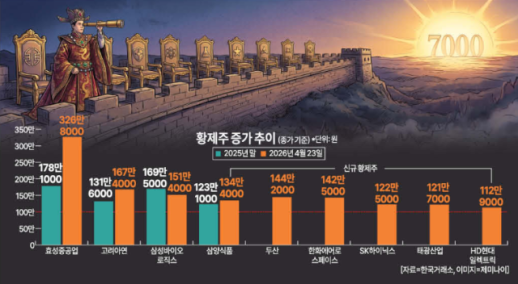 Korea’s ‘Million-Won’ Stocks Jump to 9 as KOSPI Rally Lifts High-Priced Shares A new era of so-called “million-won stocks” is taking shape in South Korea as a market rally pushes more shares above 1 million won. In less than five months, the number of such stocks has grown to nine from four, and the pipeline of potential newcomers is also expanding. The Korea Exchange said the KOSPI closed Thursday up 57.88 points, or 0.90%, at 6,475.81, extending its run of three straight record closes. The index briefly topped 6,500 in intraday trading. The gains came despite external uncertainty over stalled ceasefire talks between the United States and Iran, as buying concentrated in sectors seen as beneficiaries of the postwar environment, including semiconductors and defense. As the rally accelerated, more stocks joined the million-won club based on closing prices: Hyosung Heavy Industries (3,268,000 won), Korea Zinc (1,674,000), Samsung Biologics (1,514,000), Doosan (1,442,000), Hanwha Aerospace (1,425,000), Samyang Foods (1,344,000), SK hynix (1,225,000), Taekwang Industrial (1,217,000) and HD Hyundai Electric (1,129,000). The count has more than doubled from four at the end of last year. A day earlier, LIG Defense & Aerospace closed at 1.02 million won, putting it on the verge of becoming the 10th member. Hyosung Heavy Industries has been at the center of the surge. Its share price, 1,781,000 won at the end of last year, climbed to a closing 3,058,000 won on April 13, breaking above 3 million won. It is now the highest-priced stock among listed Korean companies. A close above 3 million won was the first in 11 years since Amorepacific and the third such case on record. Brokerages have raised targets accordingly, with Yuanta Securities setting a target price of 4.2 million won. Targets for other high-priced stocks have also been moving higher. Shinhan Investment raised its target for Korea Zinc to 1.9 million won, forecasting further gains. Hana Securities lifted its target for LIG Defense & Aerospace by 56.3% to 1.11 million won. Hana said expectations for exports of the Cheongung-II air defense system could persist because shortages of Patriot interceptor missiles continue and rapid production increases are difficult in the short term. The next tier is also growing. Nine stocks closed above 500,000 won, including Samsung Electro-Mechanics (774,000 won), SK Square (728,000), HD Hyundai Heavy Industries (641,000) and Samsung SDI (630,000). Still, some in the market are wary of what is sometimes called the “million-won stock curse.” Past cases show that after reaching the milestone, some stocks have faced pullbacks as liquidity thins and valuations look stretched. An industry official said, “Whether they settle in at these levels will ultimately be decided by earnings and the order pipeline.”* This article has been translated by AI. 2026-04-23 18:15:19