
Journalist

Song Yoon-seo
sys0303@ajunews.com
-
 KOSPI Tops 7,000, Extends Record Run Over Past Year A level once dismissed as out of reach became reality as South Korea’s benchmark KOSPI pushed past 7,000, extending a streak of record-setting gains despite external headwinds including war in the Middle East and worries about a global slowdown. According to the Korea Exchange, the KOSPI opened on May 6 at 7,093.01, up 156.02 points (2.25%) from the previous session, marking the first time it crossed 7,000. The move came just 47 trading sessions after it first topped 6,000 intraday on Feb. 25. The index has been breaking through higher levels faster as it climbs. It took 18 years and four months for the KOSPI to rise from 1,000 to 2,000 (March 1989 to July 2007). It then took 13 years and five months to move from 2,000 to 3,000 (July 2007 to January 2021), and four years and nine months to reach 4,000 (January 2021 to October 2025). By contrast, it cleared 5,000 in three months and 6,000 in about a month. The KOSPI’s gains also outpaced major global markets. Investing.com data showed the KOSPI posted a 186.39% return over the past year, the highest among major global indexes. Taiwan’s TAIEX rose 98.11%, South Korea’s KOSDAQ gained 66.21%, and Japan’s Nikkei 225 advanced 61.81%. The market’s size has surged as well. The KOSPI’s market capitalization reached a record 6,058 trillion won on May 6, nearly triple the roughly 2,107 trillion won level a year earlier. Large-cap chipmakers dominated: Samsung Electronics was valued at 1,555 trillion won and SK hynix at 1,141 trillion won, for a combined 2,696 trillion won — about 44.3% of the KOSPI’s total market cap. Exchange-traded funds, another driver of the rally, expanded quickly. The number of ETFs listed on the KOSPI rose to 1,099 from 973 a year earlier, and their market value climbed to 452 trillion won, topping 450 trillion won for the first time. That was more than double the 192 trillion won recorded a year earlier. More stocks have been setting new highs. As of the May 4 close, 76 stocks — including preferred shares — had hit 52-week highs over the past year based on closing prices. On a trade-price basis, 55 stocks did so. Investor money has also flowed in. The Korea Financial Investment Association said the number of active stock-trading accounts stood at 105.22 million as of May 4, up about 17% from 89.92 million a year earlier. Investor deposits, a measure of cash waiting to enter the market, jumped to 125 trillion won from 56 trillion won over the same period. * This article has been translated by AI. 2026-05-06 19:03:17
 -
 South Korea’s Kospi Hits Record Close After Briefly Topping 7,400 The Kospi extended its rally after the once-unthinkable “7,000” level became reality, briefly topping 7,400 during the session and setting another record. Gains eased late in the day as profit-taking emerged. According to the Korea Exchange on May 6, the Kospi closed up 447.57 points, or 6.45%, at 7,384.56. It opened at 7,093.01, up 156.02 points, or 2.25%, from the previous session, touched the 7,400 level, then gave back part of its advance to finish in the 7,300 range. Foreign investors drove the move, posting net purchases of 3.1346 trillion won, the largest on record. Retail investors and institutions were net sellers, unloading 572.4 billion won and 2.3126 trillion won, respectively, as they took profits. Most heavyweight stocks rose. Samsung Electronics gained 15.27%, SK hynix 11.61%, SK Square 11.81%, Hyundai Motor 2.23%, LG Energy Solution 2.01%, Doosan Enerbility 0.24% and Samsung Electro-Mechanics 0.44%. Hanwha Aerospace fell 1.57%. Lee Kyung-min, a researcher at Daishin Securities, said the surge in the top three stocks by market capitalization — Samsung Electronics, SK hynix and SK Square — led the index higher. But he noted the rally was concentrated in large caps: 195 issues rose, nine were unchanged and 691 fell, even as the Kospi jumped on a gap-up open. The Kosdaq ended lower. It fell 3.57 points, or 0.29%, to 1,210.17 after opening up 7.16 points, or 0.59%, at 1,220.90. The index later turned negative and at one point slipped below 1,200. On the Kosdaq, retail investors were net buyers of 610 billion won, while foreigners and institutions sold 63.3 billion won and 543.8 billion won, respectively. Moves among Kosdaq heavyweights were mixed. EcoPro BM rose 6.73%, EcoPro 4.30%, Rainbow Robotics 3.07% and HLB 1.64%. Alteogen fell 2.41%, Samchundang Pharm 1.59%, Lino Industrial 3.89%, Kolon TissueGene 1.15%, ABL Bio 3.92% and LigaChem Bio 2.37%.* This article has been translated by AI. 2026-05-06 18:07:15
 -
 Samsung Securities jumps more than 6% on expectations for Interactive Brokers tie-up Samsung Securities shares rose sharply on expectations of cooperation with a global brokerage firm. According to the Korea Exchange, Samsung Securities was trading at 147,300 won as of 9:55 a.m. on the 6th, up 6.82% (9,400 won) from the previous session. The securities industry said Samsung Securities has recently begun a pilot service with U.S. online brokerage platform Interactive Brokers (IBKR) to support foreign investors trading South Korean stocks. The process for foreigners to trade South Korean shares had been complicated, but under the partnership, IBKR users can invest in South Korean stocks more easily through Samsung Securities. In a report released on the 6th, Baek Du-san, an analyst at Korea Investment & Securities, said Samsung Securities shares rose 28% on the 4th, attributing the move to heightened attention on news of a partnership with IBKR, which is strong in online stock trading. Baek said foreign individual investors, including IBKR customers, can use Samsung Securities as an intermediary to trade South Korean stocks through the IBKR app, comparing it to how South Korean individuals can easily trade U.S. stocks through domestic brokerage apps. He added that the business model became possible due to regulatory and policy changes, including the launch of an integrated foreign investor account in 2017, the abolition in 2023 of the requirement for financial investment firms to immediately report transaction details for that account (T+2), designation as an innovative financial service, and revisions to financial investment business rules. Those changes allow overseas brokerages that do not operate securities businesses in South Korea to provide South Korean stock trading services through partnerships with local brokerages, he said.* This article has been translated by AI. 2026-05-06 10:15:51
 -
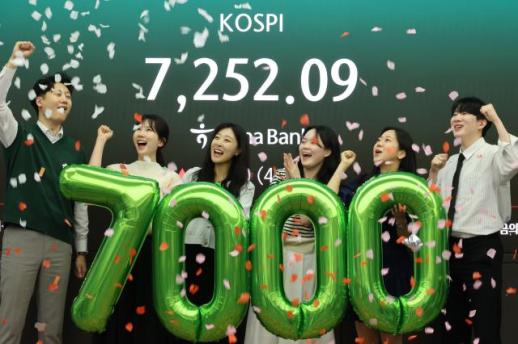 South Korea’s Kospi Surges Past 7,000 for First Time, Up More Than 3% Early South Korea’s benchmark Kospi opened higher on the 6th and climbed above 7,000 for the first time in early trading. According to the Korea Exchange, the Kospi stood at 7,195.92 as of 9:07 a.m., up 258.93 points, or 3.73%, from the previous session. It opened at 7,093.01, up 156.02 points, or 2.25%, and extended gains. Han Ji-young, a researcher at Kiwoom Securities, said the market could face “a pause for breath” for the rest of the week or short-term profit-taking by foreign investors. Still, Han said the Kospi’s earnings momentum has continued to strengthen after the first-quarter earnings season, while the absolute profit level and valuation burden are lower than on earlier net-buying days. The early surge also triggered a “sidecar” curb for program buying for the first time in about a month. At 9:06:02 a.m., the Kospi 200 futures index jumped 66.05 points, or 6.28%, to 1,116.55, prompting a five-minute halt in the effectiveness of program buy orders. In the main market, individuals and foreign investors were net buyers of 560.7 billion won and 314.2 billion won, respectively, helping lift the index. Institutions were net sellers of 707.9 billion won, appearing to take profits. Among top market-cap stocks, Samsung Electronics rose 10.32%, SK hynix gained 9.19%, SK Square climbed 13.22%, Hyundai Motor added 3.53%, LG Energy Solution rose 0.64%, Doosan Enerbility gained 0.79% and Samsung Electro-Mechanics advanced 1.85%. Hanwha Aerospace fell 2.46% and HD Hyundai Heavy Industries slipped 3.24%. Samsung Electronics and SK hynix jumped about 9% to 10% early, reaching 250,000 won and 1.6 million won, respectively. At the same time, the Kosdaq index turned lower, down 12.25 points, or 1.01%, at 1,206.22. It opened up 7.16 points, or 0.59%, at 1,220.90, but gave up gains and moved into negative territory. In the Kosdaq market, individuals were net buyers of 329.8 billion won, while foreign investors and institutions were net sellers of 164.7 billion won and 138.3 billion won, respectively. Among top Kosdaq stocks, EcoPro BM rose 2.78%, EcoPro gained 1.28% and HLB added 0.66%. Alteogen fell 2.28%, Rainbow Robotics slipped 1.75%, Samchundang Pharm dropped 2.20%, Lino Industrial declined 2.48%, Kolon TissueGene fell 1.05%, ABL Bio slid 3.32% and LigaChem Bio dropped 2.64%.* This article has been translated by AI. 2026-05-06 09:34:11
 -
 SK hynix tops 1.6 million won, Samsung Electronics hits 250,000 in premarket trade Shares of SK hynix and Samsung Electronics surged in premarket trading, extending a broader rally in chip stocks. According to Nextrade (NXT), SK hynix was trading at 1,609,000 won as of 8:48 a.m. on the 6th, up 11.2% from the previous session. Samsung Electronics rose 7.53% to 250,000 won. The gains were attributed to expectations for improving global semiconductor conditions. Overnight, the Philadelphia Semiconductor Index climbed 4.23% to a record high. The MSCI Korea ETF jumped 6.04%, and the MSCI Emerging Markets ETF rose 2.03%, signaling continued appetite for risk assets. On the back of that momentum, the Kospi is expected to attempt a move above the 7,000 level. In the previous session on the 4th, the Kospi closed at 6,936.99, up 338.12 points (5.12%), helped by net buying from foreign and institutional investors. SK hynix led that advance, ending up 12.52% at 1,447,000 won. Samsung Electronics gained 5.44% and, during the session, set a new high for the year, surpassing 230,000 won (April 30).* This article has been translated by AI. 2026-05-06 09:01:19
 -
 Hana Securities Raises Hyundai Corporation Target Price on Energy Parts Rebound Hana Securities said Tuesday it raised its target price for Hyundai Corporation by 15.2% to 38,000 won, citing a rebound in the company’s energy commercial parts business, which previously drove earnings growth. It maintained a “buy” rating. In a report, analyst Yoo Jae-seon said Hyundai Corporation’s first-quarter results beat market consensus and that previously weak segments such as steel are showing a better trend than in 2025 as market conditions improve. Yoo said profit growth is expected to moderate from the second quarter after factoring in a temporary earnings boost in petrochemicals, but added that the company is still likely to post higher profit for the full year. He estimated the stock trades at a price-to-earnings ratio of 4.5 based on this year’s forecast and a price-to-book ratio of 0.5. First-quarter revenue rose 11.6% from a year earlier to 2.1 trillion won. Yoo attributed the increase to favorable exchange rates and broad-based growth across business lines. He said steel revenue likely fell from a year earlier due to global trade restrictions such as U.S. tariffs, but he viewed last year as the bottom and said the business is gradually recovering. He added that passenger-vehicle operations are growing as weaker demand in the Commonwealth of Independent States was offset by sales in Central and South America and the Middle East. Yoo said energy commercial parts are benefiting from solid demand for power equipment, with distribution transformer performance continuing to rise. He added that a temporary sales gap caused by tariffs in the previous quarter has eased, allowing the business to return to a growth trend. He said geopolitical issues, including conflict in the Middle East, have increased global uncertainty, but Hyundai Corporation’s major businesses are continuing stable growth. He added that the company plans to keep pursuing new businesses this year and that stronger shareholder returns could be expected over the medium to long term.* This article has been translated by AI. 2026-05-06 08:12:50
 -
 Foreign Investors Chase Surging Korean Stocks, Led by Samsung Electronics ◆Aju Economy top stories ▷Foreign investors jump on momentum, concentrating net buying in soaring shares -According to the Korea Exchange on May 5, the top 10 stocks most heavily net-bought by foreign investors on the main KOSPI market at the end of last month all posted positive returns compared with the end of March. -The biggest foreign net buy on the KOSPI last month was Samsung Electronics, totaling 1.3231 trillion won. Over the same period, the stock jumped 32%, to 220,500 won from 167,200 won. -SK hynix, the No. 2 net-buy, rose 59%. With Samsung Electronics and SK hynix reporting record first-quarter results, expectations that semiconductor earnings will keep improving appear to have lifted share prices. -On the KOSDAQ, foreign money flowed into growth stocks. Many of the top net-bought names were tied to semiconductor equipment, AI semiconductors and biotech, and posted sharp gains. -In particular, many of the KOSDAQ’s top net-buy picks have shifted toward semiconductor equipment, materials and AI infrastructure, underscoring a trend of capital concentrating in “core supply chains” even within growth industries. Securities firms said foreign inflows are moving around two main themes: AI and semiconductors, and power infrastructure. ◆Key report ▷Why the KOSPI is surging: Semiconductors are beating high oil prices -The AI-driven semiconductor rally is continuing. The Philadelphia Semiconductor Index has surged 55% since the start of the year, far outpacing gains in the “M7” and the Nasdaq index. -The rally is also providing strong momentum for the economies and stock markets of major chip-producing countries such as South Korea and Taiwan. Another key point is that the semiconductor rally is offsetting the shock from high oil prices. -In past periods of high oil prices, global markets — especially South Korea’s — typically showed vulnerability. This time, an exception is emerging. iM Securities said the main reason the KOSPI can rally strongly, unlike in previous high-oil periods, is a sharp increase in the semiconductor trade surplus that more than offsets the oil trade deficit. -The report said oil prices are expected to remain elevated, fluctuating around $100, but given the semiconductor cycle, the gap between the semiconductor trade balance and the oil trade balance is likely to stay positive, with room for the surplus to widen further. -It added that a proxy for South Korea’s terms of trade — the difference between the semiconductor price increase rate and the oil price increase rate — is also likely to remain positive for a considerable period, supporting expectations for strong momentum in the domestic economy and stock market in the second half even amid high oil prices. ◆Major disclosures after the close (May 4) ▷Stage One Entertainment: 1 billion won third-party allotment rights offering ▷GS E&C: Won 680 billion contract for Seocho Jinheung Apartments reconstruction project ▷Lotte Chilsung: Q1 operating profit 47.8 billion won, up 91.2% from a year earlier ▷Pan Ocean: Q1 operating profit 140.9 billion won, up 24.4% from a year earlier ◆Fund flows (as of April 29, excluding ETFs) ▷Domestic equity funds: +28.1 billion won ▷Overseas equity funds: -86.5 billion won ◆Key events today (May 6) ▷South Korea: Consumer Price Index (April) ▷China: Caixin services PMI (April) ▷United States: ADP private employment report (April) ▷Eurozone: Producer Price Index (March)* This article has been translated by AI. 2026-05-06 07:45:19
 -
 KOSPI Nears 7,000 as Short-Selling Balances Top 20 Trillion Won, Up 36% in a Month As South Korea’s benchmark KOSPI pushes toward the 7,000 mark, short-selling balances have climbed rapidly, adding to investor caution. Short positions have stayed above 20 trillion won for three consecutive trading sessions, holding near record levels. According to the Korea Exchange on Monday, net short-selling balances in the KOSPI market totaled 20.1086 trillion won as of April 29. That was up 36.5% from 14.7313 trillion won at the end of March. The balance first topped 20 trillion won on April 27 at 20.5083 trillion won, then remained above that level on April 28 (20.3887 trillion won) and April 29. While slightly below the peak, it remains elevated. As of April 29, Hyundai Motor had the largest net short position at 1.9531 trillion won. It was followed by Hanmi Semiconductor (1.9276 trillion won), HD Hyundai Heavy Industries (1.6839 trillion won), Mirae Asset Securities (936.6 billion won), POSCO Future M (758.7 billion won), Korea Aerospace Industries (537.2 billion won), Samyang Foods (453.4 billion won), Hanwha Systems (449.8 billion won), Daewoo Engineering & Construction (374.5 billion won) and Hyundai Engineering & Construction (334.2 billion won). Short selling is a strategy in which investors borrow shares and sell them, then buy them back later to return the shares, aiming to profit if the price falls. A rise in short-selling balances is often read as reflecting expectations of a decline or increased hedging demand. The latest surge is widely seen as a move to brace for a short-term pullback after the KOSPI’s steady rally. The index on the previous trading day rose above 6,800 intraday for the first time and climbed as high as 6,900, leaving it 63.01 points short of 7,000. Still, brokerages have continued to emphasize further upside. Samsung Securities raised its year-end KOSPI ceiling to 8,400 points. Daishin Securities set a first-half target of 7,500, and Kiwoom Securities projected an upper range of 7,200 for this month. Lee Kyung-min, a researcher at Daishin Securities, said valuation pressure remains limited even as the market hits fresh highs. He said the KOSPI’s 12-month forward price-to-earnings ratio stood at 7.12 as of April 30, “still in undervalued territory.” He added that 12-month forward earnings per share rose to 926.8 points at the end of April from 666.6 points at the end of March, and said that given upward revisions to earnings forecasts, “there is still ample room for further gains.”* This article has been translated by AI. 2026-05-05 16:04:40
 -
 Samsung Electronics Tops Stock Gifts to Minors in April as Youth Accounts Rise Ahead of Children’s Day, Samsung Electronics ranked No. 1 last month among domestic stocks gifted to minors, measured by number of transactions. The trend comes as more accounts are being opened in minors’ names this year, expanding investing under children’s accounts. KB Securities said on May 5 that Samsung Electronics accounted for 56.3% of stocks its customers gifted to children age 18 and under through the firm’s “stock gifting” service. The service allows users to transfer shares they hold to another person through a brokerage’s home trading system (HTS) or mobile trading system (MTS) by entering the recipient’s name and mobile phone number. Samsung’s dominance is widely seen as reflecting expectations for a semiconductor upturn driven by expanding artificial intelligence demand. Seo Seung-yeon, an analyst at DB Securities, said, “At this earnings briefing, Samsung Electronics said it is pursuing or has completed multi-year memory contracts with some customers due to strong AI demand,” adding that the company “said it plans to supply samples of next-generation high-bandwidth memory (HBM4E) starting in the second quarter this year, demonstrating leadership in the HBM market.” After Samsung Electronics, the most-gifted stocks were Kia (6.5%), Kakao (6.1%), HLB (3.7%), EcoPro BM (3.6%), Deoksan Techopia (3.0%), DS Dansuk (2.5%) and POSCO Holdings (2.1%). SK hynix was about 1.5%, which was attributed to its higher share price. Account openings by minors are also rising. Daishin Securities said new accounts for children ages 0 to 9 increased 119.2% as of last month compared with January. That was the fourth-highest growth rate, following people in their 30s (352.6%), 20s (308.4%) and 40s (220.8%). New accounts among teenagers also rose 101.1%. Growth was more modest among older age groups. New accounts rose 45.6% for people in their 50s and 14.7% for those in their 60s, while the 70s and 80s increased 29.7% and 31.9%, respectively. For those 90 and older, new accounts fell 25.0%. Despite the increase in accounts, investment balances declined across most age groups: ages 0 to 9 (-6.0%), teens (-28.1%), 20s (-21.5%), 30s (-39.2%), 50s (-78.2%), 60s (-82.3%), 70s (-42.5%) and 80s (-74.1%). The figures suggest the rise in new accounts is being driven more by small investments than by large inflows of funds.* This article has been translated by AI. 2026-05-05 14:04:54
 -
 South Korean Optical Communications Stocks Slide After AI-Fueled Rally Optical communications theme stocks that surged on expectations of expanding artificial intelligence infrastructure have quickly moved into a sharp correction, with volatility rising and investor sentiment cooling as recent gains are erased. According to the Korea Exchange on Wednesday, major optical communications-related shares have shown a clear downtrend since forming peaks in mid-April. Optical Electronics, which makes optical sensors and related products, jumped from 2,080 won on March 17 to 17,780 won on April 15, then slid to close at 10,110 won on Wednesday after a pullback. Daehan Optical Communication topped 20,000 won, hitting 20,150 won on April 14, but closed Wednesday at 15,150 won, down about 24.8%. Wooriro, which had risen more than 1,000% since the start of the year, fell about 41.2% from 14,200 won on April 16 to 8,350 won on Wednesday, giving back a large share of its gains. Other names also extended losses: Bitsam Electronics fell about 48.8% from 23,650 won to 12,110 won; Lycom dropped about 38.0% from 8,400 won to 5,210 won. Bitgwang Electronics slid about 22.1% from 6,520 won to 5,080 won, and Gigalane fell about 27.5% from 2,855 won to 2,070 won, reflecting broad declines across the sector. Optical communications transmits data using light rather than electrical signals, enabling ultrafast, high-capacity networks over fiber optics and is widely viewed as next-generation infrastructure. As AI services spread and require real-time processing of massive data, demand has been rising for uses such as links between data centers and internal server networks, supporting longer-term growth expectations for the industry. The rally appeared to be sparked by comments from Nvidia CEO Jensen Huang. Speaking at "GTC 2026" on March 17 local time, he cited optical communications as a core technology for next-generation AI infrastructure, drawing market attention. Related shares then posted gains of several hundred percent through mid-April in a rapid run-up. More recently, however, prices have reversed and quickly surrendered gains. Market participants have described the move as typical theme-stock trading, with profit-taking accelerating after expectations were priced in. Some analysts said volatility could persist depending on whether earnings visibility improves and industry conditions are confirmed.* This article has been translated by AI. 2026-04-30 17:21:20