
Journalist

Kim Yu-jin
ujeans@ajunews.com
-
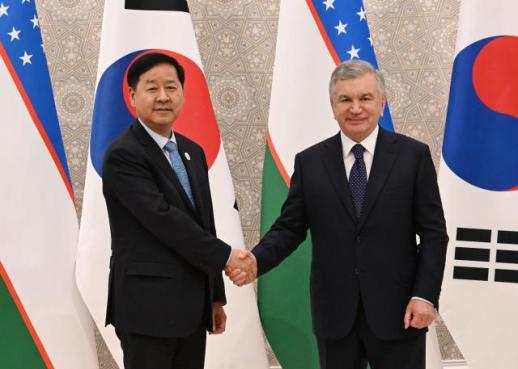 South Korea’s Koo Yun-cheol Meets Uzbek President, Seeks More Openings for Korean Firms Koo Yun-cheol, South Korea’s deputy prime minister and minister of economy and finance, met with Uzbekistan’s president and agreed to strengthen cooperation in emerging industries, including biotech, as Seoul seeks to broaden opportunities for Korean companies in Central Asia. South Korea’s Ministry of Economy and Finance said Tuesday that Koo met President Shavkat Mirziyoyev on May 3 (local time) in Samarkand to discuss the planned Korea-Central Asia summit in September and the direction of bilateral economic cooperation. According to the Korea Trade-Investment Promotion Agency, Uzbekistan imports $1.79 billion worth of Korean products. Exports are led by manufactured goods such as auto parts, passenger cars, engines and synthetic resins, while demand continues to rise for consumer goods and higher value-added items including cosmetics and medical electronic devices. Mirziyoyev cited the Afrasiyab murals in Samarkand as an example of long-standing friendly exchanges between the two countries. “Based on this, I hope trade and investment cooperation between Korea and Uzbekistan will expand further,” he said, adding that he hoped for broad discussions to identify cooperation projects and produce tangible results. Koo praised Uzbekistan’s recent reform and opening policies and the economic gains that followed. He said the two sides should strengthen cooperation in biotech, infrastructure such as railways and airports, supply chains and regional cooperation. Koo said he understood Uzbekistan is prioritizing industrial diversification and infrastructure modernization under its 2030 development strategy, and asked that opportunities be opened for Korean companies “given their strong capabilities.” Before meeting the president, Koo held talks with Uzbek officials overseeing economic cooperation with South Korea, including Deputy Prime Minister Jamshid Khodjaev and Deputy Prime Minister and Minister of Economy and Finance Jamshid Kuchkarov, as well as vice ministers from the ministries of investment, industry and trade; economy and finance; transport; and health, to review the status of bilateral cooperation. The deputy prime ministers agreed that cooperation should shift from a focus on infrastructure to more forward-looking areas such as biotech and critical minerals. Khodjaev said he hoped cooperation with South Korea would deepen in projects Uzbekistan is pushing, including the creation of medical and pharmaceutical clusters and the construction and operation of a new airport. The Export-Import Bank of Korea and Uzbekistan’s Ministry of Investment, Industry and Trade signed a strategic cooperation memorandum of understanding to expand exchanges in areas such as supply chains and digital and green cooperation. The ministry said the bank will support companies in both countries through policy financing to help broaden cooperation outcomes. Earlier, on May 2 (local time), Koo visited a medical cluster site in Tashkent with Khodjaev and Health Minister Khudayarov Anvarovich. The cluster, which is to include a national children’s hospital and a Tashkent general hospital, is being developed with support from South Korea’s Economic Development Cooperation Fund. Koo said the cluster could help Uzbekistan position itself as a medical hub in Central Asia. Khodjaev said, “With Korea’s EDCF support, we have been able to provide high-quality medical services to the people of Uzbekistan,” and expressed gratitude. Koo visited Uzbekistan on the sidelines of the Asian Development Bank’s annual meeting and met senior officials, including the president and two deputy prime ministers, the ministry said.* This article has been translated by AI. 2026-05-05 17:04:29
 -
 Incheon Port Authority to Subsidize K-Beauty SMEs’ Costs for 2026 Beauty & Healthcare Show Incheon Port Authority is offering support to help small and midsize K-beauty companies expand overseas, including subsidies to participate in a major local beauty and health expo and opportunities to meet foreign buyers. The authority, known as IPA, said on May 5 it is recruiting companies for its support program tied to the 2026 Beauty & Healthcare Show expo. Demand for K-beauty products has been rising. The Ministry of Food and Drug Safety said Korea’s cosmetics exports totaled $3.1 billion in the first quarter of this year. IPA said it will select 20 small and midsize companies and cover 50% of their booth costs, while setting up a joint IPA exhibition hall. The program is designed to promote products from smaller firms that have struggled to enter overseas markets and to support market development through activities such as one-on-one export consultations with foreign buyers. Companies seeking to participate can apply through the Win-Win Nuri website from May 6 to 19. Final selections will be announced after a document review. Now in its 11th year, the Beauty & Healthcare Show is Incheon’s flagship beauty and health exhibition. It will be held July 23-25 at Songdo Convensia in Incheon. IPA said it has supported small and midsize K-beauty companies’ participation in the show for four years to strengthen their global competitiveness. Shin Jae-wan, head of IPA’s ESG Management Office, said the project is a signature shared-growth program aimed at boosting exports by small and midsize companies and revitalizing the local economy. He said IPA will continue to support their entry into global markets based around Incheon Port. 2026-05-05 14:36:26
 -
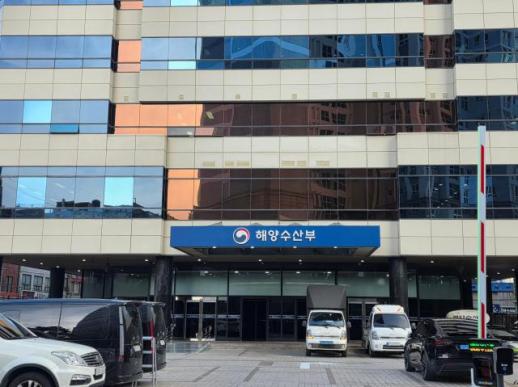
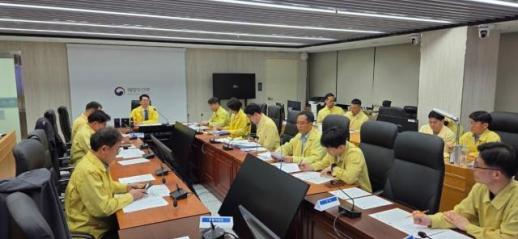 South Korea vows full response after fire on HMM NAMU cargo ship in Strait of Hormuz A blast and fire broke out on May 4 (local time) aboard the HMM NAMU, a cargo ship operated by a South Korean shipping company, while it was anchored in the Strait of Hormuz, prompting a government response. Maritime authorities said they are working to determine the cause and ensure the safety of the crew. The Ministry of Oceans and Fisheries said May 5 that it notified relevant agencies immediately after receiving the report and began an emergency situation review meeting chaired by the minister at about 10 p.m. Hwang Jong-woo instructed officials to “do their utmost to take necessary measures to protect the safety of our seafarers and vessels,” and ordered nearby South Korean ships to move to safer waters. Hwang chaired another situation review meeting at 9 a.m. May 5 to check developments. A ministry official said the government is in close contact with the shipping company and the vessel, and is working with related agencies, including the Foreign Ministry, to secure the safety of the ship and South Korean seafarers. As of May 5, a total of 160 South Korean seafarers were confirmed to be in the inner area of the Strait of Hormuz: 123 aboard South Korean vessels and 37 aboard foreign vessels. The ministry official said the government is communicating frequently with shipping companies to protect seafarers, adding that it will respect their wishes but will safely bring to South Korea those who choose to exercise their right to request disembarkation. 2026-05-05 13:27:13
 -
 South Korea, China and Japan Finance Chiefs Pledge Closer Coordination, Boost Regional Safety Net South Korea, China and Japan brought their finance ministers together to coordinate responses to global uncertainty and other medium- to long-term challenges, including steps to strengthen the region’s financial safety net. South Korean Deputy Prime Minister and Minister of Economy and Finance Koo Yun-cheol chaired the 26th trilateral meeting of finance ministers and central bank governors on May 3 in Samarkand, Uzbekistan. The three countries hold the meeting annually to share economic and financial cooperation plans and to discuss key agenda items in advance of the ASEAN+3 finance ministers and central bank governors meeting. The chair rotates among the three finance ministries, and South Korea is this year’s chair. The countries shared views on the macroeconomic impact of the recent war in the Middle East and their respective policy responses. They said their economies remained steady despite external uncertainty last year, a trend that continued through the first quarter, but agreed that downside risks have increased due to the Middle East conflict. Koo said the three countries face common medium- and long-term structural challenges, including low birthrates and aging populations, weakening growth potential and the need to stabilize supply chains. He proposed that they share information and work together on solutions. On ASEAN+3 financial cooperation, Koo said, “To respond to heightened uncertainty, we need to improve the effectiveness of the CMIM, the regional financial safety net,” and urged joint efforts to strengthen the capacity of AMRO, the region’s surveillance body. The finance ministers and central bank governors agreed that close communication can help support regional financial stability. They also decided to hold their next meeting in Nagoya, Japan, where the 30th ASEAN+ finance ministers and central bank governors meeting is scheduled to be held in 2027. * This article has been translated by AI. 2026-05-03 17:07:26
 -
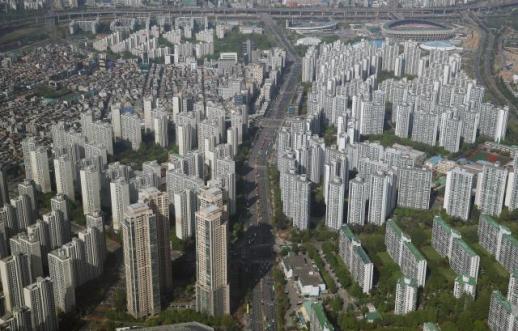 South Korea’s Higher Capital Gains Tax on Multi-Home Sellers Returns May 10; Long-Hold Deduction in Focus A one-year temporary suspension of heavier capital gains taxes on home sales by multiple-home owners will end on May 9. Starting May 10, owners who sell homes in regulated areas are expected to face a sharply higher tax burden on gains. An exception remains. In some areas, sellers can keep the tax break through November if they complete an application for land transaction approval by May 9. According to the Ministry of Finance and Economy and other officials on May 3, once the suspension ends, multiple-home owners selling in regulated areas could face an effective tax rate of up to 82.5%. Under current rules, the basic capital gains tax rate ranges from 6% to 45%. From May 10, an additional surcharge applies in regulated areas: 20 percentage points for owners of two homes and up to 30 percentage points for those with three or more. Adding local income tax of 10% brings the effective top rate to about 82.5%. With concerns rising over a sudden jump in tax bills, the government set out an exception: If a seller files the land transaction approval application by May 9, the basic rate applies even if the approval and final payment are delayed as late as November. For Seoul’s Gangnam 3 districts (Seocho, Gangnam and Songpa) and Yongsan-gu, which were regulated areas before the 10·15 measures, the sale process must be completed by Sept. 9 to avoid the surcharge. For other Seoul districts and 12 areas in Gyeonggi Province designated later, the deadline is Nov. 9. As the end of the suspension nears, attention is also turning to possible changes in real estate taxation, including the long-term holding special deduction for capital gains. The deduction was introduced to ease the tax burden on nominal gains driven by inflation and to encourage long-term ownership. Under the current Income Tax Act, owners of general real estate held for at least three years can deduct 2% per year, up to 30% for 15 years. For one-home households, the deduction can reach 80% by combining holding and residency periods. For example, if a person has owned and lived in a single home for at least 10 years, a 40% holding-period deduction and a 40% residency deduction can apply, excluding up to 80% of the gain from taxation. Critics say a deduction as high as 80% can amount to an excessive tax benefit for owners of expensive homes. President Lee Jae-myung previously raised concerns about the structure of the deduction on X. Moves toward tax changes are also gaining traction in politics. Independent lawmaker Choi Hyuk-jin introduced an amendment to the Income Tax Act that would, among other items, remove deductions for nonresidents and apply a 16% to 80% deduction rate to one-home households that have held a home for at least three years and lived in it for at least two. Another bill, introduced by Jinbo Party lawmaker Yoon Jong-oh, calls for abolishing the long-term holding special deduction. However, the bills have not been coordinated with the government, leaving their prospects unclear. Some observers expect real estate-related measures could be included in a tax package scheduled for July. A government official said, “Nothing has been decided yet,” adding that authorities are “reviewing the timing and methods comprehensively.” 2026-05-03 15:35:01
 -
 South Korea Revives Long-Stalled Services Industry Bill, Health Care Dispute Persists South Korea’s long-delayed Framework Act on the Development of the Service Industry has again been pushed for passage, but lawmakers remain deadlocked over whether to include the health and medical sector. On May 3, the Ministry of Economy and Finance and other agencies said the government has resumed efforts to pass the bill, known as the “service industry development act,” including by commissioning research projects. The bill has been stuck in the National Assembly for 15 years largely because no agreement has been reached on the scope of health and medical services. Since it was first introduced in 2011, the government, the medical community and civic groups have failed to narrow sharp differences. Opponents say including health and medical services could open the door to privatization. The government argues inclusion is needed to reduce gaps between industries and foster high value-added sectors. Medical groups and civic organizations have warned that bringing health care under a broad service-industry promotion law could lead to commercialization and conflict with the Medical Service Act, which is grounded in public interest principles and bans profit-seeking as a basic ideal. They also argue that greater inflows of private capital and changes to hospitals’ revenue structures could weaken the public health care system. Concerns have also been raised about expanded telemedicine, allowing nonprofessionals to establish medical institutions, and broader health management services, which critics say could undermine public health care and patient safety. The government and industry, however, view health and medical services as central to making the bill effective. They say South Korea needs a systematic approach to developing high value-added service industries such as tourism and health care to better balance manufacturing and services. The government has consistently said the bill is intended to promote the service sector overall and that health and medical services, as a major pillar of that sector, should be included. It has also stressed the need for a legal basis to support exports of medical technology and development of digital therapeutics. In recent discussions, a third option has been floated, such as separating health and medical services or limiting the law’s scope, but it has not unified the two sides. Four key health-related laws now being discussed as possible exclusions from the bill’s application are the Medical Service Act, the Pharmaceutical Affairs Act, the National Health Insurance Act and the Framework Act on Health and Medical Services. Under that approach, the bill would be enacted while carving out core statutes seen as posing risks to health care’s public nature. Supporters of exclusions say explicit carve-outs could block privatization disputes in the text of the law, reduce prolonged political battles, and speed regulatory reforms in areas such as tourism and content that have been delayed by health care-related conflict. They also acknowledge that limits would likely remain in some areas, including digital health care and medical technology exports. Some, however, argue the government should move cautiously rather than rush the bill, warning that legislation could hinder, rather than promote, industry growth. Seo Yong-gu, a professor of economics at Sookmyung Women’s University, said, “AI-based service industries and the software industry are areas that grow by market logic,” adding, “It is true that productivity in Korea’s service industry is low, but it is preferable to leave it to the market’s autonomy rather than enact a law.”* This article has been translated by AI. 2026-05-03 15:32:21
 -
 South Korea to Provide 3.1 Billion Won in Aid to Fish Farmers Hit by Cold-Water Losses The government has provided 3.1 billion won in support to fishing households that suffered losses from abnormal weather and other natural events. The Ministry of Oceans and Fisheries said Sunday that it provided disaster relief payments and loans to affected households on April 30 to help with recovery. Low water temperature refers to a sharp drop in sea-surface temperatures during winter cold snaps. Farmed species are vulnerable because their immunity weakens, while feed intake and digestion decline, raising the risk of die-offs. To limit damage from low temperatures this year, the ministry provided 1.5 billion won to aquaculture households that carried out emergency releases. It also paid 1.4 billion won in disaster relief to oyster farms that were damaged last year by abnormal water temperatures. In addition, 200 million won in support was applied retroactively to fishing households harmed by disasters that occurred before revisions to the Framework Act on the Management of Disasters and Safety took effect. The ministry said it will assess the scale of losses and extend repayment deadlines for existing fisheries policy loans accordingly. It will also reduce interest on policy loans for one year for damage rates of at least 30% but less than 50%, and for two years for damage rates of 50% or more. Fishers seeking support can apply through the National Federation of Fisheries Cooperatives and Suhyup Bank. Choi Hyeon-ho, director general for fisheries policy at the ministry, said the government will pay recovery funds as quickly as possible to help stabilize management at fishing operations. He said the ministry will continue working with local governments and other related agencies to minimize damage from natural disasters.* This article has been translated by AI. 2026-05-03 11:45:15
 -
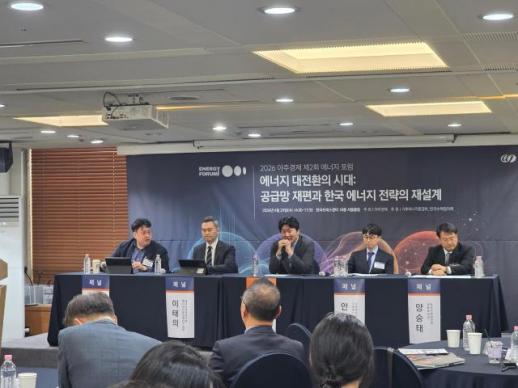 Experts urge balanced renewables-nuclear energy mix as supply chain risks grow Global geopolitical shifts and rising supply-chain risks are reshaping energy supply lines, prompting experts to call for a clear energy-mix strategy to secure South Korea’s stable power supply. Ajou Economy held the “2026 Ajou Economy Energy Forum” at the Press Center on the 29th and hosted a panel discussion on “Energy Mix Strategy for South Korea in the Era of Energy Security.” The session was moderated by Kim Hyeong-jun, a professor at KAIST’s Moon Soul Graduate School of Future Strategy. Panelists were Andre, a senior official in the Climate and Energy Policy Division at the Ministry of Climate, Energy and Environment; Lee Tae-ui, head of the Energy Security Policy Research Office at the Korea Energy Economics Institute; Yang Seung-tae, head of the Fuel Department at Korea Hydro & Nuclear Power; and Choi Deok-hwan, head of external cooperation at the Korea Wind Industry Association. Yang said nuclear power does not conflict with renewable energy, describing it as baseload generation that supports the national grid as renewables expand. He also said nuclear power’s cost advantages should be reflected in energy-mix policy. “Nuclear power produced about 31% to 32% of the nation’s electricity with an investment of 1.2 trillion won last year, and it is economical and highly resilient even if uranium prices rise,” Yang said. “We should make good use of nuclear power’s strengths to address issues such as renewables and transmission networks and move forward.” Andre pointed to expanding global supply-chain risks and urged policies that incorporate on-the-ground input to strengthen energy security. “After announcing the 2040 NDC last November, the recent Middle East war has brought a new perspective and many concerns about energy security,” he said. “To change the existing energy system, we need to consider not only production, consumption and distribution, but also the market tariff structure.” He added that the forum’s detailed discussions underscored the need for complex, multi-track solutions. Lee said countries must move quickly, warning that greenhouse gases already in the atmosphere will linger for centuries even if emissions are reduced. “The greenhouse gases on Earth have been here since 100 years ago,” Lee said. “Even if we cut emissions starting now, it could take hundreds of years for the greenhouse gases themselves to decline.” He added that cutting carbon emissions is difficult and requires major effort and time, and said countries should work aggressively to meet their Nationally Determined Contributions. Choi said economic hurdles must be overcome to maximize renewable energy use, warning that when regulatory deposits shrink, discussion of practical issues such as emissions permits and carbon reductions can fade. “When economic problems arise, the reality is that tools to respond to climate change, such as carbon reduction, are weakened,” Choi said. “Scope 3 greenhouse gases are not even being tracked in the current situation.” Choi also called for incentives for companies investing in renewables. “Right now, only state-run power generation companies are investing in renewables to score well in management evaluations,” he said. “We need to think about how to manage and revitalize this. Strengthening tax credits for companies that purchase renewable energy could also be an alternative.”* This article has been translated by AI. 2026-04-29 17:32:45
 -
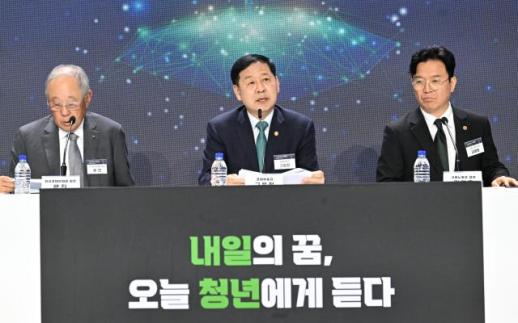 South Korea Unveils Youth New Deal to Expand Training and Help 100,000 Find Jobs Unemployed young people total 171, and the youth employment rate stood at 43.5% in the first quarter, underscoring a prolonged hiring slump for people in their 20s and 30s. The government said it drew on feedback from young people to craft a “Youth New Deal implementation plan” built around three tracks — advancement, experience and recovery — to support entry into the workforce. The government announced the plan on the 29th at a public-private Youth New Deal briefing chaired by Deputy Prime Minister and Minister of Economy and Finance Koo Yun-cheol, in a joint release with related ministries. Under the advancement track, the government will provide job training and education programs to 19,000 young people through private companies and universities. It will also launch the “K-New Deal Academy,” a 10,000-person program designed and run directly by private companies that hire, offering training for jobs in areas such as artificial intelligence and semiconductors, as well as youth-preferred fields including finance and content. Companies will also run voluntary programs such as psychological and career counseling and workplace adjustment support. Young people facing barriers to employment, including long-term unemployment, will be given priority in selection. Companies and participants outside the Seoul metropolitan area will receive preferential support for training costs and participation allowances. Short, intensive university courses previously limited to enrolled students will be linked to a “Youth Advancement Talent Boot Camp” and opened to 4,000 job-seeking young people who are not currently students. Two tracks — advanced-talent and practical-talent — will offer level-based curricula tailored from non-majors to majors. The experience track will expand work-experience programs by 22,000 slots and centrally manage participation records to support practical, job-relevant career building. In the public sector, the government will newly hire 9,500 staff to verify the status of delinquent national taxes and non-tax revenues and pursue tailored collection by debtor type. It will also hire 4,000 workers for a comprehensive farmland survey, including building databases to curb farmland speculation and track ownership and use. New programs will allow 2,500 young people to gain experience in social solidarity economy organizations — including social enterprises, village enterprises and cooperatives — in areas such as care, culture and the environment. The government also plans to expand public-institution youth internships by 3,000 from last year. In the private sector, the government will create or expand job-linked courses in youth-preferred fields such as tourism, content, culture and arts, and digital. It will also increase existing private work-experience programs by 1,500, focusing on in-demand internship-type placements and environmental, social and governance support roles. Participation records in Youth New Deal programs will be integrated and issued through an online platform, Employment 24, so they can be recognized as official experience in the job market. Under the recovery track, the government will run a close-support program covering the full cycle from counseling and daily-life recovery to job training and employment. It will expand Youth Future Centers that provide tailored services from four to 17 locations, and increase by 1,000 the Youth Challenge Support Program for young people who have given up job searching. Additional recovery programs — including parent and family relationship education and economic camps — will be offered to a total of 11,000 participants. To support job searches and hiring, the government will also redesign and upgrade youth employment support infrastructure. It will create a youth-focused track within the National Employment Support System and expand support, including job-search promotion allowances, to 30,000 more people. The government will broaden eligibility for the Youth Job Leap Subsidy — which pays up to 7.2 million won each to youth-hiring companies and to young workers who stay long term — from mid-sized firms in non-metropolitan industrial complexes to all mid-sized firms outside the Seoul metropolitan area. It will also expand low-interest loan support for young small business owners or small business owners who hire young people. A ministry official said the plan is expected to provide employment-related services to about 100,000 young people. “The government will prepare the programs without disruption so young people can quickly benefit from these measures,” the official said.* This article has been translated by AI. 2026-04-29 16:36:47
 -
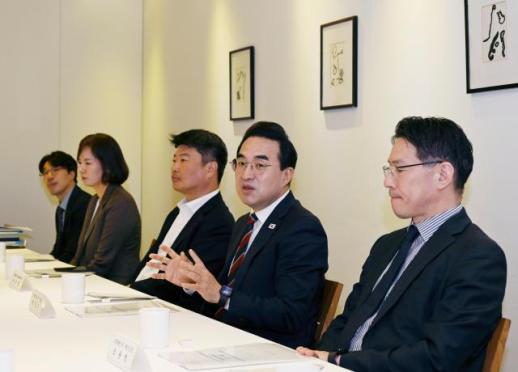 Budget Minister Park Hong-geun Pledges Constant Dialogue With Private Fiscal Advisers Park Hong-geun, minister of the Ministry of Planning and Budget, said on the 29th that he will strengthen communication between the government and the private sector by building a standing communication system for the Fiscal Policy Advisory Council. Park held a luncheon meeting that day with the council’s private-sector members to discuss policy issues broadly. He shared key points from a town hall meeting held the previous day and stressed the importance of government-private sector communication and cooperation. “The Fiscal Policy Advisory Council has played a central role as a channel for government-private communication in key national fiscal decisions,” Park said, thanking members for their work and dedication, which he said helped improve the quality of fiscal policy. He also called for more active engagement, saying that with policy conditions changing faster and more widely than ever, holding only two to four regular meetings a year could limit the government’s ability to reflect diverse policy needs raised in the field in a timely way. He said closer government-private communication is needed more than ever. In response, Park said the council plans to move beyond a regular-meeting format and establish an always-on communication system. He added that after the luncheon, the ministry plans to open and operate a group chat to enable ongoing exchanges. Private-sector members who attended freely discussed a range of views on overall fiscal policy, including institutional improvements and priority investment directions. Park said the government will closely review issues raised at the meeting as well as suggestions later posted in the group chat and reflect them in major policies, including the 2027 budget proposal. * This article has been translated by AI. 2026-04-29 15:36:11