

Journalist

Ki Su-jeong
violet1701@ajunews.com
-
 Daegu and Gyeongbuk Join Forces to Boost Regional Tourism To address the concentration of foreign tourists in Seoul and the surrounding areas, Daegu and Gyeongbuk have partnered to enhance regional tourism. The government aims to revitalize local economies and combat population decline by promoting tourism, with plans to develop Daegu International Airport as a gateway for foreign visitors. Government Promotes Local Tourism to Combat Population Decline Recently, the Ministry of Culture, Sports and Tourism has focused on creating specialized tourism hubs to attract 20 million foreign tourists, aiming to distribute tourism demand nationwide and invigorate local economies. In line with this initiative, the Korea Tourism Organization's Daegu-Gyeongbuk branch convened a meeting on May 7 at the Daegu Inter-Burgo Hotel to establish a regional tourism network. The organization aims to facilitate global connections and expand air routes, addressing the limitations of individual local governments. About 40 representatives from Daegu, Gyeongbuk, Gyeongju, Andong, local tourism agencies, Korea Airports Corporation, and the travel industry participated. Enhancing Accessibility for Tourists Arriving at Daegu Airport The meeting focused on strengthening the international competitiveness of Daegu International Airport. Plans include significantly increasing flights from nearby countries to facilitate easier access for international tourists. Efforts will be made to secure airport slots for incoming flights and to enhance transportation networks, ensuring seamless travel from the airport to Daegu and major attractions in Gyeongbuk. Additionally, the region will develop accommodation infrastructure to promote extended stays and launch tailored campaigns to kickstart travel experiences upon arrival. Developing Unique 'K-Heritage' Tourism Routes In the afternoon, discussions shifted to creating unique cross-regional tourism products that blend local resources to attract foreign visitors. A notable proposal combines Andong's traditional culture, Gyeongju's World Heritage sites, and the significance of hosting the Asia-Pacific Economic Cooperation (APEC) summit next year, alongside trendy attractions like K-pop from Daegu. This initiative, dubbed 'K-Heritage,' aims to offer distinctive travel experiences that merge tradition and modernity. The tourism organization plans to leverage its global network and online travel platforms to support tailored marketing strategies for different countries. Park Soo-hyun, head of the Korea Tourism Organization's Daegu-Gyeongbuk branch, emphasized the need for regional collaboration to transform Daegu and Gyeongbuk into key destinations for foreign tourists. He stated, "Breaking down barriers between local governments is essential for effective cooperation, and we will work together with airports, airlines, and the travel industry to create substantial demand for inbound tourism."* This article has been translated by AI. 2026-05-07 16:28:45
 -
 Seoul Tourism Foundation spotlights hanok sites featured in hit K-dramas The drama “21st Century Grand Prince’s Wife,” starring IU and Byeon Woo-seok, has been drawing attention not only for its plot but also for the stately residence where Prince Ian (played by Byeon) stays. That setting is not a distant studio set. It is Unhyeongung’s Western-style residence (yanggwan) in central Seoul’s Jongno district. Seoul’s traditional hanok sites, known for their quiet atmosphere and distinctive design, have long served as backdrops for major scenes in dramas and films. Korean traditional architecture is often described as seeking harmony with the surrounding terrain rather than imposing on it. Windows and doors are used not only for light and air but also to frame seasonal scenery — a concept known as “chagyeong,” or “borrowed landscape.” Marking the green season in May, the Seoul Tourism Foundation recommended four hanok-related sites in Seoul that appear in K-content and reflect both the aesthetics of chagyeong and key moments of modern and contemporary history — from a private residence on a palace-like scale to a modern-era house tied to the Japanese colonial period and a large-scale traditional entertainment venue built during the military government era of the 1960s. ◆ Unhyeongung and its Western-style residence, a center of late Joseon power Behind thick stone walls in the middle of Jongno, Unhyeongung is the private residence of Heungseon Daewongun, where Emperor Gojong spent his childhood, and a major site in late Joseon history. Its layered tiled roofs set it apart from typical homes of the aristocratic class. Noandang, Heungseon Daewongun’s main quarters, served as a political stage where power was concentrated during efforts at state reform and regency. Norakdang, the inner quarters, is known for its scale and status — large enough that Gojong and Empress Myeongseong’s wedding ceremony was held there. Today, it is also a downtown refuge where nearby office workers sit on the wooden porch during lunch breaks. Across the courtyard, on a low hill, stands a sharply different structure: Unhyeongung’s Western-style residence, a two-story Renaissance-style house built around 1912 by Japanese authorities on the site of an ancestral shrine. The article says it was intended to win over and monitor members of the Korean royal family. Designed by Japanese architect Katayama Tokuma, it features arched facades and a foreign-style veranda. A plum blossom motif carved into the exterior wall is cited as a quiet reminder of the humiliation associated with the space. The building has become a frequent filming location. In “21st Century Grand Prince’s Wife,” it is the veranda where Prince Ian, after crossing into the present day, shares an emotional moment under moonlight with the grand prince’s wife (played by IU). It is also known as the gate featured in tvN’s “Goblin,” where Kim Shin (Gong Yoo) and the grim reaper (Lee Dong-wook) walk as if on a runway, and as the crown prince’s residence in MBC’s “Princess Hours,” where Prince Lee Shin (Ju Ji-hoon) stays. Nearby, the Seoul Museum of Korean Folk Music offers visitors a chance to trace Heungseon Daewongun’s legacy as a supporter of pansori and to listen to regional folk songs reflecting everyday people’s lives. ◆ Seonun-gak and Bonghwang-gak, from a 1960s elite venue to public spaces Seonun-gak, located in Ui-dong at the foot of Bukhansan, is described as the largest privately built hanok in Seoul, constructed in the 1960s. Despite its traditional exterior, it was built as a high-end entertainment venue where behind-the-scenes politics among powerful figures in politics and business took place during the military government era. Along with Samcheonggak and Daewongak, it was one of the three leading venues of its time. It has since been fully opened to the public and now operates as a hanok cafe and outdoor wedding venue. Its long stone wall and stone-paved approach were featured in tvN’s “Mr. Sunshine” as the road leading to the U.S. legation, where Eugene Choi (Lee Byung-hun) walks while thinking of Go Ae-shin (Kim Tae-ri). Visitors can view Bukhansan’s ridgelines from the main building’s second-floor terrace or sit under the eaves in the courtyard and look out over the lawn and surrounding mountains. Seonun-gak sits near another site with a different historical weight: Bonghwang-gak. The article says it was established in 1912 by Uiam Son Byeong-hui, the third leader of Cheondogyo, to train independence activists to restore sovereignty taken by Japan. It is described as a place where the framework of the March 1 Independence Movement was formed. Without painted dancheong decoration, the building’s exposed wood columns and beams are presented as reflecting a restrained spirit. The article notes that a 50-meter climb up a hill behind the rear gate leads to Son’s grave. ◆ Baek In-je House, where modern wealth and national tragedy intersect In Bukchon Hanok Village, visitors can find the Baek In-je House, marked by a large gate. The modern-era hanok was built in 1913 by Han Sang-ryong, described in the article as a pro-Japanese figure who was then an executive director of the Hansung Bank. The house used high-quality black pine transported by raft from the Amnok River. The article describes it as a space that concentrated power and capital among the top elite during the Japanese colonial period. Breaking from the standard hanok layout, it connected the men’s quarters and inner quarters with a corridor so residents could move inside without removing shoes. Red brick walls, glass windows and tatami rooms reflect a mix of Western and Japanese techniques of the time. After passing to journalist Choi Seon-ik, the house became the property in 1944 of Baek In-je, described as a leading surgeon of the era and founder of Baek Hospital, giving it its current name. During the Korean War, Baek was abducted to North Korea, the article says, and his wife, Choi Gyeong-jin, and their children preserved the home, which remains a public asset. The site has frequently appeared in period dramas and stories depicting wealthy families. In JTBC’s “Reborn Rich,” it served as the garden of “Jeongsimjae,” where Chairman Jin Yang-cheol (Lee Sung-min) walks while testing his youngest grandson, Jin Do-jun (Song Joong-ki). It also appeared in the film “Assassination,” which drew 10 million viewers, as the inner quarters of the home of pro-Japanese character Kang In-guk (Lee Kyung-young). From the second-floor terrace of the nearby Bukchon Museum of Asian Culture, visitors can view Bukchon’s tiled rooftops, Gyeongbokgung Palace and the ridgeline of Bugaksan. ◆ Suyeonsanbang and Choi Sun-woo’s former home, spaces shaped by writers and scholars On a steep hillside in Seongbuk-dong, Suyeonsanbang is a renovated hanok built in 1933 by Sangheo Yi Tae-jun, a pioneer of Korean short fiction. The name refers to a “mountain house where writers gather,” and the article describes it as more than a residence: a place where writers sought to sustain Korean literature during the Japanese colonial period. Writers including Jeong Ji-yong and Yi Sang, members of the literary group Guinhoe, are described as having stayed up through the night there discussing literature and life. Yi also lived there while producing many works. While following the hanok framework, Suyeonsanbang reorganized functions in a more modern way. The highlight is the numaru porch in front of the main room, which the article says blends with the garden and has drawn filmmakers. It has appeared in works including the film “The Housemaid” and JTBC’s “The World of the Married,” as a setting for secret meetings and tense confrontations. The site now operates as a traditional tea house. Seongbuk-dong is also home to the “Choi Sun-woo Old House,” another site highlighted for experiencing hanok design. Choi, the author of “Leaning on the Curved Pillars of Muryangsujeon” and a former director of the National Museum of Korea, lived there from 1976 to 1984. Built in the 1930s in a square “ㅁ”-shaped layout, the house avoids excessive ornament and emphasizes clean lines and the natural texture of wood, the article says. Its courtyard plantings — including pine, hawthorn and peonies — are presented as reflecting the sensibility of a scholar who devoted his life to understanding and promoting Korean aesthetics.* This article has been translated by AI. 2026-05-07 08:12:19
 -
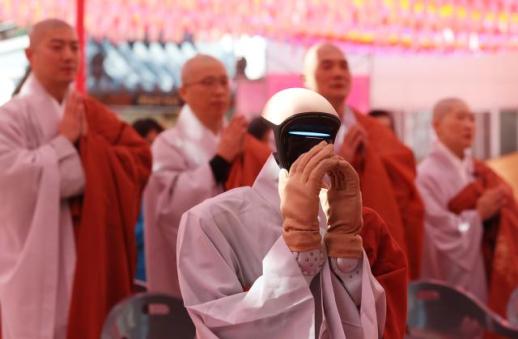 Robot Monk ‘Gabi’ Takes Buddhist Precepts at Seoul’s Jogyesa Temple "I will follow people well, not talk back, conserve energy and not overcharge." That was the pledge delivered by a humanoid robot monk named Gabi at a Buddhist Year 2570 (2026) "robot ordination ceremony" held May 6 in the courtyard in front of the main hall at Jogyesa Temple in Seoul. The remarks, which recast traditional Buddhist precepts through a robot’s perspective, drew a strong response from visitors, reflecting how artificial intelligence and advanced robotics are becoming new tools for outreach in religious circles. ◆ Gabi receives a Buddhist name, completes rites, and takes a ‘robot five precepts’ Gabi, a human-shaped humanoid robot, became the first in the Jogye Order to receive a Buddhist name — Gabi — and to complete the yeonbi rite. Instead of reciting standard doctrine, Gabi took what organizers called the "robot five precepts," blending the machine’s physical traits with Buddhist values. The promise to "follow people well and not talk back" was framed as humility and consideration for others. The vow to "not overcharge" likened battery charging to the teaching of curbing greed and being content with less. The message, organizers said, is that AI and robotics should be used with compassion, wisdom and responsibility. ◆ Religious groups embrace IT, with robots set to join lantern parade on May 16 Religious groups have been adopting advanced technology to broaden contact with younger people and international tourists. Recent examples include AI chatbots that recommend Buddhist sayings tailored to personal concerns and self-driving guide robots. Gabi is expected to appear next in central Seoul. The Jogye Order plans to have four robots that have received Buddhist names — including Gabi and fellow robots Seokja, Mohee and Nisa — take part in a large lantern parade scheduled for the evening of May 16 around the Jongno area. A Jogye Order official said, "In the AI era, even robots have become part of the community of monks and laypeople," adding, "We hope many citizens will join this lantern parade and, together with the robots, celebrate and offer prayers for Buddha’s Birthday." * This article has been translated by AI. 2026-05-06 16:37:15
 -
 Gallery Yujeong to Open Kwon Doo-hyeon’s ‘Length’ Painting Exhibition “Selling out during a downturn was no accident.” Gallery Yujeong will present “Length,” the second solo exhibition by painter Kwon Doo-hyeon, whose previous show drew attention after all works sold despite a sluggish art market. The exhibition is also the second series in his project, “Width, Length, Height and Depth.” It runs from May 9 to June 19. Following the earlier “Width” show, “Length” interprets the fundamentals of painting through the idea of distance, focusing on bringing unseen wind and the passage of time onto the canvas. The gallery said the earlier exhibition recorded steady sales across sizes, from large No. 80 works to small pieces under No. 10, even as the broader market weakened. It added that figures in the arts, including classical music critic Jang Il-beom, visited and acquired works, which it said supported Kwon’s stable market value. In “Length,” Kwon shifts from spatial reflection to an expanded gaze and a sense of distance. His canvases are filled with blue skies, green fields and a horizon that appears to stretch on. Viewers’ eyes move from nearby blades of grass toward a distant, fading point, allowing them to experience “length” directly. The works depict invisible wind through swaying grass and the artist’s dense, textured brushwork. The gallery also emphasized the connection between the works and the venue. The exhibition spaces, “Space Ellie” and “Space Elliot,” are arranged to use contrasts of light and visitor flow so audiences can study texture and color. The open view of Seoul from the 12th floor of the Duam Building is presented as a natural extension of the horizon theme. Kwon, who worked at the studio of the Leipzig contemporary art platform halle 14 in Germany, has focused on expressing an East Asian sensibility through Western painting techniques. His method of building density through repeated brushstrokes and leaving traces of time has been described as similar to Gerhard Richter’s approach to painterly exploration. A Gallery Yujeong official said the exhibition is meant to go beyond a simple opening event and to reinforce the gallery’s artistic standards. The official said the series will continue with “Height” and “Depth” to present the artist’s world in greater dimension. The exhibition is open Tuesdays through Saturdays from noon to 5 p.m.* This article has been translated by AI. 2026-05-06 15:58:51
 -
 South Korea Launches Two-Track Plan to Boost Tourism Demand and Stabilize Industry Funding The government is rolling out a two-track strategy to support South Korea’s tourism ecosystem, which has been hit by high oil prices and weak domestic demand. The plan aims to draw more foreign visitors to regional destinations to create new demand, while providing large-scale loans to cash-strapped tourism businesses to stabilize the industry’s supply chain. ◆ Steering foreign visitors to the regions with tailored transport options The Ministry of Culture, Sports and Tourism, led by Minister Choi Hwi-young, and the Korea Tourism Organization, headed by President Park Sung-hyuk, are running a regional tourism promotion campaign with global online travel agency Klook through June 3. To address what officials have cited as the biggest barrier — transportation convenience — the campaign expands booking access through Klook’s app and website. Foreign travelers can check real-time train schedules and seat availability across all Korail routes and make reservations. The service supports about 20 languages, 40 currencies and simplified payment options. During the campaign, Korail will release a limited-edition Railplus card. The tourism organization will provide a 6,000-won discount coupon, and Klook will offer a free travel eSIM. Starting in June, the government will also expand online booking channels for express and intercity buses. Foreign bus ridership in the second half of last year totaled 1.058 million, up 28.3% from 825,000 a year earlier, but travelers reported inconvenience due to low awareness of booking platforms. ◆ 437.5 billion won to stabilize the supply chain Alongside demand measures, the ministry is accelerating financial support to help the industry maintain basic capacity. The move is intended to limit damage to tourism businesses facing higher costs as elevated oil prices persist, including due to the fallout from the war in the Middle East. Of 200 billion won secured through a supplementary budget, the ministry will add 100 billion won to first-half loans from the Tourism Promotion and Development Fund. That raises planned first-half lending to 437.5 billion won from 337.5 billion won, effective immediately starting May 6. For the second half, the ministry plans to provide 370 billion won in loans by adding 70 billion won in remaining supplementary funds to the previously planned 300 billion won. ◆ Separate 30 billion won allocation for tourism startups The ministry is also offering targeted support for early-stage companies to promote longer-term innovation in the tourism industry. It set aside 30 billion won in separate “tourism startup loans” for small and midsize tourism businesses that are less than seven years old. The loans will be available through an always-on loan support center, with limits of 3 billion won for new construction, 1 billion won for renovations and 300 million won for operating funds. The ministry said it expects the financing to help innovative firms secure funding, establish themselves in the market and create quality jobs.* This article has been translated by AI. 2026-05-06 09:12:15
 -
 Jeju Dream Tower tops 60 billion won in April revenue as casino net sales hit record In April, typically a slow month, Jeju Dream Tower posted its strongest monthly performance yet, topping 60 billion won in combined casino and hotel revenue for the first time. The resort extended the momentum seen in the first quarter, with the casino driving results as profitability moved closer to levels seen in Macau, analysts said. ◆ Drop holds above 200 billion won; what a 22.6% hold rate shows Lotte Tour Development said Monday that its casino and hotel businesses generated a combined 63.492 billion won in revenue last month. The casino led the gains: April casino net sales totaled 48.842 billion won, up 48.5% from a year earlier. Key indicators for casino performance include visitor numbers, drop (the amount customers exchange for chips) and the hold rate. The casino logged 58,534 visitors in April, averaging 1,951 a day, underscoring a steady mass-market customer base. Table drop came to 205.339 billion won, remaining firmly in the 200 billion won range. Industry attention has focused on the 22.6% hold rate, which reflects the share of chip exchanges retained as revenue. The figure is approaching the average hold rate of nine large integrated resorts in Macau’s Cotai area (26.1% as of 2025), suggesting improved table efficiency and that VIP marketing is gaining traction. ◆ Foreign guests top 77%; casino-hotel cycle strengthens Casino growth has been supported by the hotel business at Grand Hyatt Jeju. Hotel revenue was 14.65 billion won, and occupancy rose to 87.6%. The share of foreign guests climbed to a record 77.3%, up from 65.7% in April last year. With more flights and more independent travelers, foreign hotel guests have increasingly flowed into the casino, reinforcing the resort’s stay-and-play model. ◆ After losses, operating leverage comes into view Lotte Tour Development opened during the pandemic in late 2020 and faced heavy fixed costs, including interest and operating expenses, as travel routes were restricted. The company has since entered a clearer turnaround, following first-quarter revenue of 156.7 billion won and cumulative revenue of 220.2 billion won from January through April. Casinos and hotels require large upfront investment and carry high fixed costs, but once they pass break-even, much of additional revenue can flow to operating profit through operating leverage. Experts say Jeju Dream Tower has moved into that phase. A company official said demand tied to the Labor Day holiday began to be reflected from late April. During the May Labor Day holiday period, the resort sold as many as 1,550 rooms a day out of 1,600, effectively running near full occupancy, the official said. The official added that the strong run is expected to continue through midmonth even after the golden holidays in South Korea, China and Japan end, raising expectations for another earnings surprise.* This article has been translated by AI. 2026-05-04 16:25:04
 -
 Why Multigenerational Families Are Ditching Flag-Led Tours for Private Pool Villas With the May holiday period approaching, planning a family trip can feel like solving a high-level puzzle. Parents try to work around a second-year middle schooler’s packed after-school schedule while also mapping routes that won’t be too demanding for a grandmother who has difficulty walking. In the past, booking a single package tour could settle most of it. But the so-called “flag-led tour,” where large groups follow a fixed itinerary, is increasingly ill-suited to families spanning multiple generations with different needs. That everyday dilemma is showing up in travel industry data. Even as high prices and exchange-rate pressures raise concerns about weakening demand for overseas travel, family travelers are paying more for customized trips built around their own schedules and preferences. ◆ 1.48 million choose independent travel as the family formula shifts Independent travel, known as FIT (free independent travel), is growing fast. HanaTour said the number of FIT users in the first quarter hit 1.48 million, the highest since it began tracking the figure. That was up 29% from a year earlier, extending a steep rise for a third straight quarter since the second quarter of last year. A key shift is that FIT, once seen mainly as a choice for travelers in their 20s and 30s, is becoming a new standard for multigenerational family trips. Instead of a one-size-fits-all circuit of famous sites, families can build precise itineraries based on stamina and tastes, and use tools such as artificial intelligence agent services to plan routes and make reservations more easily. The smarter way people are buying travel is pushing structural change in a market long dominated by large package tours for families. ◆ Beyond value for money: “value for time” drives short-haul breaks Another clear trend is “select and focus”: improving the quality of rest while minimizing the burden of long-distance travel. Yellow Balloon Tour said its May booking data showed that, despite overall demand softening, families still accounted for 33% of travelers. Destinations shifted heavily toward nearby countries: Japan (27%), China (25%) and Vietnam (11%). With many office workers reluctant to take long stretches of leave, weekend trips departing Friday and returning Sunday have gained popularity, reflecting a growing focus on “value for time.” In that environment, resort lodging has become a decisive factor in choosing family destinations. According to Kyowon Tour’s Travel Easy data, Phu Quoc’s share of all Vietnam bookings for May rose from 14.7% in 2024 to 29.8% this year, continuing a sharp climb. The rise is tied to products built around strong lodging options, including five-star resorts and private pool villas. Without spending energy constantly moving around, travelers from infants to grandparents can stay on-site and enjoy offerings such as the Exotica Village theme park and the Aquatopia water park. The appeal has also been boosted by “no-option packages” that remove unwanted shopping stops, along with perks such as a 50,000-won discount, helping families focus on rest. “Ultimately, the trend for family travel this May can be summed up as a shift from ‘how many places you see’ to ‘how comfortably you spend time together,’” an industry official said.* This article has been translated by AI. 2026-05-04 09:51:25
 -
 Korea Resorts Sell Out for May Holiday as Operators Push On-Site Experiences As the May holiday stretch began on May 1, South Korea’s resort industry reported a surge in demand, with many properties effectively sold out. With one day of leave on May 4, travelers can take up to five days off, and many family travelers have shifted to domestic trips amid a strong exchange rate and sharply higher airline fuel surcharges. Resort operators said they are focusing on programs that make on-site spending feel worthwhile, moving beyond simple lodging toward “all-inclusive”, stay-focused offerings that position the resort itself as the destination. Daemyung Sono Group’s Sono International said its properties were essentially fully booked for the holiday period running from May 1 to May 5. High1 Resort reported a similar trend, with average room reservations topping 90% during the break; its Grand Hotel was effectively at zero vacancy. To hold guests’ attention, operators are rolling out a slate of “stay-focused experiences” designed to keep visitors on property. Sono International, which operates resorts nationwide, is tailoring events by location to extend guests’ stays. At Vivaldi Park in Hongcheon, Gangwon Province — a major holiday draw — the resort is holding a “Family Festival” from May 1 to May 4 across its outdoor areas. The program includes live pop-band performances, a pop-up food truck tied to the entertainment show “Black and White Chef,” and a flea market as part of a garden festa. Experience-based offerings such as park golf at the summit of Maebongsan and a magic show are also scheduled. Sol Beach properties around the country are also offering location-themed programs. Sol Beach Yangyang is planning a dinner barbecue and an outdoor flea market; Sol Beach Samcheok is offering children’s tarot experiences and busking at Santorini Plaza; and Sol Beach Namhae is hosting a yuzu-candle one-day class and an ocean-view yoga class. High1 Resort, operated by Kangwon Land, is emphasizing “cross-generational” programming aimed at both parents and children. A featured event is the “Chick Sports Day” on May 2 at Grand Plaza, with outdoor activities such as arrow curling, a family relay and tail-chasing games designed to bring three generations together. From May 3 to May 5, the resort will run “High1 Wonderbus,” turning the property into a festival setting with performances including a kids’ wonderland and a retro-style concert. Each evening, a signature media show is planned at the casino entrance to extend entertainment into nighttime hours. Kumho Resort said it is leaning on leisure infrastructure at each site — including water parks, park golf and yachting — to differentiate its holiday offerings. Kumho Hwasun Spa Resort will hold a children’s swimming competition and a parent-and-child piggyback race, billed as the “Eobuba Water Operation,” on May 9 and 10 at its outdoor pool as part of a mini-Olympics-style program. Jeju Resort is also running “Happy Bubble Day,” filling an outdoor pool with foam. Kumho Seorak Resort is staging the fourth Seorak Park Golf Family Team Championship, with 14 two-person teams competing against a backdrop of Ulsanbawi, offering resort lodging vouchers among the prizes. Kumho Tongyeong Marina Resort will present “Sunset Yacht Romantic Busking” on weekends in May, featuring live performances by local artists on the water at dusk.* This article has been translated by AI. 2026-05-01 08:12:03
 -
 California Tourism, Dairy Group Pitch Food-Focused Family Travel to Koreans "A perfect family trip isn’t completed at a flashy landmark, but at a simple table where you laugh and share a meal together." The California Tourism Board and the California Milk Advisory Board held a joint event April 30 at the Four Seasons Hotel in Seoul to promote California as a family destination. Using the catchphrase “the ultimate playground,” the organizers highlighted travel built around everyday moments and food experiences for both children and adults. ◆ California as “the ultimate playground,” with food at the center In welcoming remarks, Kim Eun-mi, head of the tourism board’s Korea office, said what lingers after a trip is not only famous attractions but small moments such as “a dinner table where the family laughed together” or “new foods discovered while walking in an unfamiliar place.” She said California’s beaches, major cities, cultural diversity and food scene help those moments accumulate naturally, adding that children broaden their horizons while parents get a break from routine in what she called “the ultimate playground.” Jeong Sin-hyeong, vice president of the California Milk Advisory Board, said California’s dairy industry accounts for about 20% of total U.S. milk production and produces high-quality cheese from milk of “happy cows” raised in mild weather with less stress. ◆ Chef Sam Kim’s “soul food”: beef tacos with California cheese Chef Sam Kim drew attention with a cooking demonstration, making beef tacos with Monterey Jack and Colby Jack cheeses and presenting them as an easy dish for families to share. He said tacos were his go-to “soul food” when he worked as a chef in the United States, often buying them from a truck after midnight. He added that he made the tacos for his son before school that morning and “he loved it.” Kim also cited a history of American cheese spreading with the establishment of Spanish monasteries in the 1700s, and said Colby Jack is well-suited for cooking because it is not too salty and has good melt and stretch. ◆ Practical tips for value-focused family travel The tourism board also shared travel tips aimed at families looking to balance cost and satisfaction. It encouraged travelers to make use of free attractions across California, citing Los Angeles’ Griffith Observatory and The Broad, and San Francisco’s Golden Gate Bridge and sea lion viewing, all of which can be enjoyed without admission fees. For theme parks, a major budget item, it advised choosing timing and booking methods carefully. Universal Studios and Disneyland use dynamic pricing, and visiting in the off-season — January to March and September to November before Thanksgiving — can cut ticket prices by as much as $70 even within the same month. Booking online in advance can save an additional $20 to $40 per person, and hotel-and-ticket packages can reduce costs while simplifying travel logistics. It highlighted Pasadena and Greater Palm Springs as notable family destinations. Pasadena, about 14.5 kilometers from downtown Los Angeles, offers education and cultural infrastructure including the Rose Bowl and the California Institute of Technology. Greater Palm Springs, made up of nine resort cities, draws 14.4 million visitors annually and features attractions such as the world’s largest rotating cable car, the Aerial Tramway, and the Living Desert zoo and gardens. ◆ 2026 events and new infrastructure California is also preparing for major events and new development in 2026. Los Angeles and San Francisco are set to host a total of 14 matches as key cities for the 2026 FIFA World Cup held across North America. The state also plans events along its roughly 507-kilometer stretch of Route 66, including Santa Monica, as the iconic highway marks its 100th anniversary. Highway 1, previously restricted in parts for geological reasons, has fully reopened, and additional entertainment and lodging projects are planned. In Palm Springs, the DSRT Surf resort — a 6,700-pyeong facility offering artificial waves — is scheduled to open this summer. Disney’s Storyliving project, Cotino, a 1,900-home residential and resort development, will be unveiled in phases. The tourism board also cited a new attraction at Universal Studios Hollywood, the opening of Legoland’s Galaxy Coaster, and dozens of new hotel projects nearing completion. The tourism board and the dairy group said they plan to use the event to further promote California travel to Korea’s family market, emphasizing a mix of attractions and food experiences.* This article has been translated by AI. 2026-05-01 06:03:50
 -
 South Korea Welcomed 4.74 Million Visitors in Q1, Up 123% From 2019; China Led South Korea drew 4.74 million foreign visitors in the first quarter, surpassing pre-COVID-19 levels, with arrivals surging in March as inbound tourism continued to rebound. ◆ Q1 visitors hit 4.74 million; Chinese tourists lead at 1.42 million According to Korea Tourism Organization statistics, cumulative inbound visitors from January to March totaled 4.74 million, up 22.6% from a year earlier. The figure represents a 123.4% recovery compared with the same period in 2019, exceeding pre-pandemic demand. China ranked first in visitor numbers, with 1.42 million arrivals in the quarter. Japan followed with 940,000, then Taiwan with 540,000, the United States with 310,000 and the Philippines with 150,000. ◆ March alone jumps to 2.05 million; sharp growth in the Americas and Southeast Asia The monthly rise was steeper in March, when arrivals reached 2,045,992, up 26.7% from 1,614,596 a year earlier. That was 133.2% of the March 2019 level. By country in March, China led with 501,000 visitors, followed by Japan with 482,000, Taiwan with 192,000, the United States with 152,000 and Vietnam with 75,000. Compared with March 2019, China and Japan reached 102.8% and 128.4%, respectively. Taiwan (195.0%), the United States (180.9%) and Vietnam (159.3%) were near double their pre-pandemic levels. By region, the Asia-Middle East market recovered to 141.2% of 2019 levels, while Europe and the Americas reached 169.2%, pointing to broad-based growth beyond Asia. ◆ Q1 outbound Koreans total 8.33 million; market recovers to 106% Outbound travel by South Koreans also climbed. From January to March, the number of Korean overseas travelers totaled 8.33 million, or 105.9% of the first quarter of 2019, indicating a full return to pre-pandemic activity. In March alone, outbound travelers totaled 2,293,716, up 4.4% from 2,197,971 a year earlier and recovering to 98.3% of the March 2019 level.* This article has been translated by AI. 2026-04-30 15:27:17