

Journalist

Jung Yeon-woo
ynu@ajunews.com
-
 Bodyfriend Unveils New Color 'Daiadenim' for Healthcare Robot 'New Falcon' Bodyfriend has expanded its color lineup for the compact healthcare robot 'New Falcon' with the introduction of a new color, 'Daiadenim.' According to Bodyfriend, the 'New Falcon' is the flagship model of the company's Falcon series of compact healthcare robots, which has sold a total of 100,000 units and generated 300 billion won in revenue. The series includes popular models such as 'Falcon S,' 'Falcon i,' and 'Falcon N.' The new 'Daiadenim' color is the second addition to the lineup, following the initial beige option. This color features a denim material combined with a diamond quilting pattern, appealing to luxury brands. The bright sky-blue denim used on the front of the product lightens the typical weightiness associated with healthcare appliances and enhances its appeal as an interior design object. The 'New Falcon' is designed specifically for sleep and relaxation-focused massages. It features a 'Flexible SL Frame' that can be adjusted up to 155 degrees and an XD Air massage module that provides a close massage tailored to the body's contours. It supports 28 massage modes, including 'Deep Sleep,' 'Mini Nap,' and 'Quiet Night.' Additionally, it includes a heating function adjustable in three levels up to 60 degrees and 14 anti-pinch sensors. A Bodyfriend representative stated, "The New Falcon is a steady seller, loved for its compact size and healthcare robot technology. We will continue to expand the product experience by considering not only functionality but also design elements as an interior focal point."* This article has been translated by AI. 2026-05-23 14:55:17
 -
 Ministry of SMEs to Develop Five Global Startup Cities by 2030 The Ministry of SMEs and Startups is launching a project to cultivate five cities that rank among the top 100 global startup hubs by 2030. On May 21, the ministry held a "Startup City Development Project Strategy Presentation" at the Daegu Gyeongbuk Institute of Science and Technology (DGIST) Convention Hall, in collaboration with local governments, four major science and technology institutes, and regional startup support organizations. This event followed the "National Startup Era Strategy Meeting" held in April, where the initial project plan was announced. The "Startup City Development Project" aims to create a sustainable regional startup ecosystem led by local initiatives, based on government support packages for startup growth in areas such as talent development, commercialization, investment, and infrastructure. The project reflects the specialized strategies of four cities: Daegu, Gwangju, Daejeon, and Ulsan. Daegu's strategy focuses on becoming a leading city in advanced manufacturing driven by AI and robotics startups, leveraging DGIST's research capabilities to establish a deep tech testing ground. Daejeon announced its strategy to develop a deep tech startup ecosystem centered around three key sectors: space and defense, AI and robotics, and biotechnology, utilizing the strengths of the Korea Advanced Institute of Science and Technology (KAIST). Gwangju proposed a model for a testing city based on research personnel from the Gwangju Institute of Science and Technology (GIST), fostering development in future mobility, energy, AI, and semiconductors. Ulsan plans to create an open testing city that facilitates the immediate commercialization of innovative technologies from local industries such as automotive, shipbuilding, and petrochemicals. The Ministry of SMEs and Startups and the four local governments also signed a memorandum of understanding (MOU) to ensure the successful implementation of the "Startup City Development Project." Minister Han Seung-sook emphasized the importance of fostering a virtuous cycle where technology startups thrive outside the capital region and companies that grow in these areas remain rooted locally. She stated, "Through the Startup City Project, we will create a self-sustaining startup ecosystem that generates growth momentum from within the regions."* This article has been translated by AI. 2026-05-21 19:00:15
 -
 Korea's Small Business Agency Partners with POSCO for Supply Chain Support The Korea Small and Medium Enterprises and Startups Agency (KOSME) has established a supply chain cooperation system with POSCO and will provide production funds to small businesses in the steel and secondary battery sectors. KOSME announced on May 21 that it signed a memorandum of understanding (MOU) with POSCO, POSCO Future M, N2B, and POSCO HY Clean Metal at POSCO's headquarters in Pohang. About 20 officials attended the signing ceremony, including Ban Jeong-sik, KOSME's Director of Regional Innovation; Lee Seung-ki, Head of Equipment and Material Purchasing at POSCO; Jo Eun-gu, Head of Purchasing Contracts at POSCO Future M; Yoon Jin-soo, Head of Equipment Purchasing at N2B; and Park Ji-yoon, Head of Management Support at POSCO HY Clean Metal. This agreement aims to strengthen the cooperative framework with small businesses amid increasing global supply chain uncertainties in the steel and secondary battery industries. Major affiliates of the POSCO Group are participating jointly for the first time. The key elements of the agreement include: support for cooperative small businesses through the Cooperative Growth Network Loan; recommendations for outstanding companies and linkage with policy projects; expanded information exchange in industrial fields; and the establishment of a cooperative system to enhance supply chain competitiveness. Currently, approximately 90 companies are participating in the Cooperative Growth Network Loan program, which is in its third year. KOSME plans to expand participation from major corporate groups to broaden support for small businesses and actively respond to global supply chain restructuring. The Cooperative Growth Network Loan is designed to foster a collaborative ecosystem between large and small businesses. When a large or mid-sized company that has signed an agreement with KOSME recommends a small business, KOSME prioritizes providing low-interest production funds based on the order. This financial product supports up to 80% of the order amount as short-term funding within 365 days. Ban Jeong-sik, KOSME's Director of Regional Innovation, stated, "This agreement with the POSCO Group, which leads the domestic steel and secondary battery industries, will serve as a meaningful example of cooperation between large and small businesses. We will lead stable funding for cooperative small businesses and the stability of various industrial supply chains through the expansion of the Cooperative Growth Network Loan support."* This article has been translated by AI. 2026-05-21 17:58:54
 -
 Concerns Grow Over Wage Gap After Samsung's Labor Agreement The small business sector expressed concerns that the recent wage agreement between Samsung Electronics and its labor union will exacerbate the wage and benefits gap between large and small enterprises. In a statement released on May 21, the Korea Federation of Small and Medium Businesses noted, "The conclusion of this negotiation is significant as it alleviates concerns over production disruptions at a major company that has a substantial impact on our economy amid intensifying global semiconductor competition." However, the federation added, "Small business workers and employers feel heavy-hearted watching the negotiations, and there are lingering doubts about whether fair compensation and rewards have been provided to partner small businesses amid discussions of performance bonuses amounting to hundreds of millions of won." On the night of May 20, Samsung Electronics and its labor union signed a tentative agreement on the 2026 wage negotiations at the Gyeonggi Provincial Labor Office in Suwon. The agreement maintains the existing Excess Profit Performance Incentive (OPI) and introduces a special management performance bonus system for the semiconductor (DS) division. The OPI will be paid based on business performance selected by mutual agreement, while the special management performance bonus for the DS division will be set at 10.5% of the agreed business performance. The Korea Federation of Small and Medium Businesses pointed out, "The deepening polarization between large and small enterprises is one of the most serious issues in our society," emphasizing that small business workers earn only half of what their counterparts in large companies make, with even larger gaps in bonuses and benefits. It further stated, "The competitiveness of our country's semiconductor industry, recognized as a global leader, is the result of thousands of partner companies and small businesses in materials and components working together as one team, and the contributions and roles of these partner small businesses must be fairly evaluated." The federation expressed hope that Samsung's promised co-growth measures would lead to effective strategies that promote research and development, facility investment, and wage increases for partner companies.* This article has been translated by AI. 2026-05-21 17:23:54
 -
 Han Yu-won Launches Second Recruitment for Online Sales Support Program Targeting 300 SMEs The Korea Small and Medium Enterprises and Startups Agency (Han Yu-won) is recruiting small and medium enterprises (SMEs) for the second phase of its "Comprehensive Online Sales Support" program, aimed at helping businesses expand their market reach. According to Han Yu-won, the program aims to support a total of 300 companies this year, aligning with the growing trend of online consumerism. The initiative seeks to enhance online distribution channels for SME products by connecting them with private retail channels and establishing a foundation for comprehensive support in e-commerce marketing and distribution. The second recruitment phase will run for 16 days, from May 21 to June 5, following the closure of the first phase on May 8. Selected SMEs will receive support for expanding online sales, including e-commerce advertising (such as time deals and exclusive promotions), specialized marketing and sales for vertical commerce, and tailored promotional and advertising initiatives for different platforms. Additionally, SMEs with outstanding sales performance will be offered comprehensive support programs, including opportunities to enter TV and data home shopping channels, launch offline pop-up stores, and enhance their marketing capabilities. Earlier, on May 20, Han Yu-won hosted the "2026 SME Purchase Consultation Fair," aiming to support 200 SMEs in their market development efforts. During the event, participating SMEs engaged in one-on-one consultations with product planners from distribution platforms tailored to their product categories. Lee Tae-sik, CEO of Han Yu-won, stated, "We will support SMEs in discovering the most suitable sales channels based on the experiences gained from the 'Comprehensive Online Sales Support' program to foster their growth."* This article has been translated by AI. 2026-05-21 16:40:41
 -
 Home & Shopping Launches 'Traditional Market Revitalization' Project at Yeonggwang Terminal Market Home & Shopping hosted a 'Local Small Business E-Commerce Seminar' at Yeonggwang Terminal Market in Jeolla Province. According to Home & Shopping on the 21st, this event is part of the 'Traditional Market Revitalization Project' launched last year, which focuses on providing concentrated support to five selected traditional markets across the country each year. Last year, the project included markets such as Changwon Masan Fish Market (Gyeongsang region), Gwangju Yangdong Traditional Market (Jeolla region), Chungbuk Yeongdong Traditional Market (Chungcheong region), and Gangwon Chuncheon Pungmul Market, as well as the Hwajeongbon-dong Market in Gangseo-gu, Seoul, and southern alley markets. This year, it follows the event at Hapcheon Wanghu Market (Gyeongsang region). The project aims to connect traditional market products, which struggle with distribution, to online sales and home shopping broadcasts. During the seminar, the procedures for entering home shopping and successful case studies were presented, and the Small Business Market Promotion Corporation delivered a lecture on 'Digital Transformation of Traditional Markets.' Home & Shopping plans to sequentially support online sales for 6 to 10 businesses, home shopping broadcasts for 3 to 6 businesses (60 minutes of broadcasting), and promotional video production for markets and stores, starting with this event. A representative from Home & Shopping stated, "We will do our best to support the merchants of Yeonggwang Terminal Market, who have excellent local specialties, in gaining digital competitiveness to reach consumers nationwide through home shopping and online sales channels."* This article has been translated by AI. 2026-05-21 16:21:40
 -
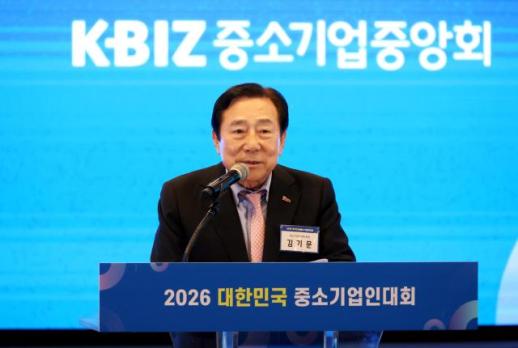 Small Business Leaders Gather for 2026 National Small Business Awards The Korea Federation of SMEs and the Ministry of Small and Medium Enterprises and Startups hosted the 2026 National Small Business Conference. During the event, 92 government awards, including the Gold Tower Industrial Medal, were presented to individuals who contributed to economic growth and job creation. According to the Korea Federation of SMEs, this year marks the 37th iteration of the conference, themed "Turning Change into Opportunity: Challenging Small Businesses." Over 300 attendees included Prime Minister Kim Min-seok, Minister Han Seung-sook, and leaders from various small business organizations. This year's Gold Tower Industrial Medals were awarded to Lee Yeon-bae, CEO of Autozen, and Lee Neung-gu, CEO of Chilgapsan. The Gold Tower Industrial Medal is a prestigious government award given to individuals with significant contributions to national industrial development. Lee Yeon-bae was recognized for his nearly 40 years in the automotive parts industry, particularly for enhancing national industrial competitiveness through the localization of key technologies. Lee Neung-gu was honored for modernizing rice processing products and promoting the globalization of K-food. Kim Ki-moon, chairman of the Korea Federation of SMEs, stated in his opening remarks, "Government investment and support are essential to innovate not only advanced strategic industries but also traditional manufacturing through the National Growth Fund," adding, "We will invest 200 billion won through the Yellow Umbrella Fund." He further emphasized that the AI transformation of traditional manufacturing is now a matter of survival, urging the need to expand support for data infrastructure and cooperative AX projects centered around industry-specific cooperatives.* This article has been translated by AI. 2026-05-19 17:19:22
 -
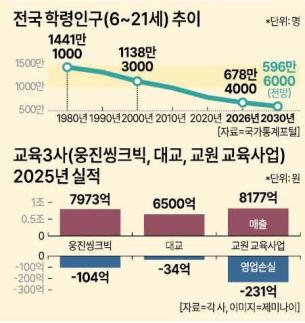 Education Industry Faces Crisis Amid Declining Birth Rates Amid a declining birth rate, leading education companies in South Korea are expressing a sense of crisis, stating they are at a "survival crossroads." The drop in birth rates directly impacts the school-age population, which is essential for the education market. Facing slowed growth, major education firms are seeking solutions through global expansion driven by artificial intelligence (AI) and edtech, as well as diversifying their portfolios to include senior care and lifelong learning. According to the National Statistical Portal, the school-age population (ages 6 to 21) is estimated at 6.784 million this year. This figure has been on a steady decline since peaking at 14.411 million in 1980. By 2030, the school-age population is projected to fall below 6 million, reaching approximately 5.966 million. The population crisis poses a "survival challenge" for education companies that have traditionally relied on this demographic for growth. Their core education business has been struggling, as evidenced by recent financial reports. For instance, Woongjin ThinkBig reported a consolidated revenue of 797.3 billion won in 2025, down 8.1% from 867.1 billion won the previous year. Its operating profit shifted from a profit of 9.2 billion won to an operating loss of 10.4 billion won. During the same period, Daekyo's revenue decreased by 2.03%, from 663.5 billion won to 650 billion won, with operating losses increasing from 1.6 billion won to 3.4 billion won. Kyowon Group's education division also saw a revenue drop of 5.5%, from 865.4 billion won to 817.7 billion won, while its operating losses expanded from 16.2 billion won to 23.1 billion won. In response to the declining school-age population, education companies are accelerating efforts to explore new markets as a necessary growth engine. Woongjin ThinkBig is targeting high-value overseas markets with its proprietary edtech and metaverse educational tools. Notably, its generative AI-based reading solution, Booxtory, won the Best Innovation Award in the AI category at CES 2025, positioning the company to challenge markets in the U.S., Japan, and Taiwan. Additionally, the company is increasing exports of its augmented reality reading platform, ARpedia, which is already available in 24 countries, to boost its technology-driven performance. Daekyo is shifting its focus to the Korean language education market, targeting multicultural families and foreign residents in South Korea. The company has developed specialized courses for the Test of Proficiency in Korean (TOPIK) and created dedicated learning platforms, significantly broadening its target audience to include foreigners living both domestically and abroad. The senior care and funeral service sectors have become another competitive arena for the big three education companies. Last year, Woongjin acquired Fried Life, the leading funeral service provider in South Korea, for approximately 883 billion won, rebranding it as Woongjin Fried Life and quickly becoming the top player in the funeral industry. Kyowon established Kyowon Life in 2011, solidifying its position as a top competitor in the sector by employing a hybrid strategy that combines home appliances and educational services. Daekyo has launched a senior-focused brand, Daekyo New Life, and has built a nationwide franchise network for home care and daycare centers. The company is aggressively expanding its influence in related services, including funeral services and AI care calls. An industry insider noted, "The rapid decline in the school-age population means that if we remain idle, we will inevitably face extinction. By exporting K-edutech to generate high profits and simultaneously entering the senior and funeral service sectors in a super-aged society, a two-track strategy will become the standard survival formula for the education industry."* This article has been translated by AI. 2026-05-18 22:46:47
 -
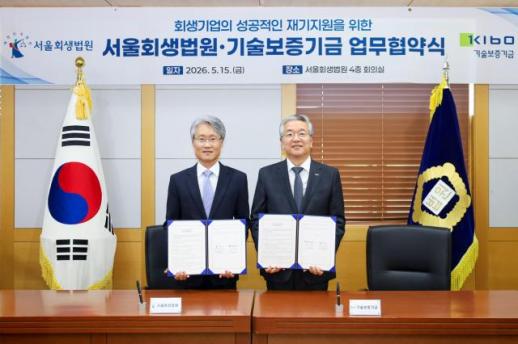 Korea Technology Guarantee Fund Partners with Seoul Bankruptcy Court to Support Reviving Companies The Korea Technology Guarantee Fund has signed a business agreement with the Seoul Bankruptcy Court to support the successful revival of bankrupt companies. According to the Technology Guarantee Fund on May 18, the agreement aims to identify companies with a high potential for management normalization and link them with financial support, enabling these companies to establish a stable recovery foundation and quickly normalize their operations. Under the agreement, the Seoul Bankruptcy Court will recommend companies undergoing bankruptcy proceedings that have a high likelihood of revival to the Technology Guarantee Fund. In turn, the Fund will assess these recommended companies and provide financial support, including the 'Revival Support Guarantee.' Both institutions will also collaborate on providing guidance and promoting systems for bankrupt companies to facilitate smooth recoveries. The Revival Support Guarantee program, operated by the Technology Guarantee Fund, helps outstanding small and medium-sized enterprises in financial distress by repaying their debts and assisting in their recovery. It can reduce existing debts by up to 90% and also guarantees new funding. This program is based on technology assessments, making it relatively likely to succeed. Building on the operational success of this agreement, the Technology Guarantee Fund plans to expand its cooperation to five bankruptcy courts nationwide to broaden the support framework for the revival of bankrupt companies. Kim Jong-ho, Chairman of the Technology Guarantee Fund, stated, "This agreement is significant as it establishes a cooperative system between the courts and policy financing institutions in response to the increasing number of bankruptcy applications from small and medium-sized enterprises due to rising external uncertainties and economic slowdown. The Technology Guarantee Fund will continue to expand its collaboration with bankruptcy courts to support the successful revival of these companies and serve as a strong pillar for crisis-stricken businesses to make a comeback."* This article has been translated by AI. 2026-05-18 22:03:00
 -
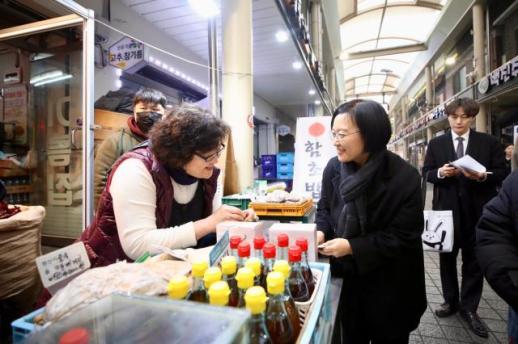 Minister Han Seung-sook Visits Gongju's Saseong Market to Discuss Local Bookstore Development Minister Han Seung-sook of the Ministry of SMEs and Startups visited Gongju's Saseong Market and the surrounding Jeamincheon commercial area to gather feedback and discuss the future of local bookstores. On May 18, the ministry reported that Minister Han visited Saseong Market, where she purchased rice cakes and side dishes, encouraging merchants who are struggling due to rising prices and decreased consumer spending while listening to their concerns. She then toured the Jeamincheon area, visiting the 'Gongju Youth Shared Housing,' which has transformed an old inn into shared housing for young entrepreneurs, as well as the independent bookstore 'Bookstore, Itta' and the Hanok cafe 'Lucia's Garden,' where she heard from small business owners. A 'Local Bookstore Meeting' was held at the independent bookstore 'Old Questions' near Jeamincheon. Attendees included Ji Myung-hoon, the representative of 'Old Questions,' Yeon Young-sook, who operates 'Danbi Bookstore' in Sejong, and Kim Jun-tae, who runs 'Dadada' in Daejeon, among other representatives from regional bookstores in the Chungcheong area. Also present were Lee Dae-geon, president of the National Local Bookstore Network, along with commercial district planners and experts who shared their insights. The meeting began with a presentation by Lee on the 'Current Status of Local Bookstores, Best Practices, and Future Development Directions,' followed by a free discussion format. Participants shared the role and importance of local bookstores as key hubs that connect people within local commercial districts and traditional markets, discussing future development directions. According to a 2024 survey on local bookstores conducted by the Korea Publishing Culture Industry Promotion Agency, there are approximately 3,295 local bookstores nationwide, with 21 areas identified as at risk of extinction. Minister Han stated, "Local bookstores are not just spaces for selling books; they are cultural hubs where community stories come to life. We will continue to support the development of local bookstores as cultural anchors in commercial districts, from startup assistance to collaboration and revitalization efforts."* This article has been translated by AI. 2026-05-18 19:05:16