

Journalist

박선태
-
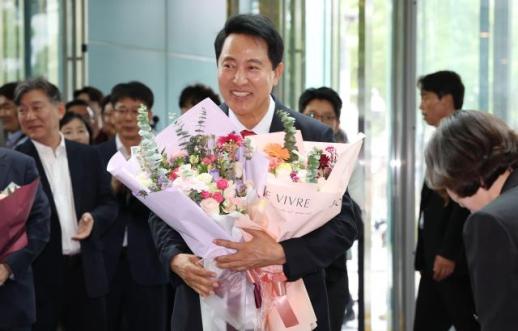 What lies ahead for DP after falling short where it mattered most despite overall win? SEOUL, June 5 (AJP) - South Korean voters handed President Lee Jae Myung's ruling Democratic Party (DP) a broad victory in this week's local elections while simultaneously delivering a warning against one-party dominance, as the conservatives retained the key Seoul mayoralty and narrowed losses in parliamentary by-elections. The DP won 12 of 16 metropolitan mayoral and gubernatorial races in the June 3 local elections, a sharp reversal from its crushing defeat in the 2022 vote, when it lost 12 governorships and mayoralties to the conservative People Power Party (PPP). But the ruling party failed to capture Seoul, the country's biggest political battleground, where conservative incumbent Oh Se-hoon won reelection over DP candidate Chong Won-o after a tight race. The result dimmed what initially appeared to be a sweeping victory for the liberals and suggested voters were seeking checks and balances rather than giving the government a free hand. The DP also faced unexpectedly close contests in several regions, including Gangwon, South Chungcheong and Ulsan, where the ruling camp had been widely expected to cruise to easy victories. Results from 14 parliamentary by-elections held alongside the local elections carried a stronger political warning for the ruling bloc. Before the vote, 13 of the 14 seats had been held by DP lawmakers. But the party won only nine seats, reducing its parliamentary strength by four seats, while the PPP captured four constituencies and an independent candidate won one. The elections were widely viewed as the first nationwide referendum on Lee’s administration since he took office a year ago following the ouster of former President Yoon Suk Yeol. Lee entered the elections with approval ratings above 60 percent, and many in the ruling camp had expected a decisive victory. Instead, the outcome indicated that voters broadly supported Lee's governing agenda while also signaling discomfort with what critics described as the DP's increasingly unilateral style of governance, backed by its legislative majority. Political observers said the results reflected growing concerns over hard-line legislative pushes led by pro-Lee lawmakers and perceptions that the ruling bloc had become complacent after consolidating control of both the executive and legislative branches. The DP's nomination process also became a source of controversy during the campaign. Critics accused party leader Jung Chung-rae and the party leadership of forcing through contentious nominations in races including the North Jeolla governorship and a parliamentary by-election in Pyeongtaek. The internal disputes diverted senior party officials from nationwide campaigning and may have contributed to Democratic losses in Seoul and several closely fought races in the country's southeastern conservative strongholds, analysts said. AJP asked lawmakers how they analyzed the reasons behind the DP’s defeats in the Seoul mayoral race and key parliamentary by-elections. PPP lawmakers pointed to the Lee Jae Myung government as the cause. Rep. Kang Seung-gyu said, "Elections are a judgment." "The biggest reason" the Democratic Party lost in key battlegrounds is that "citizens judged the Lee Jae Myung government," he added. "The public evaluated and judged the Lee government for pushing ahead with unreasonable laws with arrogance and self-righteousness and for pursuing the prosecution cancellation special counsel." Rep. Kim Gunn made similar remarks. "Seoul citizens felt it was wrong for the government and ruling party to push ahead with the prosecution cancellation special counsel and to exercise excessive public power in matters that should be morally condemned, such as the Starbucks incident," Kim said. "It was also effective that Oh clearly showed an effort to break with our party's past mistakes," he added. The "prosecution cancellation special counsel" mentioned by the two lawmakers refers to the special counsel bill on fabricated indictments proposed by the DP last month. The bill calls for a special counsel investigation into whether charges brought against President Lee before he was elected president and while he was standing trial were fabricated. The bill includes a provision allowing the special counsel to make a "decision on whether to maintain the prosecution" (Article 8, Clause 7) after receiving the cases from prosecutors. This means the special counsel could cancel the prosecution in Lee's cases. DP Rep. Kim Sung-hoi also said that Mayor Oh Se-hoon's acknowledgment that the Dec. 3 martial law declaration constituted insurrection and his apology over it were reasons he won the Seoul mayoral election. "Moderate conservative voters were highly dissatisfied with the Jang Dong-hyuk leadership system, but they went to the polls hoping that 'normal conservatives' would win," he said. "'Normal conservatives' refers to conservatives such as Mayor Oh Se-hoon and Rep. Han Dong-hoon who oppose insurrection," he explained. Three-term DP Rep. Eo Gi-gu said, "From the public's perspective, our Democratic Party appeared arrogant and conceited." "You win elections only when you are humble, desperate and earnest," he said. "I think only looking toward the president and complacently assuming we would win were also reasons for our defeats in places such as Seoul," he added. Rep. Kim Young-bae said, "In Seoul, we failed to manage the issues properly," adding that "we failed to ease public anxiety over the real estate market." He pointed to the lack of strategy from the party leadership as a cause of the defeats in Pyeongtaek and Busan's Buk district. "As seen in the Ulsan mayoral race, the central party also wavered over the issue of forming a unified candidacy with other progressive parties," he said. "Overall, the DP acted arrogantly, as if it had already won every election," he added. 2026-06-05 18:25:37
 -
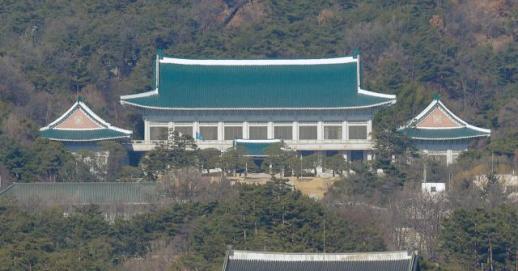 Blue House Responds to Resignations of Election Commission Leaders Blue House officials expressed that they take the resignations of National Election Commission Chairman Noh Tae-ak and Secretary General Heo Cheol-hoon on June 5 seriously. A Blue House spokesperson stated, "The Election Commission must provide sufficient explanations that the public can accept regarding the significant concerns raised during the election process, along with strict follow-up measures." The spokesperson further emphasized the need for responsible actions to review overall election management and implement reforms to restore public trust. Additionally, the Blue House congratulated National Assembly Speaker Cho Kuk on his appointment and reiterated its commitment to collaboration with the National Assembly. Blue House Spokesperson Kang Yu-jeong conveyed congratulatory messages to Speaker Cho and Vice Speakers Nam In-soon and Park Deok-heum in a written briefing. Kang stated, "The Blue House will closely communicate and cooperate with the National Assembly to address the pressing tasks of restoring livelihoods, promoting economic growth, and fostering national unity. The Yoon Suk-yeol administration is committed to fulfilling its responsibilities alongside the National Assembly to achieve tangible results that the public can feel." Earlier, Speaker Cho was elected as the Speaker of the 22nd National Assembly, receiving 267 votes in favor out of 276 members present. His term will last until May 2028.* This article has been translated by AI. 2026-06-05 18:21:00
 -
 Semiconductor selloff raises questions over AI rally SEOUL, June 5 (AJP) - A sharp selloff in semiconductor stocks is raising questions about the future of the artificial intelligence-driven rally, following HSBC's prediction on Thursday that the current chip boom is entering a broader phase, with gains spreading beyond chipmakers. While chipmakers such as Nvidia have dominated the AI rally so far, HSBC, one of the world's largest banking groups, said that the current AI cycle has produced an uneven pattern of growth, with AI-related investment surging while spending in many non-tech sectors remains comparatively weak. On South Korean bourse, Samsung Electronics and SK hynix recently accounted for 51.5 percent of the KOSPI200 index, up from 38.7 percent at the start of the year, while the two companies contributed 90.8 percent of the increase in KOSPI earnings estimates through April, according to Meritz Securities. Yet the market's heavy reliance on semiconductor stocks was also on display Thursday. The KOSPI tumbled 5.54 percent after concerns over chip-sector earnings triggered a global selloff in semiconductor shares. Samsung Electronics fell 6.40 percent and SK hynix dropped 9.92 percent, highlighting how closely market performance remains tied to a handful of AI-related companies. That imbalance is one reason the bank expects the next phase of the boom to be defined by what it calls "broadening out." As investment in AI infrastructure continues to grow, HSBC expects the benefits of AI to spread beyond technology companies and across borders, creating opportunities in non-tech sectors and emerging markets. Under its base-case scenario, the bank expects AI-driven growth to become more broadly distributed across industries and regions while U.S. economic growth remains around 2 percent. The bank said strong corporate profits driven by the AI boom are helping markets look past geopolitical tensions and supply-side shocks. The bank described the current environment as one in which "markets and economists describe different worlds," noting that markets have largely shaken off geopolitical concerns despite a complicated macroeconomic backdrop of trade tensions, supply-chain disruptions and geopolitical uncertainty. As spillovers from the AI capital-expenditure boom become more apparent, HSBC expects strong profit growth to hold and broaden beyond borders into non-tech sectors. The bank said emerging markets could be well positioned to benefit from that trend. The report also highlights opportunities outside the United States. HSBC said emerging markets may benefit from expanding AI supply chains and manufacturing investment, while non-U.S. equity markets could gain as AI-driven growth becomes less concentrated in a handful of American technology companies. The bank also urged investors to "diversify the diversifiers," arguing that opportunities are no longer limited to a narrow group of AI-related stocks. The bank said higher bond yields are creating new income opportunities across fixed-income assets and defensive equity sectors. The report comes as investors question whether the AI-driven rally has become overheated. HSBC acknowledged concerns over elevated valuations and the market's reliance on a small number of technology companies. Still, the bank said strong corporate profits continue to support markets despite a complicated macroeconomic backdrop, although periodic volatility remains possible amid geopolitical tensions and supply-side shocks. 2026-06-05 18:15:49
 -
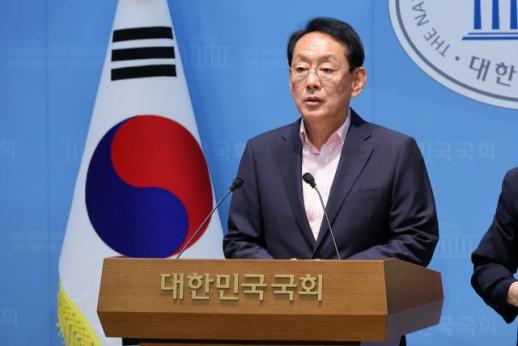 Kim Do-eup, Sung Il-jong, and Jeong Jeom-sik Announce Candidacy for People Power Party Floor Leader On June 5, Song Eon-seok resigned as floor leader of the People Power Party, prompting the party to prepare for a new election on June 9. Candidates for the position include four-term lawmaker Kim Do-eup from Busan, three-term lawmakers Sung Il-jong from South Chungcheong, and Jeong Jeom-sik from South Gyeongsang.Kim Do-eup emphasized his commitment to party unity and neutrality. At a press conference, he stated, "I will do my utmost to restore harmony within the divided party and rebuild conservatism, which has been weakened." He added, "The People Power Party must be reborn. We can no longer cause conflict and concern among the public. We need to regain the trust of the people through change and renewal, and unify the party to rebuild a crisis-stricken conservatism."He also called for a fight against the ruling party's dominance, stating, "We must defend liberal democracy and the rule of law. We need to normalize the dysfunctional National Assembly and restore politics through dialogue and compromise, while also achieving results in the economy through negotiation and persuasion."Kim expressed his belief that he is the right person to unify and revitalize the party, saying, "I have dedicated myself to the Republic of Korea and its people from a neutral standpoint, regardless of factions."Sung Il-jong highlighted his independent political stance, stating, "In my ten years in the National Assembly, I have never relied on any specific faction or group." He asserted, "I am confident that I can be the right person to create a platform for unity solely for the people and the party, based on the beliefs I have upheld until now. I will boldly drive the party's renewal efforts on the foundation of unity."He further emphasized the need for transformation within the People Power Party, stating, "It is essential for the party to change for the sake of unification and renewal. However, having leaders from the legal profession monopolize these roles is not what the public desires. We need a floor leader who can resonate with the people's experiences and speak their language."Jeong Jeom-sik spoke about his dedication to the party, saying, "I have always stood by the party during difficult times and have fought with action, not just words."He stressed the need for leadership that can unite all 110 members to ensure victory in the upcoming 23rd general election, stating, "I will be the floor leader who brings that strength together." He pledged to focus on restoring trust and unity within the party during his one-year term as floor leader, laying the groundwork for success in the next general election.All three lawmakers acknowledged the issue of independent lawmaker Han Dong-hoon's potential return to the party, describing him as an asset to the broader conservative movement, but emphasized the need to consider the opinions of party members and approach the matter with care.* This article has been translated by AI. 2026-06-05 18:15:00
 -
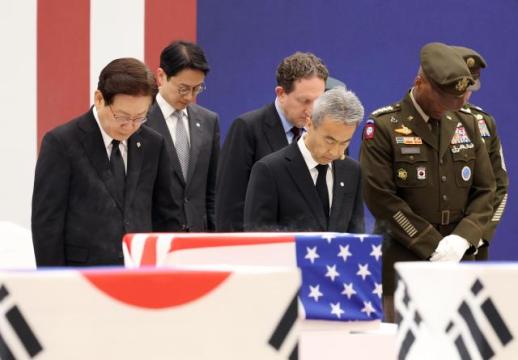 President Yoon Highlights Sacrifice of Korean War Veterans at U.S.-Korea Remains Ceremony President Yoon Suk Yeol stated on June 5 that the repatriation of remains at the U.S.-Korea joint ceremony for Korean War veterans marks a significant milestone in strengthening the alliance built on the sacrifices of those who served. This ceremony, held for the first time in South Korea, took place at the Seoul Airport's state guest hall. In his commemorative speech, President Yoon emphasized the importance of the event, saying, "This is a meaningful occasion for the first mutual repatriation of remains of Korean War veterans, which both South Korea and the U.S. have steadfastly protected together." He added, "The remains of ten of our soldiers, who have waited alone in distant Hawaii, have finally returned to the embrace of their homeland," and expressed his commitment to honor the remains of three U.S. soldiers with the utmost respect as they return home. During his speech, President Yoon underscored the significance of the U.S.-Korea alliance. He remarked, "The effort to return not only our own soldiers but also those of our allied nations to their families is the strongest testament to the bond forged in blood between our nations. The trust that has upheld the U.S.-Korea alliance, even after decades, is the solid root that sustains it." He further stated, "With the strong U.S.-Korea alliance as our foundation, South Korea is writing a new history of prosperity that astonishes the world. I am confident that if our two nations join hands and move forward unwaveringly toward the future, we can establish complete peace on this land and bloom the flowers of mutual prosperity." On this day, a transport aircraft carrying the remains of ten South Korean soldiers entered the Korean Air Defense Identification Zone (KADIZ) and arrived at the ceremony site under the protection of domestically produced KF-21 fighter jets and U.S.-made F-35A stealth fighters. At the event, President Yoon presented an unidentified soldier's dog tag to symbolize the remains of unidentified South Korean soldiers, expressing his determination to identify their names and families. The remains of U.S. soldiers included a reproduction of an "Arirang scarf" made by a U.S. soldier during the war, wishing for his mother's health. Attendees included Minister of National Defense An Kyung-bak, Chairman of the Joint Chiefs of Staff Jin Young-seung, and the chiefs of the Army, Navy, and Air Force, along with U.S. representatives such as Acting U.S. Ambassador to South Korea James Heller and United Nations Command and U.S.-Korea Combined Forces Commander Javier Brunson. The Blue House noted that the participation of Major Park Byung-jun, whose great-grandfather and grandfather were recognized for their contributions to the independence movement and as Korean War veterans, respectively, added to the significance of the event, as he served as the pilot of the first F-35A during the escort mission, symbolizing a legacy of patriotism and dedication across generations.* This article has been translated by AI. 2026-06-05 18:15:00
 -
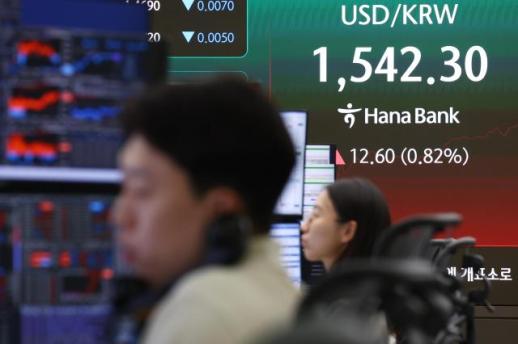 Won plummets past 1,540 as bonds extend losses SEOUL, June 5 (AJP) - South Korea's financial markets remained unsettled on Friday as the won-dollar exchange rate closed at about 1,540 won, for the first time in nearly 17 years and bond yields extended their rise. Heavy foreign selling in local equities continued to weigh on the won and debt markets, while traders saw no clear signs of actual intervention by foreign exchange authorities. In the Seoul foreign exchange market, the exchange rate closed at 1,539.1, down 9.4 from the previous session's overnight close. It was the first time the exchange rate ended regular trading above the 1,540 threshold in 17 years - since the aftermath of the global financial crisis in March 2009. During intraday trading, the rate rose as high as 1,547, marking a sharp increase from Thursday's daytime close of 1,529.7. The won's weakness came alongside a sharp sell-off in the domestic stock market, with the benchmark KOSPI falling more than 6 percent intraday, briefly dipping below 8,100 and triggering a selling "sidecar" that temporarily halted program trading sell orders. Overnight on Wall Street, Broadcom's post-earnings plunge weighed on sentiment toward artificial intelligence and semiconductor stocks, adding pressure to tech and AI heavyweights that had led the recent rally in Seoul. Foreign investors net sold more than 3.5 trillion won ($2.27 billion) worth of KOSPI shares on Friday, after unloading a net 16.5 trillion won over three trading sessions from Monday to Thursday despite a one-day market closure for local elections. The foreign selling streak, which began last month, extended to a 20th consecutive session, the longest stretch of net selling since March-April 2020. Despite limited moves in the U.S. Dollar Index and the dollar-yen exchange rate, the won fell more sharply than major emerging market currencies, underscoring Korea-specific pressure tied to foreign selling in local stocks. The won's underperformance was also clear against regional peers on June 5, with the Singapore dollar, Hong Kong dollar and Vietnamese dong largely flat against the dollar and the Indonesian rupiah down about 0.2 percent, while the won fell nearly 1 percent from the previous session's regular market close. Equity outflows also offset strong exports and a solid current account surplus, adding upward pressure on the exchange rate. The Bank of Korea said Friday that the April current account surplus reached $28.29 billion, the second-largest on record after the previous month's all-time high, but the large goods surplus was overshadowed by currency conversion and hedging demand linked to foreign stock selling. The debt market also extended its losses, with the benchmark three-year government bond yield closing up 2.4 basis points at 3.882 percent - highest level in 31 months - and the 10-year yield rising 2.5 basis points to 4.254 percent. This followed a sharp sell-off on Thursday, when the three-year yield jumped 8.5 basis points to 3.858 percent and the 10-year yield climbed 9.4 basis points to 4.229 percent. The continued bond weakness reflects concerns that the weaker won, rising international crude prices, Middle East tensions and additional U.S. tariff pressure could add to import-price inflation and prompt further tightening by the BOK. Policymakers have stepped up verbal intervention for two consecutive days. Koo Yun-cheol, Deputy Prime Minister and Minister of Economy and Finance, said on Friday that authorities are "responding with extraordinary vigilance to the widening volatility in financial and foreign exchange markets, as well as the challenges facing consumer prices." The remark followed his warning Thursday that "immediate necessary measures" would be taken against excessive one-way herd behavior, but traders said there were no clear signs that authorities had supplied dollars to stabilize the market. "No clear indications of smoothing operations to cap the upper limit of the exchange rate have been observed so far," an FX trader said on the condition of anonymity. With the exchange rate nearing the 1,550 won threshold, market participants are watching the tone of further official messages and whether authorities will take concrete market-stabilization steps. 2026-06-05 18:03:38
 -
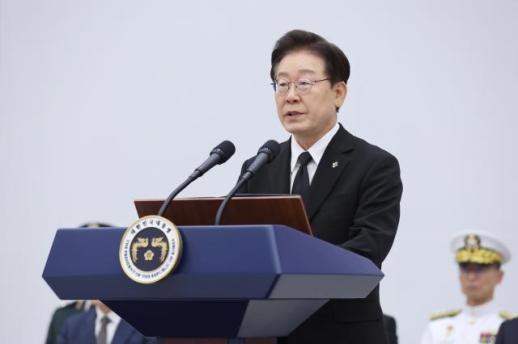 President Lee: Stock Market Stabilization is Key to Pension Reform President Lee Jae-myung stated on June 5 that "the normalization of the stock market has significantly reduced the need for pension restructuring and the associated pain of that process."He made these comments while sharing an article on X (formerly Twitter) that discussed how the recent strength in the domestic stock market could delay the depletion of the National Pension Fund.President Lee emphasized that "the normalization of stock valuations, which are representative assets of South Korea, is a good means for painless pension reform," adding that "the normalization of South Korea will continue."The article indicated that the improvement in the National Pension Fund's returns due to the strong domestic stock market could push back the projected depletion date of the fund. According to Kim Yong-ha, a professor at Soonchunhyang University, if the increased fund size from last year to this year is taken into account, the depletion date could be delayed from 2071 to 2095, a difference of 24 years.This projection assumes that the fund's average annual return will be 5.5% starting next year, while other variables, such as demographic changes and long-term economic growth rates, remain consistent with the figures used during last year's pension reform discussions.The article reported that the National Pension Fund has grown from 1,458 trillion won at the end of last year to approximately 1,800 trillion won by the end of May this year.* This article has been translated by AI. 2026-06-05 18:03:00
 -
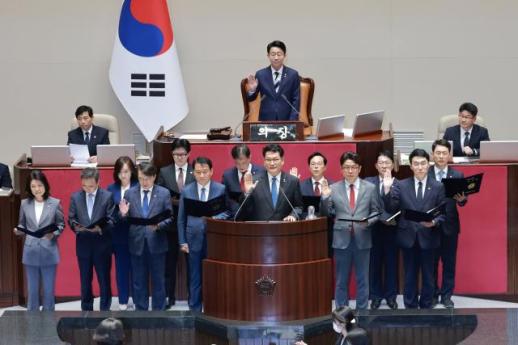 14 Newly Elected Lawmakers Begin Their Duties After Taking Oath On June 5, 14 lawmakers elected in the recent by-elections took their oaths during a session of the National Assembly, marking the beginning of their official duties. Among them, Kim Nam-kuk, Kim Nam-jun, and Jeon Eun-soo, who have previously worked at the Blue House, emphasized the need for swift policy implementation and the success of the Lee Jae-myung administration. In contrast, Lee Jin-sook and Kim Tae-kyu, who have backgrounds in the Korea Communications Commission, highlighted recent issues, including a shortage of ballots at polling stations in Songpa, Seoul, positioning themselves in opposition to the ruling party. The newly elected lawmakers from the Democratic Party include Song Young-gil, Kim Nam-jun, Lim Mun-young, Kim Nam-jun, Lee Kwang-jae, Jeon Eun-soo, Kim Ui-gyeom, and Park Ji-won. From the People Power Party, the newly elected members are Lee Jin-sook, Kim Tae-kyu, Yoo Ui-dong, and Yoon Yong-geun, along with independent lawmaker Han Dong-hoon. Kim Seong-beom, also elected as a Democratic Party member, did not attend due to personal reasons. After taking their oaths, the lawmakers expressed their commitments. Song Young-gil was the first to speak, referencing the recent declaration of martial law, stating, "The attempt by armed troops to invade the National Assembly is unprecedented in our constitutional history. I am honored to join the 22nd National Assembly, which has a significant historical mission, and I will strive to uphold the order of our democratic republic." Jeon Eun-soo, who has worked at the Blue House, remarked, "I will work tirelessly for the success of this government, even if it means sacrificing sleep." Kim Nam-kuk and Kim Nam-jun pledged to focus on stabilizing people's livelihoods and economic recovery, with Kim Nam-jun stating, "I will be a strong partner in ensuring the success of the government's initiatives for restoring livelihoods and national development." Lee Jin-sook and Kim Tae-kyu, both former officials at the Korea Communications Commission, addressed the ballot shortage issue. Lee Jin-sook expressed, "It is extremely regrettable and unacceptable that a shortage of ballots occurred in 21st-century South Korea. Lawmakers, as representatives of the people, must take responsibility and work together to resolve this issue." Kim Tae-kyu echoed her sentiments, urging, "Let us not export a democracy where ballots are unavailable due to a lack of paper." Additionally, Han Dong-hoon stated, "I was here in this assembly on the night of December 3, 2024. After the decisions and actions I took as the leader of the People Power Party, I entered a path of political hardship. However, if I were to go back, I would walk the same path again."* This article has been translated by AI. 2026-06-05 18:00:00
 -
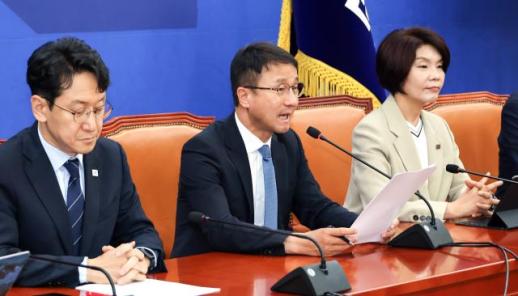 Democratic Party Pushes for National Investigation into Voting Paper Shortage The Democratic Party announced plans to pursue a national investigation into the shortage of voting papers that occurred at polling stations in Songpa District, Seoul, during the June 3 local elections. Han Byeong-do, the party's floor leader, stated that the People Power Party is also taking the situation seriously, and they will work together to conduct a swift and thorough investigation. In a press conference following the National Assembly session on June 5, Han described the voting paper shortage as "an incomprehensible and outrageous situation." He emphasized, "We will push for a national investigation. This is an opportunity to implement bold reforms within the National Election Commission to regain public trust." Han noted that with the election of the new National Assembly leadership, including Chairman Jo Geum-sik, and the People Power Party's serious approach to the matter, they aim to initiate the investigation as quickly as possible. He stated, "With the chairman elected, there should be no disagreements between the ruling and opposition parties on this issue. If there is consensus, we can proceed with the investigation in any format or method. We will explore ways to expedite this process in consultation with Chairman Jo and the People Power Party rather than through the regular committee channels." However, Han acknowledged that discussions regarding the specific timing and methods of the investigation have not yet taken place. He asserted, "The Democratic Party is committed to ensuring that nothing undermines public trust. There are even movements attempting to spread false claims of electoral fraud, and we will clarify the truth to restore public confidence."* This article has been translated by AI. 2026-06-05 18:00:00
 -
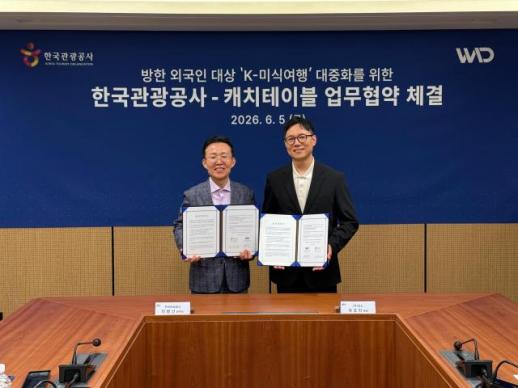 Korean Tourism Agency Expands K-Local Tourism to Attract Foreign Visitors Efforts are underway to broaden the travel routes of foreign tourists, traditionally concentrated in areas like Myeongdong and Gangnam, to regional destinations. The Korea Tourism Organization (KTO), led by President Park Seong-hyeok, is working on establishing a reservation platform for local dining while accelerating the development of tourism content driven by local residents, thereby expanding the 'K-Local tourism' ecosystem. ◆ Partnership with Catch Table to Ease Dining Reservations for Foreign Tourists On June 5, KTO signed a business agreement with Wad, the operator of the dining platform Catch Table, to promote culinary tourism for foreign visitors and expand the local tourism ecosystem. The agreement focuses on addressing the challenges foreign tourists face due to a lack of information and difficulties in making reservations at local restaurants. The two parties plan to collaborate on various projects centered around the KTO's selected local culinary content, 'K-Local Culinary Journey 33.' KTO aims to enhance services through the Catch Table global app, allowing foreign tourists to search for local restaurant information, make reservations, and process payments all in one place. This initiative seeks to improve accessibility for foreign visitors, enabling them to enjoy local dining experiences without language barriers and encouraging tourism spending beyond the metropolitan area. ◆ 48 New Local Tourism Businesses Selected Across 21 Regions Simultaneously, efforts to expand content supply for attracting tourists are being pursued. The Ministry of Culture, Sports and Tourism and KTO announced the final selection of 48 new resident-run tourism businesses for the '2026 Tourism Dure' program. Tourism Dure supports local residents in starting and operating tourism businesses that utilize local resources for accommodations, dining, experiences, souvenirs, and travel. Launched in 2013, the Tourism Dure initiative has identified and nurtured over 1,400 resident-led tourism businesses across 152 regions nationwide. This year's call for applications saw participation from 116 resident businesses across 21 basic local governments, with the final 48 selected after document reviews, on-site inspections, and presentations. The selected businesses will receive support for up to five years, with a maximum funding limit of 110 million won for education, consulting, pilot project operations, and legal and tax advice. The largest number of selected businesses comes from South Chungcheong Province with 11, followed by South Jeolla with 8 and North Gyeongsang with 6. Gyeonggi, South Gyeongsang, and Ulsan each had 5, while Gangwon had 3, and North Jeolla and Gwangju each had 2, with Busan having 1, indicating a balanced selection. The majority of the selected business types are in the experience sector at 52%, followed by dining at 23%, travel at 17%, and souvenirs at 8%. Notably, several business models led by young entrepreneurs include 'Kkulkkak House,' a culinary experience space utilizing Busan's traditional fermentation culture, and 'Bintum Farm,' a wellness program linked to smart farms and the West Sea Trail in Seocheon, South Chungcheong Province. The Ministry and KTO will also recruit participants for the '2026 Youth Tourism Dure Plus Project' starting June 10, focusing on supporting young entrepreneurs. About 100 businesses currently operating or preparing to launch will be selected to receive tailored consulting and market development assistance, with up to 26 million won in commercialization funds available per business.* This article has been translated by AI. 2026-06-05 17:54:00