
Journalist

AJP
-
 Asian Culture Calendar SEOUL, February 27 (AJP) - Dec. 5 - Mar. 15 Garden of Morning Calm Winter Lights Festival 2026 Mar. 15 Seoul Marathon 2026 Mar. 14 - 16 Jeju Fire Festival Mar. 29 - Apr. 6 Jinhae Gunhangje Festival Japan Mar. 1 Konomiya Naked Festival Mar. 6 Umekoji Handicrafts Market Feb.1 - May 24 Kyoto Nippon Festival 2026 Mar. 9 - 22 Grand Sumo Tournament 2026 Hong Kong Mar. 21 Complex Live! Mar. 27 - 29 Art Basel Hong Kong Feb. 27 - Mar. 30 The 54th Hong Kong Arts Festival Mar. 25 - 29 Art Central 2026 Singapore Mar. 21 Hari Raya Puasa 2026-02-27 16:11:37
 -
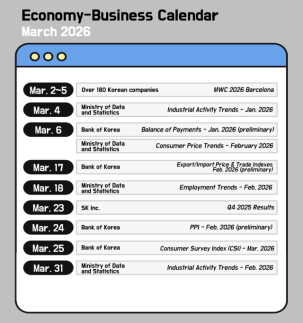 Korean Economy/Business Calendar SEOUL, Feb 27 (AJP) - Mar. 2–5 (Mon–Thu) MWC 2026 Barcelona - Over 180 Korean companies Mar. 4 (Wed) Jan. 2026 Industrial Activity Trends - Ministry of Data and Statistics Mar. 6 (Fri) Jan. 2026 Balance of Payments (Preliminary) - Bank of Korea February 2026 Consumer Price Trends - Ministry of Data and Statistics Mar. 17 (Tue) Feb. 2026 Export/Import Price & Trade Indexes (Preliminary) - Bank of Korea Mar. 18 (Wed) Feb. 2026 Employment Trends - Ministry of Data and Statistics Mar. 23 (Mon) (Mon) Q4 2025 Results - SK Inc. Mar. 24 (Tue) Feb. 2026 PPI (Preliminary) - Bank of Korea Mar. 25 (Wed) Mar. 2026 Consumer Survey Index (CSI) - Bank of Korea Mar. 31 (Tue) Feb. 2026 Industrial Activity Trends - Ministry of Data and Statistics *Major Shareholders' Annual General Meetings (AGM) Mar 18 (Wed) - Samsung Electronics Mar 20 (Fri) - Samsung Biologics - Samsung C&T - LG Energy Solution - Kia Mar 23 (Mon) - LG Electronics - NAVER Mar 24 (Tue) - POSCO Holdings - Celltrion 2026-02-27 16:11:14
 -
 South Korea conditionally approves Google's long-awaited request for map data SEOUL, February 27 (AJP) - Global tech giant Google is now allowed to use official South Korean map data for its app services, the Ministry of Land, Infrastructure and Transport said on Friday. According to the ministry, it decided to approve Google's long-awaited request to use precision map data for its services like Google Maps and Google Earth, following a meeting with officials from other relevant ministries, provided that Google "strictly comply with security guidelines." Under the conditional approval, Google will still face some restrictions including blurring classified sites such as military facilities and security-related installations and limiting the exposure of precise coordinates. It will also need to assign domestic companies to handle map data processing. Any satellite or aerial imagery of South Korean territory used in Google's services must also undergo security screening to restrict exposure and have precise coordinates removed. The ministry said it will monitor Google's compliance with the conditions, and warned that serious violations could result in the suspension or revocation of the approval. Google, along with other major foreign tech companies, has repeatedly sought permission since 2007 to use such data to offer services similar to those it provides in other countries. Friday's decision was likely influenced by the growing number of foreign tourists visiting South Korea and the economic benefits that improved map services could bring. 2026-02-27 15:59:31
 -
 New Books: ‘Rome in the Baroque’ and Two More Titles Rome in the Baroque: A City That Opens Your Eyes to Beauty=By Jeong Jin-guk, Datjip. Art critic and photographer Jeong Jin-guk writes that after suffering repeated losses during the COVID-19 pandemic — family, friends and acquaintances — he traveled to Rome. The book pairs photographs he took across the city with humanities-based reflections that came to him on site, aiming to share the essence of Baroque art with friends who could not make the trip. Jeong argues that 17th-century Baroque art shaped the Rome seen today, describing churches in the historic center as “giant museums” where architecture and art are inseparable. He writes that Baroque works foregrounding the Virgin Mary as a compassionate mother became a refuge that encompassed the worlds of masters including Bernini, Caravaggio and Borromini, and that churches touched by their hands evolved beyond religious facilities into living spaces for art. He also frames Baroque as a “visual art” strategy by the Catholic Church to win back popular support in response to the Reformation. In that context, he rereads Rome’s churches, galleries and museums, inviting readers to consider art and faith, life and the cycles of nature amid masterpieces and saints’ legends. “Churches redeveloped in this period decided their facades to fit road conditions. The sacred axis of stubbornly aligning direction had no meaning, and they prioritized roads that made it easier for worshippers to come and go. Elders took the view, ‘What could be more sacred and important than following a path that is good for believers to repent and pray!’ It was a rational yet flexible judgment typical of Romans. They did not believe in ancient geomancy, but they also did not openly dismiss superstition, mindful of public sentiment. For these reasons, the rear and front of churches often changed to match new roads, side-aisle doors were turned into main entrances, or facades were redesigned.” (p. 273) The Invisible Hands Behind the Korean Wave=By Kwon Ho-jin and others, Sawu. The book collects voices of the “invisible hands” that have supported the Korean Wave behind idol stars and hit content. Its 12 co-authors are figures who have worked over the past 30 years in fields including content exports and production, policy design, tourism and academic research. They focus on how the Korean Wave was planned and delivered, then translated and adjusted to local languages and cultures, and they describe how it seeped into fans’ daily lives around the world. The authors also examine the structure of Hallyu as it expanded into industry, tourism and business, viewing it as a layered social, historical and political landscape — what they call a “scene.” “Changing ‘single-director’ arts institutions — where the government appointed the head and the head ran the organization alone — into ‘committees’ was also meant to block government interference and give cultural and arts experts independence and autonomy. Today we take bodies like the Korean Film Council or the Arts Council Korea for granted, but it was not that long ago they were the Korean Motion Picture Promotion Corp. and the Korea Culture and Arts Foundation. When I was a working-level official in the Culture Ministry’s arts bureau, I handled the work of converting the foundation into the Arts Council. I went to the National Assembly several times with an amendment to the Culture and Arts Promotion Act. Back then, I said countless times, ‘Support, but do not interfere.’” (p. 57) Create 3 Million Won in Monthly Dividends in 3 Years With 10 Million Won=By Insaeng-eop, Gyeongiro-um. During the COVID-19 pandemic, the author writes, he narrowly kept his job amid layoffs and began worrying, “If I get fired tomorrow, how will I make a living?” Confronted with the limits of side jobs and juggling multiple gigs, he started looking for ways to make “money work for itself,” focusing on U.S. dividend ETFs and covered-call ETFs. The book says it can create tangible cash flow in a short period without a large investment, and lays out portfolio construction and management based on the author’s chosen mix of dividend ETFs, BDCs and covered-call ETFs. It also explains ETF structures and types, basic mechanics, tax issues and risk factors to help readers design their own portfolios. “One advantage of ETFs is that you can see very transparently where your money is and how it is invested. Most ETFs disclose their holdings and weights on a daily basis. For example, if you hold an S&P 500 ETF, you can immediately check what percentage is in Apple, what percentage is in Microsoft, and how much is allocated to sectors like health care or financials.” (p. 38) * This article has been translated by AI. 2026-02-27 15:48:23
 -
 Chipflation (2): Winners — component makers; losers — consumers Editor’s Note: This is the second installment in AJP’s Chipflation series, examining how explosive AI demand and South Korea’s dominance in memory chips are reshaping the global technology supply chain — from Silicon Valley data centers to everyday consumer electronics. SEOUL, February 27 (AJP) - Chipflation is, at its core, a story about economic rents. When demand concentrates on a scarce, indispensable input, the suppliers of that input capture returns well above competitive norms. In the current AI cycle, high-bandwidth memory has become precisely such a bottleneck. The result is a redistribution of profits along the semiconductor value chain — and South Korea sits at the point of rent capture. The latest financial disclosures from Dell Technologies illustrate the scale. The company reported a $43 billion AI server backlog, more than double the previous quarter. Nvidia, meanwhile, generated $62.3 billion in quarterly data center revenue. The architecture is increasingly clear: Nvidia designs the AI processors, Dell assembles the servers, and Korean firms supply the high-density memory modules without which those systems cannot function. In such an ecosystem, pricing power migrates upstream. Rent extraction as export engine The macroeconomic implications are visible in South Korea’s trade data. Customs figures for the first 20 days of February show semiconductor exports surging 134.2 percent year-on-year to $15.1 billion. This surge is not simply a volume expansion. It reflects rent extraction driven by scarcity. HBM3E and HBM4 modules now command prices six to ten times higher than standard DDR5 memory. Enterprise SSD prices have risen nearly 40 percent over the past six months. These are not incremental adjustments; they are structural repricings of critical components. Unlike past memory cycles — dominated by volatile consumer PC demand — today’s AI infrastructure buildout provides longer-term visibility. Massive pre-orders from hyperscalers and enterprise server vendors create forward revenue certainty. In some AI memory segments, industry estimates suggest operating margins exceeding 40 percent. For Samsung Electronics and SK hynix, this marks a transformation from commodity suppliers subject to cyclical oversupply to rent-earning bottleneck providers. At the national level, the impact is profound. With automobiles and steel facing softer global demand, semiconductors have become the principal engine of export growth. The sector now accounts for a record share of South Korea’s trade surplus. Yet rent concentration carries risk. When one sector disproportionately underwrites national growth, exposure to investment cycles intensifies. Should AI capital expenditure moderate, the same rent dynamics currently lifting the economy could reverse. The downstream squeeze Economic rents do not vanish. They are financed somewhere. In this case, downstream device manufacturers — and eventually consumers — bear the cost. A new report from Gartner projects that combined DRAM and SSD prices will surge 130 percent by the end of 2026. As memory becomes a larger share of bill-of-materials costs, PC and smartphone makers must either absorb margin compression or raise retail prices. Most are choosing the latter. Gartner forecasts that average selling prices will rise 17 percent for PCs and 13 percent for smartphones this year. Shipments are projected to decline 10.4 percent and 8.4 percent, respectively. "The shipments of PCs and smartphones this year are projected to hit their lowest levels in over a decade," said Ranjit Atwal, Senior Director Analyst at Gartner. "Price increases are narrowing the range of products available to consumers and forcing them to extend the life of existing devices, fundamentally shifting upgrade cycles." In effect, AI servers — backed by corporate capital budgets — are crowding out consumer devices in the competition for scarce high-performance memory. The pressure is most acute at the lower end of the market. Memory accounted for roughly 16 percent of a PC’s production cost in 2025. Gartner expects that share to rise to 23 percent by 2026. For manufacturers operating on thin margins, absorbing such increases is unsustainable. The sub-$500 laptop segment, Gartner warns, could largely disappear by 2028 as vendors prioritize profitability over shipment volume. "PC manufacturers must prioritize maintaining profitability over shipment volume, instead of sacrificing margins to capture price-sensitive demand," said Atwal. He added that companies "need to take proactive measures before the full impact of component price hikes hits in the second quarter." The likely outcome is a prolonged “device freeze.” Consumers extend replacement cycles. Entry-level offerings narrow. Technology diffusion slows among price-sensitive buyers. Latest cycle differs from prior semiconductor booms not merely in scale but in structure. AI infrastructure represents capital expenditure by hyperscalers and corporations capable of paying premium prices for performance gains. Consumer electronics represent discretionary spending constrained by household budgets. When supply tightens, the higher-value application captures the rent. For Korea, the immediate effect is positive. The country supplies one of the most critical inputs in the global AI expansion. Memory has become the strategic choke point — and choke points generate rents. But history chart in semiconductors shows, scarcity is self-correcting. Today’s rent concentration finances tomorrow’s capacity — and with it, eventual oversupply. 2026-02-27 15:42:39
 -
 BTS Comeback D-22: The line between private and public - Jungkook Editor’s Note — As BTS prepares to return as a full seven-member act with a new album set for March 20 and an open-stage performance at Gwanghwamun on March 21, following a near four-year hiatus for rotational military service, AJP revisits the group’s 13-year trajectory. This series reexamines BTS’s history, music, performance identity and enduring appeal. The eight installment traces the roots and growth of Jungkook. SEOUL, February 27 (AJP) - They sing about love, self-worth and empathy. At the same time, BTS members are adults with private lives that occasionally surface in public view. A late-night livestream by BTS member Jungkook on Feb. 26 prompted debate across fan communities, highlighting the tension between authenticity and expectation in global pop culture. Jungkook went live at approximately 3:40 a.m. KST (0640 GMT) on fan platform Weverse and streamed for about 90 minutes. The broadcast began informally, with Jungkook drinking alongside his older brother and acquaintances. He spoke about recent activities and preparations for BTS’ upcoming “ARIRANG” comeback, later shifting to a more candid tone about feeling busy and under pressure. Some segments of the livestream drew criticism. Viewers cited instances in which he used profanity, made an obscene hand gesture toward friends and responded firmly to fans who urged him to end the broadcast due to his intoxicated state. Jungkook told viewers not to dictate what he could or could not do. Shortly after the livestream ended, Jungkook posted a selfie on Weverse with the message: “The album is coming up soon. Please wait a little bit more. I’ll do my best when we make a comeback. I love you,” followed by seven purple hearts. A recording of the livestream was later removed from the platform. A divided response Reaction was immediate and varied. A full recording reposted on YouTube accumulated roughly 340,000 views, 14,000 likes and more than 2,500 comments. On X (formerly Twitter), discussion posts circulated widely. Korean-language reactions tended to express concern. Some users questioned Jungkook’s judgment, arguing that public figures representing a global group carry added responsibility. One longtime BTS-focused YouTube account with more than 44,000 followers announced it would stop uploading new content, citing disappointment, while leaving existing videos online. English-language responses often emphasized personal autonomy and stress. Several users described Jungkook as appearing tired or frustrated, while others stated that as an adult he has the right to live privately as he chooses. The contrast reflected differing expectations across segments of the fandom. Established livestream identities Some fans framed the incident within BTS’ long-standing livestream culture. One widely shared X thread analyzed each member’s communication style during broadcasts, describing Jungkook’s persona as more informal and friend-like compared to other members’ more structured or measured approaches. Such interpretations suggest that fan expectations are shaped by perceived consistency. When tone or behavior diverges from that established image, reactions intensify. Career context Born Jeon Jungkook on Sept. 1, 1997, in Busan, Jungkook entered the entertainment industry as a teenager. After auditioning for the television program “Superstar K,” he received offers from multiple agencies and chose Big Hit Entertainment. He debuted in 2013 as the youngest member of BTS at age 16 internationally (17 in Korean age). Known as the group’s “Golden Maknae,” he serves as main vocalist and a central performer. As a solo artist, Jungkook achieved measurable commercial milestones. In 2023, “Seven (feat. Latto)” debuted at No. 1 on the Billboard Hot 100. Subsequent singles “3D (feat. Jack Harlow)” and “Standing Next to You” both reached the top five. His album “GOLDEN” peaked at No. 2 on the Billboard 200 and charted for 25 weeks. “Seven” also topped the Billboard Global 200 and remained on global charts for an extended period. Brand partnerships have included global campaigns for Calvin Klein and associations with luxury brands such as Chanel and Hublot. That level of visibility amplifies scrutiny. Informal interactions, including livestreams, are often interpreted within the broader context of global brand representation. Public access and expectation BTS’ global rise has been closely linked to direct digital communication with fans. Livestreams have served as a primary channel for real-time engagement. However, increased accessibility can heighten expectations of conduct. For artists who have grown up under sustained public attention, the boundary between personal expression and public responsibility remains narrow. Whether the Feb. 26 livestream is remembered as a minor controversy or a transitional moment may depend less on the broadcast itself and more on subsequent public and professional developments. In global pop culture, authenticity and accountability frequently coexist. How audiences interpret that balance continues to evolve. 2026-02-27 15:35:29
 -
 UK Ambassador Colin Crooks Visits Hanwha Ocean Shipyard in Geoje 콜린 크룩스(Colin Crooks) 주한 영국 대사가 27일 오전 한화오션 거제사업장을 방문해 장보고-III 배치-II 잠수함 건조 현장을 둘러보고 한·영 협력 현황을 점검했다. 한화오션은 이번 방문이 자사와 영국 밥콕이 전략적 파트너십을 바탕으로 캐나다 초계 잠수함 프로젝트(CPSP)에 함께 참여하는 가운데, 협력 진행 상황을 점검하기 위해 마련됐다고 밝혔다. 크룩스 대사는 잠수함 블록 제작 현장과 자동화 설비, 스마트 야드 기반 생산 시스템을 살펴봤다. 특히 건조 중인 장보고-III 배치-II 잠수함 현장을 둘러보며 관심을 보였다고 회사는 전했다. 한화오션이 캐나다 잠수함 사업에 제안한 장보고-III 배치-II에는 영국산 어뢰발사관과 무장 제어 체계, 잠수함 내 CO2 제거기 등을 탑재할 계획이다. 회사는 이번 방문에서 관련 진행 상황과 협조 사항을 공유하는 자리도 마련됐다고 했다. 한화오션은 양사 협력 모델이 캐나다의 요구 조건을 이해하고 반영하는 데 긍정적으로 작용할 것으로 기대하고 있다. 밥콕 캐나다는 2023년 한화오션과 기술협력협약(TCA)을 체결했으며, 현재 캐나다 해군의 유지·보수·운영(MRO)과 해군 지원 서비스를 맡고 있다. 한화오션은 한·영 협력 체계가 캐나다 정부가 중시하는 현지화를 통한 산업 기반 강화와 잠수함 장기 운용의 신뢰성 확보 측면에서도 경쟁력을 갖출 수 있을 것으로 보고 있다고 밝혔다. 크룩스 대사는 "한화오션과 밥콕 간 공동 수행 협약은 한국과 영국 양국 정부가 추진하고 있는 국방공동수출 업무협약을 구체화한 대표적인 사례"라며 "양국 기업 간 전략적 파트너십이 향후 다양한 방산 분야에서의 협력 확대를 이끄는 중요한 기반이 될 것"이라고 말했다. 정승균 한화오션 특수선해외사업단 부사장은 "한화오션과 밥콕사 양국 기업의 기술력과 해군 사업 수행 경험이 결합된 협력 구조는 캐나다 잠수함 사업에 있어 실질적이고 지속 가능한 해법이 될 것"이라며 "CPSP 사업을 통해 캐나다 해군 전력 강화는 물론 현지 산업 생태계 발전에도 기여할 수 있도록 최선을 다하겠다"고 전했다. 2026-02-27 15:21:21
 -
 The birth of humanoid robots (4): A Christmas Carol for steel and silicon Editor's Note: This is the fourth and final installment in AJP's series on humanoid robotics, examining the anatomy, technologies and economic logic behind one of the most hyped industries of the decade. SEOUL, February 27 (AJP) - A line of humanoid robots flips in unison. They lunge, pivot, brandish swords beside children in a synchronized kung fu routine. In the next sequence, they stagger theatrically, swaying through a stylized "drunken boxing" set — collapsing backward only to rebound with uncanny balance. The spectacle, staged by China's Unitree Robotics at the Spring Festival Gala, ricocheted across the globe. For many viewers it was entertainment. For roboticists elsewhere, it was a reckoning. In South Korea, some scientists watched with admiration; others, with a familiar pang. Decades of painstaking work still sit largely confined to laboratories — brilliant machines, but rarely public performers. In a lab at Hanyang University, a different drama unfolds. A humanoid named Alice 4 stands tethered to a rear frame — a metal Pinocchio awaiting animation. With a light tap on a keyboard, the machine jolts to life. It runs in place, almost straining against its restraints, optical sensors fixed straight ahead — on its creator. Han Jae-kwon, professor of robotics at Hanyang University and chief technology officer of Aei Robot, watches without theatrical flourish. "It's not about the kung fu or the backflips," he said. "The essence of a humanoid robot is what it does for work. Replace dangerous, undesirable labor. Help address the population cliff." That, he insists, is the measure that matters. The long arc of Korean humanoids South Korea's humanoid lineage stretches back more than two decades, to an era when bipedal machines were symbols of national ambition. At the Korea Institute of Science and Technology (KIST), a towering metallic figure still hangs in the institute's history hall. Known as "Centaur," it never truly walked upright. Its lower half resembled a mechanical horse — four legs instead of two. Korea's first humanoid was, in effect, a compromise between aspiration and stability. "Centaur was a small project we undertook to understand intelligent machines. Not long after Japan's Honda showcased ASIMO, we were asked to build ubiquitous robot companions capable of performing multiple tasks," recalled You Bum-jae, principal research scientist and former head of humanoid development at KIST. Japan's unveiling of ASIMO had electrified the region. In response, two Korean institutions embarked on parallel paths. At the Korea Advanced Institute of Science and Technology (KAIST), Professor Oh Jun-ho and his team introduced HUBO in late 2004 — a full-scale biped capable of walking, grasping and limited speech. "HUBO is the beginning of that history, we believe," Han said. "There was a sense of national pride — we could do what only Japan had done." In early 2005, KIST followed with MAHRU, billed as the world's first network-based humanoid. Standing 150 centimeters tall, MAHRU was designed for domestic assistance — a precursor to what today might be called "physical AI." "MAHRU was a network-based humanoid, capable of understanding vocal commands. It could walk to a microwave, open it, pick up a piece of toast, place it in the toaster, take it out and deliver it to its master," said Yoo, gently patting the robot's original plastic head. "We didn't have advanced AI back then — only recognition skills and programs to support it. But that's essentially how all humanoids aim to function even today: a body running light, a powerful computer supporting it through a network, now equipped with AI." Yet progress proved incompatible with political cycles. As Yoo noted, humanoid development was "not capable of significant results within two-year government projects." By the 2010s, funding for large-scale bipedal programs was pared back. Then disaster intervened. The Fukushima nuclear accident in 2011 prompted the U.S. Defense Advanced Research Projects Agency to launch the DARPA Robotics Challenge in 2012. The competition was designed to push robots into hazardous environments no human should enter. By the finals in June 2015, 24 teams had qualified. Three were Korean — each fielding its own platform rather than relying on Boston Dynamics' Atlas. Team KAIST, led by Professor Oh, won in 44 minutes and 28 seconds. Han's team from Robotis and a team from Seoul National University also competed — both using robots Han had helped design. For a brief moment, Korea stood at the apex of disaster-response robotics. But the aftermath told a more complicated story. In the United States, many participants flowed into emerging ventures such as Figure AI or Tesla's Optimus program. In Korea, talent dispersed. Rainbow Robotics, spun off from Team KAIST, pivoted to collaborative industrial arms and was later acquired by Samsung Electronics. Robotis listed publicly and diversified. "The people who competed back then — it's such a waste," Han said. "Many went to the U.S., others became professors but stopped working on humanoids. If all of them had stayed, the situation would be very different today." Research continued, though largely out of public view. A five-year project funded by the Ministry of Trade, Industry and Energy sustained further development at KAIST, including hydraulically actuated humanoids capable of dynamic motion. "But if the media doesn't cover much of it, the public simply doesn't notice," said Park Hae-won, who now leads KAIST's humanoid lab. The motor that changed the race Ironically, the decisive shift did not originate in humanoids at all. At the Massachusetts Institute of Technology, Professor Kim Sang-bae's MIT Cheetah project advanced quasi-direct drive (QDD) motor technology — compact, high-torque electric actuators that allowed quadruped robots to run with unprecedented speed and efficiency. Crucially, the designs were open-sourced. Hydraulics, long dominant in high-performance robots, were heavy and maintenance-intensive. Electric QDD systems offered lighter frames and lower costs — prerequisites for commercialization. Korean researchers argue that China moved quickly to absorb this architecture and adapt it to bipedal platforms. "China absorbed the QDD technology very quickly, establishing firm baseline requirements for humanoid development. That includes critical reinforcement learning for robots as well — we now believe the government distributes it to Chinese robotics firms," said Yoo. "That's how so many Chinese humanoids can run from the start, while ours begin with baby steps. We can't share reinforcement learning in Korea — institutions and private firms alike refuse to give up hard-earned data." The divergence, in this telling, is less about talent than about scale and coordination. AI as accelerant The recent resurgence of humanoid ambition in Korea owes much to artificial intelligence. When OpenAI signaled investment interest in Figure AI, the message was clear: large language models might finally supply the cognitive layer humanoids had long lacked. "Bipedal robots could perform tasks, but they required heavy engineering and years of coding. Imagine AI guiding them — robots understanding whatever their operators say and handling tasks without tedious step-by-step instructions. It was sensational," Yoo said. At KAIST, Park's team is assembling a fully domestically developed humanoid under MOTIE funding, targeting full integration by April 2026. At KIST, a joint effort with LG Electronics is producing KAPEX, described as Korea's first AI humanoid platform, with more than 70 degrees of freedom and predominantly domestic actuators. Yet laboratory elegance is not factory reliability. "What you see at trade shows is the most refined version," Park said. "If a robot falls over at the exhibition, imagine how many times it crashed in the lab." The initial commercial target, Park suggests, is not spectacle but small and medium-sized factories — cramped, uneven spaces where wheeled automation struggles. "If you visit Korean SME factories, the floors are uneven, spaces are narrow — wheels can't even get through," he said. "Humanoids could help there, if they can handle tasks without disrupting existing workflows." Han is candid about Korea's relative position. "This year's Chinese Spring Festival Gala — robots were doing gymnastics, flipping like athletes," he said. "Our spirits sink. But the essence of a humanoid is not dancing or kung fu. The real question is: what are you going to do with it?" He argues that Korea's strength lies in manufacturing depth — batteries, semiconductors, precision motors and bearings — the physical half of "physical AI." Equally important is data. "Which country has industrial complexes in every neighborhood?" Han said. "That's all data. If we digitize it quickly and feed it to our robots, ours will outperform the competition." China's scale and cost advantages loom large. The United States is reviewing robotics imports under a Section 232 national security investigation. Korea is unlikely to erect similar barriers. "The only option is to make them cheaper than China," Han said. More pressing than tariffs, however, is demonstration. Korea spends substantially on humanoid research, Han noted, but allocates only a fraction of that to large-scale deployment trials. "What's needed now is getting existing robots into factories, gathering data and proving they work," he said. "That's demonstration projects — not more lab R&D." Yoo tempers expectations. "It's going to take at least five years for robots to be genuinely useful. They can only perform simple tasks like moving items, and even that carries a 10 percent margin of error. Humanoid-tailored AI has yet to arrive — the global race is now on," he said. "We should stop comparing robots against one another and instead draw on each one's unique characteristics to work as a team, talents putting heads together. Of course, that would require a new breed of engineers — ones who understand both software AI and hardware robotics. Attention, money, time — we need all of it." Korea's humanoid story — from HUBO and MAHRU to Alice and KAPEX — is neither triumphalist nor moribund. It is incremental, intermittently brilliant, frequently underfunded. Whether it can contend with American venture capital and Chinese industrial scale will define the next chapter. Han's closing line carries neither romance nor despair. "Try running in a factory," he said. "They'll tell you to stop." Robots, he implies, must earn their keep the same way humans do — not by acrobatics, but by utility. For steel and silicon, the future will not be written on a gala stage. It will be decided on the factory floor. 2026-02-27 14:57:15
 -
 Nearly 80% of online shoppers fear exposure of personal information, survey finds SEOUL, February 27 (AJP) - Nearly 80 percent of online shoppers expressed concern about the potential exposure of their sensitive personal information, a survey reveals. The findings were based on the survey of 1,000 consumers released by the Seoul Metropolitan Government on Friday. About 78 percent of respondents worried about a personal data leak while shopping on online malls and other platforms, and 28.1 percent said they had experienced at least one. The survey also revealed that three out of 10 having encountered issues such as defective products or late deliveries. The most common complaints were defective or faulty products (65.6 percent), delays in deliveries (42.7 percent), and false or exaggerated advertising (30.1 percent). Nearly half of respondents also reported frustrations with customer service, citing automated systems that left them unable to reach a representative or a person in charge. When it comes to artificial intelligence (AI)-assisted chatbots, the most cited inconveniences were generic, unhelpful responses (39.4 percent) and poor handling of more complex issues (23.4 percent). But many users found value in AI-driven recommendations, particularly for discovering new products (39.5 percent) and finding items that suited their preferences (28.6 percent), though nearly a third admitted they often ended up buying things they did not need. Some 69.7 percent said feedback from other shoppers often influenced their purchasing decisions, but many questioned its authenticity, suspecting that some reviews were written by staff or paid reviewers, as negative feedback was rarely seen. Fast delivery also mattered to some 86.2 percent of respondents when deciding on a purchase, but many also agreed that improving working conditions for delivery workers, such as ensuring adequate rest, sufficient workspace, and increased staffing, was necessary. About half of respondents worried about false or exaggerated claims by influencers and TV personalities who leaned on their fame rather than the quality of the products they promoted. "Online shopping has become part of our daily lives, and while it brings great convenience, it also exposes consumers to new risks," said city official Kim Myeong-seon, pledging to work toward consumer safety. 2026-02-27 14:56:59
 -
 NPS enjoys record returns on two-year KOSPI rally SEOUL, February 27 (AJP) -South Korea’s National Pension Service (NPS) posted a record annual investment return of 18.82 percent in 2025 — the highest since its establishment in 1988 and outperforming major global pension peers — driven by an exceptionally strong domestic equity rally. The double-digit return generated 231.6 trillion won in earnings, nearly five times its annual pension payout of 49.7 trillion won, and lifted total assets under management to 1,458 trillion won, the fund said Thursday. The cumulative average annual return since inception reached 8.04 percent. The NPS outperformed major overseas pension funds on a calendar-year basis. Japan’s Government Pension Investment Fund returned 12.3 percent, Norway’s Government Pension Fund Global gained 15.1 percent, Canada Pension Plan Investment Board posted 7.7 percent, while the Netherlands’ ABP recorded a negative 1.6 percent return. By asset class, domestic equities delivered an exceptional 82.44 percent return, leading overall performance. Overseas equities gained 19.74 percent, domestic bonds returned 0.84 percent, overseas bonds rose 3.77 percent and alternative investments yielded 8.03 percent. The NPS attributed the sharp rise in domestic stocks to a rally in artificial intelligence- and semiconductor-related shares, along with expectations for government capital market reforms. The benchmark KOSPI index soared 75.63 percent in 2025, far outpacing the global average gain of 22 percent. Overseas equities remained resilient despite uncertainties surrounding U.S. tariff policy, supported by solid earnings from global technology companies. Domestic bonds posted modest gains following two benchmark rate cuts and signs of economic recovery. Overseas bonds also generated positive returns, benefiting from three U.S. rate cuts and declining yields amid growth concerns. Returns from alternative investments reflected valuation gains and realized profits, the fund said. NPS Chairman Kim Sung-joo said the record performance stemmed from disciplined risk management, diversified asset allocation and continued improvements in operational infrastructure, including the performance-based compensation system. “In particular, the strong rise in domestic equities contributed significantly,” Kim said, adding that the fund would further strengthen investment capabilities and pursue flexible asset allocation and regional diversification to secure stable long-term returns. The final evaluation of the 2025 fund management performance will be confirmed by the Fund Management Committee around the end of June following a review by its risk management and compensation advisory panel. Early indicators suggest momentum has carried into 2026. Market observers estimate the NPS could already be seeing returns of around 9 percent for the year to date, supported by a sharp rally in Korean equities during the first two months. Samsung Electronics on Thursday joined the $1 trillion market capitalization club, while the KOSPI has surged close to 50 percent so far this year, extending a powerful two-year rally. 2026-02-27 14:52:40