

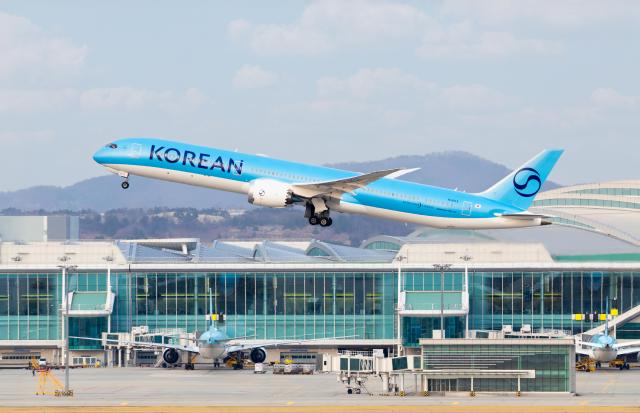
Weak won squeezes South Korea’s airlines, with Korean Air the lone profit holdout
SEOUL, December 29 (AJP) -The Korean won, averaging its weakest level on record this year, has eaten into profitability across South Korea’s airline industry by driving up U.S. dollar-denominated costs for aircraft leases and fuel.
According to financial data provider FnGuide, Korean Air’s consolidated operating profit for the year is estimated at 1.40 trillion won ($1.05 billion), down 33.5 percent from 2.14 trillion won a year earlier. The decline largely reflects rising costs linked to the weaker exchange rate.
Airlines are particularly vulnerable to currency swings because a significant share of their expenses — including fuel, aircraft leases and maintenance — is denominated in the greenback. The weak won has also dampened outbound travel demand by raising overseas travel costs for Korean passengers.
The blow would have been heavier on smaller carriers. Brokerage-house consensus forecasts show Asiana Airlines posting an operating loss of about 245 billion won this year, partly reflecting the impact of its cargo business divestment.
T’way Air is projected to see operating profit fall by 223.1 billion won, Jeju Air by 140.9 billion won, and Jin Air by 4.2 billion won. Intensifying competition on short-haul routes — particularly to Japan and Southeast Asia — has compounded the pressure alongside the weak currency.
Choi Min-gi, a senior researcher at Shinhan Securities, said Korean Air is relatively insulated because it earns a higher share of revenue in foreign currencies from inbound passengers and cargo, providing a form of “natural hedge.” Other airlines, he noted, are more directly exposed to exchange-rate fluctuations, which feed quickly into earnings volatility.
Foreign-currency expenses account for roughly half of airlines’ operating costs, according to industry estimates. Using an exchange rate of 1,400 won per dollar as a benchmark, the sector calculates that every 10-won depreciation adds about 75.2 billion won in operating costs for Korean Air, 5.1 billion won for Jeju Air, 3.9 billion won for Jin Air and 5.9 billion won for T’way Air.
The won that hovered around 1,480 for most of the month eased to 1,440.3 last Friday following verbal intervention and measures to stabilize foreign-exchange supply and demand. Market participants, however, say uncertainty over the currency outlook remains elevated.
Asiana Airlines has moved to reinforce its financial buffer by issuing 200 billion won in perpetual bonds.
Lee Jong-woo, a professor of business administration at Ajou University, said it would be difficult for both the exchange rate and broader economic conditions to improve meaningfully next year. He added that if industry restructuring and consolidation move forward, reduced competition could eventually help stabilize airline profitability.
Copyright ⓒ Aju Press All rights reserved.
