
Journalist

AJP
-
 Kia Named One of South Korea’s 100 Best Companies to Work For Kia said Wednesday it was named one of South Korea’s 100 Best Companies to Work For at the “GPTW Management Innovation Conference” held Tuesday at the Conrad Seoul in Yeouido. Great Place to Work, or GPTW, is a U.S.-based global evaluator that diagnoses and assesses workplace culture at about 30,000 companies in 170 countries each year. Its certification process has three stages following domestic and international verification. Kia earned the first-stage certification after recording a 79% positive response rate in an online employee survey. The company was also rated highly in its workplace-culture submission, leading to its selection for the top-100 list. More than 5,000 employees in South Korea across all job categories took part in the survey, which included 60 questions. Respondents reported high satisfaction in areas including ethical management, pride in the company, trust in leaders, engagement and a participatory culture. In the workplace-culture submission, evaluators gave favorable marks to Kia’s stated direction of being “customer-centered, people-centered.” Kia said it runs programs to strengthen internal communication, including “CEO Live,” an online town hall with senior management that includes global employees, and monthly Kia value meetings held by each division. Programs that cross workplace and job boundaries also drew attention, the company said. In 2024, marking its 80th anniversary, Kia held a “Kia, Let’s Run Together” marathon event for employees across all job groups in South Korea. Last year, it also rolled out companywide a “Happy New Kia” program in which division and office leaders encourage new employees on their first day. A Kia official said the company’s domestic and overseas units will work together to build an agile and flexible culture under its customer- and people-centered direction, adding that Kia will seek certification as one of the world’s best places to work based on the latest recognition.* This article has been translated by AI. 2026-02-26 08:54:16
 -
 Autonomous A2Z Exports Self-Driving System to UAE Autonomous A2Z will export its autonomous driving system to the United Arab Emirates. The company said Thursday that it delivered an export approval certificate on Feb. 25 (local time) in Abu Dhabi to its local joint venture. Autonomous driving is designated by the South Korean government as a national core technology, requiring prior approval from relevant authorities for overseas exports on technology security grounds. After a review by the Ministry of Trade, Industry and Energy, Autonomous A2Z became the first in the autonomous driving sector to receive export approval, the company said. Attendees included Ha Jung-woo, senior presidential secretary for AI Future Planning; Choi Young-jun, minister-counselor at the South Korean Embassy in the UAE; and Kim Sang-jin, director at the National AI Strategy Committee, as part of a South Korean special delegation. Autonomous A2Z Chief Strategy Officer Yoo Min-sang shared the joint venture’s business roadmap and discussed plans for testing and commercialization. Munira Al Marzouki, a managing director at Space42, the joint venture partner, also attended and confirmed the approval certificate. With the approval, the company plans to deploy in the UAE its self-developed Level 4 autonomous vehicle, ROii, along with various modified vehicles. It aims to win $7.6 million (about 11 billion won) in contracts by the end of this year and generate $78 million (about 110 billion won) in local revenue by 2035. The company said the figures reflect UAE government policy goals, including shifting 25% of Dubai public transportation to autonomous operation by 2030 and a full transition to autonomous driving in Abu Dhabi by 2040. Chief Executive Han Ji-hyung said autonomous driving is a national strategic industry combining AI, semiconductors, communications, software and urban infrastructure. “This export approval goes beyond one company’s overseas expansion,” Han said. “It shows autonomous driving has entered the global stage as a core technology that will help lead South Korea’s push to become one of the world’s top three AI powers.” 2026-02-26 08:39:18
 -
 The Cross’ Lee Si-ha Takes Office as Korea Music Copyright Association President Lee Si-ha, a member of the band The Cross, has been inaugurated as the 25th president of the Korea Music Copyright Association, known as KOMCA, and laid out a four-year plan centered on creators. Taking office, Lee said he would “change the center of the association,” signaling a push for practical reforms. Lee outlined four main tasks. First, he said the association will focus not only on expanding collections but on increasing the real income of Korean songwriters — shifting from headline figures to raising the amounts that reach creators. Second, he called for building a framework in which artificial intelligence and music writers can coexist. Rather than viewing the spread of AI only as a threat, he said the association will work to institutionalize a fair compensation system. Third, Lee said he aims to double the amount of copyright royalties flowing into South Korea from overseas by strengthening global collection networks and reorganizing rights-protection systems. Fourth, he pledged tangible improvements in creator welfare, saying the association will redesign its benefits system so writers can work in a more stable environment. “We will become an association that changes creators’ lives, not one that just grows numbers,” Lee said, adding, “I will prove it with results within four years.” Lee has performed with The Cross alongside vocalist Kim Hyeok-geon, who suffered an unexpected accident, and is known for hits including “Don’t Cry” and “For You.” He is also a professor at Sejong University’s Graduate School of Industry. Lee said he plans to pause his music activities for the next four years and focus on making KOMCA an organization that contributes in practical ways to South Korea’s national interest.* This article has been translated by AI. 2026-02-26 08:28:20
 -
 Musinsa goes offline to challenge beauty Goliath on Seoul's beauty street SEOUL, February 26 (AJP) - Musinsa, the online fashion platform that has grown into a household name in K-fashion, is venturing into brick-and-mortar cosmetics — a field long dominated by CJ Olive Young under CJ Group. The move is being watched closely, either as a possible overreach or as a necessary step in Musinsa’s bid to scale beyond fashion. Musinsa said it will open its first permanent offline beauty flagship, “Musinsa Megastore Seongsu,” between April and June in Seongsu-dong, one of Seoul’s trendiest commercial districts. The large-format store will house about 800 beauty brands and target Gen Z consumers and foreign tourists — a scale that rivals even Olive Young’s largest outlets. Beauty has emerged as Musinsa’s next major growth category as the company looks beyond apparel. Its total transaction volume reached 4.5 trillion won ($3.08 billion) in 2024, generating revenue of 1.24 trillion won and operating profit of 102.8 billion won. The beauty segment has been a standout, with overseas transaction volume surging 161 percent in 2025. The challenge now is whether those online clicks can be converted into sustained offline sales. "Cosmetics fundamentally require a physical space where consumers can test products before making a firm purchase decision," said Kim Ju-deok, a professor of beauty industry at Sungshin Women's University. The elephant in the room: Olive Young Any push into physical beauty retail must confront a dominant incumbent. CJ Olive Young operates more than 1,300 stores nationwide and controls an estimated 68.3 to 90 percent of Korea’s health and beauty (H&B) market, depending on measurement standards. Its financial scale underscores the gap. While Musinsa’s revenue grew from about 993 billion won in 2023 to 1.24 trillion won in 2024, Olive Young’s sales expanded from 3.86 trillion won to nearly 4.8 trillion won over the same period. The retailer is widely expected to surpass 5 trillion won this year, supported by an operating margin of around 12.7 percent — unusually high for a brick-and-mortar chain. The trap of fixed costs Musinsa’s offline bet also comes at a structural price. By opening a flagship in Seongsu, the company is giving up one of its biggest advantages as an online platform: low fixed costs. Commercial rents in Seongsu-dong rose about 15 percent in the year to October 2025, driven by heavy foot traffic from young consumers and tourists. Property transaction prices in the area have surged more than tenfold over the past 15 years, exceeding 300 million won per pyeong (3.3 square meters). For Musinsa, this means high upfront investment, rising operating costs and pressure to deliver consistently strong store traffic. Pressure from below: Daiso’s rise Musinsa is not only challenging Olive Young at the top. It is also facing growing competition from below. Daiso has rapidly expanded its low-priced beauty lineup, turning its stores into major destinations for budget-conscious consumers. Daiso’s cosmetics sales jumped 85 percent in 2023 and 144 percent in 2024, and are estimated to be growing at 70 to 80 percent annually in 2025. By offering viral indie brands such as VT Cosmetics at rock-bottom prices, Daiso expanded its beauty portfolio from seven brands in late 2022 to more than 140 by late 2025. The strategy has drawn price-sensitive young shoppers away from conventional H&B chains. Betting on fashion-beauty synergy Still, Musinsa is betting on differentiation rather than direct imitation. The company plans to leverage its fashion-centric user base, proprietary data and influencer-driven ecosystem to blend apparel and cosmetics in ways traditional H&B stores cannot easily replicate. By combining fashion intellectual property with curated beauty zones, Musinsa hopes to turn its flagship into a lifestyle destination rather than a conventional drugstore-style outlet. Executives have also emphasized cross-selling, using online fan communities to drive traffic into physical stores. "Operating both online and offline channels is no longer optional; it is essential," Kim added. "Gen Z relies heavily on the convenience of online shopping, but the physical experience completes the purchase—a dual-channel formula Olive Young has already proven highly effective." Whether the Seongsu megastore becomes a “Trojan horse” that disrupts Korea’s beauty hierarchy, or falls victim to the “winner’s curse” that often hits fast-growing platforms entering the mainstream, remains uncertain. What is clear is that South Korea’s cosmetics competition is no longer confined to apps and algorithms. With Musinsa moving offline, Olive Young defending its turf, and Daiso pressing from below, the country’s beauty war has now moved decisively from screens to streets. 2026-02-26 08:09:14
 -
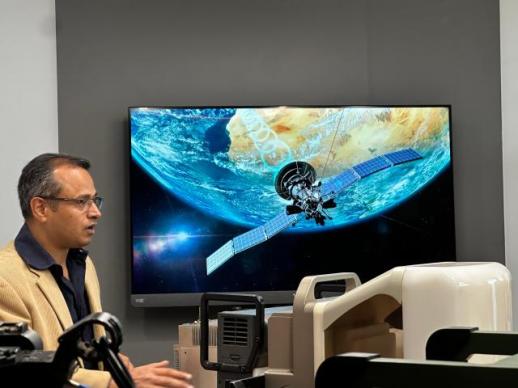 Indian satellite startup invites Korean tech names to develop military solutions BENGALURU, INDIA, February 26 (AJP) - Astrome Technologies, an Indian defense technology startup specializing in high-frequency satellite and wireless systems, is seeking strategic partnerships with South Korean companies to jointly develop next-generation military satellite solutions, its president said in an exclusive interview with AJP. “We would be very happy to work with the satellite and telecom businesses of Korean companies such as SK Telecom, Samsung Electronics and LG Electronics,” said Venkatesh Kumaran, president of Astrome Technologies, at the company’s headquarters in Bengaluru. “With geopolitical tensions rising, every country now wants sovereign technological capabilities, especially in satellite communications. We believe we can help Korean companies build and supply these systems to their military,” he said. Astrome is actively seeking what it calls a “reputable South Korean partner” — an intermediary capable of translating advanced technology into operational engagement with South Korea’s military and major defense contractors. Such a partner, Kumaran said, would play a central role in joint research and development, regulatory coordination and market entry. “Our technology is highly specialized. To deploy it effectively in Korea’s defense ecosystem, we need a partner that understands both the engineering and the institutional landscape,” he said. Suited for mobile and naval platforms The biggest challenge for high-speed communication at sea or on the move is stability. Traditional antennas are often bulky, mechanical devices that must physically rotate to track a moving ship or satellite. In harsh military environments, these moving parts are highly prone to wear and tear, leading to frequent maintenance issues and mechanical fatigue. Astrome’s core systems eliminate these vulnerabilities by using electronically steerable beams. Instead of moving the dish itself, the technology compensates for platform movement and environmental vibrations entirely through electronic signals, requiring zero mechanical components. The design is particularly suited for naval vessels and mobile ground platforms — sectors in which South Korea’s defense industry has established global competitiveness. “We are a small company, but we have cracked a technology that no one else in the world has,” Kumaran said. “Building products together with a Korean partner could create immense synergy in R&D and deployment.” Leadership in E-band phased arrays While South Korea is a global leader in 5G, the industry has faced challenges in deploying higher-frequency millimeter-wave networks due to technical hurdles and high costs. As the world shifts its focus toward 6G and the E-band spectrum (around 80 GHz)—a frequency range critical for high-capacity, low-latency communications—Astrome’s technology offers a ready-made solution that South Korea is currently striving to master. Its GigaMesh system drastically reduces deployment time. While traditional systems require hours of manual alignment by specialists, GigaMesh can be operational within 30 minutes, with subsequent control managed remotely through software. The system also supports multi-point transmission, enabling a single transmitter to serve multiple receivers simultaneously. According to the company, this reduces capital expenditure by up to 50 percent compared with conventional equipment. “Even major players like Ericsson and Nokia have not been able to do this,” Kumaran said. “We are the only ones who have cracked it and secured patents. Even if someone starts today, it would take three years to catch up.” From ground networks to space systems Building on its terrestrial wireless expertise, Astrome has expanded into a full satellite communications ecosystem. Its portfolio includes GigaSat, a flat-panel satellite ground terminal for maritime and land-mobile platforms, and SpaceNet, a software-defined E-band payload capable of delivering more than 180 gigabits per second per satellite. The company’s defense credentials were recently reinforced when India’s Ministry of Defence awarded Astrome for its Anti-ECM Tactical LAN Radio, a system designed to resist jamming and interception. The equipment successfully completed trials in environments ranging from desert heat to high-altitude cold, underscoring its operational resilience. Astrome’s engagement with South Korea predates its current partnership push and is rooted in early-stage investment. The company has received funding from South Korean venture capital firms, including Impact Collective and The Ventures, which supported its transition from a startup to a deep-tech defense supplier. “We received Korean investment at a very early stage,” said Brighu Bhattrahalli, head of global commercial business at Astrome. “That support was critical during our formative period.” Korean investors participated in a $3.4 million bridge funding round in September 2021, which was used to expand Astrome’s presence in the U.S. market and conduct international operator trials. To date, Astrome has raised more than $14 million in total funding. Company executives say Korean capital has played an important role in technology refinement and international credibility. That support enabled Astrome to finalize its patented digital beamforming phased array architecture — the core platform behind its GigaMesh and GigaSat products. The technology is designed to deliver high-speed, cost-effective connectivity in remote and underserved regions, while also meeting military-grade reliability standards. “With the right Korean partner, we believe our systems can be scaled for both civilian and defense applications,” Kumaran said. “The opportunity is strategic, not just commercial.” 2026-02-26 08:09:01
 -
 Samsung Electronics ushers in agentic AI phone era with Galaxy S26 SEOUL, February 26 (AJP) -The drizzle over the Palace of Fine Arts in San Francisco did not stop more than 1,200 journalists and influencers from crowding into the domed venue Wednesday for Samsung Electronics’ latest Unpacked event — a return to the same stage where the company once declared it was preparing for a “new decade” of mobile. This time, instead of dazzling hardware theatrics, Samsung framed the Galaxy S26 series as its first truly “agentic” AI phone: a device that does not wait for commands but gently intervenes. Not assistance. Not automation. But what executives repeatedly called a “nudge.” When CEO TM Roh took the stage, he did not begin with chip speeds or camera sensors. Instead, he showcased a simple text exchange: “Beer on the 27th?” Before a reply could be typed, a subtle banner surfaced above the keyboard: “27th — All-day event at Phoenix Park.” The feature, called Now Nudge, does not require a request. It reads context — across messages, calendar and gallery — and surfaces the right action at the right moment. Samsung is betting that this shift — from reactive AI to anticipatory AI — defines the next phase of the smartphone wars. For years, Samsung’s Unpacked events led with displays, sensors and silicon. The S26 series still delivers on that front. The Ultra model runs on the Snapdragon 8 Elite Gen 5 for Galaxy, promising double-digit CPU, GPU and NPU gains. Thermal redesigns and Super Fast Charging 3.0 round out the hardware upgrades. But those specifications were deliberately secondary. Samsung’s narrative emphasized something more intangible: AI that “fades into the background.” A single press of the side key can summon Gemini or other integrated agents to complete multi-step tasks — from ordering an Uber to placing food deliveries — without switching apps. The distinction Samsung is drawing is clear: this is not AI as a chatbot. It is AI as a silent coordinator. The most enthusiastic response inside the hall was reserved for a different innovation: Privacy Display — described as the world’s first built-in side-view blocking screen for mobile. Unlike stick-on privacy filters, Samsung’s solution disperses light at the pixel level. When activated during sensitive moments — PIN entry, banking apps, messaging — it limits visibility from side angles while preserving brightness and clarity for the user. In an era of AI-driven personalization, Samsung is pairing proactivity with containment. And for a company unveiling its 26th-generation flagship, the devil is in those details. While Apple’s iPhone ecosystem emphasizes privacy branding and vertical integration, Samsung is introducing hardware-level visual discretion. Against Chinese competitors such as Huawei and Xiaomi — which are rapidly integrating AI features at aggressive price points — Samsung is differentiating not merely through AI capability, but through AI governance embedded into hardware. The strategy suggests Samsung sees the next battleground not just as performance, but trust. The S26 Ultra widens apertures for improved low-light capture and introduces support for a professional-grade APV video codec. AI ISP improvements refine skin tones even on the selfie camera. But again, the headline is workflow integration. With the upgraded Photo Assist suite, users can simply describe edits: “Make it night.” “Add more strawberries.” “Change the outfit.” Edits unfold within the native gallery — no third-party app, no export/import friction. For creators accustomed to hopping between apps — including Google tools or other generative platforms — the frictionless editing could become Samsung’s practical edge. The S26 series arrives amid intensifying competition. Apple continues refining on-device AI within iOS while tightly guarding ecosystem control. Chinese brands are pushing hardware innovation and aggressive pricing. Generative AI models are turning smartphones into gateways for cloud intelligence. Samsung’s counter-position is distinct: agentic AI embedded system-wide, not siloed in one assistant, hardware-backed privacy, not just software encryption, cross-agent flexibility (Gemini, Perplexity, Bixby), rather than a single locked ecosystem, and seven years of security updates, reinforcing long-term device value. The choice to spotlight “nudging” over megapixels signals Samsung believes smartphone competition is shifting — from a hardware race to behavioral intelligence. 2026-02-26 07:52:30
 -
 Actor Park Yeong-gyu Stuns Hwang Jae-gyun With Question About Marriage on 'Radio Star' Actor Park Yeong-gyu put retired professional baseball player Hwang Jae-gyun on the spot with an unexpected question about his personal life. On the Feb. 25 broadcast of MBC’s “Radio Star,” Park appeared alongside Hwang, Yu Hui-gwan and Noh Min-woo. Hwang said he had wrapped up a 20-year playing career. “Everyone tried to stop me, but I’d been thinking about it since the start of last season,” he said. He added that this is normally the time he would be heading to spring training, and that it felt strange to be in South Korea during the cold season for the first time in 20 years. Park then asked who was at home. When Hwang replied that he had two dogs, Park reacted with surprise and asked, “Aren’t you married?” drawing awkward reactions in the studio. Park followed up, asking if Hwang had split up, then joked, “Nice to meet you. I suddenly feel affectionate. Don’t worry,” prompting laughter.* This article has been translated by AI. 2026-02-26 07:24:16
 -
 Kwon Hyuk’s Offshore Tax Case: Was the NTS Approach Appropriate After Acquittal? In December 2010, the passport of Sido Group Chairman Kwon Hyuk, 75, was effectively frozen. With the National Tax Service preparing to file a criminal complaint over alleged offshore tax evasion, authorities imposed a travel ban. For nearly 15 years, the head of a shipping company operating a 128-ship fleet has run the Hong Kong headquarters by phone and email. In 2016, South Korea’s Supreme Court finalized an acquittal on the central charge of corporate tax evasion. But the NTS tax assessment remained in place, and the unpaid amount grew to 393.8 billion won after 14 years of penalties were added to the principal. Even now, the dispute has not faded. What began as an offshore tax-evasion case has continued through diverging criminal and administrative tracks, prompting tax and shipping experts to question whether the case was properly framed in the first place. ◆ What “offshore tax evasion” means Offshore tax evasion refers to tax avoidance or evasion through transactions in which at least one party or the taxable subject is overseas. In plain terms, it can mean moving money earned at home abroad or using foreign transactions to conceal taxes. Common patterns include manipulating prices or costs in dealings with overseas affiliates, omitting commission income, or using foreign investments and financial transactions to build slush funds. The underlying premise is that assets formed domestically are shifted overseas. Because such schemes can park funds abroad, they can reduce domestic jobs and the tax base. That is why the term is often linked to concerns about an outflow of national wealth. ◆ What the system was designed to target South Korea created a dedicated offshore tax-evasion unit in 1986, when President Chun Doo-hwan directed the NTS to set up a specialized team. The instruction was explicit: preventing illegal overseas outflows of national wealth was described as a key national-interest priority. After the 1997 foreign exchange crisis, the unit expanded. In the wake of the IMF crisis, the team grew to 36 people and handled cases involving hundreds of billions of won in foreign-currency flight. Major cases in that period shared a similar structure: people who built assets in South Korea and then moved them abroad. Former NTS officials familiar with offshore investigations have also warned of risks, saying that creating excessive anxiety around cross-border economic activity in a global economy can harm national interests in ways that are hard to quantify. ◆ Kwon’s business followed a different path The article’s account says Kwon’s money flows did not match the typical offshore-evasion pattern. After leaving Hyundai Motor Co. in 1990 and moving to Japan, Kwon did not take domestic capital out of South Korea, it said. He started without capital, and in 1993 set up what became the predecessor of Sido Group by renting a corner of a Marubeni Corp. office. He later built ship financing around Hong Kong and expanded the fleet. The business began overseas and grew overseas, the article said. During that process, funds flowed into South Korea, it said. Orders placed with South Korean shipyards totaled about $7.15 billion. Including operations of a ship-management company in Busan, ship insurance and registration with the Korean Register, the combined amount was about $9.64 billion — nearly 13 trillion won — that flowed into the country, according to the article. ◆ SPCs: tax tool or industry practice? The NTS pointed to special purpose companies, or SPCs, as a tool for tax evasion. An SPC is a standalone entity set up for a specific project or asset. Kwon used a structure in which one SPC was established per vessel, and the NTS raised concerns that the entities were incorporated in tax havens. But the one-ship, one-SPC structure is described as a standard financing method in international shipping. It is used to contain risk within a single entity in the event of an accident and to secure international ship financing. The article says it is common for global lenders to refuse loans unless an SPC is set up in a jurisdiction offering tax advantages. The article cites examples abroad, saying Greek shipowners often manage through companies in places such as the United Kingdom, and Japanese Imabari shipowners use Panama SPCs to hold Panama-flagged vessels while operating in Japan, without typically facing tax-evasion allegations. In shipping, it said, placing SPCs where financing terms and tax regimes are favorable is widely accepted practice. ◆ Tax evasion, or a residency determination? The NTS complaint rested on a determination that Kwon was a “domestic resident.” Under the Income Tax Act, a resident is an individual with an address in South Korea or who has lived there for at least 183 days. If deemed a resident, a person owes South Korean tax on worldwide income. The NTS cited factors including Kwon’s resident registration, his family’s stay in South Korea, and records of hospital and credit-card use. Kwon repeatedly objected, according to the article. It said canceling resident registration is effectively impossible without giving up South Korean nationality, and that someone intending to evade taxes would not leave such records. It also argued that the NTS had treated him as a nonresident for the period he worked in Japan starting in 1993, but switched to treating him as a resident and taxing him after he moved his base to Hong Kong in 2006. The article also said there were records of taxes paid to Japan’s tax authorities. As a result, the central issue came to resemble a dispute over the validity of the residency determination more than proof of an evasion scheme, the article said. It added that when someone runs a business overseas for decades while keeping South Korean nationality and having family in South Korea, deciding which country should treat the person as a taxpayer remains an area without clear international standards. ◆ Courts reached a different conclusion In 2013, a trial court sentenced Kwon to four years in prison and fined him 234 billion won. On appeal, the ruling changed. The appeals court acquitted him on the key corporate tax-evasion charge, saying the creation of single-ship companies and use of overseas bases reflected common international shipping practice and were difficult to view as sham acts aimed at tax avoidance. The only conviction was for evading about 240 million won in comprehensive income tax, and the sentence was reduced to eight months in prison, suspended for two years. The Supreme Court finalized that decision in 2016. A criminal acquittal does not automatically invalidate a tax assessment because criminal trials and tax administration apply different legal standards. Still, the article said, the courts’ view of the SPC structure as industry practice highlighted a significant gap with the NTS position that it was a tax-evasion device. ◆ View from a former Seoul regional tax chief The article cites Yoon Jong-hoon, who served as Seoul Regional Tax Office chief during the Roh Moo-hyun government and was involved in shaping the concept of offshore tax evasion. Yoon has said Kwon’s case did not fit offshore tax evasion because Kwon did not take a single won out of South Korea and instead earned money overseas and brought it into the country. From the original purpose of offshore investigations — monitoring outflows of national wealth — Yoon said Kwon was closer to someone who should be commended, according to the article. Former NTS officials familiar with offshore investigations have offered similar assessments, the article said, arguing that the selection of Kwon as a target did not align with the historical purpose of such probes and that the national-interest damage from an aggressive audit is difficult to quantify but substantial. ◆ The weight of a 15-year travel restriction In global shipping, the article said, on-the-ground activity by shipowners is central to the business. Vessel purchases and sales, freight-rate negotiations, long-term contracts with cargo owners and ship financing depend on face-to-face networks. It described Japanese, Greek and Norwegian shipowners as routinely traveling among major financial centers as part of standard practice. The article said it is unclear whether orders to South Korean shipyards and foreign-currency inflows stayed at prior levels while Kwon was unable to travel for nearly 15 years. But if the nearly 13 trillion won brought into South Korea was the result of direct sales and field networks, it said, the loss from restricting that business foundation for 15 years cannot be reduced to a private tax dispute alone. With the criminal case concluded by a Supreme Court ruling nine years ago, the article said, it is time to examine what it means for the national economy that administrative and judicial proceedings over the tax assessment have continued and the travel restriction remains in place.* This article has been translated by AI. 2026-02-26 07:04:33
 -
 Toss Bank Nears CEO Decision as Lee Eun-mi Seen as Leading Candidate for Second Term Toss Bank’s process to pick its next chief executive is in its final stage, with industry observers widely viewing incumbent CEO Lee Eun-mi as the leading candidate for another term. They cite the bank’s shift to profitability and the need to maintain continuity in its mid- to long-term strategy. Toss Bank said Feb. 25 it plans to recommend and disclose a final CEO candidate as early as this month and no later than early March. It then plans to confirm the next CEO through a board resolution in March. The bank began its succession process in December, when its executive candidate recommendation committee reviewed a long list of CEO candidates. In January and February, it narrowed the field to a short list and conducted checks on qualifications and capabilities. Lee, the bank’s second leader, is credited with strengthening its financial footing. Toss Bank posted net profit of 45.7 billion won in 2024, marking its first full-year profit since launch. It then recorded cumulative net profit of 81.4 billion won through the third quarter of last year, its best performance to date, after years of early losses. Under Lee, the bank has also accelerated efforts to diversify its business. She has formalized plans to introduce mortgage lending to broaden a loan portfolio previously centered on unsecured credit loans, and the bank has been preparing the rollout in stages. It has also outlined plans to expand overseas, saying it is actively reviewing entry into markets such as Southeast Asia with a goal of going global within three to five years. Observers also point to parent company Viva Republica’s push for a Nasdaq listing as a factor supporting continuity, as stable performance and risk management can weigh heavily in valuation during an IPO process. At the same time, internal controls and consumer protection have been flagged as areas for improvement. Toss Bank experienced an internal embezzlement case last year and received an “insufficient” rating in the Financial Supervisory Service’s 2025 assessment of financial consumer protection practices. “Financial results have improved clearly, and key strategic tasks are still underway, so there is a need to maintain stable leadership,” a financial industry official said. “Unless there is an unusual variable, the likelihood of a second term appears high.” If Lee is reappointed, she is expected to keep her role as board chair. Toss Bank operates a structure in which the CEO also serves as chair, alongside a lead outside director. Some have criticized the arrangement as out of step with regulators’ recent emphasis on strengthening board independence, arguing that combining the CEO and chair roles can weaken oversight.* This article has been translated by AI. 2026-02-26 07:03:00
 -
 Hyundai Founder Chung Ju-yung Remembered at 25th Anniversary Memorial Concert in Seoul "My father in heaven will also be grateful." (Chung Mong-joon, chairman of the Asan Foundation) Members of the wider Hyundai founding family, along with figures from business, politics and culture, gathered in Seoul on Feb. 25 for a memorial concert marking the 25th anniversary of the death of Chung Ju-yung, honorary chairman of Hyundai Group. Around 6 p.m., the lobby of the Seoul Arts Center Concert Hall in Seocho-gu was already crowded ahead of the program. Hyundai family members began arriving about an hour before the concert. Chung Mong-joon, chairman of the Asan Foundation, arrived at the venue’s above-ground parking lot at about 6:36 p.m. and briefly greeted reporters. "Thank you for coming today," he said. "My father will also be grateful that you came." Direct family members also appeared in succession, including Chung Ki-sun, chairman of HD Hyundai; Chung Myung-yi, president of Hyundai Commercial; and Chung Tae-young, vice chairman of Hyundai Card. Other attendees included Lotte Group Chairman Shin Dong-bin; Hong Ra-hee, former director of the Leeum Museum of Art; National Assembly Speaker Woo Won-shik; Kim Jong-in, former emergency committee chairman of the People Power Party; and lawmaker Na Kyung-won. Actor Yoo Hae-jin was among those from the entertainment and cultural sector. Hyundai Motor Group Chairman Chung Euisun arrived about two hours before the concert to check the rehearsal and review preparations. Hyundai Motor CEO Jose Munoz, Hyundai Motor Group Vice Chairman Jang Jae-hoon, Hyundai Motor R&D chief Manfred Harrer and Hyundai Motor President Sung Kim also arrived early to welcome guests. The memorial concert featured performances by internationally known pianists Kim Sunwook, Sunwoo Yekwon, Cho Seong-jin and Lim Yunchan. Tickets were not sold; they were provided only to invited guests, including public-service workers, future talent, key figures from various fields and Hyundai Motor employees, organizers said, to preserve the event’s purpose. Attendees received a gift set that included Chung’s autobiography, "Born on This Land," and an event booklet. Organizers said the concert was held to reflect on the meaning of Chung’s entrepreneurial spirit for society and future generations. Chung is widely regarded as a symbol of Korean entrepreneurship, credited with helping lead the country’s industrialization through a bold vision and determination to maintain hope in the face of hardship. 2026-02-25 21:12:21