
Journalist

AJP
-
 The murmured question: Will Rhee become third BOK chief in second term? SEOUL, Feb. 26 (AJP) — That the Bank of Korea will keep the policy rate steady at 2.5 percent on Thursday is hardly in doubt. Whether Governor Rhee Chang-yong will still be holding the gavel beyond the April meeting is. Rhee’s four-year term ends on April 20, shortly after the next rate-setting meeting on April 10. Whether he remains in office will be decided next month. Under the Bank of Korea Act, the governor’s term may be extended once with presidential endorsement. Whether through reappointment or a new nomination, the post must be confirmed at least one month before the term expires to allow for a confirmation hearing. A BOK chief is rarely rejected, given the central bank’s legal independence. Second terms are also uncommon. Only Rhee’s predecessor, Lee Ju-yeol, and Kim Sung-hwan, who served in the 1970s, have been reappointed. Whether Rhee becomes the third remains uncertain. Supporters cite crisis management Those backing Rhee credit his steady navigation through the dramatic monetary tightening and easing cycle in the United States following the post-pandemic inflation surge. Rhee took office in April 2022, at the start of the U.S. Federal Reserve’s withdrawal of excess liquidity injected during the pandemic. Under his watch, the benchmark interest rate rose from 1.5 percent to 3.5 percent by January 2023. As inflation softened and economic growth slowed in the United States, the policy direction shifted in October 2024. Rates came down to 2.5 percent by May 2025. Since then, Rhee’s policy board has opted for caution amid conflicting variables — rising housing prices and household debt at home, shifting rate paths in the U.S. and Japan, and exchange-rate volatility. Inside the central bank, officials largely supported the approach. According to a survey conducted by the BOK labor union in December, more than 61 percent of over 1,100 respondents evaluated Rhee’s monetary policy performance positively. Many economists agreed. “Rhee delivered timely monetary policy and maintained a strong presence during moments of crisis,” said Lee Seung-hoon, an economist at Meritz Securities. Another economist, speaking on condition of anonymity, added, “He managed to keep consumer inflation near the 2 percent target despite a challenging landscape.” Expanding the central bank’s scope Rhee has also been praised for broadening the BOK’s policy outlook beyond monetary frontier. Under his tenure, the bank expanded its “Issue Notes” series, applying statistical methods to challenges ranging from housing to the impact of artificial intelligence on employment. Many of the publications are now released in English, reflecting efforts to deepen international engagement. At a meeting of the Bank for International Settlements in January 2025, Rhee said Korea’s economic challenges “cannot be addressed by monetary policy alone.” Political friction Rhee’s scholarly and outspoken style, however, has unsettled some policymakers. He was appointed in 2022 by outgoing Moon Jae-in, and his term has overlapped with the impeached president Yoon Seok Yeol. Moon and President Lee Jae Myung are of the same progressive Democratic Party. Rhee publicly questioned Lee Jae Myung's campaign proposal to institutionalize universal basic income. Last November, Lee Un-ju, a member of the Democratic Party’s supreme council and a close ally of President Lee, expressed discomfort with the BOK’s focus on social issues such as housing and unemployment. “Why does he keep focusing on irrelevant issues while being so reckless with his own duties?” she wrote on social media. “If that’s the case, he should quit as BOK governor and focus on social policy research.” Such remarks highlighted lingering political unease over Rhee’s broader policy engagement. Successor names surface Given the sensitivity of the matter, officials have remained tight-lipped as differing views emerge. Still, alternative names are being floated. According to a ruling party official who requested anonymity, Shin Hyun-song, head of research at the BIS, is being discussed as a leading candidate. Known for his nonpartisan profile and academic credentials, Shin was also a top contender when Rhee was first nominated. Other names circulating in political circles include Ha Joon-kyung, senior presidential secretary for economic growth, and Lee Seung-heon, a former senior deputy governor of the BOK. “There is a possibility of reappointment, considering that Governor Rhee has recently rolled out measures aligned with the administration’s stance,” the source said. Since last year, Rhee has introduced several initiatives seen as supportive of the government’s broader economic agenda. These include promoting the development of a won-based stablecoin and arranging a foreign exchange swap between the BOK and the National Pension Service. He has championed easing capital-region concentration as a way to address youth unemployment and promote balanced national growth — goals that closely mirror the administration’s policy priorities. 2026-02-25 15:26:08
 -
 KAI Board Fails to Take Up Vote on New CEO Amid Union Objections Korea Aerospace Industries (KAI) on the 25th failed to move forward with selecting a new CEO after internal opposition prevented the board from taking up the agenda item. The company plans to complete the selection before next month’s regular shareholders meeting, but further friction is expected as the union and employees challenge the candidate’s suitability and the fairness of the process. KAI had planned to discuss appointing Kim Jong-chul, former head of the Unmanned Systems Division at the Defense Acquisition Program Administration, at a board meeting held that morning at its Seoul office in Gangnam. But the union’s opposition kept the item from being placed on the agenda, leaving the CEO post vacant for about seven months. A KAI official said the board meeting proceeded as scheduled, but the CEO appointment item was not brought forward. “The future schedule is uncertain,” the official said. Kim, born in 1962, is a graduate of the 31st class of the Korea Air Force Academy. He served about 23 years as an Air Force officer, retiring in 2006 as a lieutenant colonel. That year, when DAPA was launched, he was hired through a special recruitment process at Grade 4. He is credited with helping draw up the agency’s initial organization and staffing, innovation plans and basic plans to promote defense exports, according to the report. He is also known to have close ties with DAPA Commissioner Lee Yong-cheol as a member of the agency’s founding group. During his time at DAPA, Kim held key posts including head of the Defense Export Support Team, head of the Project Operations Management Team, director of the Offset Trade Division and planning and coordination officer. From June 2011 for about two years, he served as director of the Offset Trade Division under the Acquisition Planning Bureau, handling planning work related to offset trade for major export items. While his background as a military defense-industry specialist is seen as a strength, the report said his experience in unmanned aircraft programs — cited as a key asset — has limited overlap with KAI’s work. Kim also has political ties dating to the 20th presidential election, when he worked with Lee Jae-myung’s campaign. In 2022, he served as vice chairman of the campaign’s Smart Strong Military Committee, a group of former generals that developed policies for advanced science and technology, with goals including AI-based manned-unmanned teaming systems involving drones and robots, and training drone warriors. The report said he is believed to enjoy Lee’s trust after serving as a bridge to bolster confidence in the campaign’s security views within a military culture known for strong conservative leanings. Inside KAI, opposition has been strong. The union is protesting that another figure with ties to a presidential campaign and a military background has been named as CEO candidate. It argues that with tasks piling up — including improving management efficiency, developing new weapons and fostering export products — it is inappropriate for a military figure to lead the company. Many employees are also said to be questioning the procedural legitimacy of the selection process. In a statement issued the previous day, the union said it is widely being discussed that the candidate, after working on a presidential campaign, was mentioned as a possible DAPA commissioner but fell through and is now “coming down” to KAI as CEO. If the appointment goes ahead, the union said, it would be hard to avoid criticism that it is a reward-based parachute appointment by the Lee Jae-myung government. KAI has been without a CEO for about seven months since July 2025, when Kang Goo-young — described in the report as having ties to former President Yoon Suk Yeol’s presidential campaign — resigned early. Vice President Cha Jae-byung is serving as acting CEO, but the prolonged absence of a control tower has created difficulties in major projects at home and abroad, the report said. 2026-02-25 15:06:24
 -
 Thirteen KPGA Players, Including Ok Tae-hoon and Moon Do-yeob, Enter New Zealand Open Thirteen players from the Korea Professional Golfers' Association (KPGA) Tour, including Ok Tae-hoon and Moon Do-yeob, will compete in the 105th New Zealand Open, the Asian Tour's second event of the season, with a total purse of 2 million New Zealand dollars. The tournament will be played Feb. 26 through March 1 (local time) at Millbrook Resort in Queenstown, New Zealand, using the Coronet Course (par 71) and the Remarkables Course (par 71). Co-sanctioned by the Asian Tour and the Australian Tour, the event awards its winner a berth in July's major championship, The Open Championship. The best finish by a South Korean player is a runner-up by Eom Jae-woong in 2023. The South Korean field includes Ok, Moon, Kim Hong-taek, Kim Bi-o, Heo In-hoe, Shin Sang-hoon, Kang Yun-seok, Hong Soon-sang, Lee Seong-ho, Kim Hak-hyeong, Lee Dong-min, Choi Chan and Luke Kwon. Ok said he expects a better result based on last year's experience, adding that the Open berth provides strong motivation. "I'll stay focused on every shot and do my best to win," he said. Moon said he is excited to return to the event and use it to check improvements made during training. "My first goal is to make the cut," he said. "If things go well, I'd like to challenge for a top 10. I'll play calmly."* This article has been translated by AI. 2026-02-25 14:51:00
 -
 Ferry service along Han River set to fully resume this weekend SEOUL, February 25 (AJP) - Seoul's water ferry service along the Han River is set to resume its full operations this weekend, the Seoul Metropolitan Government said Wednesday. The service was halted on some routes shortly after its bombastic launch in September last year due to a series of technical glitches and other problems. After being partially suspended for about 100 days, the service is set to fully resume on Sunday following the completion of safety inspections and other checks, along with some ongoing measures. The service will offer about 16 round trips daily, with departures every hour from around 10:00 a.m. to 8:00 p.m. Additional routes including express trips, will gradually become available. To improve efficiency, some routes including a key stop at Yeouido, have been rearranged, with the city also ensuring crews have adequate rest time to maintain overall safety. During the first week of the service's resumption, riders aged 65 and older can take part in a survey. Those who provide feedback will receive free weekday rides. "We will prioritize safety to restore public trust while making the service more convenient for commuters and other users," said Park Jin-young, a city official. 2026-02-25 14:37:42
 -
 China's Unitree Robotics unveils new robot dog with enhanced speed and mobility SEOUL, February 25 (AJP) - Chinese robotics firm Unitree Robotics has unveiled the As2, a new quadruped robot with upgrades in speed, endurance and terrain-handling capability, as the company expands its lineup of compact size industrial capability robots. The Hangzhou-based company announced the As2 on its website on Tuesday, offering the robot dog in three variants — Air, Pro and Edu. Weighing about 18 kilograms with its battery, the machine's standout feature is its pace: the Air version reaches a top speed of 3.0 meters per second, while the Pro and Education models hit 3.7 m/s, climbing to 5 m/s under no-load conditions. The As2 also delivers notable endurance, covering around 20 kilometers on a single charge over four hours without a load. Even carrying about 15 kilograms of payload, it can operate for over two and a half hours and travel more than 13 kilometers with its maximum batter capacity of 15000mAh. Agility is another hallmark of the new model. The As2 can scale 25-centimeter stairs, traverse slopes of up to 40 degrees and mount vertical ledges as high as 50 centimeters, making it suited for rugged outdoor terrain as well as indoor staircases. Rated IP54 for dust and water resistance, the robot operates in temperatures ranging from minus 20 to 50 degrees Celsius, equipping it for harsh industrial and field environments. Unitree is one of China's leading robotics companies, producing both quadruped robots and humanoid machines. The firm gained global attention last year when its humanoid robots performed a synchronized dance alongside human performers during the Spring Festival Gala, China's most-watched television broadcast. Its humanoid robot H1 returned to the gala stage this year, showcasing a martial arts routine featuring complex maneuvers that underscored the company's rapid advances in robotic mobility and control. 2026-02-25 14:27:58
 -
 Except for chips, Korea now a laggard behind China in next-gen industries SEOUL, February 25 (AJP) - With the exception of semiconductors, South Korea has slipped into laggard status behind China across most next-generation industries, from robotics and electric vehicles to batteries and autonomous driving, a government-backed report warned Tuesday, underscoring a widening competitiveness gap that is no longer narrowing. A study released by the Korea Institute for Industrial Economics and Trade (KIET) found that China now holds comprehensive value-chain advantages over Korea in core advanced manufacturing sectors, with chipmaking emerging as the country's lone remaining area of relative strength. Based on expert surveys and focus group interviews conducted in September 2025, the report said competition between the two countries has moved beyond technological catch-up into a structural phase involving ecosystems, supply chains and global markets. "Competition between Korea and China has now shifted from simple catch-up to structural rivalry," said Cho Eun-kyo, head of KIET's China analysis team. "China has built integrated industrial systems that Korea is struggling to match." China's rapid ascent in future industries has redrawn the regional landscape, leaving Korean manufacturers increasingly on the defensive in sectors they once viewed as core growth engines. Robotics: China almost a monopoly in humanoid market The gap is most pronounced in robotics. Chinese firms accounted for about 87 percent of the roughly 13,000 humanoid robots shipped worldwide in 2025, according to Omdia. Shanghai-based AgiBot captured about 39 percent of global shipments, followed by Unitree Robotics with 32 percent. Korea, by contrast, remains largely confined to industrial robots used in factories. KIET said that while Korea retains limited strengths in research and development for manufacturing robots, China leads in mass production, procurement and overseas market expansion. In humanoid and personal service robots, China holds advantages in technology, pricing and infrastructure. "Yes, to be candid, South Korea does lag behind in the humanoid race," said Han Jeak-weon, a professor of robotics at Hanyang University. "But Korea still has long-term potential if it can translate manufacturing know-how into new platforms." Batteries: scale and localization favor China The battery sector presents a similar picture. According to SNE Research, six major Chinese companies controlled about 69 percent of global electric-vehicle battery installations in the first 10 months of 2025. CATL and BYD together accounted for roughly 55 percent of the total. By contrast, Korea's three leading battery makers — LG Energy Solution, SK On and Samsung SDI — saw their combined market share fall to about 15.7 percent, down 3.5 percentage points from a year earlier. KIET noted that China's lithium battery industry has achieved localization rates exceeding 90 percent across raw materials, components and equipment. South Korea, meanwhile, continues to rely heavily on imports for key materials such as cathodes, anodes and electrolytes, leaving it vulnerable to supply disruptions and cost pressures. EVs and autonomous driving In electric vehicles, China has surpassed even its own industrial targets. Under the "Made in China 2025" strategy, new energy vehicles were meant to account for 20 percent of total auto sales by 2025. The actual figure reached 45.3 percent in 2024. Korea's EV penetration stood at about 13 percent in 2025, crossing into double digits for the first time but remaining far behind China. The gap is widest in autonomous driving. KIET said China leads across every segment of the value chain, supported by massive road-testing data, advanced artificial intelligence capabilities and extensive government-backed infrastructure. In contrast, Korea's autonomous driving sector remains fragmented, with limited large-scale commercialization. Semiconductors: the lone bright spot Semiconductors remain South Korea's principal stronghold. Its dominance in memory chips continues to offset China's growing presence in non-memory areas such as AI processor design and system chips. Even here, however, KIET described the balance as "contested," warning that China's heavy investment and policy support are steadily narrowing the gap. "The semiconductor sector is no longer a guaranteed safe zone," the report said. KIET urged policymakers and corporate leaders to fundamentally reassess Korea's industrial strategy toward China. Rather than focusing solely on narrowing technology gaps, the institute recommended what it called "competitive cooperation" — leveraging China's massive industrial ecosystem as a testing ground for next-generation technologies, while protecting Korea's niche strengths in premium markets in the United States and Europe. China should no longer be viewed simply as a low-cost production base or a rival to be outrun, the report said, but as a strategic learning environment. Without structural reforms, sustained investment and clearer industrial priorities, the country risks becoming increasingly dependent on semiconductors as its last remaining pillar in the global technology race, it concluded. 2026-02-25 14:11:33
 -
 LIV Golf Launches Fantasy Game and LIV X Digital Platform With Sony Affiliate LIV Golf said Feb. 25 that it has partnered with Beyond Sports, a Sony Group company, to launch two game platforms: LIV Golf Fantasy and LIV X. The products were developed to give golf fans worldwide a more immersive way to engage with players, teams, tournaments and the season overall. LIV Golf said the collaboration reflects its approach of letting a new generation of fans experience golf in different ways, on and off the course. The league said its goal is to broaden golf’s reach globally by combining top-level competition with entertainment and culture. LIV X is built on the “Playbook” platform and is designed to keep fans connected to LIV Golf through games and content. LIV Golf said it expects the digital experience to expand access to league and player content and increase fan engagement. Dennis Taylor, LIV Golf’s chief technology officer, said, “The launch of LIV Golf Fantasy is an important step forward in expanding fan engagement through technology.” He said it will make golf “a more exciting, participatory sport,” strengthen interaction among fans and offer new ways to enjoy the league worldwide. Taylor said the new offerings will help fans who attend events in person as well as those who follow through the LIV Golf app, social channels and broadcasts to experience players and teams more deeply, while also strengthening the foundation for fans to compete with one another. He added that LIV Golf is “very proud” to be Beyond Sports’ first golf partner and called it the start of a long-term effort to bring fans closer to the game. Luke Gough, head of Play at Beyond Sports, said the products began with a simple idea: people can be golf fans without playing a round. He said the platforms combine interactive experiences with meaningful rewards to reach both existing golf fans and the broader public, encouraging continued participation and competition. Gough said the partnership with LIV Golf is a significant opportunity and that he is proud to help advance the league’s modern vision. The launches come ahead of the HSBC LIV Golf Hong Kong tournament, scheduled for March 5-8 at Hong Kong Golf Club. LIV Golf said additional features for the LIV Golf Fantasy platform are in development and will be released in stages later in the season.* This article has been translated by AI. 2026-02-25 14:09:21
 -
 KAMA Names Jung Dae-jin as New Chairman The Korea Automobile & Mobility Association (KAMA) said it appointed Jung Dae-jin, who previously served as trade vice minister at the Ministry of Trade, Industry and Energy, as its 19th chairman at a regular general meeting held on the 25th. Jung is set to take office March 3. His term will run for three years. Jung graduated from Seoul National University with a degree in economics and earned a master’s degree from its Graduate School of Public Administration. He entered public service in 1993 after passing the 37th national civil service exam. He has held a range of posts spanning industrial policy, investment promotion and innovation, including director of the Industrial Technology Information Cooperation Division and the Industrial Economy Policy Division at the former Ministry of Knowledge Economy, and later served at the Ministry of Trade, Industry and Energy as director general for Creative Industry Policy, investment policy chief and head of the Trade Policy Bureau. From 2021 to September 2023, he served as trade vice minister. KAMA said Jung is well suited to lead the association amid protectionist trends in major markets such as the United States and the European Union, citing his broad understanding of the auto industry and trade policy. It said it expects his leadership to pursue both continuity and innovation, strengthening the competitiveness of South Korea’s auto industry and supporting the shift to future mobility. * This article has been translated by AI. 2026-02-25 13:54:06
 -
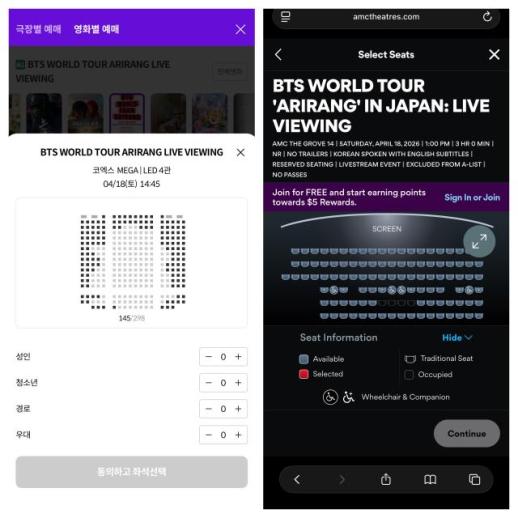 BTS Comeback D-24 : Less hype over BTS' 'ARIRANG' tour concert live cinema booking SEOUL, February 25 (AJP) - The last-resort seats for the first round of BTS comeback concerts are now open, but unlike the stampede over the group’s free open-air performance in central Seoul, the rush has been muted, suggesting many fans still prefer the atmosphere of sharing the same physical space with their idols. Advance bookings for the live cinema screenings of BTS’ “ARIRANG” tour opened Wednesday at 10 a.m. (KST) across South Korea’s three major multiplex chains — CGV, Megabox and Lotte Cinema. The screenings will broadcast two concerts live: the April 11 performance in Goyang and the April 18 show in Tokyo. Each event will run for about 180 minutes, delivering the energy of on-site performances to movie theaters nationwide. Globally, the live viewing is scheduled to take place in more than 3,500 theaters across 75 countries and regions. Some locations will offer delayed broadcasts due to time zone differences, with additional venues expected to be announced. In South Korea, the event will be shown at 26 Megabox theaters, 45 CGV locations and 28 Lotte Cinema sites. Ticket prices are set at 59,000 won per seat, about one-third of the minimum 198,000 won required for in-person attendance at the Goyang concert. By contrast, demand for BTS’ free performance at Gwanghwamun Square on March 21 was overwhelming. More than 100,000 fans rushed to secure 15,000 seats on Feb. 23, selling out the allocation within seconds. Early figures for the cinema screenings, however, point to more moderate interest. As of 10:14 a.m. Wednesday, 243 of 298 seats had been sold for the April 11 screening at the COEX complex. In Mokdong, 45 seats remained available out of 318. Sinchon showed 32 seats unsold, while Sangbong and Hongdae also recorded sizable vacancies. Overseas markets showed a similar pattern. At an AMC Theatres location in Burbank, California, only five tickets had been sold by late afternoon local time. In Malaysia, two TGV Cinemas branches reported minimal or zero early sales for the April 18 broadcast. Industry observers say the figures reflect fans’ continued preference for live, in-person concerts, even as alternative viewing options expand. “With BTS returning as a full group after nearly four years, many fans still place the highest value on being there in person,” a local distributor said. “Cinema screenings are viewed as a secondary choice.” With the April concerts approaching, ticket sales for both on-site performances and theater broadcasts remain ongoing, leaving room for a possible late surge in demand. 2026-02-25 13:54:04
 -
 South Korea to allow pets in restaurants as ownership rates surge SEOUL, February 25 (AJP) - South Korea will lift its long-standing ban on pets in dining establishments starting March 1, a regulatory overhaul aimed at accommodating the nearly 30 percent of households that now own companion animals. The Ministry of Food and Drug Safety announced the policy shift following a successful pilot program, though the transition has met with mixed reactions from small business owners concerned about the administrative and financial costs of compliance. The country’s pet population has grown steadily in recent years, with approximately 15.46 million people in the nation of 52 million now living with dogs or cats. This surge was largely driven by the COVID-19 pandemic, as prolonged social isolation and a rise in single-person households accelerated the trend of "pet humanization," where animals are treated as family members. The new rules under the Food Sanitation Act effectively move pet-friendly dining from a limited "regulatory sandbox" experiment into a formal legal framework. Under the updated guidelines, restaurants and cafes must meet rigorous hygiene standards to permit pets indoors. Entry is restricted to dogs and cats that have completed mandatory vaccinations, and staff are expected to verify these records via certificates or mobile applications. Establishments are required to install physical barriers, such as fences or partitions, to prevent animals from entering kitchens or ingredient storage areas. Plus, operators must provide specialized equipment, including pet-only chairs, cages, or fixed leash hooks, to ensure animals do not roam freely among other diners. The regulations also include specific sanitation protocols, such as requiring food and beverages to be served with covers to prevent contamination from fur. Businesses must maintain sufficient distance between tables and provide dedicated waste bins for pet disposal. Operators who fail to meet these facility standards or allow pets into food preparation zones face administrative penalties, including business suspensions ranging from five to 20 days. The reaction from the service industry is divided. Major franchises such as Starbucks Korea and the Italian restaurant chain Mad for Garlic have already begun integrating pet-friendly zones at select branches. However, independent operators on an online community platform operated by South Korea's web service giant Naver, which has 1.9 million members, voiced concerns over the cost of required renovations. Many owners expressed worry that the burden of policing vaccination records and managing pet noise would be unmanageable for small-scale shops with limited staff. The new regulatory landscape brings South Korea closer to the standards of other major economies. In Britain, dogs are frequently welcomed inside pubs and cafes as a matter of cultural tradition. In the United States, pets are generally restricted to outdoor patios and sidewalk seating, with indoor access largely reserved for service animals. Japan maintains a high degree of pet accessibility in urban centers like Tokyo, provided owners adhere to strict leashing and etiquette protocols enforced by private businesses. Ministry officials stated the framework is intended to bring thousands of businesses that previously allowed pets unofficially into legal compliance. By standardizing hygiene requirements, the government aims to ensure a consistent level of public health and safety for both pet owners and the general public. 2026-02-25 13:53:41