TikTok said the platform, which surpassed 1 billion monthly active users globally in 2021, continues to expand its reach, with more than 100 million videos uploaded each day.
According to TikTok's second-quarter data, over 99 percent of content removed for policy violations was detected proactively, before users reported it.
"We have strengthened our technology development, content moderation workforce and security infrastructure," said Yang Soo-young, a TikTok manager, speaking at the company's media day in Seoul.
Beyond safety, TikTok has also emerged as a key conduit for the global spread of Korean culture. An analysis of data from more than 70 countries, including Korea, shows that roughly half of all K-culture hashtag posts created over the past three years were generated in just the past 12 months.
Survey results indicate that 86 percent of U.S. consumers and 76 percent of Southeast Asian consumers say they learned more about Korean culture through TikTok, with Korean dramas and music driving interest in Korean products and brands.
That proactive posture stands in sharp contrast to the mounting security crisis facing Korea's homegrown platforms.
Coupang recently suffered a large-scale personal data breach affecting millions of users, while Naver and Kakao have become targets of bomb-threat posts this week, triggering police investigations. What began as online harassment has escalated into physical terror warnings, fueling public outrage and raising questions about the resilience of Korea's digital infrastructure.
In Coupang's case, a former employee of Chinese nationality has been identified as a suspect, underscoring China's complex role in the global cybersecurity landscape. China ranks second worldwide in cybersecurity market size after the U.S., according to Statista's 2026 projections, while also harboring the world's second-largest hacker population — about 22 percent — trailing only North Korea at 33 percent.
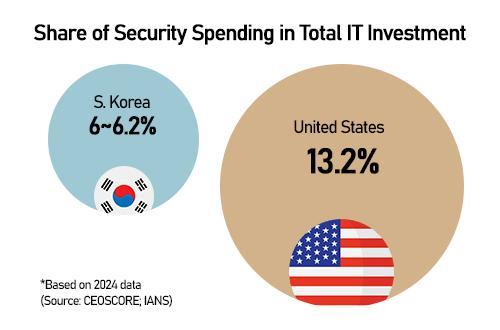
Despite being prime targets, Korean companies remain reluctant to invest meaningfully in security.
The underlying calculus is economic. Since the launch of the Personal Information Protection Commission in August 2020 through September this year, 109.16 million cases of personal data leaks have been recorded, resulting in cumulative fines of 367.1 billion won ($249 million). That equates to roughly 3,300 won per breach — a trivial cost compared with the punitive damages imposed in Europe or the U.S., where data-protection penalties can be severe.
"Investment alone won't solve everything, but investment has to come first," said Park Choon-sik, a professor in the Division of Information Security at Seoul Women's University. "Companies need to allocate at least 10 percent of their IT budgets to security. Only then can they hire specialists, build dedicated teams and meaningfully reduce damage."
China has already moved in that direction. In 2023, it introduced its first cybersecurity insurance framework, offering tax breaks and insurance subsidies to encourage voluntary enrollment. The system establishes quantitative risk-assessment standards for key industries, standardizes cyber-risk evaluation and encourages insurers to diversify coverage, including liability protection.

Copyright ⓒ Aju Press All rights reserved.