
Journalist

AJP
-
 BTS’ Jimin, an Emotion-Driven Performer, Builds His Solo Story With ‘FACE’ and ‘MUSE’ With BTS preparing to return in March, anticipation is rising worldwide. News of the comeback and plans for a world tour has prompted immediate reactions beyond the music industry, including in tourism and local economies, signaling another major wave of interest. BTS is seen as both a global economic force and a symbolic name that elevates South Korea’s image. Ahead of the comeback, this outlet is publishing a “BTS member profile” series, taking a closer look at each of the group’s seven members. <Editor’s note> Jimin serves as BTS’ main dancer and a lead vocalist. Onstage, his strength is how movement and breath work together. As a singer, he uses breath to heighten emotion, shifting between a sensual edge and a softer tone. He is also known for smooth transitions between chest voice and falsetto, steady tone across his range and a distinctive vocal color that is easy to recognize. Dance is central to his identity as a performer. He began popping in middle school and entered Busan High School of Arts as the top student in its dance department. Before moving to Seoul, he focused on contemporary dance, refining line and emotional expression. That background helps explain why his performances often feel narrative-driven, with detailed facial expressions and mood changes that track each song’s concept. As a solo artist, Jimin started with self-examination. His first official solo album, “FACE,” centered on confronting emotional highs and lows during the pandemic. The pre-release track “Set Me Free Pt.2” opened with a rougher intensity, while the title track “Like Crazy” translated his inner world with a more delicate touch. Moving among pop, hip-hop and R&B, the album links its emotional arc across tracks, leaving what the title suggests: a record of facing his “real self.” Results followed. “Like Crazy” reached No. 1 on Billboard’s Hot 100, a first for a Korean solo artist, and also earned a certification from the Recording Industry Association of America. “FACE” quickly expanded its global streaming performance, firmly establishing the start of Jimin’s solo run. His second solo album, “MUSE,” shifts direction. If “FACE” confronted the self, “MUSE” looks outward for sources of inspiration. The album’s through line is love, moving from “Rebirth” through “Smeraldo Garden Marching Band” and “Slow Dance,” changing emotional texture, turning the mood with “Be Mine,” and peaking with the title track “Who.” Across seven tracks, Jimin frames love as searching, confirming and, at times, drifting. The album’s palette also widens. Working again with producer Pdogg and additional producers, Jimin aimed for higher polish, while collaborations with Loco and Sofia Carson broadened its harmonies. He has said the album drew inspiration from The Beatles’ “Sgt. Pepper’s Lonely Hearts Club Band,” a reference point for its romantic tone and structure. “Smeraldo Garden Marching Band,” which invokes the Smeraldo symbol from BTS’ broader narrative universe, presents a message for feelings that cannot be spoken, highlighting both Jimin’s lyricism and optimism. Above all, “Who” has become a song defined by endurance. Its cumulative streams on Spotify have continued to rise, sustaining long-term momentum, and “MUSE” has also expanded its presence through steady streaming results. The approach of letting the music build over time, rather than relying on flashy promotion, has become another side of Jimin’s solo identity. Jimin ultimately is an artist who speaks emotion first through dance and leaves it lingering through his voice. When his onstage immersion and the narratives in his recordings point in the same direction, his name comes into sharper focus. In this “BTS member profile” series, Jimin has built his chapter in that way.* This article has been translated by AI. 2026-02-24 17:04:08
 -
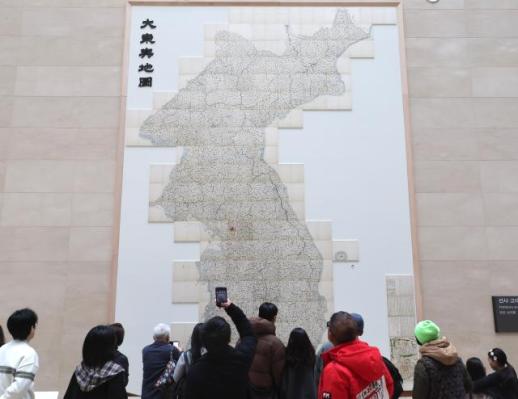 The Great Map of the East unfolds SEOUL, February 24 (AJP) - On the first floor of the National Museum of Korea, there is a "History Path." On one wall hangs a massive map—the Daedong Yeojido (Great Map of the East) by Gosan Kim Jeong-ho. The exhibition "Unfolding Daedong Yeojido" has been on display since Feb. 12. Originally, the Daedong Yeojido was a folding map divided into 22 volumes for portability. However, to commemorate the 160th anniversary of Gosan's death, the museum connected and mounted all 22 volumes printed on traditional Korean paper to recreate the map in its complete form on the wall, measuring approximately 6.7 meters in height and 3.8 meters in width, equivalent to a three-story apartment building. Kim Jeong-ho, who created the Daedong Yeojido in 1861, was a geographer who dedicated his life to mapmaking. To create the map, he traveled around the country's eight provinces three times over 30 years and climbed Mt. Baekdu eight times. The name "Daedong Yeojido" means "Map of the Great Eastern Country," reflecting an independent consciousness free from Chinese influence. 2026-02-24 17:01:49
 -
 KOSPI hits record high as Samsung and SK hynix fly SEOUL, February 24 (AJP) - Seoul's benchmark KOSPI closed Tuesday, just shy of 6,000 milestone, less than a month after the break above 5,000. Shares of Samsung Electronics and SK hynix also hit historic heights - 200,000 won, up 7,000 won from the previous close and 1,005,000 won, up 54,000 won respectively 2026-02-24 16:59:31
 -
 Ex-DP lawmaker faces arrest after Nat'l Assembly passes motion over bribery allegations SEOUL, February 24 (AJP) - The National Assembly on Tuesday passed a motion allowing the arrest of Kang Sun-woo, a former lawmaker of the ruling Democratic Party (DP) over alleged bribery and breach of trust. The motion was passed with 164 votes in favor and 87 against, with three abstentions and nine invalid ballots. Kang is accused of receiving 100 million Korean won (US$68,500) from Kim Kyung, a former Seoul city official in return for the DP's candidate nominations for the 2022 local elections. The money was allegedly delivered to Kang's former aide, identified only by his surname Nam. Before the vote, Kang said she had returned the money every time it was given, totaling 322 million won over five occasions, and added that she never demanded 100 million won and that it would not have been worth risking her career over that amount. She said she believed she had lived by her principles, while admitting that her conduct was "immature." In South Korea, lawmakers are immune from arrest during a parliamentary session unless the National Assembly votes to lift that protection. Since the motion was passed, Kang now faces arrest, with a hearing expected in early March. 2026-02-24 16:52:53
 -
 KR chief Lee Young-seok touts 2025 revenue milestone, targets record 2026 results "Even as global environmental rules tighten and the maritime industry undergoes digital transformation, the Korean Register will continue to grow based on technological competitiveness and customer trust," KR Chairman Lee Young-seok said at a KR press briefing on Feb. 24 at the Korea Chamber of Commerce and Industry. Lee said external uncertainty is expected to persist this year and stressed that KR will push technological innovation to overcome challenges. "Through field-focused management and open communication, we will work closely with the government and related maritime organizations," he said. "We will continue to expand our capabilities in digital and eco-friendly technologies to contribute to the sustainable development of the maritime industry." KR set targets for this year of 213 billion won in revenue and 95 million tons in registered fleet. It also outlined a mid- to long-term plan to raise revenue to as much as 270 billion won and expand its registered fleet to 120 million tons by 2030. To reach those goals, KR said it will build strategic footholds overseas and step up focused sales efforts. It named China as its top priority market and said it will seek to increase the volume of existing ships it attracts from major shipping companies to create a virtuous cycle that brings more vessels to KR. It also said it aims to find new markets, including Dubai, and raise the share of purely foreign-flagged ships from about 30% to 40% over the mid to long term. KR also approved the appointment of three new full-time executives and reassigned other executive roles. Kim Seong-ju, head of the China regional headquarters; Yeon Gyu-jin, head of the drawing approval office; and Choi Cheol, head of the international cooperation office, were appointed as full-time executives, overseeing the inspection, technical and business divisions, respectively. Choi Won-jun, a vice president who had overseen the management division, was reassigned as senior vice president in charge of the strategy division. Yoon Seong-ho, the senior vice president who had led the strategy division, was reassigned as vice president overseeing the management division. Earlier, KR held its 64th regular general meeting and approved a business report and its 2025 financial statements. KR said it expanded inspection volume for newbuild ships through active sales efforts. As a result, revenue last year totaled 206 billion won and its registered fleet grew to 90.35 million tons. Of newly registered existing ships, 71% were owned by overseas shipowners, KR said, reflecting expanded technological competitiveness and international trust. 2026-02-24 16:46:29
 -
 Silla Gold Crown Exhibition Draws 285,401 Visitors at Gyeongju National Museum Gyeongju National Museum said Monday that its special exhibition “Silla Gold Crowns: Power and Prestige,” which ended Feb. 22, drew a total of 285,401 visitors. The exhibition opened to the public on Nov. 2, 2025, and ran for 110 days through Feb. 22, 2026. The museum estimated average daily attendance at about 2,594. Attendance was capped at 150 people per time slot, or 2,550 a day, but every slot sold out, with more than 270,000 visitors coming during the run. The show also sparked an “open run” trend, with visitors lining up before the museum opened, popularizing the term “gold crown open run.” Boosted by the exhibition, the museum’s cumulative visitor total this year reached 401,683 as of Feb. 22, about 2.4 times the 169,464 recorded over the same period last year. The surge was also evident during the five-day Lunar New Year holiday period (2. 14.~2. 18.). Even with the museum closed on Lunar New Year’s Day, attendance totaled 72,005. “The golden culture of Silla is a defining feature of Silla culture,” the museum said, adding that it plans to hold related exhibitions every 10 years by compiling research findings from Korea and abroad, aiming to make them signature shows for the museum and for Gyeongju. In the next exhibition, the museum said it will broaden the scope of “gold crowns” in spatial and conceptual terms, presenting not only six Silla gold crowns but also a range of crowns from Korea and overseas. It also plans to expand beyond band-style crowns (帶冠) to include hat-style crowns (帽冠). Director Yoon Sang-deok said the museum will continue working to promote the excellence of Silla culture by actively staging special exhibitions in Korea and abroad. * This article has been translated by AI. 2026-02-24 16:45:39
 -
 Chips, KOSPI on fire as institutions bet on more upside SEOUL, February 24 (AJP) — Asian markets traded mostly higher Tuesday, with the exception of Hong Kong, as investors digested the rollout of a blanket 10 percent U.S. import levy that replaced earlier, steeper tariffs under former President Donald Trump following a Supreme Court ruling last week. South Korea’s benchmark KOSPI roared higher, pushed by chip titans Samsung Electronics and SK hynix, which hit fresh milestones of 200,000 won and 1 million won, respectively. Samsung rose 3.63 percent to close at 200,000 won, while SK hynix climbed 5.68 percent to 1,005,000 won, as analysts cited strengthening fundamentals in the memory sector. Park Jun-young of Hanwha Investment & Securities said stronger pricing leverage for next-generation HBM4 chips, backed by robust capacity, is expected to drive Samsung’s earnings growth. He set a new target price of 260,000 won. Han Dong-hee of SK Securities said memory demand is becoming structurally linked to the AI investment cycle, improving earnings visibility for SK hynix. He added that a potential U.S. ADR listing could highlight the stock’s undervaluation, raising his target to 1.6 million won. The chip-led rally pushed the KOSPI above the 5,900 mark to finish at 5,969.64, up 2.11 percent and edging closer to the symbolic 6,000 level — less than a month after breaking through 5,000. The tech-heavy KOSDAQ gained 1.13 percent to 1,165.00. The won strengthened amid cautious risk sentiment over U.S. trade policy, with the dollar falling 2.30 won to 1,143.70. Institutional investors drove the rally, net buying 2.38 trillion won ($2.08 billion) worth of shares. Individual and foreign investors sold a net 2.29 trillion won and 196 billion won, respectively. Non-chip large-cap stocks showed mixed moves. SK Square jumped 6.38 percent to 617,000 won, while Samsung Life Insurance fell 3.45 percent to 224,000 won. Samsung Biologics edged up 0.35 percent to 1,723,000 won, and LG Energy Solution rose 4.17 percent to 412,500 won. In defense and aerospace, Hanwha Aerospace added 0.40 percent to 1,241,000 won. Shipbuilders retreated, with HD Hyundai Heavy Industries down 1.81 percent and Hanwha Ocean falling 2.79 percent. Auto shares were modestly higher. Hyundai Motor rose 0.19 percent, while Kia advanced 0.75 percent. Entertainment shares remained sidelined despite BTS’s announcement of a comeback concert at Gwanghwamun Square next month, reflecting heavy concentration in AI-driven large caps. HYBE slipped 0.62 percent, JYP Entertainment fell 0.85 percent, while YG Entertainment gained 0.68 percent. Analysts said major artist comebacks are now largely priced in, limiting their impact as stock catalysts. Elsewhere in Asia, Japan’s Nikkei 225 added 0.87 percent, while Hong Kong’s Hang Seng Index fell 1.93 percent. China’s Shanghai Composite rose 0.85 percent after the central bank kept its loan prime rates unchanged for a ninth straight month. China’s Ministry of Commerce said it added 20 Japanese firms and institutions to its export control list, banning exports of dual-use items with immediate effect — a move that added fresh geopolitical uncertainty and could cap further gains in mainland markets. 2026-02-24 16:41:23
 -
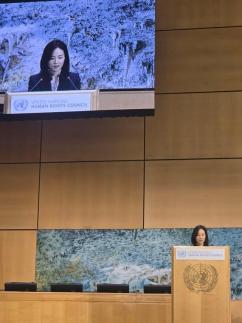 Vice FM Kim pledges inter-Korean dialogue on humanitarian issues at UN rights council SEOUL, February 24 (AJP) - Seoul will pursue inter-Korean dialogue to address humanitarian issues such as family reunions and the return of detainees, Vice Foreign Minister Kim Jin-a said Monday at the United Nations Human Rights Council. In a keynote address to the council’s 61st session in Geneva, Kim said the government would work closely with the international community to achieve “practical” improvements in the human rights of North Korean residents. “It will pursue inter-Korean dialogue to resolve humanitarian issues such as separated families, abductees, detainees and prisoners of war,” the Foreign Ministry said in a statement, quoting Kim. She also reaffirmed South Korea’s commitment to its role as a council member for the 2025–2027 term, pledging to help promote global norms for stronger protection and advancement of human rights. Kim highlighted Seoul’s efforts to narrow social and development gaps arising from new technologies, including artificial intelligence, as well as challenges related to youth, climate change, digital innovation, welfare and healthcare. She voiced support for international action to eliminate conflict-related sexual violence, noting that South Korea remains committed to restoring the honor and dignity of victims of Japan’s wartime sexual slavery. Kim also introduced a recent amendment to the Comfort Women Victims Protection Act, which aims to strengthen protections against the spread of false information about survivors. During her visit to Geneva from Feb. 23 to 25, Kim met with UN Deputy High Commissioner for Human Rights Nada Al-Nashif to discuss cooperation on North Korean human rights and South Korea-led priorities on technology, local governance and human rights. She also held talks with International Committee of the Red Cross Secretary General Pierre Krähenbühl, with both sides agreeing to strengthen cooperation amid growing humanitarian crises linked to global armed conflicts. 2026-02-24 16:41:14
 -
 FootJoy Unveils Next-Generation PRO/SL Golf Shoe Backed by Tour Feedback FootJoy said Monday it is introducing a next-generation PRO/SL golf shoe after redesigning the model’s structure from top to bottom. The company unveiled the PRO/SL at a launch event at the Westin Josun Parnas Harmony Ballroom in Samseong-dong, Seoul. Chris Lindner, chief executive at FootJoy’s U.S. headquarters, and Richard Fryer, global vice president of product, attended the event and outlined the brand’s footwear philosophy and the development of the PRO/SL with Z-TEC. First released in 2016, the PRO/SL has sold more than 3 million pairs over about 10 years and has become one of FootJoy’s signature spikeless performance golf shoes, the company said. FootJoy said the new PRO/SL was redesigned across the upper, traction system and cushioning, incorporating feedback from PGA Tour players including Im Sung-jae. A key feature is its Z-TEC (Zonal Targeted Engineered Composite) design, a zone-based approach that places specific functions where needed. FootJoy said the composite structure is intended to provide stable support during the swing while maintaining natural comfort when walking. Lindner said, “PRO/SL with Z-TEC is a next-generation golf shoe completed based on tour player feedback,” adding that because FootJoy focuses only on golf, every element was developed for golfers. “You’ll be able to feel performance and comfort that can’t be compared with anything else,” he said. Choi Seung-bin, a FootJoy brand ambassador who competes on the Korea Professional Golfers’ Association Tour, said he was impressed by the firm support in the lower body during the swing. “I could clearly feel improved stability and traction, especially at impact,” he said.* This article has been translated by AI. 2026-02-24 16:27:00
 -
 Wildfire in Miryang contained after 20-hour battle SEOUL, February 24 (AJP) - A wildfire in the southeastern city of Miryang was contained on Tuesday after firefighters battled flames for more than 20 hours. The fire broke out around 4 p.m. the previous day on a hill in a small town in Miryang, South Gyeongsang Province, forcing about 150 residents to evacuate. About 1,511 emergency workers, along with 52 helicopters and 318 pieces of equipment, were deployed to combat the fire, but their efforts were hampered by low visibility as night fell. Firefighting resumed the following day shortly after sunrise, with morning rain also aiding efforts to contain the blaze. The affected area was estimated at 143 hectares, but no casualties or damage to facilities were reported. "Wildfires occur frequently in spring due to dry weather and strong winds, a spokesman for the Korea Forest Service warned, urging people to refrain from using fire outdoors. 2026-02-24 16:07:36