
Journalist

AJP
-
 Hana Bank Wins Partial Ruling in Lime Case; Lime, Shinhan Investment to Pay 36.4 Billion Won Hana Bank won a partial victory in a lawsuit tied to the Lime Asset Management fund redemption freeze and will receive damages. The Seoul Southern District Court on Wednesday ruled partly for Hana Bank in its damages suit against Lime Asset Management, Shinhan Investment Corp. and others. The court found Hana Bank held about 38.9 billion won in bankruptcy claims and ordered the defendants to pay 36.4 billion won. Hana Bank filed the suit in January 2022, saying it suffered losses from the sale of Lime funds. It sought about 36.4 billion won in damages. The Lime scandal erupted in 2019 after allegations that Lime Asset Management improperly managed returns through irregular trading of convertible bonds and other assets tied to KOSDAQ-listed companies. As prices of stocks held by Lime funds plunged, redemptions worth 1.6 trillion won were suspended.* This article has been translated by AI. 2026-02-05 17:57:00
 -
 Defense officials from Seoul and Beijing meet for first working-level talks in four years SEOUL, February 5 (AJP) - Defense officials from South Korea and China held working-level talks in Beijing on Thursday, their first such meeting in about four years. According to the Ministry of Defense, the South Korean delegation led by Lee Gwang-seok, in charge of the ministry's international policy met with his Chinese counterpart Guo Hongtao. First launched in 1995, the meeting was held for the first time since the last one, which was via Zoom in June 2022. The two sides agreed to hold close consultations to revive strategic dialogue channels and expand bilateral cooperation. They also discussed ways to resume joint search-and-rescue drills in the West Sea. The ministry said it expects the meeting to "lay the groundwork for building trust" between the two countries. 2026-02-05 17:55:41
 -
 Dongkook Drug Marks 87 Million Madeca Cream Sales; Hanmi Wins FDA Breakthrough Tag; Yuyu Invests in U.K. Pet Food Firm Dongkook Drug to hold customer sale after Madeca Cream tops 87 million in cumulative sales Dongkook Drug said Wednesday it will run a “Madeca Cream Customer Appreciation Sale” through Feb. 28 to mark cumulative sales of 87 million units of its Centellian24 derma-cosmetic flagship product, Madeca Cream. The promotion will be offered on the company’s official online store, DK SHOP, under two themes: a Lunar New Year gift event and a “Find the right Madeca Cream for my skin” campaign. Through Feb. 18, the Lunar New Year gift event will offer discounts of up to 87% on best-selling products including Madeca Cream Tight Lifting, Expert Madeca Mela Capture Ampoule Max and Madeca Cream, and provide a 100,000-won coupon pack. DK SHOP will also give gifts based on purchase totals of 30,000 won, 50,000 won and 70,000 won or more, and run events including a first-purchase welcome deal and a lucky-bag New Year’s cash drawing. Through Feb. 28, the “Find the right Madeca Cream for my skin” promotion will sell a 9,900-won kit that lets customers try multiple versions at once, including Madeca Cream Time Reverse Zero, Madeca Cream Power Boosting Formula, Madeca Cream Hydra Calming and Madeca Cream Tight Lifting. New members will receive coupons worth up to 30,000 won, and DK SHOP will also hold a review event for the “NEW Aging Focus Cream.” Hanmi Pharmaceutical says FDA grants breakthrough therapy designation for congenital hyperinsulinism drug Hanmi Pharmaceutical said Wednesday that the U.S. Food and Drug Administration has granted breakthrough therapy designation to efpeglucagon, its treatment candidate for congenital hyperinsulinism. The designation is intended to speed development and review for drugs targeting serious or life-threatening conditions when early clinical evidence suggests a meaningful improvement over existing therapies. Breakthrough therapy drugs receive intensive guidance and support, and may qualify for rolling review, allowing portions of an application to be submitted and reviewed as they are completed. Congenital hyperinsulinism is a rare disease in which excessive insulin secretion causes hypoglycemia. Hanmi said no FDA-approved treatment has been approved specifically for the condition. Hanmi is developing efpeglucagon as a once-weekly formulation. The company said an interim analysis from a global Phase 2 trial last year showed favorable safety and tolerability and a marked reduction in both hypoglycemia and severe hypoglycemia. The global Phase 2 trial is ongoing, with results expected in the second half of this year. Yuyu Pharma makes strategic investment in U.K. freeze-dried pet food company James & Ella Yuyu Pharma said Wednesday it has made a strategic investment in James & Ella, a U.K. premium freeze-dried pet food company. The company described James & Ella as a leading player in the U.K. freeze-dried pet food category. It sells through major retail channels including Waitrose, Ocado and Amazon, and also operates a direct-to-consumer subscription channel. Yuyu said demand for freeze-dried nutrition products is rising in the pet market, driven by interest in premium ingredients suitable for human consumption, high digestibility and veterinary-based products. The investment is part of Yuyu’s global expansion strategy in the pet wellness market. Yuyu said it plans to build an animal-industry portfolio spanning veterinary biologics, sustainable food-system technologies, and pet nutrition and community models.* This article has been translated by AI. 2026-02-05 17:45:00
 -
 Hyundai Motor Robotics Lab chief says people matter more than tech as robots advance Hyun Dong-jin, an executive director who leads Hyundai Motor and Kia’s Robotics Lab, said that as industry evolves, people matter more than the technology itself because they operate it, understand it and build the systems around it. Speaking Thursday at the fourth Korea Top CEO Forum at the Westin Josun Seoul, Hyun said, “Rather than imagining a dystopia, if we think about how technology can solve social problems, our society can become a warm, technology-based society.” His remarks come as Hyundai Motor Group’s plan to introduce the humanoid robot Atlas is seen as signaling structural changes in the labor market, underscoring the need for productive public discussion and consensus. “Engineers’ efforts and social consensus are needed for robots to fully replace people,” Hyun said. “I think we still have time.” After outlining the development path of artificial intelligence from large language models, or LLMs, to vision-language models, or VLMs, and then vision-language-action, or VLA, Hyun said automation of physical work will arrive last because VLA is the most technically behind. Introducing a dual-arm robot under research at the lab, Hyun said the goal is not to replace people but to take on tasks that could cause illness if done by humans. On Chinese robotics companies, Hyun said China benefits from government support and a large market that allows firms to optimize products through trial and error, adding that they are showing signs of being leaders in physical AI. “We must always stay alert that we could fall behind,” he said, adding, “I will fight fiercely like Adm. Yi Sun-sin, who fought with 12 ships.” Hyun cited functionality and price as key factors in whether robots succeed commercially. “From quality to maintenance and after-sales service, we must manage everything well and offer prices consumers are willing to pay,” he said, stressing the need for engineering efforts toward common use, standardization and modularization. Hyundai Motor and Kia’s Robotics Lab last year unveiled a mass-production model of its autonomous-driving mobility robot platform MobED, and in 2024 launched the industrial wearable robot X-ble Shoulder.* This article has been translated by AI. 2026-02-05 17:30:00
 -
 Hanmi Pharmaceutical Posts Record Operating Profit of 257.8 Billion Won Hanmi Pharmaceutical said in a regulatory filing on Wednesday that its consolidated operating profit last year rose 19.2% from a year earlier to 257.8 billion won, based on preliminary results. Revenue increased 3.5% to 1.5475 trillion won, and net profit climbed 33.9% to 188.1 billion won. The company said the results were driven by steady growth in key products including Rosuzet, higher income from supplying clinical trial samples and technology fees from partner MSD, and progress in normalizing operations at Beijing Hanmi. In the fourth quarter of 2025, revenue rose 23.1% from a year earlier to 433.0 billion won, while operating profit jumped 173.4% to 83.3 billion won. Hanmi Pharmaceutical said it generated 1.0836 trillion won in sales from outpatient prescriptions alone, marking its eighth straight year as the top seller in South Korea’s outpatient prescription market. Rosuzet, a combination drug for dyslipidemia, posted prescription sales of 227.9 billion won, up 8.4% from a year earlier. The Amodartan Family line of combination hypertension drugs recorded 145.4 billion won in sales last year. Its China unit, Beijing Hanmi Pharmaceutical, supported the performance as annual revenue topped 400.0 billion won last year, the first time since its founding that it has exceeded that level. Hanmi Fine Chemical, an affiliate specializing in active pharmaceutical ingredients, posted 91.3 billion won in revenue last year. Fourth-quarter revenue rose 36.8% from a year earlier to 28.3 billion won. The company said fourth-quarter operating profit returned to the black on new contract development and manufacturing orders and expanded volumes for existing projects. Hanmi Pharmaceutical said it plans to launch at least one “flagship product” a year worth more than 10.0 billion won in annual sales, starting with Amoprel, billed as the world’s first one-third low-dose antihypertensive drug introduced in the second half of last year.* This article has been translated by AI. 2026-02-05 17:27:22
 -
 Freefall may be looming in Seoul as short selling mounts SEOUL, Feb. 05 (AJP) - “What goes up must come down,” the saying goes — and after a prolonged roller-coaster ride, Korean stocks plunged Thursday as heavy institutional selling triggered a sharp reversal. The immediate cue came from a retreat in U.S. technology shares. But the pullback was hardly unexpected, given the rapid buildup in short-selling positions and growing signs of speculative excess. Both the KOSPI and the secondary KOSDAQ tumbled nearly 4 percent Thursday from their previous day’s peaks, underscoring how quickly sentiment had shifted. The reversal had been foreshadowed by institutional investors’ readiness to lock in profits at the first sign of weakness. As of Tuesday, the balance of stock lending — widely seen as a precursor to short selling — climbed to a record 140.8 trillion won ($96 billion), up 24.5 percent from six months earlier, according to market data. In stock lending transactions, institutional players such as pension funds and insurers lend shares to traders, who sell them in anticipation of repurchasing them later at lower prices. The expanding lending balance suggests a growing number of investors have been positioning for a correction or seeking protection against heightened downside risks. Market volatility in early February has been unusually intense. On Monday, concerns over a potential hawkish shift in U.S. monetary policy triggered a 5.3 percent plunge in the KOSPI, briefly pushing it below the psychologically important 5,000 mark. The index rebounded sharply the following day, surging 6.84 percent to a record close, before extending gains on Wednesday — only to reverse course again. By comparison, Japan’s Nikkei 225 posted far more moderate fluctuations over the same period, highlighting the exceptional turbulence in Korean equities. Reflecting elevated investor anxiety, the VKOSPI volatility index climbed above 50 on Feb. 5, more than 50 percent higher than a month earlier. “As volatility widens and the market appears increasingly disconnected from economic fundamentals, investors are actively seeking hedging tools,” a market official said, speaking on condition of anonymity. Yet products designed to profit from falling markets have struggled as the rally continues. Samsung Asset Management’s KODEX 200 Futures Inverse 2X ETF — the most actively traded inverse product — closed at 345 won on Feb. 4, down 38 percent over the past month and more than 90 percent below its 2016 listing price, leaving it trading at levels comparable to penny stocks. Other inverse products have also weakened. Mirae Asset’s TIGER Inverse ETF has fallen about 22 percent since the start of the year. Inverse ETFs move opposite to the underlying index, meaning their performance deteriorates when markets rise. When the KOSPI fell 3.86 percent in the following session, the KODEX leveraged inverse fund briefly jumped nearly 9 percent, underscoring the products’ sensitivity to market swings. Analysts say structural factors also weigh on returns, including frequent trading and retail investors’ tendency to react quickly to market headlines. Average daily ETF trading value this year has nearly doubled from last year to more than 11 trillion won, according to the Korea Exchange, reflecting heavier speculative activity. The Bank of Korea has also noted rising trading volumes in leveraged and inverse ETFs. “Participants in leveraged and inverse ETF markets, especially double-inverse products, tend to focus on short-term trades and are highly sensitive to external news,” said an official at a capital markets research institute. 2026-02-05 17:25:32
 -
 Asian stocks mostly down on US losses, Korean markets take a header SEOUL, February 05 (AJP) -Korean stocks rode a volatile roller coaster downward Thursday on heavy foreign selling on global tech shares. The benchmark KOSPI tumbled 3.9 percent to close at 5,163.6, marking a steep pullback from recent record highs. The KOSPI 200 slid 4.2 percent to 757, reflecting broad-based losses among large-cap stocks, particularly in semiconductors and export-oriented names. Selling pressure was led by overseas and institutional investors. On the main board, foreigners dumped 5.01 trillion won ($3.43 billion), while institutions sold 2.07 trillion won. Retail investors stepped in aggressively to pick up a net 6.78 trillion won, although their dip-buying fell short of stemming the decline. The bullish sentiment was soured by overnight losses in global technology stocks. Shares of Advanced Micro Devices plunged more than 17 percent after issuing first-quarter revenue guidance pointing to a quarter-on-quarter decline. The weakness spread across the sector, with ASML down about 4 percent, while Nvidia and Broadcom each fell roughly 3 percent, dragging down global tech sentiment. Korean semiconductor and platform stocks followed suit. Heavyweights led losses on the KOSPI, with Samsung Electronics falling 5.8 percent to 159,300 won and SK hynix sliding 6.4 percent to 842,000 won, reflecting heightened sensitivity to global chip-sector weakness. Automakers and internet stocks also retreated. Hyundai Motor fell 3.1 percent, while NAVER lost 2.8 percent. Defense and shipbuilding names also came under pressure. Hanwha Ocean dropped 5.8 percent, while Hanwha Systems plunged 9.5 percent. Pharma Research tumbled 23.4 percent, marking one of the session’s steepest single-stock declines. Amid the broad selloff, solar-related stocks emerged as a rare pocket of strength. HD Hyundai Energy Solutions surged 16.2 percent to close at 81,900 won after soaring more than 25 percent intraday before paring gains. Hanwha Solutions also edged higher, rising 0.14 percent to 36,500 won. Market participants attributed the buying interest to improving prospects for the global solar market, supported by management comments pointing to stronger demand and pricing momentum in the U.S. solar sector. Sector-wise, losses were widespread, with only a handful of pockets showing resilience. Office equipment-related stocks posted gains, with the sector rising 4.37 percent, topping industry performance. The tech-heavy KOSDAQ mirrored the downturn, falling 3.6 percent to 1,108.4. Foreign investors sold 286.1 billion won, while institutions offloaded 539.9 billion won. Retail investors bought 903.4 billion won, signaling selective dip-buying in smaller-cap shares despite elevated volatility. On heavy foreign selling, the won weakened to 1,463.6 per U.S. dollar, down 3.1 won, or 0.21 percent. The damage was softer across Asia. Japan’s Nikkei 225 fell 0.9 percent to 53,818.04, China’s Shanghai Composite slipped 0.6 percent to 4,075.9, while Hong Kong’s Hang Seng Index held up, rising 0.1 percent to 26,880.3. 2026-02-05 17:18:31
 -
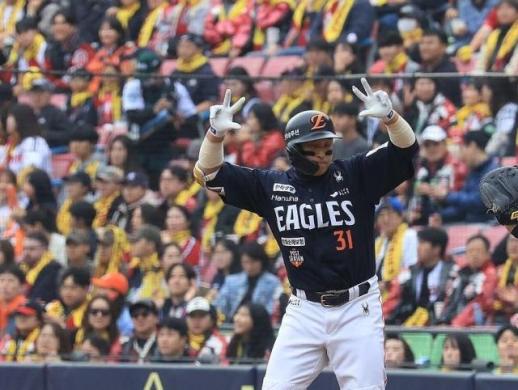 KBO hits leader Son Ah Seop settles for one-year FA deal with Hanwha This series takes a closer look at players and the issues surrounding them, drawing on interviews, statistics and career arcs. <Editor’s note> KBO League career hits leader Son Ah Seop got a harsh reminder of how cold free agency can be, settling for a one-year deal with the Hanwha Eagles, his original club. Attention now turns to whether he can rebound the way infielder Ha Ju Seok did after making a similar choice last offseason. Hanwha announced on Wednesday that it signed Son to a one-year free-agent contract worth 100 million won in salary. Son is set to join the Futures spring camp in Kochi, Japan, on Thursday. The outcome surprised some observers because Son has long been regarded as one of the league’s top contact hitters and holds the KBO’s all-time hits record. Questions also lingered because Son was a C-tier free agent, meaning a team signing him away would not have to send a compensation player — unlike A-tier and B-tier free agents. A club would have needed to pay only 150% of his previous salary as compensation. With Son earning 500 million won last year, that would have been 750 million won. The lack of interest is widely attributed to concerns about aging curves for Son, who was born in 1988. Last season, he hit .288 with 107 hits, one home run and a .723 OPS. The batting average was solid, but there were questions about overall offensive production (wRC+), power and defensive value. Designated hitter spots are typically filled by home run hitters, and Son has been viewed as a contact-oriented DH whose outfield defense is a weakness. Some evaluations also said his contact skills have slipped from his peak. His wins above replacement also drew scrutiny. According to the statistics site STATIZ, Son posted 1.21 WAR with the NC Dinos last season and just -0.05 with Hanwha — a disappointing figure given his reputation. That context meant Hanwha did not have to rush. The Eagles also signed Kang Baek Ho to a blockbuster free-agent deal worth up to 10 billion won over four years, giving the club leverage in talks with Son. Son ultimately accepted Hanwha’s terms and pledged to restart his career path, a move that recalled Ha’s situation a year earlier. In the previous free-agent market, Ha struggled to negotiate after Hanwha first signed infielder Shim Woo Joon to a deal worth up to 5 billion won over four years. Ha eventually stayed on a one-year, 110 million won contract (90 million won guaranteed plus 20 million won in incentives). Ha then delivered last season, starring at the plate and in the field as Hanwha finished runner-up. He also played second base and showed he could coexist with Shim. On the strength of that performance, Ha signed a salary deal for 200 million won this season, a 122.2% increase. Son and Ha play different positions — Ha can handle both shortstop and second base — but Son could still reshape his value if he improves his outfield defense and restores more noticeable offensive production. Given the changes Son faced after being traded from NC to Hanwha last season, the article said there is room for improvement this year. If he carries his offseason training into a productive season built on his contact hitting, his future evaluation could change significantly. 2026-02-05 17:18:00
 -
 KAI posts 2025 operating profit of 269.2 billion won, up 12% Korea Aerospace Industries, or KAI, said Wednesday it posted preliminary 2025 revenue of 3.6964 trillion won and operating profit of 269.2 billion won. Revenue rose 1.7% from a year earlier and operating profit increased 11.8%. Net profit climbed 9.6% to 187.3 billion won, the company said. Fourth-quarter revenue was 1.4667 trillion won and operating profit was 77.0 billion won, up 34% and 82.7%, respectively, from a year earlier. KAI said orders rose 30.4% to 6.3946 trillion won, driven by the first mass-production contract for the KF-21, a second mass-production batch for a medical evacuation helicopter, expanded helicopter procurement by the Korea Forest Service, and exports of the FA-50PH to the Philippines. The company said additional exports of the FA-50PH and follow-on work such as an airframe life-extension program for Indonesia’s KT-1 helped secure a long-term revenue base of more than 40 years. Its order backlog at the end of 2025 stood at 27.3437 trillion won, up more than 10% from a year earlier. For 2026, KAI forecast revenue of 5.7306 trillion won and orders of 10.4383 trillion won, up 58.1% and 63%, respectively, from the prior year on a separate basis. The company said it expects revenue to top 5 trillion won for the first time since its founding, with the KF-21 moving into mass production after 10 years and six months of system development, alongside Light Armed Helicopter, or LAH, production. KAI also said it expects production stabilization for the FA-50PL for Poland and the FA-50M for Malaysia, and higher aircraft-structure exports as the commercial aviation market recovers. On orders, KAI said it will pursue the KF-21’s first export, expand additional exports and follow-on support for the FA-50 and Surion, and push domestic programs including a third LAH mass-production batch and a broader government helicopter market. Chief Executive Cha Jae Byung said, “Last year was a year in which we steadily advanced major development programs and diversified our global business, once again proving KAI’s technological capabilities and reliability.” He added, “This year, we will complete development of the KF-21, which the entire nation has long hoped for, and successfully carry out mass production and the first export, focusing all companywide capabilities on creating sustainable future value for South Korea’s aerospace industry.” KAI also said its board approved issuing 500 billion won in convertible bonds. It said 400 billion won will be used to prepare for full-scale KF-21 and LAH mass production, and 100 billion won will go to materials costs and advance component purchases to support on-time deliveries of the FA-50 and Surion (KUH) and strengthen competitiveness in winning orders. 2026-02-05 17:00:19
 -
 BTS comeback D-44: More than a show when Seoul pours its heart into the king's return SEOUL, February 05 (AJP) - A royal comeback. A literal red carpet for the monarchs of K-pop. A “concert of the century.” These are some of the phrases circulating ahead of BTS’s long-awaited return in March — a national-scale production that brings together state support, cultural symbolism, and the global reach of Netflix. The show, already being hailed as the cultural event of the year, is shaping up as a culmination of South Korea’s most powerful contemporary assets: K-pop, cutting-edge technology, digital platforms, ultrafast connectivity, and a hyper-connected fan culture — all staged against an iconic landscape where traditional heritage meets a forest of modern towers. On March 21, Gwanghwamun Square will become the focal point of this convergence, as BTS returns as a full group for a live event titled “THE COMEBACK LIVE: ARIRANG.” More than a concert, the performance is designed as a national narrative moment — blending history, pop culture, and collective emotion. Rejecting conventional stadiums and indoor arenas, the seven-member group has chosen the symbolic heart of the capital for its first group concert in three years and nine months. Framed by Gyeongbokgung Palace and its legendary main gate, Gwanghwamun, the venue is inseparable from Korea’s political and cultural identity. For fans, the choice signals an experience meant to be lived and remembered, not merely streamed. According to the Seoul Metropolitan Government and event organizers, the group is considering a dramatic entrance through all three palace gates during the 8 p.m. performance — a sequence that would transform centuries-old royal protocol into contemporary stagecraft. Under the plan, the members would begin at Geunjeongmun, the gate leading to the palace’s inner court where state affairs were once conducted. They would proceed through Heungnyemun, a transitional threshold between royal and civic space, before emerging through the fully opened gates of Gwanghwamun. From there, they would cross the Woldae, a ceremonial stone platform historically reserved for royal processions and official proclamations, toward the main stage. The route follows the palace’s historic ceremonial corridor — the path once taken by kings as they moved from secluded authority into public view. In Joseon-era terms, it marked the extension of royal power into civic life. In today’s setting, it reimagines that procession as a shared cultural ritual between artists and the public. As stage design and choreography take shape, the comeback increasingly resembles a carefully composed civic spectacle rather than a conventional concert. Geography becomes part of the performance, and architecture part of the narrative. The movement of seven performers through these symbolic spaces is already being read as an act of cultural storytelling. Even before the first note is played, the idea has ignited the public imagination. What began as logistical planning has evolved into a collective anticipation — a sense that this return represents not only a reunion of artists and fans, but a moment when modern pop culture aligns seamlessly with historical memory. That expectation has spilled rapidly onto social media, where fans at home and abroad are reacting to both the scale of the production and its symbolism. For many, the March event is no longer just a concert. It is being framed as a national showcase — a declaration of how Korea’s past, present, and digital future can converge on one stage. Fans were quick to respond on X (formerly Twitter). One South Korean fan wrote: "Wow… to think BTS's comeback performance will happen here. I don't even know how the cameras will capture the full view, but just imagining this scene already makes me feel emotional…" Other domestic reactions echoed the massive scale of the event, with some comparing it to national milestones like the 2002 World Cup. Comments such as "This feels like the biggest Gwanghwamun event since the 2002 World Cup" appeared alongside relatable remarks like, "I work near Gwanghwamun—please let me go home early that day." International fans viewed the announcement as a major cultural milestone. One fan shared a post on X: "#BTS THE COMEBACK LIVE: ARIRANG at Gwanghwamun Square in Seoul on March 21st. As the FIRST EVER solo concert by a singer at this venue, BTS is poised to create ANOTHER milestone in cultural history." On Reddit's r/kpopthoughts, the discussion centered on the production value and the "return" narrative. One user wrote: "They are going to devour this. BTS are incredible live performers, the show is set at a historic landmark, and Hamish Hamilton is directing it. With media already expecting around 200,000 attendees—and an album documentary following a week later—this feels like a powerful return." Another international fan pointed to reports that BTS may enter by walking the traditional royal path once used by kings, describing it as the group's symbolic "return of the kings." That idea resonated with others commenting on Arirang TV's coverage. One fan wrote, "I think you are spot on with the 'Return of the Kings' idea… If anyone can meld past and present together, it is them." Another added that the plan would be "a cinematic masterpiece" that connects directly to "the spirit of Arirang—honoring endurance and history." As anticipation grows, so do concerns about crowd safety. Under a news clip posted by Channel A on YouTube, comments urged authorities to prepare for far more than the estimated 200,000 attendees. One suggestion to plan for "up to one million people" drew hundreds of likes, while others warned against repeating past crowd-related tragedies in the city. What turns the Gwanghwamun concert into a truly global event is its reach beyond the square. The performance will be livestreamed worldwide via Netflix, an unusual move for a K-pop comeback. Under a video posted by YTN, viewers reacted with excitement, with some joking about servers crashing and predicting a surge in new subscriptions. A documentary following the album's creation is set to be released shortly after the concert, positioning the Gwanghwamun stage as the opening scene of a longer narrative. Even the technical details of this era are evolving. On Thursday, Weverse announced the release of the BTS Official Light Stick Version 4, the first major upgrade in nearly six years. Featuring enhanced synchronization and a redesigned app, the new version is intended to deepen audience participation throughout the upcoming ARIRANG world tour. The announcement sparked another wave of digital reactions. On X and other platforms, fans expressed excitement, "OMG, new light stick?" and "Finally, a new version for this era," while others looked ahead to how the upgraded synchronization could shape the atmosphere of the outdoor stage at Gwanghwamun. For many, the new light stick is more than merchandise; it is a signal that this comeback is being built with a long-term vision. When the lights turn on at Gwanghwamun, some fans will be standing in the square while others watch from living rooms around the world, yet all will be sharing the same moment. It is a convergence of place, memory, and fandom. Long after the music fades, the echo of the night at Gwanghwamun will likely remain. 2026-02-05 16:51:59