
Journalist

AJP
-
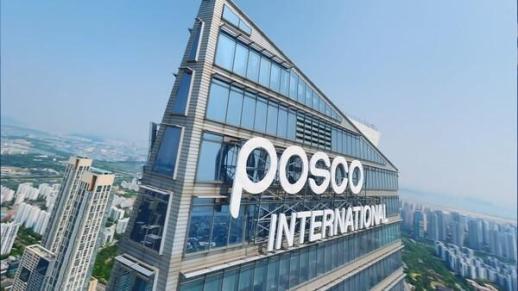 POSCO International posts record operating profit in 2025 SEOUL, January 29 (AJP) - POSCO International said on Thursday that its consolidated operating profit rose 4.3 percent in 2025 from a year earlier to a record 1.17 trillion won, supported by stronger results from its energy and food businesses. Revenue edged up to 32.37 trillion won, while net profit climbed 26.5 percent to 636.8 billion won, the company said in a regulatory filing. The company has reported operating profit of more than 1 trillion won for three consecutive years since its 2023 merger with POSCO Energy. Operating profit from the energy segment totaled 623 billion won, accounting for about 54 percent of the group’s total. The increase reflected higher sales from the Myanmar gas field and expanded production at Australia’s Senex gas field, the company said. In the food segment, revenue surged 58 percent to 357 billion won, driven by the acquisition of a palm oil company and firm palm oil prices. Operating profit in the segment rose 23 percent to 101 billion won. In the materials business, the drive motor core unit returned to profit, posting operating profit of 19.0 billion won after improving its product mix and cutting costs. Operating profit from power generation, however, fell 33 percent to 114 billion won, weighed down by lower wholesale electricity prices and reduced utilization rates. POSCO International said its net debt ratio stood at 62.8 percent at the end of 2025, down 3 percentage points from a year earlier. Total assets rose by about 1.4 trillion won to 18.75 trillion won. * This article, published by Aju Business Daily, was translated by AI and edited by AJP. 2026-01-29 09:57:36
 -
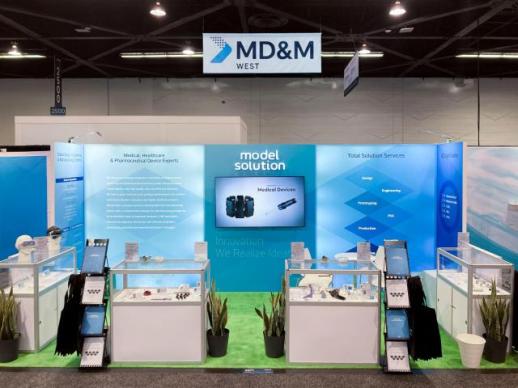 Model Solution to Exhibit at MD&M West 2026 in Anaheim Model Solution said Wednesday it will take part in Medical Design & Manufacturing West 2026 (MD&M West), a medical-device trade show running Feb. 3-5 in Anaheim, California. MD&M West is North America’s largest specialized exhibition covering medical-device design, manufacturing and engineering. Medtech companies and medical-device manufacturers and supply-chain officials from around the world attend to share technology trends and industry developments. Model Solution is an affiliate tasked with advancing “Rising Tech” under the mid- to long-term portfolio plan “STREAM (S.T.R.E.A.M),” which the chairman of Korea & Co. Group, Cho Hyun-bum, planned and designed. The company has participated in MD&M West every year since 2017 to find global medical-device clients, with a focus on the U.S., and to deepen its market understanding. At this year’s show, it plans to highlight its “total hardware solution” capabilities for medical devices, spanning product planning, development, production and mass manufacturing, built on a combination of design and precision manufacturing. It also plans to display medical devices for diagnostics and analysis, gene-therapy-related devices and diabetes management devices, for which it has participated in development and currently supplies key components. “Demand is rising for manufacturing partners that can deliver design and engineering capabilities while also ensuring stable mass production and quality response,” CEO Yoo Hyung-min said. “Model Solution will strengthen its role as a partner that supports global medical-device customers in both development and production, based on an integrated manufacturing solution spanning design, prototypes and mass production.”* This article has been translated by AI. 2026-01-29 09:06:13
 -
 KOSPI Tops 5,200 for First Time South Korea’s benchmark KOSPI index topped 5,200 points for the first time, extending a rally into a third straight session after closing above 5,000 on Jan. 27. According to the Korea Exchange, the index rose 2.61 points, or 1.40%, from the previous session to trade at 5,243.42 shortly after the open, pushing past the 5,200 mark.* This article has been translated by AI. 2026-01-29 09:06:00
 -
 South Korea’s Kospi Opens Up 1.40% to 5,243.42; Kosdaq Rises 1.76% South Korea’s Kospi opened up 72.61 points, or 1.40%, at 5,243.42. The Kosdaq opened up 19.91 points, or 1.76%, at 1,153.43.* This article has been translated by AI. 2026-01-29 09:03:00
 -
 SK Securities Raises Samsung C&T Target Price on Earnings, Shareholder Returns Outlook SK Securities said Wednesday it raised its target price for Samsung C&T to 370,000 won from 350,000 won, citing improving results and the likelihood of stronger shareholder returns. It maintained its “buy” rating. Choi Kwan Soon, an analyst at SK Securities, said Samsung C&T’s revenue fell 3.2% last year, but the firm forecasts revenue of 44.5 trillion won this year, up 9.3%. He said the goal is achievable given rising orders in the construction unit’s high-tech segment and higher utilization in the biotech business. Choi said improved internal cash flow is likely to support expanded shareholder returns. He added that with the company set to cancel all treasury shares it holds, additional buybacks this year are possible, and expectations remain for a new dividend policy scheduled to be announced next month. Choi said Samsung C&T trades at a 54.6% discount to its net asset value, meaning gains in subsidiary share prices have not been fully reflected. He said the new shareholder-return policy expected next month could be a trigger to narrow that discount. Samsung C&T’s fourth-quarter revenue and operating profit rose 8.4% and 29.6% from a year earlier to 10.8 trillion won and 822.3 billion won, respectively. The company confirmed a dividend of 2,800 won per share, up 200 won from the previous year, and decided to cancel 4.6% of its treasury shares.* This article has been translated by AI. 2026-01-29 09:00:17
 -
 Gwangju Police Book 50-Something Woman for Drunk Driving After Red-Light Violation Gwangju Bukbu Police Station said Thursday it booked a woman in her 50s, identified only as A, on suspicion of driving under the influence in violation of the Road Traffic Act. Police said she is accused of driving about 2 kilometers while intoxicated, leaving a restaurant in Yongbong-dong, Buk-gu, at about 4 p.m. Wednesday and heading to an area near the Unam 2-dong Administrative Welfare Center. Officers said she ran a red light while driving through an intersection and was caught by nearby patrol police who witnessed the violation. Her blood alcohol concentration measured between 0.03% and 0.08%, a level that triggers license suspension, police said. Police said they are investigating the circumstances of her drinking.* This article has been translated by AI. 2026-01-29 09:00:00
 -
 Auction to Shut Down Secondhand Marketplace Service After 25 Years Auction’s secondhand marketplace, a service credited with helping shape South Korea’s online used-goods trade, will shut down after 25 years as mobile-first rivals dominate the market. According to the industry on Wednesday, Auction will end both the used-goods section on its website and its used-goods marketplace app starting March 31. New item listings in the app will stop first, on Feb. 26. An Auction official said the company decided to close the service to reassign staff and resources to “more efficient services.” The used-goods marketplace was closely tied to Auction’s origins. The company launched in 1998 as South Korea’s first auction-focused site, introducing a model in which individuals sold used items through open bidding. Auction opened the used-goods marketplace section in 2001. The service was also seen as helping standardize escrow-style payments — releasing funds only after a buyer confirms a purchase — as a way to reduce fraud that was common in community-based trading forums such as Joonggonara. Listings ranged from rare collectibles to home appliances and clothing, drawing sellers and buyers nationwide. Auction introduced an app in 2013. Auction’s position weakened in the late 2010s as mobile-optimized platforms such as Karrot, which is built around local neighborhoods, and Bunjang, which targets interest-based trading, gained ground. Users moved to specialized apps offering simple chat functions and GPS-based in-person transactions. Data from app and retail analytics service Wiseapp Retail showed that last month the number of unique users on major secondhand platforms was 23.4 million for Karrot, 4.73 million for Bunjang and 1.95 million for Joonggonara. Over the same period, app usage rates — the share of installers who actually used the app — were 69% for Karrot, 39% for Bunjang and 27% for Joonggonara. Wiseapp Retail said Auction’s used-goods marketplace was not included because its user base was not large. Industry observers said the shutdown reflects a push by Shinsegae Group’s e-commerce unit, which operates Gmarket and Auction, to improve efficiency. One industry official said a general e-commerce platform’s secondhand section can be less efficient in a market dominated by specialized apps, calling the move a strategic choice to drop inefficient services and focus on core open-market competitiveness.* This article has been translated by AI. 2026-01-29 08:58:05
 -
 U.S. Treasury chief: No trade deal with South Korea until National Assembly approves U.S. Treasury Secretary Scott Bessent said there will be no trade agreement with South Korea until its National Assembly approves it. Bessent made the remarks in a CNBC interview on Tuesday local time when asked whether President Donald Trump was raising tariffs on South Korea because it had not approved a trade deal. His comments came as Trump has warned he could restore higher tariffs, citing delays in the National Assembly’s passage of a “special law on investment in the United States.” Bessent was seen as again urging lawmakers to act. “The signal from the Trump administration is: sign the trade agreement,” Bessent said. Asked whether South Korea would face a 25% tariff until parliamentary approval, he did not give a direct answer, saying, “I think this will help move things forward.” Earlier, Trump wrote on Truth Social on Sunday that because South Korea’s legislature had not enacted “our historic trade agreement,” he was raising reciprocal tariffs on autos, lumber, pharmaceuticals and “all other” items to 25% from 15%. But the next day, Trump said the two countries would “work out a solution,” suggesting the tariff increase could be put on hold through talks. * This article has been translated by AI. 2026-01-29 08:57:56
 -
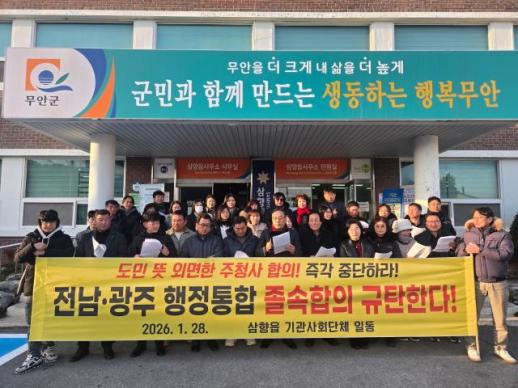 Dispute Grows Over Proposed South Jeolla-Gwangju Administrative Merger Controversy over a proposed administrative merger between South Jeolla Province and the city of Gwangju is spreading across the region. The Samhyang-eup Council of Local Institutions and Social Groups in Muan County said the recent merger agreement between the provincial government and Gwangju was “a rushed deal” that “gave up South Jeolla’s interests.” In a statement released Jan. 28, the council criticized an announcement that South Jeolla Gov. Kim Young Rok and Gwangju Mayor Kang Ki Jung agreed to name the merged local government “Jeonnam-Gwangju Special City,” with the abbreviated name “Gwangju Special City,” and to operate offices across the eastern region, Muan and Gwangju without designating a main headquarters. The council said the decision “betrays residents’ common sense and expectations.” The council said the move reversed a tentative agreement reached just a day earlier, on Jan. 25, at a “Gwangju-South Jeolla administrative merger meeting” to place the main headquarters at the South Jeolla Provincial Government building in Muan. It called the reversal an act that undermined the merger’s stated principles of coexistence and balanced development. It also argued that deciding such a major issue through a meeting among a few local leaders, without sufficient discussion with residents, city and provincial councils, amounted to an abuse of authority that ignored democratic process. It said opinions from South Jeolla’s 22 cities and counties and their residents were excluded. The council said Muan is already the administrative center of South Jeolla because the provincial government is located there, and that it can best ensure continuity and efficiency in regional administration. It added that the Namak and Oryong new towns have grown into a major living area where housing, commerce and education functions are concentrated. If the merger proceeds without a confirmed main headquarters, the council warned, it could lead to the collapse of existing commercial districts, threaten small businesses, deepen economic stagnation and accelerate population decline. It said the issue is directly tied to the future of Samhyang-eup and the wider Muan area. Saying it cannot accept a merger without a main headquarters, the council urged officials to immediately confirm the South Jeolla Provincial Government building as the main headquarters of the proposed “Jeonnam-Gwangju Special City.” It also called for disclosure of a clear administrative center and division of authority, rather than vague language about “balanced operation,” and urged the government and National Assembly to specify in merger legislation that the provincial government building will serve as the core of the integrated regional administration. The council said it will continue to take action to protect South Jeolla’s interests and residents’ pride. * This article has been translated by AI. 2026-01-29 08:57:23
 -
 South Korean Investor Deposits Top 100 Trillion Won for First Time as Stocks Rally South Korea’s stock market surge has pushed investor deposits above 100 trillion won for the first time. The Korea Financial Investment Association said investor deposits totaled 100.2826 trillion won as of Jan. 27. That is up 12.4535 trillion won from 87.8291 trillion won at the end of last year. Investor deposits are funds clients keep at brokerage firms to trade stocks, funds and other investment products. Because the money can move into the market at any time, it is treated as standby cash and is widely used as a gauge of investor sentiment. Historically, rising deposits have been read as a sign that expectations for stronger indexes are growing and that more money could still flow into the market. The latest increase comes as the rally continues, with money appearing to shift from other assets such as savings products and real estate. As the Kospi and Kosdaq have repeatedly hit record highs this year, profits taken by investors are also seen accumulating as deposits. As sentiment has strengthened, margin investing has also increased. As of Jan. 27, outstanding margin loans stood at 29.2450 trillion won, including 18.7847 trillion won in the Kospi market and 10.4603 trillion won in the Kosdaq market. The Kospi is up 22.7% this year, breaking above 5,000 for the first time and reaching as high as 5,130. Its market capitalization totals 4,276 trillion won. The Kosdaq has gained 22.48% since the start of the year, topping 1,000 points for the first time since the 2000 “IT bubble” and settling around 1,130.* This article has been translated by AI. 2026-01-29 08:54:00