
Journalist

AJP
-
 OPINION: Massive data breach at Coupang exposes lax security and lack of accountability SEOUL, January 6 (AJP) - Coupang, South Korea's leading e-commerce giant, has offered just 50,000 Korean won (about US$35) in compensation to customers affected by its massive data breach detected in late last year. It is a meager amount, considering that sensitive personal information including home addresses and phone numbers, was exposed. As the breach occurred on a platform widely used to purchase daily necessities such as bottled water, following data leaks at telecom companies, many consumers now fear that their information could be stolen again. Similar incidents in the financial and banking sectors have further eroded public trust. Following a large-scale hacking incident at Lotte Card last summer, Shinhan Card also belatedly detected a massive data breach affecting 190,000 users. Making matters worse, Shinhan Card failed for more than three years to detect that its employee was involved in the breach, and then waited nearly 20 days to inform affected customers after becoming aware of the leak. This has raised questions about whether companies have strengthened their internal security by learning from previous data breaches at other firms. Upbit, South Korea's largest cryptocurrency exchange, also suffered a hacking incident involving hundreds of billions of won but faced no penalties, since virtual assets are not subject to regulation due to a lack of relevant laws. The industry says hacking methods have become more sophisticated, and it can take up to five years to identify hackers. Experts say these incidents reflect both failed internal security and lax supervision by financial authorities, arguing that government watchdogs such as the Financial Services Commission and the Financial Supervisory Service should also bear responsibility. Authorities say individual misconduct is difficult to detect in advance, making thorough preparation of preventive measures the only viable way to prevent any future breaches. As financial services become more complex, protecting consumer data matters more than ever. Financial firms, as private companies driven by short-term profits, often treat security as an afterthought. For this reason, experts argue that regulators should hold them accountable with significant financial penalties. * This article, published by Aju Business Daily, was translated by AI and edited by AJP. 2026-01-06 10:07:11
 -
 South Korea to strengthen protection of K-brands in China SEOUL, January 06 (AJP) - South Korea’s intellectual property office said on Tuesday it signed a memorandum of understanding with its Chinese counterpart to deepen cooperation on intellectual property, on the sidelines of a South Korea–China summit held at the Great Hall of the People in Beijing. The agreement, signed between the Korean Intellectual Property Office (KIPO) and China’s National Intellectual Property Administration (CNIPA), updates and expands a similar pact reached in 2021. Under the revised agreement, the two sides will broaden cooperation in areas including the protection of intellectual property rights, the prevention of counterfeit goods, the use of new technologies such as artificial intelligence and big data in patent examinations and analysis, and the promotion of intellectual property transactions, commercialization and finance. Ahead of the signing, KIPO Commissioner Kim Yong-seon met with CNIPA head Shen Changyu for talks on IP policy trends, existing cooperation and priority areas for future collaboration, the KIPO said. The two offices also agreed to jointly respond to bad-faith trademark applications, including cases in which applicants seek to preemptively register trademarks already in use in order to extract economic gains. “This MOU and stronger cooperation to prevent malicious trademark preemption will help protect K-brands more effectively in China,” Kim said. 2026-01-06 10:04:45
 -
![[CES 2026] LG Innotek showcases autonomous driving, EV solutions](https://image.ajunews.com//content/image/2026/01/06/20260106083216631868_518_323.jpg) [[CES 2026]] LG Innotek showcases autonomous driving, EV solutions LAS VEGAS, January 06 (AJP) - South Korea's LG Innotek unveiled future mobility solutions combining autonomous-driving and electric-vehicle technologies at CES 2026, the world’s largest technology trade show, on Tuesday. Exhibiting at CES 2026 in Las Vegas, the components maker gave a preview to South Korean reporters one day before the show opened. The company set up a roughly 330 square-meter booth near the entrance of the West Hall at the Las Vegas Convention Center. LG Innotek centered its exhibition on mobility, highlighting next-generation convergence solutions for the “AI-defined vehicle” era. The company displayed a concept mock-up for autonomous driving, moving beyond a parts-only showcase to present integrated solutions combining hardware and software. The mock-up features 16 advanced driver-assistance system components, including cameras, LiDAR and radar. A key highlight was a fusion sensing solution that integrates multiple sensing functions into a single camera module. LG Innotek demonstrated a camera combining heating and active-cleaning functions, with a cleaning module capable of removing moisture or dust from the lens in about one second. The company said the system, combined with its in-house software, improves sensing performance for autonomous driving. The company also showcased an ultra-compact LiDAR developed in collaboration with U.S. sensor firm Aeva. The LiDAR can detect objects at distances of up to 200 meters, addressing limitations of camera-based sensing. Visitors were able to experience the sensing performance from a test seat designed to simulate a vehicle ride. In-cabin technologies were also on display, including a next-generation under-display camera module, which LG Innotek said was shown for the first time at CES. Installed behind an instrument panel, the module uses AI-based image restoration to enable facial recognition without obstructing the display, while also supporting dual cabin recording during driving. The company also presented a separate electric-vehicle-focused mock-up, displaying 15 electronic components including an 800-volt wireless battery management system and its “B-Link” solution, which integrates a battery and junction box to improve weight reduction and system integration. “This CES is a place to seek new business opportunities in autonomous driving and EVs,” Chief Executive Officer Moon Hyuk-soo said. 2026-01-06 08:55:55
[[CES 2026]] LG Innotek showcases autonomous driving, EV solutions LAS VEGAS, January 06 (AJP) - South Korea's LG Innotek unveiled future mobility solutions combining autonomous-driving and electric-vehicle technologies at CES 2026, the world’s largest technology trade show, on Tuesday. Exhibiting at CES 2026 in Las Vegas, the components maker gave a preview to South Korean reporters one day before the show opened. The company set up a roughly 330 square-meter booth near the entrance of the West Hall at the Las Vegas Convention Center. LG Innotek centered its exhibition on mobility, highlighting next-generation convergence solutions for the “AI-defined vehicle” era. The company displayed a concept mock-up for autonomous driving, moving beyond a parts-only showcase to present integrated solutions combining hardware and software. The mock-up features 16 advanced driver-assistance system components, including cameras, LiDAR and radar. A key highlight was a fusion sensing solution that integrates multiple sensing functions into a single camera module. LG Innotek demonstrated a camera combining heating and active-cleaning functions, with a cleaning module capable of removing moisture or dust from the lens in about one second. The company said the system, combined with its in-house software, improves sensing performance for autonomous driving. The company also showcased an ultra-compact LiDAR developed in collaboration with U.S. sensor firm Aeva. The LiDAR can detect objects at distances of up to 200 meters, addressing limitations of camera-based sensing. Visitors were able to experience the sensing performance from a test seat designed to simulate a vehicle ride. In-cabin technologies were also on display, including a next-generation under-display camera module, which LG Innotek said was shown for the first time at CES. Installed behind an instrument panel, the module uses AI-based image restoration to enable facial recognition without obstructing the display, while also supporting dual cabin recording during driving. The company also presented a separate electric-vehicle-focused mock-up, displaying 15 electronic components including an 800-volt wireless battery management system and its “B-Link” solution, which integrates a battery and junction box to improve weight reduction and system integration. “This CES is a place to seek new business opportunities in autonomous driving and EVs,” Chief Executive Officer Moon Hyuk-soo said. 2026-01-06 08:55:55 -
 Korean AI firm Upstage releases AI model as open source SEOUL, January 06 (AJP) - South Korean artificial intelligence company Upstage said on Tuesday it has released its in-house large language model, Solar Open 100B, as open-source software. Solar Open is the first output of the Ministry of Science and ICT’s “Independent AI Foundation Model” project, in which Upstage is participating as the lead company. Upstage said it developed the model entirely in-house, overseeing the full process from data construction to training. The company released the model on the global open-source platform Hugging Face and published a technical report detailing its development. Upstage said the 102-billion-parameter model delivers performance comparable to global frontier models. It said Solar Open is about 15 percent the size of China’s DeepSeek R1 but outperformed it in key benchmark evaluations across three languages: Korean, English and Japanese. According to the company, Solar Open recorded performance gains of 110 percent in Korean, 103 percent in English and 106 percent in Japanese compared with DeepSeek R1. The company said it plans to open part of the dataset through the National Information Society Agency’s AI Hub, describing it as a public resource aimed at strengthening South Korea’s artificial intelligence research ecosystem. “Solar Open is a model Upstage trained independently from the beginning, and it is the most Korean yet also global AI, with a deep understanding of Korea’s emotions and linguistic context,” Chief Executive Kim Sung-hoon said. 2026-01-06 08:44:14
 -
 CES 2026: Hyundai Motor to start deploying self-developed robots in US plants in 2028 LAS VEGAS, January 06 (AJP) -South Korea's auto conglomerate Hyundai Motor Group will start training its self-developed fleet of robots for full deployment in U.S. assembly lines from 2030, according to its vision on “AI robotics” unveiled at the CES. At a CES 2026 media day held at the Mandalay Bay Convention Center in Las Vegas, the group presented its overarching theme, “AI Robotics, From the Lab to Life,” signaling a shift beyond hardware- and mobility-focused robotics toward what it calls human-centered AI robotics. Hyundai outlined three strategic priorities: expanding human–robot collaboration beginning on factory floors; building an AI robotics ecosystem by integrating the technological capabilities of its group affiliates; and strengthening partnerships with leading global AI companies. The group said it aims to become a leader in “physical AI” by leveraging its broad value chain and product portfolio. To support that push, Hyundai said it plans to establish a Hyundai Motor Group Physical AI Application Center in South Korea, along with a robot finished-product manufacturing and foundry plant based on customized robot technologies developed through physical AI. A Hyundai Motor Group official said the company’s focus is “not what technology can do, but what humanity can achieve through technology,” adding that Hyundai will demonstrate “true cooperation” between humans and robots in line with its corporate philosophy of “progress for humanity.” Hyundai said Atlas, showcased at CES, is expected to play a pivotal role in turning human–robot collaboration into reality across manufacturing and industrial sites. The humanoid robot combines Hyundai’s manufacturing data and production expertise with research and development from Boston Dynamics. The group also introduced a next-generation electric Atlas development model, which adds autonomous learning capabilities and enhanced flexibility. Hyundai said the upgraded model can be applied across diverse work environments, improving efficiency in real-world manufacturing settings. Hyundai identified humanoid robots as the largest future market within physical AI and set a goal of mass-producing the next-generation electric Atlas model to enable large-scale deployment at industrial sites. Hyundai plans to deploy Atlas at production bases, including Hyundai Motor Group Metaplant America (HMGMA), with a phased rollout following process-by-process verification. From 2028, the robot will first be applied to tasks with clearly verified safety and quality benefits, such as sequencing work for parts classification. From 2030, Hyundai plans to expand Atlas’s role to parts assembly. Hyundai also said it will open a Robot Metaplant Application Center (RMAC) in the United States this year. Atlas models trained at RMAC are expected to contribute to worker safety and product quality improvements at HMGMA. Hyundai said it has maintained a strategic partnership with Nvidia since January last year and plans to use advanced AI infrastructure and platforms to accelerate innovation and improve development efficiency. Within the group, Hyundai Motor and Kia will provide manufacturing infrastructure, process control systems and production data. Hyundai Mobis will develop precision actuators, while Hyundai Glovis will optimize logistics and supply-chain flows. Hyundai Mobis also plans to supply actuators for Atlas in partnership with Boston Dynamics, marking what the group described as a full-scale entry into the global robot components market. Hyundai said it aims to build a system capable of producing 30,000 robots annually by 2028, accelerating mass production and positioning Atlas as an industrial humanoid robot for large-scale deployment across industrial and commercial markets. Over the longer term, the group plans to use data accumulated through Atlas to enhance learning and usability, expand beyond automotive manufacturing into other industrial fields, and eventually enter the B2C market by developing a general-purpose humanoid robot. Hyundai said its existing robots Spot and Stretch have already proven their usefulness at companies including Intel, Michelin and DHL, and are expected to expand into sectors such as construction, logistics, facility management and energy. Separately, the group announced plans to invest $26 billion in the United States over four years starting in 2025, expanding cooperation with leading U.S. companies in future technologies including robotics, AI and autonomous driving. Hyundai said it expects broader economic cooperation between South Korea and the United States and plans to widen business opportunities to strengthen competitiveness across mobility and future industries. * This article, published by Aju Business Daily, was translated by AI and edited by AJP. 2026-01-06 08:00:57
 -
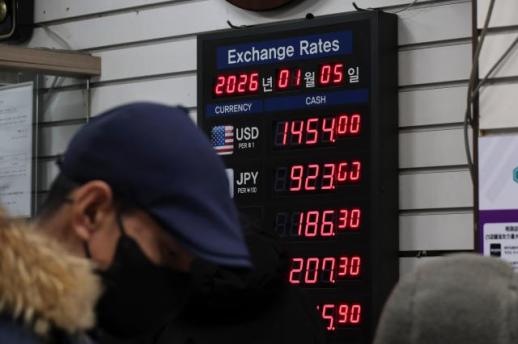 Korea's FX reserves recede by near $3 billion Dec amid won defense efforts FX rates displayed at a currency exchange shop in Seoul’s Myeong-dong on Jan. 5, 2026. AJP You Na-hyun SEOUL, January 06 (AJP) -South Korea’s foreign exchange reserves fell by $2.6 billion in December from the previous month — the first decline in seven months — signaling stepped-up dollar-selling intervention to shore up the won, which had hovered near crisis-era lows. According to a report released Tuesday by the Bank of Korea, the country’s foreign exchange reserves stood at $428.05 billion at the end of December, down from $430.66 billion a month earlier. The reserves had dropped to $404.6 billion at the end of May, the lowest level in nearly five years, after the dollar surged to the 1,480-won range in April amid a tariff barrage from the new Trump administration. They then recovered steadily, topping $430 billion for the first time in three years and three months in November. That milestone proved short-lived, however, as the dollar revisited the 1,480-won range late in the year. Authorities encouraged the National Pension Service and other institutional investors to hedge their dollar exposure to stabilize the won as it edged closer to the psychologically sensitive 1,490-per-dollar level, while mobilizing a range of incentives to prompt the sale of dollar assets. A Bank of Korea official attributed part of the earlier increase in reserves to quarter-end effects, including a rise in foreign-currency deposits at financial institutions and valuation gains from converting non-dollar assets into U.S. dollars. At the same time, measures aimed at curbing foreign-exchange market volatility weighed on the total. These included smoothing operations in both the spot and forward markets, as well as hedging activity by the pension fund, the official said. By asset class, securities — such as government and corporate bonds — fell by $8.22 billion to $371.12 billion, suggesting the divestment of foreign-currency-denominated papers to secure ammunition for won-stabilization efforts. Deposits, by contrast, increased by $5.44 billion to $31.87 billion. Holdings of the International Monetary Fund’s special drawing rights rose $150 million to $15.89 billion, while gold holdings were unchanged at $4.79 billion, as they are recorded at purchase price rather than market value. As of the end of November, South Korea’s foreign exchange reserves ranked ninth globally at $430.7 billion. China topped the list with $3.3464 trillion, followed by Japan ($1.3594 trillion), Switzerland ($1.0588 trillion), Russia ($734.6 billion), India ($687.9 billion), Taiwan ($599.8 billion), Germany ($552.3 billion) and Saudi Arabia ($463.7 billion). The dollar has returned toward the 1,450-won level after all-out year-end stabilization efforts from authorities upon a renewed flight to safe-haven assets following the Venezuela crisis. 2026-01-06 07:44:34
 -
 Lee, Xi push economic cooperation as summit sidesteps regional flashpoints SEOUL, January 05 (AJP) -South Korean President Lee Jae Myung and Chinese President Xi Jinping agreed Monday to deepen economic and technology cooperation and frame 2026 as a “year of full restoration” in bilateral ties, even as the summit conspicuously avoided addressing several sensitive security and geopolitical issues looming over the region. Meeting for about 90 minutes at the Great Hall of the People in Beijing, Lee called the talks the first state-level diplomatic engagement of 2026 for both leaders and pledged to make bilateral relations an “irreversible trend of the times.” He emphasized expanding cooperation in areas tied to people’s daily lives and jointly supporting peace on the Korean Peninsula. Xi welcomed Lee’s state visit - the first by a South Korean president in about nine years, stressing the importance of frequent high-level exchanges between the two neighbors amid a rapidly destabilizing global environment. “Friends grow closer the more they interact, and neighbors grow closer the more they visit,” Xi said in opening remarks, urging the two sides to meet more often and communicate regularly. “In just two months, we have met twice and made mutual visits,” Xi said, calling it a sign that both countries attach great importance to South Korea–China relations. Xi said the world is undergoing “changes unseen in a century,” with international affairs becoming increasingly complex. Against that backdrop, he said South Korea and China share “a major responsibility” to safeguard regional peace and promote global development, adding that the two countries have broad overlapping interests and should “stand firmly on the right side of history” by making the right strategic choices as great-power competition sharpens. The two governments signed 14 memorandums of understanding and one deed of donation, spanning science and technology, digital cooperation, startups and small businesses, climate and environment, transportation, food safety, intellectual property protection, and quarantine procedures for animal and plant trade. The agreements underscored a shared effort to anchor the relationship in practical, economy-focused cooperation after years of diplomatic strain. Yet the summit’s carefully calibrated agenda also revealed what was left unsaid. North Korea fired a ballistic missile on the day Lee traveled to Beijing — a development that underscored heightened security risks on the Korean Peninsula — but the provocation was not publicly addressed in joint remarks or official readouts. While Lee reiterated the need for peace and stability, there was no explicit reference to Pyongyang’s latest launch, nor to concrete coordination measures with Beijing. The leaders also avoided direct mention of the United States’ recent military intervention in Venezuela, an issue with far-reaching implications for global energy markets and geopolitical alignments. Xi referred only broadly to rising international instability, without naming specific conflicts or actors. The omissions appeared deliberate, reflecting a shared preference to keep the summit tightly focused on restoring bilateral ties and advancing economic cooperation, while steering clear of issues that could expose strategic differences or complicate relations with Washington. Lee reaffirmed South Korea’s respect for China’s “one-China” position, a long-standing stance that remains a sensitive diplomatic signal amid rising cross-strait tensions. Discussions on other contentious issues — including North Korea’s denuclearization, maritime concerns in the Yellow Sea, and the easing of China’s informal restrictions on Korean cultural content — were described as ongoing but incremental. The Beijing meeting followed the leaders’ first summit on the sidelines of the Asia-Pacific Economic Cooperation (APEC) meeting in Gyeongju in November, signaling a rapid resumption of high-level diplomacy after years of friction. Still, analysts say the summit highlighted the limits of rapprochement, with Seoul and Beijing opting for pragmatism and restraint over confronting the region’s most volatile fault lines head-on. * This article, published by Aju Business Daily, was translated by AI and edited by AJP. 2026-01-05 20:23:47
 -
 OPINION: Intervention in Venezuela may be unjust unjust but what about inaction? U.S. intervention in Venezuela has triggered swift criticism framed as a violation of international law. Civic groups, some governments and parts of the international community argue that forcibly removing a sitting president of a sovereign state sets a dangerous precedent that risks eroding the global order. These concerns deserve serious consideration, because legal norms exist precisely to restrain the use of force. But if the debate ends there, it avoids a more difficult question: What was the alternative? Venezuela is not a country condemned by geography or resources. It is among the world’s most resource-rich states. It holds one of the largest proven oil reserves globally and significant natural-gas reserves within South America. Add strategic minerals such as gold, iron ore, bauxite and coltan, along with vast hydropower and agricultural potential, and the foundations for a stable society were firmly in place — had institutions been allowed to function normally. Instead, Venezuela has descended into a prolonged economic, social and humanitarian collapse. International institutions have described the situation as a breakdown of state functions comparable to wartime conditions. Years of governance from Hugo Chávez to Nicolás Maduro hollowed out markets and institutions through populist policy choices and aggressive nationalization. Oil revenues were channeled into political survival and short-term loyalty, while investment and maintenance at the state oil company steadily eroded. The damage is visible in hard data. Oil production, once close to 3 million barrels a day, fell to a fraction of that level by the late 2010s. Aging refineries and pipelines suffered repeated failures and spills, compounding environmental harm. An industry meant to anchor the economy instead became a source of fragility. The human cost has been staggering. More than 7 million Venezuelans — roughly one-third of the population — have fled the country. Many describe Venezuela not in ideological terms but simply as “a country you can’t return to.” Doctors, teachers and technicians crossing borders only to survive on informal work illustrate how institutional collapse translates into personal loss. The crisis has not remained contained within national borders. As state authority weakened, Venezuela became a transit hub for drug trafficking and illicit economies, straining public safety across Latin America. Yet for years, the international response largely consisted of cautious language about sovereignty and calls for dialogue. It is difficult to argue that such restraint prevented hunger or slowed the exodus. Washington had signaled pressure and the possibility of action for months. During that period, the Maduro government deepened ties with China and Russia rather than pursuing structural reform or political compromise. Critics argue that the intervention also reflects geopolitical rivalry and energy interests. That argument carries weight, underscoring why this episode cannot be reduced to a simple morality play. The debate ultimately returns to practical questions: Who will revive Venezuela’s economy, under what conditions, and with what capital? With trust in law and institutions shattered, large-scale reconstruction is unlikely to emerge from humanitarian appeals alone. The focus now should move from judging the past to managing what comes next. Condemnation will not rebuild Venezuela. What is required is coordinated international judgment — restoring public security, restarting economic activity and repairing damaged rights in parallel. Support for free and fair elections must follow so that a government with democratic legitimacy can emerge. The transition will be fraught with risk. Societies shaped by prolonged authoritarian rule rarely move smoothly toward stability. Security vacuums, elite fragmentation and public disillusionment are real dangers. A poorly managed transition could deepen suffering rather than relieve it. The priority, therefore, is not speed but management — a phased, multilateral approach that links institutional recovery, social stability and economic reconstruction step by step. Ultimately, this crisis is not only about whether intervention was justified. It is also about the cost of prolonged inaction. Intervention is not always right. But in Venezuela’s case, inaction repeatedly failed — and its burden fell first and most heavily on the most vulnerable. About the author ▲Latin America specialist (former diplomat; honorary professor at Peru’s National University of Trujillo) ▲Global ambassador, Korea National Railway ▲Director, Latin America Railway Economy Research Institute * This article, published by Aju Business Daily, was translated by AI and edited by AJP. 2026-01-05 17:55:11
 -
 New S. Korean regional carrier SUM Air's first aircraft arrives at Gimpo SEOUL, January 05 (AJP) - SUM Air, a new South Korean regional carrier, said its first new-build aircraft has arrived at Gimpo International Airport after completing a multi-leg ferry flight from France. The inaugural aircraft of SUM Air, a Regional Air Mobility (RAM) operator, departed Toulouse on Jan. 1 and landed at Gimpo International Airport on Jan. 4, according to the company. The aircraft was formally handed over on Dec. 29 following the completion of leasing procedures with aircraft lessor Avation. It was registered in South Korea on Dec. 30 under the registration number HL5264 before departing France. The delivery flight was conducted as a ferry flight, operating without passengers or cargo, and passed through Cairo, Muscat, Nagpur and Da Nang en route to South Korea. SUM Air said the aircraft will undergo demonstration flights required for air operator certification. Following consultations with the Ministry of Land, Infrastructure and Transport, the airline plans to conduct trial takeoffs and landings in February at Goheung Airfield in South Jeolla Province, which has a 1,200-meter runway comparable in length to Ulleung Island's planned airport. SUM means "island" in Korean, and the carrier plans to connect cities and islands, including Ulleung, Heuksan and Baengnyeong, once their airports open. "SUM Air aims to address mobility challenges in regions with limited air connectivity and grow into a core regional carrier linking communities across Korea by revitalizing regional airports," said Choi Yong-duck, CEO of SUM Air. 2026-01-05 17:35:18
 -
 Seoul's National Folk Museum draws record number of foreign visitors SEOUL, January 5 (AJP) - Over a million foreign tourists visited the National Folk Museum in central Seoul last year. According to tallies compiled by the museum and released on Monday, out of 2.28 million total visitors, about 1.35 million were foreigners, the highest among museums in South Korea. Overall admissions rose about 58.3 percent from 1.44 million in 2024, while foreign visitors increased by 103 percent. The country's largest museum showcases everyday life and culture including historical and traditional rituals, seasonal customs, and folklore, attracting many foreign visitors as it sits at the heart of Seoul near Gwanghwamun and Gyeongbokgung Palace, one of the top attractions for international travelers. Based on its survey conducted last year, the museum said foreign respondents cited informative displays and exhibitions as the top reason for their visit, followed by various hands-on programs and a tour package with Gyeongbokgung Palace. "As the museum marks its 80th anniversary this year, we will make efforts to enhance visitors' experiences by offering more programs and revamping shops and other facilities,” said the museum's director Jang Sang-hun. Meanwhile, the museum held a New Year's Day event, giving a welcome gift to its first visitor, who came from Ho Chi Minh City, visiting with her family. 2026-01-05 17:30:20