
Journalist

AJP Special News Team
-
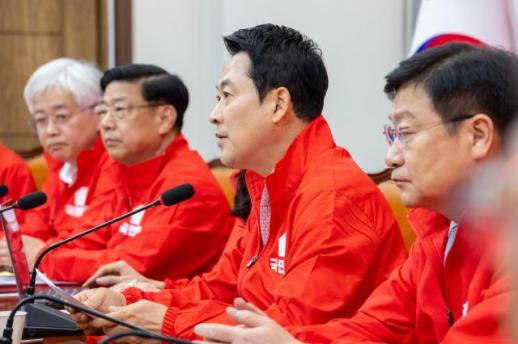 Jang Dong-hyuk Criticizes Jung Won-o's Housing Policy and Past Assault Case Jang Dong-hyuk, leader of the People Power Party, launched an attack on Jung Won-o, the Democratic Party's candidate for Seoul mayor, on May 15, addressing his housing policies and a past assault incident. Jang criticized Jung, stating, "Following Lee Jae-myung's intentions is the priority, while Seoul citizens are left behind." During a meeting of the Central Election Countermeasure Committee at the National Assembly, Jang warned, "If Jung Won-o becomes mayor, a tax bomb will drop, and 'Hell Seoul' will open up." He expressed concern that Lee Jae-myung's housing policies seem to be a continuation of the Moon Jae-in era, but added, "The new Lee Jae-myung is even worse." He noted that housing prices in Seoul, including Gangnam, have skyrocketed, and the abolition of the capital gains tax has drastically reduced available listings. Jang pointed out, "With rental properties so scarce, we are seeing 'no-look' contracts where payments are made without viewing the homes first," and mentioned that monthly rents have surged, with some reaching 3 million won even in northern Seoul. He remarked, "Ordinary citizens, whose loans have been cut off, are now spending their entire salaries on rent," and criticized Lee Jae-myung for shifting to silence after previously pressuring the real estate market, stating, "The government seems to have no further measures in sight." Jang also criticized Jung for proposing a property tax reduction for retirees with no substantial plans for housing policies to assist young people who are delaying marriage. He questioned whether the development approach is effective, saying, "Is it a steady development or a gradual one? The supply policy is inadequate." He added, "There has been no stance on increasing property taxes or abolishing long-term holding special deductions," emphasizing that the only mayor who protects homes and assets is Oh Se-hoon from the People Power Party. Regarding Jung's past assault controversy, Jang stated, "His explanations only seem to fuel public anger rather than clarify the situation," and pointed out that the minutes from council meetings show that the then-district mayor did not respond at all to inquiries. He questioned the validity of bringing in unusual individuals to stir public outrage, stating, "He cannot address his campaign promises or clarify allegations and keeps passing them off to substitutes." He concluded, "Broken things tend to leak everywhere," asserting that this local election is about ousting underqualified Democratic candidates.* This article has been translated by AI. 2026-05-15 10:34:25
 -
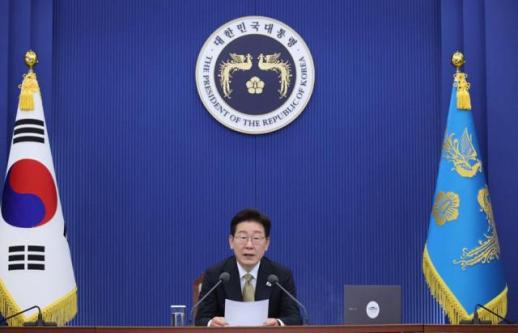 Lee expresses respect on Teachers' Day SEOUL, May 15 (AJP) - President Lee Jae Myung on Friday expressed "deep respect and gratitude" to teachers as the country marked Teachers' Day. In a Facebook post, he thanked teachers across the country "who are working tirelessly in schools and classrooms even at this moment." He added, "Because of their efforts and dedication, today's Korea exists." He also pledged to do his best to create better environments in which teachers can concentrate on teaching their students, with support to help them keep their passion and sense of calling from fading. His comments came amid growing calls for stronger protection for teachers amid recent incidents of abusive behavior toward teachers by parents and students. Quoting a saying, "We receive life from our parents, but learn from our teachers how to make life meaningful," he recalled that, as a child, he gained the courage to move forward thanks to a teacher's warm encouragement. He added that a single encouragement from that teacher has remained a "great source of strength" for him even after many years. 2026-05-15 10:29:32
 -
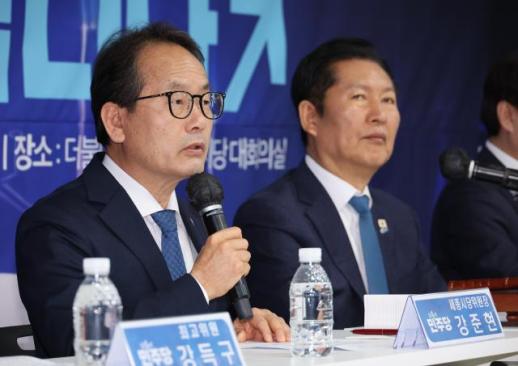 Kang Jun-hyun to Announce Candidate Unification with Progressive Party for Ulsan Mayor The Democratic Party is set to announce a candidate unification with the Progressive Party for the Ulsan mayoral race ahead of the June 3 local elections. Kang Jun-hyun, the party's spokesperson, held a press conference on the morning of May 15 in Yeouido, Seoul, addressing local election issues. He stated that the unification involves "the Ulsan mayor, local council heads, and provincial council members," adding that "the secretaries of both parties are scheduled to meet today for final adjustments." Regarding unification in other regions, he noted, "I understand that each candidate is handling the unification process on their own," and emphasized that to avoid confusion, it would be ideal to finalize unifications by today, before the ballots are printed. When asked if the unification discussions include the Pyeongtaek district, where Justice Party candidate Cho Kuk is running, Kang responded, "Does Representative Cho have the will for unification?" Additionally, Kang criticized the People Power Party's attacks on Democratic Party candidate Jeong Won-o for the Seoul mayoral race, calling them very malicious. He stated, "The People Power Party is leading with crude expressions and unreasonable incitement across various sectors," and pointed out their intention to exploit weak evidence to sensationalize discussions about the May 18 incident for electoral gain. He further questioned, "What kind of mayor was Oh Se-hoon? He spent 20.7 billion won of taxpayer money to create an awkward structure resembling a ceremonial sword in Gwanghwamun Square. Is this the normal image of a Seoul mayor? Who exactly is the People Power Party running this election for?" Regarding the Election Commission's referral of Democratic Party candidate Yoo Chan-jong for Jongno District to prosecutors, Kang stated, "The investigation is a separate issue," and clarified, "Based on the party's internal investigation, it seems there are no grounds for disqualifying the candidate. If the party does not reach a conclusion, the candidate's eligibility remains intact."* This article has been translated by AI. 2026-05-15 10:28:26
 -
 Government signals emergency powers as Samsung strike clock ticks SEOUL, May 15 (AJP) - Samsung Electronics and its overarching labor union are waging a war of nerves to settle their dispute on their own under competing deadlines, as the government signals it may invoke a rarely used emergency strike suspension authority. The National Samsung Electronics Union (NSEU), the company’s largest labor group, sent an official letter to Vice Chairman and Device Solutions chief Jun Young-hyun on Thursday, giving management until 10 a.m. Friday to present an acceptable proposal on the company’s reward system. The union demanded concrete measures to improve transparency in the Overall Performance Incentive (OPI) system, remove payout caps and institutionalize clearer compensation standards. It warned that failure to provide a specific response by the deadline would lead to a lawful general strike scheduled for May 21. Samsung management has maintained a relatively calm public posture while internally emphasizing operational discipline and production stability. According to industry sources, Jun recently warned executives against complacency, describing the current AI-driven semiconductor upcycle as the company’s “last golden time” to restore fundamental competitiveness. Rather than relying on strong first-quarter earnings, Jun reportedly urged executives to maintain a humble “super supplier” mindset to preserve long-term customer trust. He is also understood to have stressed the need for uninterrupted chip production and stable operations regardless of external uncertainties, including the looming strike threat. With the deadline quickly approaching, attention is focused on whether Samsung management will offer a last-minute compromise to prevent what could become the company’s most disruptive labor action in decades. The government has meanwhile escalated its rhetoric amid concerns over broader economic fallout. Trade, Industry and Energy Minister Kim Jung-kwan issued one of the strongest warnings yet late Thursday, saying emergency mediation could become unavoidable if the union proceeds with its planned strike. “Samsung Electronics’ importance to the Korean economy cannot be overstated,” Kim wrote on X, describing the company’s semiconductor business as a strategic national asset. He warned that disruptions to continuous wafer-processing lines could cause as much as 100 trillion won ($74 billion) in economic damage, affecting roughly 1,700 partner firms and inflicting potentially irreversible disruption on global supply chains. “As industry minister, I believe emergency adjustment measures would become inevitable if a strike occurs,” Kim said. Emergency mediation is a rarely used government intervention that can suspend strike action for up to 30 days if authorities determine a labor dispute poses a serious threat to the national economy or public welfare. Kim’s remarks drew particular attention because they were noticeably more forceful than those of Prime Minister Kim Min-seok and Deputy Prime Minister and Finance Minister Koo Yun-cheol, both of whom have stressed dialogue while warning that “a strike must never happen.” The dispute is increasingly being viewed as more than a conventional wage negotiation, emerging instead as a critical test of labor stability at South Korea’s largest company during a pivotal moment in the global AI semiconductor race. Share prices fell 1.6 percent to 291,250 won amid waning sign of breakthrough. 2026-05-15 10:28:25
 -
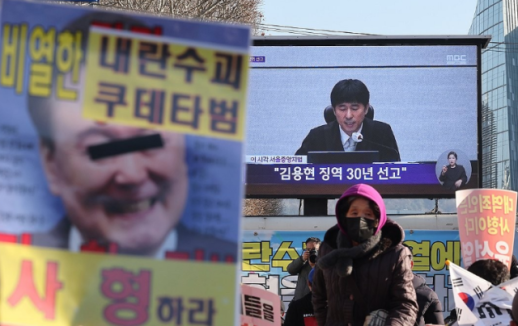 Kim Yong-hyun Summoned Again Amid Rebellion Charges; Special Prosecutor Pressures Yoon and Former Minister The second special prosecutor team, led by Kwon Chang-young, has notified Kim Yong-hyun, former Minister of National Defense, of a summons scheduled for May 21. According to legal sources, the special prosecutor's team informed Kim that he is to appear as a suspect in a rebellion case under military law. Kim is accused of conspiring with former President Yoon Suk Yeol and others to incite a riot by sending armed soldiers to the National Assembly and the National Election Commission during the declaration of martial law. Kim's team plans to decide whether he will attend the questioning after internal discussions. They argue that the special prosecutor's team is attempting to apply different charges to the same case for which Kim is already under indictment and undergoing trial, claiming this constitutes double investigation and prosecution. Former President Yoon is also asserting that this is a double investigation regarding the same charges. Previously, the special prosecutor's team had summoned Kim on April 29 for questioning related to the rebellion charges. The police special investigation unit had been questioning Kim regarding perjury related to Yoon's impeachment trial, which overlapped with the special prosecutor's investigation, causing it to be postponed. On May 6, the special prosecutor attempted to question Kim regarding charges of organizing a criminal group, but Kim's team submitted a notice of non-attendance. The special prosecutor's team has also notified former President Yoon to appear for questioning on May 23 regarding the rebellion charges, followed by another session on May 26 concerning allegations of abuse of power related to a "justification message for martial law." Kwak Jong-geun, former commander of the Army Special Warfare Command, was summoned for questioning as a suspect for the first time the previous day. The special prosecutor's team has charged Yoon, Kim, and former National Intelligence Service Director Noh Sang-won with rebellion. It remains uncertain whether they will be brought to trial on these charges.* This article has been translated by AI. 2026-05-15 10:26:21
 -
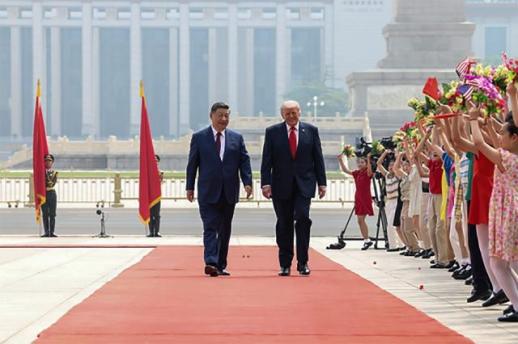 ASIA INSIGHT: AI and semiconductors become global power amid recession of tariff war As the Tariff War Recedes, Artificial Intelligence and Semiconductors Rise to the Center of Global Power Beijing in May 2026 was not a city of Cold War hostility. Yet neither was it a city of complete reconciliation. Beneath the red carpets of the Great Hall of the People and along the quiet stone paths of the Temple of Heaven, one could sense both tension and restraint — the unmistakable weight of two powers attempting to manage the future of the international order. The summit between President Donald Trump of the United States and President Xi Jinping of China outwardly projected stability and cooperation. But the true substance of the meeting was no longer tariffs. The real center of gravity had shifted decisively toward artificial intelligence and semiconductors. Global power is no longer defined primarily by oil, steel, automobiles, or low-cost manufacturing. It is increasingly determined by data, computational capacity, advanced semiconductor architecture, and the ability to dominate the infrastructure of artificial intelligence. One symbolic moment captured this transformation with unusual clarity: the presence of Nvidia chief executive Jensen Huang alongside President Trump during the Beijing visit. After concluding his Alaska schedule, Trump effectively brought Huang with him into the strategic theater of the summit. This was not merely the inclusion of a corporate executive. It was a declaration that advanced artificial-intelligence chips have now become instruments of national power. Only a few years ago, the center of U.S.-China confrontation was the tariff war. During Trump’s first presidency, sweeping tariffs on Chinese goods shook global supply chains and rattled both Chinese manufacturing and American consumers. Washington framed the measures as an attempt to reduce trade imbalances and challenge what it regarded as unfair Chinese trade practices. Beijing responded with retaliatory tariffs of its own. The phrase “tariff war” soon became a defining term of the era. But within a remarkably short period, the strategic landscape changed. The central question is no longer who can produce goods more cheaply. It is now who will shape the architecture of the future. And at the heart of that struggle stand artificial intelligence and semiconductors. Semiconductors are no longer simply industrial components. In the age of artificial intelligence, they have become a direct expression of national capability. Military systems, cloud computing, autonomous vehicles, robotics, aerospace, biotechnology, financial infrastructure, and advanced communications all depend upon high-performance chips. In particular, Nvidia’s graphics processing units — once associated primarily with gaming and visual computing — have evolved into what many now call the “oil of the artificial-intelligence era.” It is therefore no coincidence that Washington’s strongest pressure on China has focused precisely on advanced AI semiconductors. The United States has restricted exports of its most advanced AI chips, including the H100 and H200 series, while tightening controls on semiconductor equipment and software. American allies have increasingly aligned themselves with these measures. The Dutch lithography giant ASML and major Japanese semiconductor-equipment firms have, to varying degrees, joined the broader strategic effort, significantly limiting China’s access to cutting-edge manufacturing technology. Yet China has not retreated. On the contrary, Beijing has elevated semiconductor self-sufficiency to the level of a national survival strategy. Efforts are accelerating simultaneously across multiple fronts: artificial-intelligence chip development led by Huawei, domestic graphics-processing ecosystems, memory-chip independence, and the expansion of Chinese semiconductor-equipment manufacturing. The rise of the Chinese artificial-intelligence company DeepSeek has especially attracted global attention. Despite restrictions on access to America’s most advanced chips, DeepSeek has demonstrated that optimization techniques and highly efficient computational structures can still produce competitive AI performance. That development has challenged a widely held assumption in the West — namely, that Chinese artificial intelligence could not advance meaningfully without unrestricted access to American semiconductor technology. This reality has created growing strategic anxiety in Washington as well. Excessive pressure may produce short-term advantages for the United States, but over time, it could accelerate China’s technological independence. History repeatedly shows that technological containment often strengthens the very ecosystems it seeks to weaken. That is precisely why both sides handled the semiconductor issue with such caution during the Beijing summit. The United States remains wary of China’s ambitions in military artificial intelligence, yet it also understands that American corporations cannot easily abandon the Chinese market. Companies such as Nvidia, Apple, and Tesla still regard China as indispensable to their global strategies. China, meanwhile, fully recognizes that sustained economic growth remains difficult without access to advanced Western technology and the broader global financial system. As a result, the atmosphere surrounding this summit differed fundamentally from earlier tariff confrontations. The old dispute centered on trade balances and customs duties. The new rivalry concerns the command of future civilization itself. Behind the diplomatic smiles and carefully choreographed handshakes lies a deeper and quieter struggle: who will control the operating system of the artificial-intelligence age? Across the United States, competition for AI infrastructure and advanced graphics processors has already become intense. Microsoft, Google, Amazon, and Meta are investing enormous sums into artificial-intelligence data centers and computational networks. Wall Street financial institutions are also pouring unprecedented capital into AI systems. America still retains commanding advantages in chip design, software ecosystems, and advanced processing architecture. China, however, is leveraging a different strength: scale. Supported by vast domestic markets, state-directed investment, and one of the world’s deepest manufacturing bases, China is accelerating its pursuit of technological parity. Provincial governments are spending heavily on AI industrial zones, semiconductor talent recruitment, and domestic equipment development. Beijing, Shanghai, and Shenzhen are rapidly evolving into concentrated hubs of artificial-intelligence and semiconductor innovation. This is why the AI and semiconductor struggle cannot be understood merely as industrial competition. It is a contest over the future structure of state power and the shape of the international order itself. And within this transformation, the tariff war has gradually moved into the background. Tariffs still matter, certainly. But tariffs belong largely to the industrial logic of an earlier era. The decisive assets of the artificial-intelligence century are data, computational power, advanced chips, and supply-chain control. The world is moving from an age defined by manufacturing efficiency toward one defined by algorithmic dominance and computational supremacy. The implications for the global economy are profound. If Washington and Beijing maintain a workable level of cooperation and commercial exchange in artificial intelligence and semiconductors, the global chip market may regain a measure of stability. But if tensions intensify again, supply-chain fragmentation and technological bloc formation are likely to deepen further. The world could gradually divide into competing American-centered and China-centered technology spheres. For South Korea, the challenge is particularly delicate. South Korea remains one of the world’s leading semiconductor powers, especially in memory chips. Yet it also stands directly between America’s security alliance system and China’s economic gravity. Samsung Electronics and SK hynix must comply with U.S. semiconductor restrictions while simultaneously protecting their production bases and commercial interests in China. South Korea therefore, faces a historic strategic test. It can no longer remain merely a manufacturing power. It must evolve into a comprehensive technology state capable of leadership in AI semiconductor design, software ecosystems, power semiconductors, advanced packaging, and next-generation computing architecture. At the same time, Seoul must preserve the diplomatic sophistication necessary to avoid becoming trapped entirely within either side’s geopolitical orbit. The Beijing summit of 2026 revealed one reality with unmistakable clarity: The central axis of global power is no longer tariffs. It is now artificial intelligence and semiconductors. And that quiet war has already begun. 2026-05-15 10:24:12
 -
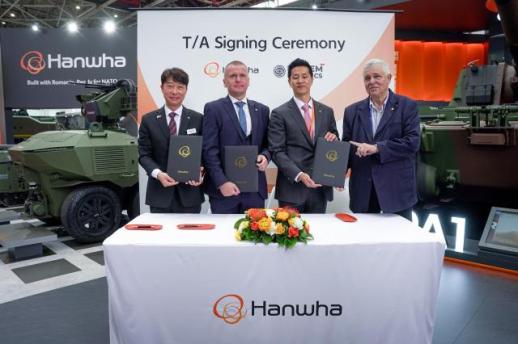 Hanwha Aerospace Partners with Milrem Robotics for Romanian UGV Project Hanwha Aerospace has announced a partnership with Milrem Robotics, a leading European unmanned systems company, to collaborate on unmanned ground vehicle (UGV) projects in Romania. This initiative aims to expand Hanwha's European portfolio, traditionally focused on firepower systems, into the unmanned systems sector, enhancing its competitive edge in future ground warfare markets. On May 14, during the BSDA 2026 international defense exhibition in Bucharest, Hanwha Aerospace signed a cooperation agreement with Milrem Robotics and Hanwha Aerospace Romania (HARO) to jointly participate in UGV projects. In response to evolving security dynamics in Europe, there is a growing demand among European and NATO member countries for versatile unmanned systems, with Romania also pursuing the introduction of next-generation UGVs. Hanwha Aerospace possesses independently developed wheeled UGV platforms, including the Arion-SMET and GRUNT. Milrem Robotics' tracked UGV platform, THeMIS, is recognized globally for its superior off-road mobility, hybrid propulsion system, and capability to integrate various mission equipment. The two companies are also developing a larger tracked UGV platform. Prior to this agreement, Hanwha Aerospace garnered significant interest from Romanian military officials by demonstrating the capabilities of the GRUNT and THeMIS in a manned-unmanned teaming (MUM-T) performance showcase in Romania. Kuldar Väärsi, CEO of Milrem Robotics, stated, "THeMIS is one of the first UGVs to enter mass production in Europe. We aim to contribute to expanding production capabilities in Romania and revitalizing the local defense ecosystem." Lim Kyung-wook, head of Hanwha Aerospace Romania, remarked, "Through this collaboration, we will provide solutions optimized for the Romanian operational environment while expanding our unmanned systems portfolio in the European and NATO markets." Hanwha Aerospace plans to establish local production and supply systems for next-generation unmanned solutions in Romania, thereby expanding its unmanned systems business in the European market. In February, the company broke ground on a local factory (H-ACE Europe) to produce K9 self-propelled howitzers and K10 ammunition supply vehicles, laying the foundation for local production in Europe. H-ACE Europe, located on a site of approximately 180,055 square meters (about 44.5 acres) in the Petresti area of Romania, features advanced assembly lines, performance and verification testing facilities, and a 1,751-meter-long driving test track. The factory is set to produce 54 K9 self-propelled howitzers and 36 K10 ammunition supply vehicles under a contract worth 1.38 trillion won, signed in July 2024. A Hanwha Aerospace official stated, "Through H-ACE Europe, we will establish a comprehensive life-cycle support system, including assembly, integration, testing, and maintenance, and aim to increase the localization rate in Europe to as high as 80% based on local industrial participation."* This article has been translated by AI. 2026-05-15 10:20:11
 -
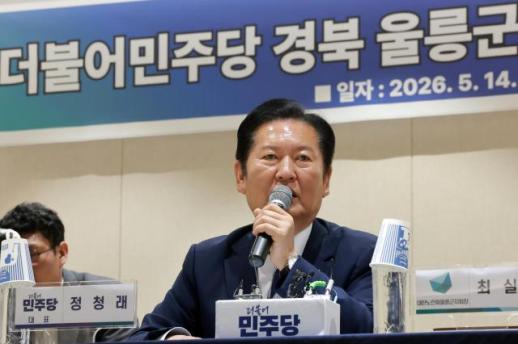 Jung Cheong-rae Criticizes People Power Party's Negative Campaigning Jung Cheong-rae, chairman of the Democratic Party's central election committee, criticized the People Power Party for its negative campaigning, stating, "They seem to be focused on negative tactics rather than offering a vision for the future." Speaking at a Central Election Countermeasure Committee meeting in Jeju on May 15, Jung expressed concern that the People Power Party does not understand the public's desire for constructive policies that improve their lives. "It is frustrating, but we have nothing to lose," he added. In response to perceptions that People Power Party leader Jang Dong-hyuk is seen as a strategic asset for the Democratic Party, Jung remarked, "We hope the People Power Party will normalize. If they become stronger, it will also make us stronger and more vigilant." Jung characterized the People Power Party's campaign as a "five-no" campaign, lacking in policy, vision, candidates, communication, and integrity. He suggested that even within the People Power Party, there are sentiments labeling it as a "burden to the people" and "the people's enemy." He asserted that the public perceives the party as engaged in negative tactics, including controversial nominations and undermining public welfare. He further criticized the party's attempts to distance itself from what he termed "insurrectionist forces," stating that the public likely views the recent cancellation of charges as an attempt to cover up numerous politically motivated prosecutions during the tenure of the Yoon Suk-yeol administration. "How many wrongful prosecutions must there have been for them to want to hide it?" he questioned. 2026-05-15 10:18:27
 -
 KakaoTalk Expands Message Reaction Feature, Supports 114 Types Kakao has significantly enhanced the message reaction feature and revamped user convenience functions through a regular update to KakaoTalk. On May 15, Kakao announced the expansion of its existing reaction feature and the introduction of new functionalities, including improvements to open chat and call features. The core of this update is the enhancement of the reaction feature. Users can now leave up to 30 different reactions on KakaoTalk message bubbles, with the total number of reaction types increasing to 114. Notably, the range of mini emoticons that users can utilize as reactions has been broadened. Users can now tap on reactions left by others, even if they do not own those mini emoticons, allowing for a more natural and diverse expression of emotions during conversations. The emoticon store has also been revamped. The 'Emoticons' menu under the More tab now includes new and popular sections, making it easier for users to explore a variety of emoticon products and the latest trends. Users can save their favorite items using the 'like' feature, and enhanced search functionality allows them to quickly view popular styles and emoticon rankings. Improvements have also been made to the open chat feature. Users can now reply to specific comments, facilitating a more natural flow of conversation. Additionally, a new 'Call' folder has been added at the top of the chat tab, where users can view recent call records for voice and video calls in one place. KakaoTalk's regular updates typically occur on a monthly basis. The new features are available in KakaoTalk version 26.4.0 and above.* This article has been translated by AI. 2026-05-15 10:15:41
 -
 Government Warns of Economic Downside Risks Amid Ongoing Middle East Conflict 정부는 최근 우리 경제가 중동전쟁 장기화에 따른 지정학적 리스크로 경기 하방 위험이 이어지고 있다고 진단했다. 국제유가와 원자재 가격 불안이 지속되면서 물가 상승과 민생 부담 확대 우려도 함께 커지고 있다는 판단이다. The government has assessed that the South Korean economy continues to face downside risks due to geopolitical uncertainties stemming from the prolonged Middle East conflict. Concerns over rising prices and increased burdens on households have also intensified amid ongoing volatility in international oil and commodity prices. In its May report on recent economic trends, the Ministry of Economy and Finance stated, "While domestic consumption and the service sector show signs of recovery, the geopolitical risks associated with the Middle East conflict persist, leading to continued downside risks for the economy." The government reiterated its concerns about external uncertainties, maintaining similar language from its April report, which noted that the escalation of geopolitical risks due to the Middle East conflict has heightened economic downside risks. Notably, this month, the government emphasized the impact of high oil prices on inflation and household burdens. Recent inflation trends have also shown signs of instability. In April, consumer prices rose 2.6% compared to the same month last year, an increase from the previous month's 2.2%. The inflation rate for industrial products climbed to 3.8%, while the cost of living increased by 2.9%. Fluctuations in international oil prices and exchange rates are additional burdens. At the end of April, the won-dollar exchange rate stood at 1,483.3 won, remaining at a high level, and government bond yields also rose due to the impact of the Middle East conflict. However, the government noted improvements in some indicators, such as production and exports. In March, total industrial production increased by 0.3% compared to the previous month, and service sector output rose by 1.4%. The coincident composite index and leading composite index also saw increases of 0.5 points and 0.7 points, respectively. Exports continue to show signs of recovery, particularly in the semiconductor sector. In the first quarter of this year, the current account recorded a surplus of $65.4 billion, and net financial assets also increased. Notably, strong exports in the information and communication technology sector, driven by semiconductors, have propelled overall export growth. In the financial markets, the stock market has shown significant strength. In April, the KOSPI surged 30.6% to reach 6,598.87, influenced by improved earnings from major companies. The proportion of foreign ownership in the market has also expanded. The government has stated that it will maintain an emergency economic response system to minimize the impact of the Middle East conflict, expedite the disbursement of support funds for high oil prices, manage the supply of key items, and ensure stability in prices and livelihoods.* This article has been translated by AI. 2026-05-15 10:13:20