
Journalist

AJU PRESS Business Team
-
 Starbucks Korea CEO Apologizes for Inappropriate Reference to May 18 Movement Starbucks Korea issued an additional apology after facing backlash for using language associated with the May 18 Democratic Movement in an online event. On May 18, CEO Son Jeong-hyeon released a statement saying, "We deeply apologize to the spirits of the May 18 Movement, the May organizations, the citizens of Gwangju, and the families of the late Park Jong-cheol, as well as all those who have contributed to Korea's democratization, for the inappropriate expression used in our marketing related to the May 18 Democratic Movement." Earlier that day, Starbucks faced criticism for using language that evoked the May 18 Movement during an online tumbler sales event. As the controversy grew, the company halted the event and issued an initial apology, followed by a second apology from the CEO. In his statement, Son acknowledged, "I recognized that content related to the May 18 Gwangju Democratic Movement was used inappropriately, and I immediately halted the event." He added, "I sincerely apologize again for causing this issue on a day that honors the noble spirit of the May 18 Movement and the sacrifices of those who lost their lives." Starbucks plans to investigate the circumstances surrounding the incident and identify accountability, while also improving internal processes to prevent a recurrence. Son expressed, "I feel a heavy sense of responsibility and the seriousness of this matter," and stated that the company will conduct education on historical awareness and ethical standards for all employees, as well as implement more thorough review procedures in all event preparations, including marketing.* This article has been translated by AI. 2026-05-18 23:08:08
 -
 Yang Hyang-ja Calls for Samsung Labor Agreement, Begins Indefinite Hunger Strike Yang Hyang-ja, the People Power Party's candidate for Gyeonggi Province governor, announced on May 18 that she would begin an indefinite hunger strike to urge a labor agreement at Samsung Electronics. She stated that her protest aims to prevent a crisis in the country's key semiconductor industry. According to Yang's campaign, she will start her hunger strike in front of Samsung's Pyeongtaek campus in Gyeonggi Province starting that evening. Her team expressed hope that "this small struggle will serve as a catalyst for dialogue and problem-solving between labor and management." As a result, Yang's campaign activities are expected to be temporarily halted, reflecting her urgent concern over semiconductor issues. Earlier that day, Yang met with former President Lee Myung-bak in Seoul. She urged him, saying, "Just as you navigated the global financial crisis with bold pragmatism centered on national interest, we must also confront the current technological hegemony war with a practical perspective. I ask for your advice on the pressing issues facing Gyeonggi Province, which supports South Korea's future economy." Yang, a former Samsung executive, has recently expressed concerns about the government's push for a semiconductor special law that excludes the metropolitan area and the prolonged labor dispute at Samsung Electronics.* This article has been translated by AI. 2026-05-18 23:05:19
 -
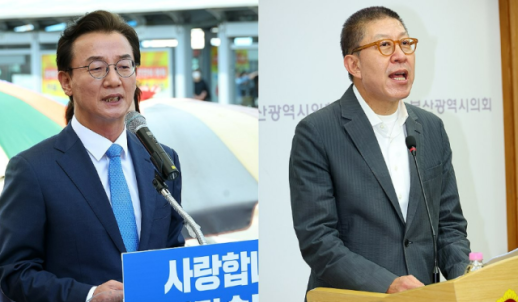 Candidates Clash Over Allegations in Busan Mayoral Debate In a heated debate on May 18, Busan mayoral candidates Jeon Jae-soo of the Democratic Party and Park Hyung-jun of the People Power Party exchanged accusations over various allegations, including the promotion of Busan as a maritime capital. The candidates participated in a debate hosted by the International Newspaper at Pukyong National University’s Daeyeon Campus, where they raised suspicions against each other. During his opening remarks, Park brought up allegations of Jeon receiving money from the Unification Church, stating, "He should answer honestly whether he received 'Cartier' or 'did not receive anything' instead of saying 'I did not receive anything.'" He also questioned, "Four of his aides were indicted for evidence destruction; does he claim he was completely unaware of this?" In response, Jeon countered, "The results came from a four-month intensive investigation. We must wait for the trial results regarding the aides' evidence destruction." He then pointed out, "Park promised to sell LCT but did not, and the capital gains from it, amounting to roughly 10 billion won, are under his wife and children's names. Many believe he could not keep his promise to sell LCT due to these capital gains." Park replied, "Are you combining separate items to claim a capital gain of 10 billion won? How can you know about capital gains when it hasn’t even been sold?" Regarding the increase in sales at the gallery operated by his wife during his tenure as mayor, which rose from 5 billion won to 20 billion won, Park stated, "Most of the sales from the gallery came from overseas, contributing to Busan's economy. If there is even a hint of corruption related to the gallery, I will not run for mayor of Busan again." The candidates also clashed over the agenda of elevating Busan to a maritime capital. Jeon emphasized, "As the first Minister of Oceans and Fisheries under the Lee Jae-myung government, I included the maritime capital of Busan in the national agenda. The labor-management agreement for HMM's relocation to Busan has also been finalized. The one who started this will finish it." Conversely, Park criticized Jeon regarding the Busan Global Hub Special Law, which is pending in the National Assembly, stating, "Jeon proposed this law and claimed it would pass this session, but after a comment from the president, the narrative changed as if there were issues with the law. To claim we can create a maritime capital without passing this law is contradictory."* This article has been translated by AI. 2026-05-18 23:04:07
 -
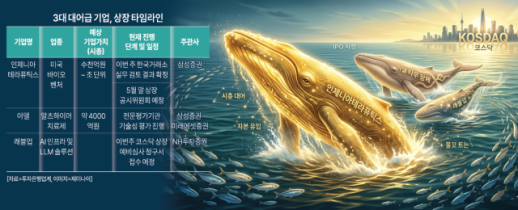 Ingenia Therapeutics Set to Reveal KOSDAQ Listing Review Results Amid IPO Market Revival The sluggish initial public offering (IPO) market is expected to see a resurgence with the entry of major companies. Ingenia Therapeutics, a U.S. biotech firm, is set to reveal the results of its KOSDAQ listing review as early as this week, paving the way for several companies with market capitalizations ranging from hundreds of billions to trillions of won to join the listing race. According to investment banking sources on May 18, the Korea Exchange is expected to finalize its review results for Ingenia's KOSDAQ listing this week and notify the lead underwriter. An IB industry insider noted, "If the practical review results from the exchange's examiners are finalized this week, a listing committee meeting will be held at the end of this month to determine final approval." Ingenia submitted its preliminary listing application on January 30, selecting Samsung Securities as its lead underwriter. Under exchange regulations, the review period for foreign companies is limited to 65 business days, longer than the 45 business days for domestic firms. If the review results are favorable, Ingenia is expected to be a key player in revitalizing the bio IPO market in the second half of the year. As Ingenia's review results approach, the timeline for other promising companies aiming to lead the IPO market in the second half is also becoming clearer. Notably, major firms in advanced technology sectors such as biotechnology and artificial intelligence (AI) are preparing for their listings. Adel, a company developing treatments for Alzheimer's disease, is also considered a major player for the second half. Although Adel previously failed to qualify for a KOSDAQ technology special listing due to insufficient business viability, it reversed its fortunes by signing a significant technology transfer agreement worth 1.53 trillion won with global pharmaceutical company Sanofi in December. Additionally, last month, Adel secured 49 billion won in pre-IPO investments, raising its estimated corporate value to around 400 billion won. The company is currently undergoing a re-evaluation of its technology through a specialized evaluation agency in preparation for its formal review application. Meanwhile, Rablup, a company specializing in AI infrastructure and large language model (LLM) management software, has also begun its journey toward KOSDAQ listing. Rablup plans to submit its preliminary listing application to the exchange this week, with NH Investment & Securities as its lead underwriter. Market experts believe the entry of these companies will reshape the IPO landscape in the second half of the year. A financial investment industry source stated, "The IPO market has been stagnant due to a lack of large deals since the beginning of the year, but the participation of companies with proven technology and visible performance is expected to restore a positive cycle of capital inflow." The source added, "If Ingenia's practical review results, Adel's technology evaluation progress, and Rablup's application submission all occur in succession, it will create an opportunity for liquidity in the capital market to flow back into the IPO market."* This article has been translated by AI. 2026-05-18 23:01:13
 -
 Doosan Expands Semiconductor Territory with Support from KDB and Woori Banks KDB Industrial Bank and Woori Bank will jointly arrange financing for Doosan Group's acquisition of SK Siltron. The funding is aimed at strengthening the national semiconductor supply chain, with the final amount currently under negotiation. According to financial sources on May 18, Doosan Group plans to sign a stock purchase agreement (SPA) with SK Group for the acquisition of SK Siltron by the end of this month. The company's valuation is estimated to be around 5 trillion won. To secure the acquisition funds, Doosan Group has selected KDB and Woori as joint arrangers and is discussing financial terms. The financing will be pursued through a syndicated loan involving multiple financial institutions, with market estimates suggesting a total amount of approximately 2.5 trillion won. A KDB official stated, "We are in discussions for a joint arrangement, but we are also working on a structure that involves multiple financial companies, and the final amount may vary." Doosan Group currently produces core semiconductor materials, such as copper-clad laminates (CCL), through its Doosan Electronics BG and also owns Doosan Test, a semiconductor backend testing company. If the acquisition of SK Siltron is successful, Doosan will secure wafer manufacturing capabilities, completing the value chain from materials to backend processes. This move is also expected to boost the local economies in regions where SK Siltron operates, such as Gumi in North Gyeongsang Province and Cheongju in North Chungcheong Province, while attracting additional investments. Notably, Doosan Group, which previously faced a liquidity crisis, has made a remarkable recovery with the support of KDB. Doosan Enerbility (formerly Doosan Heavy Industries) received 3 trillion won in emergency funding from KDB and the Export-Import Bank in 2020, followed by a rigorous restructuring process that allowed it to exit creditor management in 2022. However, as national policy banks provide financial support for large mergers and acquisitions by conglomerates, discussions about the appropriateness of such interventions are expected to continue. Despite the overarching goal of fostering national strategic industries, there may be differing opinions on how far policy financing should go in supporting the expansion of specific conglomerates.* This article has been translated by AI. 2026-05-18 22:57:59
 -
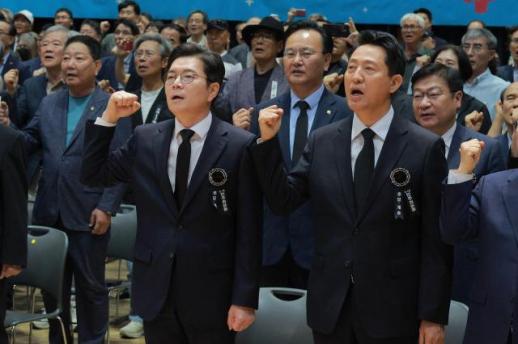 Seoul Mayoral Candidates Clash Over Safety Concerns and Transparency Jung Won-o, the Democratic Party candidate for Seoul mayor, called on his opponent, Oh Se-hoon of the People Power Party, to clarify when he first became aware of the omission of rebar in the construction of the GTX-A line at Samsung Station. Oh countered by asserting that he has never concealed reports from construction companies and demanded that Jung disclose details of his trip to Cancun, Mexico. After announcing youth housing measures in front of Seoul City Hall, Jung told reporters that "important matters should be reported either individually or in person," adding, "I asked Oh when he first received the report and what actions he took afterward, but I have yet to receive a response." He urged Oh to clarify the timeline and subsequent actions regarding the rebar omission, stating, "If what he said about confirming it yesterday is true, it cannot be a trivial matter." In response to accusations from the People Power Party that he is spreading a so-called 'rebar myth,' Jung criticized the party for its 'safety complacency.' He stated, "Avoiding and hiding safety issues is a sign of safety complacency. The reasons for accidents later stem from this. Safety issues must be transparently disclosed." Oh refuted Jung's claims, asserting that the Democratic Party is making unfounded allegations during the election campaign. After visiting the Youth Employment Academy in Yeongdeungpo, he told reporters, "It has been confirmed that the omission report from Hyundai Engineering & Construction was promptly communicated to the Korea Railroad Corporation by the Seoul City government." He added, "As the election atmosphere shifts, they are politicizing the issue. This is a cowardly and unjust attempt," and emphasized that creating unfounded rumors is not something the ruling party should engage in. Oh also raised concerns about Jung's trip to Cancun during his tenure as the head of Seongdong District. He explained on Channel A's YouTube broadcast that, "From the perspective of Seoul City, it is quite rare for overseas trips to last more than ten days." He further criticized, "If a three-day vacation was included in the middle of the trip, it is advisable to disclose the details to avoid misunderstandings as a public figure, as it is the duty of a public servant."* This article has been translated by AI. 2026-05-18 22:55:14
 -
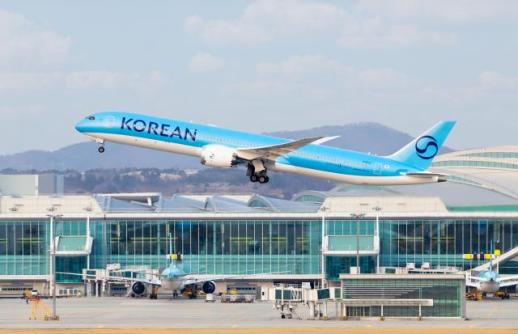 Airfare Prices Drop Ahead of Vacation Season as Fuel Surcharge Decreases As fuel surcharges decrease, international airfare prices are expected to drop slightly next month. According to industry sources on May 18, tickets issued for June will apply a fuel surcharge of 27 stages (ranging from 410 to 419 cents per gallon). This marks a reduction from the 33 stages (over 470 cents per gallon) applied this month. The fuel surcharge is an additional fee airlines impose to offset losses incurred from rising oil prices. The reduction in surcharge stages is due to the average price of Singapore jet fuel (MOPS) falling to 410.02 cents per gallon, based on data from April 16 to May 15. Domestic airlines plan to sequentially adjust fuel surcharges by route in accordance with this change. Korean Air, for instance, charged a minimum of 75,000 won to a maximum of 564,000 won for one-way flights this month, but will reduce these charges to a minimum of 61,500 won and a maximum of 451,500 won in June, resulting in a potential decrease of up to 112,500 won. Asiana Airlines will set its international fuel surcharge for next month at a minimum of 68,000 won and a maximum of 382,800 won for one-way flights, reflecting a decrease of up to 93,400 won compared to May's rates of 85,400 won to 476,200 won. * This article has been translated by AI. 2026-05-18 22:52:59
 -
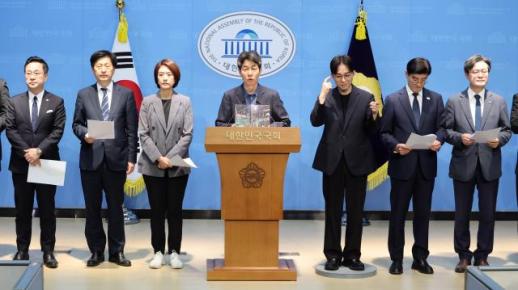 Political Tensions Rise Over GTX Construction Issues in Seoul Tensions escalated on May 18 during a full meeting of the National Assembly's Administrative Safety Committee, as both the ruling and opposition parties engaged in accusations against candidates for Seoul mayor. The Democratic Party and the People Power Party each alleged that their respective candidates, Oh Se-hoon and Jung Won-oh, violated election laws. The conflict intensified following allegations of Jung's misconduct and issues related to the rebar omission in the GTX-A project, as well as Oh's attendance at the audit garden completion ceremony. Democratic Party members of the committee reported Oh and acting mayor Kim Sung-bo to the Seoul Metropolitan Police Agency for allegedly violating Article 86, Section 2 of the Public Official Election Act, which prohibits actions that influence elections. This accusation stemmed from Oh's attendance at the completion ceremony held on May 12 at Gwanghwamun Square. In response, People Power Party members stated they would file a complaint against Jung for spreading false information regarding the GTX-A rebar omission. They claimed that Jung and his campaign team were inciting fear with sensational phrases like "raw GTX" and "Seoul's safety negligence". They emphasized that the Seoul city government had reported anomalies to the Ministry of Land, Infrastructure and Transport, countering Jung's assertion that the report was made five and a half months after the issues arose. They expressed deep regret over the use of public safety concerns in the election. Earlier in the meeting, lawmakers clashed over allegations against Jung and the controversies surrounding the GTX-A project and the audit garden. A Seoul city official stated that relevant institutions had been informed, which sparked further debate. People Power Party lawmaker Park Soo-min questioned, "Is it necessary for all matters to be reported directly to the mayor when they have already been communicated to the relevant institutions?" Conversely, Democratic Party members held a separate press conference, asserting that the People Power Party claimed the city had already reported the issues through official documents. They criticized the evidence presented as merely a few pages from a 400-500 page monthly construction management report, arguing that while the city was aware of the problems, it failed to adequately share this information for prompt action by relevant agencies.* This article has been translated by AI. 2026-05-18 22:51:00
 -
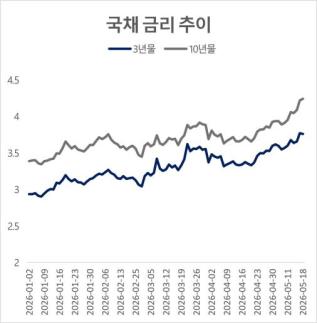 Inflation Fears Hit South Korea, U.S., and Japan as Bond Yields Reach Multi-Year Highs Concerns over inflation are escalating globally, pushing government bond yields to their highest levels in years and intensifying anxiety in the bond market. Analysts suggest that international oil prices are a key factor influencing future interest rates. On May 18, the Financial Investment Association reported that the yield on three-year government bonds closed at 3.757%, while the yield on ten-year bonds reached 4.239%. This ten-year yield is the highest since October 13, 2022, when the "Legoland incident" occurred. In May alone, yields rose by 16.2 basis points for three-year bonds and 31.6 basis points for ten-year bonds. The rise in South Korean government bond yields reflects growing inflation concerns. Persistent high oil prices have driven up energy supply costs, increasing upward pressure on prices, while the economy is performing better than expected. As a result, the likelihood of the Bank of Korea shifting its monetary policy towards raising interest rates has increased, contributing to this outlook. Additionally, caution surrounding government bond auctions is also seen as a negative factor. External factors are also influencing bond yields. Following a U.S.-China summit that yielded no significant outcomes, international oil prices have surged past $100 per barrel. Brent crude futures for July delivery rose to $110 per barrel on the ICE Futures Exchange, while West Texas Intermediate (WTI) futures for June delivery on the New York Mercantile Exchange also surpassed $100 per barrel, amid concerns of a stalemate in peace negotiations between the U.S. and Iran. Yields on government bonds in major economies are also on the rise. As international oil prices climb, inflationary pressures are increasing, leading to widespread concerns about central bank tightening. According to the CME FedWatch Tool, the futures market reflects a 41.7% probability that the Federal Reserve will raise interest rates by December this year. The yield on the benchmark U.S. 10-year Treasury bond reached 4.597% on May 15 and continues to rise, currently hovering around 4.6%. The yield on the sensitive two-year U.S. Treasury bond is above 4.10%, while the 30-year bond yield has exceeded 5.14%, marking its highest level since 2007. Japanese government bond yields have also surged, contributing to global bond market instability. Following an unexpected rise in Japan's inflation rate in April, the yield on the 10-year Japanese government bond climbed to around 2.7%, the highest level in 29 years since 1997. In the UK, bond yields have reached their highest levels in decades as a pro-expansion prime ministerial candidate emerges. Experts predict that the current surge in yields is unlikely to reverse anytime soon. Im Jae-kyun, a researcher at KB Securities, stated, "With yields rising sharply, the government intervened verbally on May 15, but the Bank of Korea has shifted towards raising interest rates. Given the concerns about supply and demand, market instability is unlikely to ease quickly." Ultimately, international oil prices are seen as a critical variable for the future direction of interest rates. Ahn Ye-ha, a researcher at Kiwoom Securities, noted, "The structural increase in term premiums due to expanded fiscal burdens in major countries is unlikely to be easily resolved, so significant declines in oil prices are necessary for market interest rates to change direction. This means that as long as geopolitical uncertainties persist, volatility is likely to continue."* This article has been translated by AI. 2026-05-18 22:49:02
 -
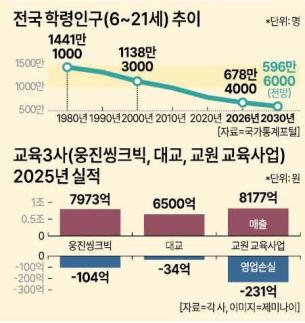 Education Industry Faces Crisis Amid Declining Birth Rates Amid a declining birth rate, leading education companies in South Korea are expressing a sense of crisis, stating they are at a "survival crossroads." The drop in birth rates directly impacts the school-age population, which is essential for the education market. Facing slowed growth, major education firms are seeking solutions through global expansion driven by artificial intelligence (AI) and edtech, as well as diversifying their portfolios to include senior care and lifelong learning. According to the National Statistical Portal, the school-age population (ages 6 to 21) is estimated at 6.784 million this year. This figure has been on a steady decline since peaking at 14.411 million in 1980. By 2030, the school-age population is projected to fall below 6 million, reaching approximately 5.966 million. The population crisis poses a "survival challenge" for education companies that have traditionally relied on this demographic for growth. Their core education business has been struggling, as evidenced by recent financial reports. For instance, Woongjin ThinkBig reported a consolidated revenue of 797.3 billion won in 2025, down 8.1% from 867.1 billion won the previous year. Its operating profit shifted from a profit of 9.2 billion won to an operating loss of 10.4 billion won. During the same period, Daekyo's revenue decreased by 2.03%, from 663.5 billion won to 650 billion won, with operating losses increasing from 1.6 billion won to 3.4 billion won. Kyowon Group's education division also saw a revenue drop of 5.5%, from 865.4 billion won to 817.7 billion won, while its operating losses expanded from 16.2 billion won to 23.1 billion won. In response to the declining school-age population, education companies are accelerating efforts to explore new markets as a necessary growth engine. Woongjin ThinkBig is targeting high-value overseas markets with its proprietary edtech and metaverse educational tools. Notably, its generative AI-based reading solution, Booxtory, won the Best Innovation Award in the AI category at CES 2025, positioning the company to challenge markets in the U.S., Japan, and Taiwan. Additionally, the company is increasing exports of its augmented reality reading platform, ARpedia, which is already available in 24 countries, to boost its technology-driven performance. Daekyo is shifting its focus to the Korean language education market, targeting multicultural families and foreign residents in South Korea. The company has developed specialized courses for the Test of Proficiency in Korean (TOPIK) and created dedicated learning platforms, significantly broadening its target audience to include foreigners living both domestically and abroad. The senior care and funeral service sectors have become another competitive arena for the big three education companies. Last year, Woongjin acquired Fried Life, the leading funeral service provider in South Korea, for approximately 883 billion won, rebranding it as Woongjin Fried Life and quickly becoming the top player in the funeral industry. Kyowon established Kyowon Life in 2011, solidifying its position as a top competitor in the sector by employing a hybrid strategy that combines home appliances and educational services. Daekyo has launched a senior-focused brand, Daekyo New Life, and has built a nationwide franchise network for home care and daycare centers. The company is aggressively expanding its influence in related services, including funeral services and AI care calls. An industry insider noted, "The rapid decline in the school-age population means that if we remain idle, we will inevitably face extinction. By exporting K-edutech to generate high profits and simultaneously entering the senior and funeral service sectors in a super-aged society, a two-track strategy will become the standard survival formula for the education industry."* This article has been translated by AI. 2026-05-18 22:46:47