
Journalist

Abe Kwak
-
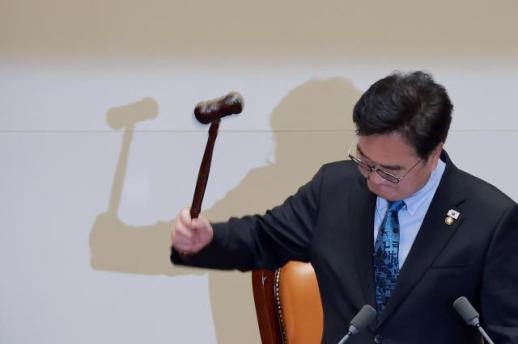 South Korea's first constitutional reform push in decades fails amid boycott SEOUL, May 08 (AJP) - South Korea's National Assembly came close this week to passing its first constitutional amendment in nearly four decades aimed at preventing presidential abuses of power such as martial law declarations, but the effort collapsed after a boycott by the opposition People Power Party. National Assembly Speaker Woo Won-shik withdrew plans to resubmit the amendment shortly after Thursday's plenary session opened after the People Power Party warned it would launch a filibuster if the proposal returned to the floor. The move effectively ended efforts by the ruling Democratic Party of Korea and five smaller parties to hold a national referendum alongside the June 3 local elections. The amendment, narrower than many past reform proposals, focused primarily on democratic safeguards rather than broader changes to presidential power or the electoral system. Its key provisions included stronger National Assembly control over emergency martial law, elevating parliament's authority to terminate martial law, adding the spirit of the 1979 Bu-Ma Democratic Protests and the 1980 May 18 Gwangju Democratic Movement to the Constitution's preamble, and making balanced regional development an explicit constitutional obligation. The Bu-Ma protests in Busan and Masan against the Yushin dictatorship of President Park Chung-hee are widely seen as a prelude to the collapse of authoritarian rule. The May 18 Gwangju Democratic Movement, violently suppressed by military forces after the expansion of martial law in 1980, later became a defining symbol of South Korea's democratization. The bill was introduced on April 3 with backing from 187 lawmakers from the Democratic Party of Korea, Rebuilding Korea Party, Progressive Party, Reform Party, Basic Income Party, Social Democratic Party and six independents. But constitutional amendments require approval from at least two-thirds of the 300-member National Assembly before proceeding to a referendum. The proposal failed to secure a valid vote the previous day after lawmakers from the People Power Party boycotted proceedings, leaving the chamber without quorum. Because the vote was deemed invalid rather than defeated, the ruling bloc argued the bill could legally return for another attempt. But the plan unraveled after the People Power Party made clear it would block any renewed vote through an unlimited debate, or filibuster — an unprecedented move against a constitutional amendment bill. The boycott also made the numbers impossible, as at least 12 party lawmakers would have needed to participate and support the measure for it to clear the constitutional threshold. The most urgent part of the amendment concerned martial law powers. Supporters argued that requiring parliamentary approval for emergency martial law, or otherwise strengthening legislative oversight at the outset, would reduce the risk of abuse before democratic order could be threatened. The proposal also sought to strengthen parliament's authority after martial law is imposed. Under the current Constitution, the president must lift martial law when the National Assembly demands it by majority vote. The revision would have transformed that into a more direct constitutional power for the legislature to terminate emergency rule. Legal scholars, however, warned that stricter controls could weaken the government’s ability to respond during wartime or national emergencies. Seung Lee-Do, a former rapporteur judge at the Constitutional Court and now a professor at Konkuk University Law School, said he agreed with the purpose of preventing abuse of martial law powers, but warned that prior parliamentary approval could delay urgent responses. "While I agree with the purpose of preventing the possible abuse of martial law authority, martial law is a system designed to respond urgently to emergency situations such as war or similar national crises," Seung said. "If prior approval by the National Assembly is required, there is a risk that the government may be unable to respond in time to a national emergency." The ruling Democratic Party of Korea criticized the People Power Party for refusing to participate, arguing the amendment could prevent future illegal martial law declarations and reduce administrative costs. Rep. Park Kyun-taek said, "This is a highly meaningful constitutional amendment in symbolic, practical, and regional-development terms. If the amendment is put to a vote during the local elections, there would be no need to designate an additional public holiday, nor would there be separate election costs. I am deeply disappointed in the People Power Party for rejecting the amendment." Responding to criticism that the amendment could politically hurt the opposition in the June 3 elections, Park said, "I find it difficult to understand why a party that was brought down by illegal emergency martial law would consider it electorally disadvantageous to take part in an amendment designed to prevent that from happening again." He added that if the Constitution were revised to require National Assembly approval for martial law declarations, "illegal emergency martial law will not be able to happen in the future," adding that the amendment "will be highly practical and will be able to prevent abuse of executive power in the form of illegal emergency martial law." PPP criticized the amendment as being pushed through hastily and unilaterally. Party lawmakers said constitutional reform should proceed through broader bipartisan and public deliberation. Rep. Yoon Sang-hyun emphasized, "The People Power Party is not opposed to constitutional amendment itself." He argued that public consensus should come first and warned that the ruling party's approach — "pushing it through unilaterally, tied to the election schedule, while excluding the main opposition party as it is doing now" — risked prioritizing politics over national unity. He added, "The Constitution should be a document of national unity, not a political document for the winners." Cho Eung-cheon, the Reform Party's candidate for Gyeonggi governor, also stressed the need for bipartisan agreement, saying, "There can be no constitutional amendment without agreement," and adding, "A constitution is created through broad consensus, and forcing through an amendment by sheer numbers is not procedurally right." 2026-05-08 17:29:58
 -
 KOSPI closes at fresh record as Korea defies broader Asia weakness SEOUL, May 08 (AJP) - South Korea's benchmark KOSPI index closed at an all-time high for a fourth consecutive session on Friday. Domestic investors absorbed a significant sell-off by foreign funds as geopolitical tensions in the Middle East rattled regional markets. The index edged up 0.1 percent to finish at a record 7,498.0. It fluctuated during the day between a low of 7,318.96 and an intraday record of 7,511.01. Regional sentiment soured following reports of renewed military clashes between the United States and Iranian forces near the Strait of Hormuz. The escalation weighed on Wall Street overnight, with the Dow Jones Industrial Average sliding 0.6 percent and the S&P 500 declining 0.4 percent. Foreign investors sold a net 5.59 trillion won (3.81 billion dollars) of KOSPI shares, marking a flight toward safe-haven assets. Domestic retail and institutional investors countered the trend by purchasing 3.98 trillion won and 1.55 trillion won, respectively. Technology shares were mixed as global demand for artificial intelligence components provided a buffer against broader market volatility. Samsung Electronics fell 1.1 percent to 268,500 won, while SK hynix gained 1.9 percent to close at 1,686,000 won. Automobile and robotics companies led the session's gains as investors shifted toward physical AI technologies. Hyundai Motor surged 7.2 percent to 613,000 won after its robotics affiliate, Boston Dynamics, released footage of the Atlas humanoid robot performing advanced movements. The momentum extended to infrastructure and software firms within the automotive ecosystem. Hyundai AutoEver and Gaon Cable both surged 30 percent to close at 592,000 won and 477,000 won, respectively. Industrial and energy sectors saw profit-taking following recent rallies. SKC plunged 8.2 percent to 159,900 won, while Samsung Heavy Industries dropped 5.2 percent to 31,950 won and Doosan Enerbility fell 5.0 percent to 129,600 won. The tech-heavy KOSDAQ index rose 0.7 percent to close at 1,207.7, outperforming the main board. Foreign investors were net buyers on the secondary market, adding 404.4 billion won worth of shares. Other regional markets struggled, with Japan's Nikkei 225 slipping 0.2 percent to 62,713.7. Hong Kong's Hang Seng Index fell 0.8 percent to 26,413.5 as concerns over energy disruptions persisted. The South Korean won weakened 0.8 percent to 1,469.1 per dollar amid the rising geopolitical uncertainty. In the energy market, West Texas Intermediate crude gained 0.4 percent to end at 95.1 dollars. 2026-05-08 17:24:43
 -
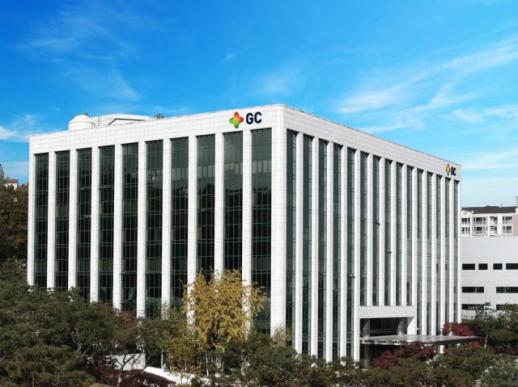 GC Green Cross Reports 1st Quarter Operating Profit of 11.7 Billion Won Driven by Aliglo Sales Thanks to the explosive growth of its blood product Aliglo, GC Green Cross reported a nearly 50% increase in operating profit for the first quarter of this year. The company anticipates that the quarterly sales growth of Aliglo will continue throughout the year, especially after the U.S. customs policy announced in April exempted plasma-derived products from tariffs, significantly alleviating uncertainties in the local market.On May 8, GC Green Cross announced that its consolidated financial statements for the first quarter showed sales of 435.5 billion won and an operating profit of 11.7 billion won. Sales increased by 13.5% compared to the same period last year, while operating profit rose by 46.3%. The net profit was reported at 20.1 billion won.Notably, Aliglo's sales for the first quarter reached 34.9 billion won, nearly quadrupling compared to the same period last year.Sales by business segment included 114.9 billion won from plasma-derived products, 81.6 billion won from prescription drugs, 56.8 billion won from vaccines, and 32.4 billion won from over-the-counter medicines and consumer healthcare.In the U.S., the company's subsidiary ABO Plasma recently received FDA approval for its plasma center in Laredo, Texas, and is planning to open a new center in Eagle Pass within the year. The recent U.S. customs policy, which includes plasma-derived products in the tariff exemption, has also resolved uncertainties related to this business.By subsidiary, GC Cell reported 37.4 billion won in sales, while GC Green Cross MS generated 23.6 billion won. GC Green Cross Wellbeing achieved sales of 49.1 billion won, although it will be excluded from consolidated results starting in the second quarter due to a stake sale on March 31.Market analysts believe that GC Green Cross, which recorded a significant loss of over 100 billion won in the fourth quarter of last year, will continue to improve its performance in the first quarter, driven by stable growth in key products like Aliglo.A representative from GC Green Cross stated, "We will continue to expand our market dominance through the stabilization of plasma center operations and the opening of additional centers."* This article has been translated by AI. 2026-05-08 17:19:58
 -
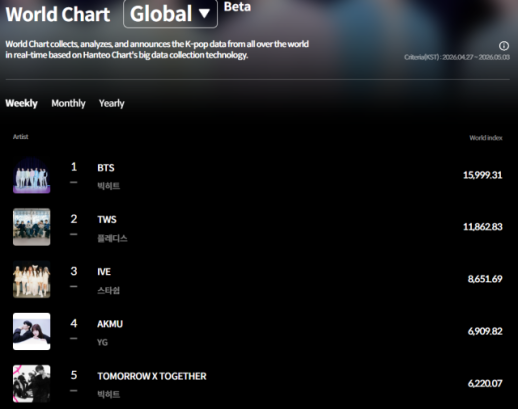 Hybe artists BTS, TWX and ILLIT sweep music charts in China, Japan and US SEOUL, May 08 (AJP) - Hybe artists swept the top positions in international music rankings for the final week of April, securing the first through third spots in China, Japan, and the United States. According to data released by Hanteo Chart on May 8, South Korean acts including BTS, TWS, and ILLIT led the charts in these major global markets. The results demonstrate the broad reach of the South Korean entertainment conglomerate across different regions and sub-labels. The data suggests that both veteran artists and newer groups from the company are maintaining high levels of engagement with international audiences. In the China category for the period between April 27 and May 3, BTS claimed first place with the track Arirang, recording a total index score of 34,575.44. Tomorrow X Together followed in second place with a score of 27,119.46, while Kortis took the third position. All three of the top-ranking artists in China are managed by Big Hit Music, a prominent subsidiary under the Hybe umbrella. The group TWS led the rankings in Japan with the song No Tragedy, earning a total index score of 25,773.27. BTS and ILLIT followed in second and third place respectively, completing a clean sweep of the Japanese chart by Hybe-affiliated groups. In the United States, the girl group ILLIT secured the first position with the song Mamihlapinatapai, achieving a total index score of 12,692.11. BTS occupied the second spot in the American rankings, while Tomorrow X Together finished in third place. While BTS and Tomorrow X Together are part of Big Hit Music, ILLIT is managed by Belift Lab, another subsidiary within the Hybe corporate structure. Hanteo Chart utilizes big data technology to collect and analyze real-time K-pop information including physical album sales, digital performance, and social portal engagement. These regional breakdowns are released every Friday to track the global footprint of South Korean artists. 2026-05-08 17:18:45
 -
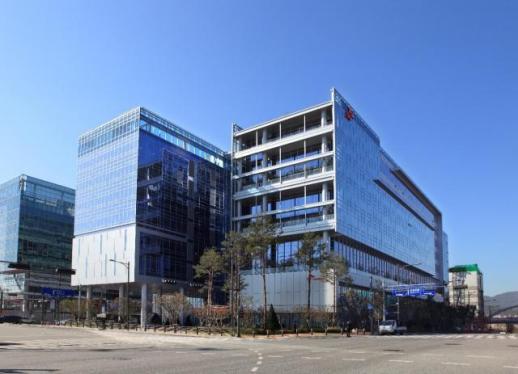 SK Chemicals Reports 464.3% Increase in Q1 Operating Profit SK Chemicals has reported strong performance in its key business sectors during the first quarter of 2026, despite a challenging economic environment. The company announced on May 8 that it achieved a standalone revenue of 385.7 billion won and an operating profit of 21.2 billion won for the first quarter. This marks a 14.2% increase in revenue and a remarkable 464.3% rise in operating profit compared to the previous quarter.SK Chemicals attributed its growth to increased sales in its core businesses, including copolyester and pharmaceuticals, amid ongoing economic uncertainty. Despite a downturn in the global petrochemical market, the company is focusing on high-value specialty products centered around 'green chemistry' and expanding its recycling initiatives to defend its performance. However, when including its subsidiary SK Bioscience, the consolidated results showed revenue of 655.9 billion won and an operating loss of 18.9 billion won.A representative from SK Chemicals stated, "Even in the first quarter, which faced significant external volatility, we were able to maintain a stable operation across sourcing, production, and sales, which helped sustain our revenue growth. We will continue to enhance our competitiveness by reviewing our product portfolio, cost structure, and operational processes to respond more flexibly to market changes and uncertainties such as fluctuations in oil prices and supply chain disruptions."* This article has been translated by AI. 2026-05-08 17:18:21
 -
 Investigation Underway into Fire on HMM Namoo Vessel A fire caused by an explosion on the HMM Namoo vessel, which was docked in the Strait of Hormuz, is now under investigation. According to HMM, a government investigation team boarded the vessel at 3 PM KST on May 8 at Drydocks World Dubai, the largest ship repair yard in the Middle East. The team consists of three investigators from the Central Maritime Safety Tribunal and four fire investigation experts from the National Fire Agency. The investigation will focus on whether the fire was caused by external factors, such as an attack from Iran, or internal issues related to the vessel itself. The crew members aboard the Namoo will participate in the investigation, after which a decision will be made regarding their disembarkation. An HMM official stated, "It seems that the crew will disembark after participating in the vessel investigation," adding that the exact timing and follow-up actions are still undecided. Previously, at around 8:40 PM KST on May 4, the HMM Namoo experienced a fire in the engine room due to an explosion while docked north of Sharjah in the UAE, inside the Strait of Hormuz. The vessel, which is operated by South Korea's largest shipping company HMM, is registered in Panama and has a total of 24 crew members, including six South Korean nationals and 18 foreign crew members. There were no reported injuries from the incident. Currently, five HMM vessels are stranded in the Persian Gulf, including two oil and petroleum product carriers, two bulk carriers, and one container ship. The HMM Namoo is classified as a bulk carrier.* This article has been translated by AI. 2026-05-08 17:16:49
 -
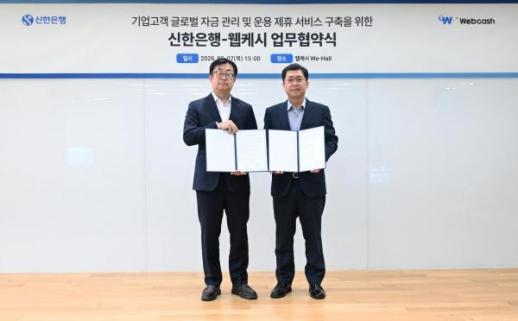 Shinhan Bank Partners with Webcash to Launch Global Cash Management Service Shinhan Bank is set to introduce a global integrated cash management service for companies expanding overseas.On May 8, Shinhan Bank announced that it has signed a memorandum of understanding with fintech firm Webcash to develop an integrated cash management service and enhance its cash management services (CMS). Webcash is a leading domestic fintech company providing business-to-business (B2B) financial solutions.The signing ceremony, held on May 7 at Webcash's headquarters in Yeongdeungpo, Seoul, was attended by Lee Seung-mok, head of Shinhan Bank's Group Solutions Group, and Kang Won-joo, CEO of Webcash.This agreement aims to improve the convenience of cash management for corporate clients operating overseas.Shinhan Bank plans to launch the 'Global Integrated Cash Management Service' through its corporate non-face-to-face platform later this month. Companies operating overseas subsidiaries or branches will be able to access cash information from approximately 300 financial institutions across 40 countries through Shinhan Bank's corporate banking services. The service will also support regular report dispatch via email and integration with clients' enterprise resource planning (ERP) systems.Additionally, both companies plan to pursue initiatives such as introducing customized services for clients, joint marketing efforts, and identifying projects to enhance CMS based on a global network.A Shinhan Bank official stated, "We will continue to expand digital-based financial services to support our corporate clients' global business operations."* This article has been translated by AI. 2026-05-08 17:15:22
 -
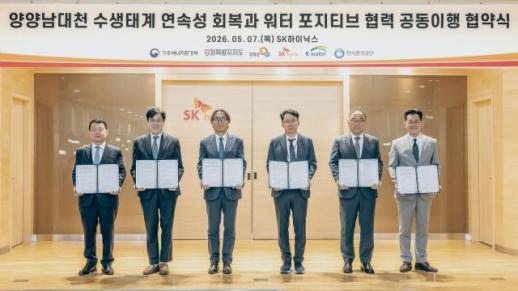 SK hynix pledges 'water positive' future starting with salmon route fix SEOUL, May 08 (AJP) - South Korean chipmaker giant SK hynix inc. has signed a multilateral agreement with the government and local authorities to restore the aquatic ecosystem of Namdaecheon Stream, a move aimed at reviving the country’s largest salmon spawning ground. Under the "Water Positive" initiative, the memory chipmaker will cooperate with the Ministry of Climate, Energy and Environment and the Gangwon provincial government to modernize aging weirs that have long obstructed salmon migration. The strategy focuses on returning more water to natural sources than the company consumes during its industrial operations, reflecting an shift toward corporate water stewardship. The restoration project, scheduled to run from 2026 through 2037, focuses on securing consistent water flow and upgrading deteriorating infrastructure to ensure a clear return path for migratory species. Namdaecheon has faced ecological challenges in recent years as outdated barriers and altered currents prevented salmon from reaching their native spawning sites. Beyond the ecological impact, the partnership is expected to bolster the regional economy by enhancing local tourism and improving the riverside environment for residents. This collaboration marks a shift toward a public-private model where corporate resources are directly integrated into national environmental conservation policies. “This project illustrates how corporate water management can serve as a tool for shared growth with both nature and local communities,” said Lee Byung-ki, Chief Production Officer at SK hynix. “We will continue to pursue sincere activities to protect water resources moving forward.” 2026-05-08 17:15:18
 -
 Government Plans Renewable Energy Roadmap for Agriculture by July The South Korean government is set to restructure the energy framework for agriculture and rural areas to achieve "oil price worry-free agriculture." The plan aims to create a long-term roadmap connecting renewable energy-based energy independence to farm income. On May 8, the Ministry of Agriculture, Food and Rural Affairs announced the launch of a task force (TF) to develop a strategy for the energy transition in agriculture and rural areas during its first meeting at the Government Sejong Center. This task force will comprehensively address rural energy independence, agricultural energy transition, and ways to utilize agricultural and rural resources to contribute to national energy transformation. It plans to establish a renewable energy transition roadmap and detailed implementation tasks by July. Amid rising energy price volatility due to recent instability in the Middle East, the agricultural sector, which is experiencing increased energy demand from the expansion of smart farms and electrification, is facing greater burdens. The government aims to shift agriculture from an energy-consuming industry to a producer and supplier of energy in response to these changing conditions. Specifically, to achieve rural energy independence, the government will promote the expansion of solar energy in farming, the establishment of energy-independent villages, and the distribution of solar power systems for farms. This initiative aims to create a "locally produced, locally consumed" energy structure in rural areas. The government will also work on improving energy efficiency throughout the entire agricultural production process. This includes transitioning old farming machinery to electric and hydrogen-based systems, expanding renewable energy facilities in greenhouses and livestock farms, and introducing self-generation facilities in processing facilities such as distribution centers and slaughterhouses. Additionally, renewable energy production models utilizing agricultural infrastructure like reclaimed land and reservoirs, as well as biomass from livestock waste and agricultural byproducts, will be established. The government expects rural areas to function as energy production hubs, providing additional sources of income. The task force is led by Kim Jong-gu, Deputy Minister of Agriculture, Food and Rural Affairs, and Kim Jeong-wook, Director of Agricultural Industry Innovation Policy, with three divisions focusing on rural energy independence, agricultural energy transition, and agricultural resource utilization, all staffed by senior officials. A private advisory group comprising industry and academic experts will also be involved. Based on the discussions of the task force, the government plans to gradually implement energy transition policies that can be felt in the agricultural and rural sectors, alongside financial projects and institutional improvements. On this day, Deputy Minister Kim stated, "Energy security is food security," adding that the government plans to establish fundamental principles and performance indicators for the energy transition in agriculture and rural areas that align with the national renewable energy transition policy, as well as to refine related systems.* This article has been translated by AI. 2026-05-08 17:13:39
 -
 Government Allocates Record 104,000 Foreign Workers for Agriculture in First Half of 2026 The South Korean government is addressing labor shortages in agriculture by allocating a record 104,000 foreign workers for the first half of 2026 and increasing support for domestic labor. On May 8, Minister of Agriculture, Food and Rural Affairs Song Mi-ryeong visited a seasonal foreign labor site in Imsil, North Jeolla Province, to assess working conditions and announce the agricultural labor supply plan for the busy farming season. This year, the government has allocated a total of 104,000 foreign workers for the agricultural sector, including 94,000 seasonal workers and 10,000 under the employment permit system. This measure aims to alleviate the ongoing labor shortage, which has seen over 60% of agricultural labor demand concentrated during specific periods. The new measures will significantly expand public seasonal labor programs. The National Agricultural Cooperative Federation will directly employ workers and supply them to small farms on a daily basis, increasing the number of operational sites from 91 last year to 142 this year, and expanding the workforce from 3,067 to 5,039. Additionally, the government plans to promote a 'contract-based seasonal labor' system, allowing qualified corporations to utilize seasonal workers for agricultural tasks. To facilitate the swift deployment of foreign workers, a dedicated team will operate at immigration offices, along with a 'mobile fingerprint registration service.' Support for domestic labor will also be enhanced. The subsidy for workers supplied through rural labor brokerage centers will be increased, raising transportation costs from a maximum of 10,000 won to 20,000 won per day, and accommodation costs from 20,000 won to 30,000 won. The government aims to encourage domestic labor influx by providing agricultural job information through private recruitment platforms and expanding assistance programs in collaboration with businesses and public institutions. During the busy farming season, the government will operate a 'special task force for labor support.' From April 9 to June 30, the task force will monitor labor supply and wage trends weekly in 35 major fruit and vegetable producing cities and counties, sharing labor pools from nearby regions as needed. Minister Song Mi-ryeong stated, "We will strengthen communication with the field to prevent labor shortages during the busy farming season and establish a close collaboration system with relevant agencies."* This article has been translated by AI. 2026-05-08 17:10:56