

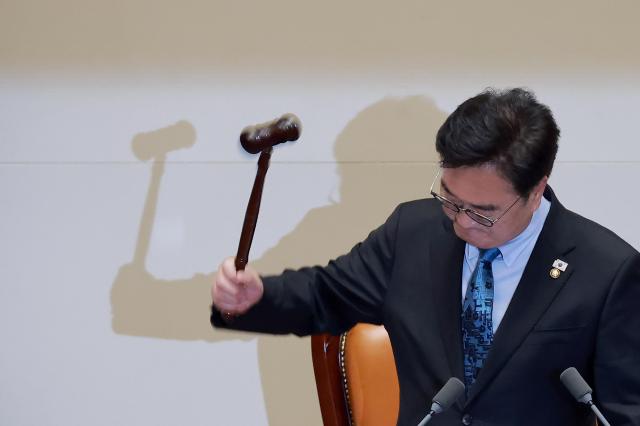
National Assembly Speaker Woo Won-shik withdrew plans to resubmit the amendment shortly after Thursday's plenary session opened after the People Power Party warned it would launch a filibuster if the proposal returned to the floor. The move effectively ended efforts by the ruling Democratic Party of Korea and five smaller parties to hold a national referendum alongside the June 3 local elections.
The amendment, narrower than many past reform proposals, focused primarily on democratic safeguards rather than broader changes to presidential power or the electoral system. Its key provisions included stronger National Assembly control over emergency martial law, elevating parliament's authority to terminate martial law, adding the spirit of the 1979 Bu-Ma Democratic Protests and the 1980 May 18 Gwangju Democratic Movement to the Constitution's preamble, and making balanced regional development an explicit constitutional obligation.
The Bu-Ma protests in Busan and Masan against the Yushin dictatorship of President Park Chung-hee are widely seen as a prelude to the collapse of authoritarian rule. The May 18 Gwangju Democratic Movement, violently suppressed by military forces after the expansion of martial law in 1980, later became a defining symbol of South Korea's democratization.
The bill was introduced on April 3 with backing from 187 lawmakers from the Democratic Party of Korea, Rebuilding Korea Party, Progressive Party, Reform Party, Basic Income Party, Social Democratic Party and six independents. But constitutional amendments require approval from at least two-thirds of the 300-member National Assembly before proceeding to a referendum.
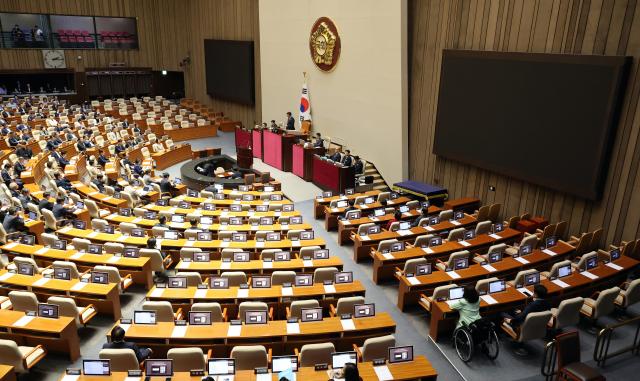
But the plan unraveled after the People Power Party made clear it would block any renewed vote through an unlimited debate, or filibuster — an unprecedented move against a constitutional amendment bill. The boycott also made the numbers impossible, as at least 12 party lawmakers would have needed to participate and support the measure for it to clear the constitutional threshold.
The most urgent part of the amendment concerned martial law powers. Supporters argued that requiring parliamentary approval for emergency martial law, or otherwise strengthening legislative oversight at the outset, would reduce the risk of abuse before democratic order could be threatened.
The proposal also sought to strengthen parliament's authority after martial law is imposed. Under the current Constitution, the president must lift martial law when the National Assembly demands it by majority vote. The revision would have transformed that into a more direct constitutional power for the legislature to terminate emergency rule.
Legal scholars, however, warned that stricter controls could weaken the government’s ability to respond during wartime or national emergencies.
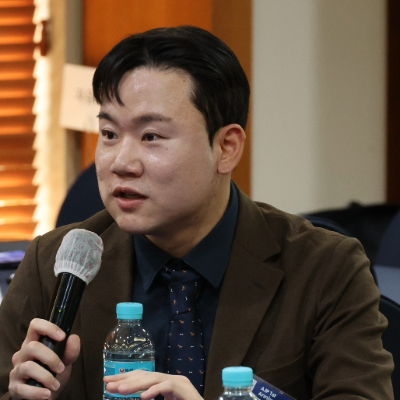
Seung Lee-Do, a former rapporteur judge at the Constitutional Court and now a professor at Konkuk University Law School, said he agreed with the purpose of preventing abuse of martial law powers, but warned that prior parliamentary approval could delay urgent responses.
"While I agree with the purpose of preventing the possible abuse of martial law authority, martial law is a system designed to respond urgently to emergency situations such as war or similar national crises," Seung said. "If prior approval by the National Assembly is required, there is a risk that the government may be unable to respond in time to a national emergency."
The ruling Democratic Party of Korea criticized the People Power Party for refusing to participate, arguing the amendment could prevent future illegal martial law declarations and reduce administrative costs.
Rep. Park Kyun-taek said, "This is a highly meaningful constitutional amendment in symbolic, practical, and regional-development terms. If the amendment is put to a vote during the local elections, there would be no need to designate an additional public holiday, nor would there be separate election costs. I am deeply disappointed in the People Power Party for rejecting the amendment."
Responding to criticism that the amendment could politically hurt the opposition in the June 3 elections, Park said, "I find it difficult to understand why a party that was brought down by illegal emergency martial law would consider it electorally disadvantageous to take part in an amendment designed to prevent that from happening again."
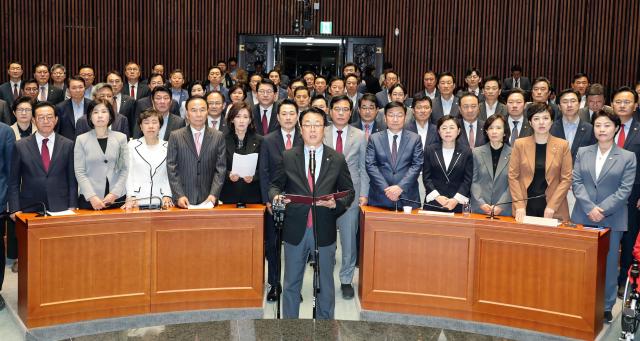
PPP criticized the amendment as being pushed through hastily and unilaterally. Party lawmakers said constitutional reform should proceed through broader bipartisan and public deliberation.
Rep. Yoon Sang-hyun emphasized, "The People Power Party is not opposed to constitutional amendment itself." He argued that public consensus should come first and warned that the ruling party's approach — "pushing it through unilaterally, tied to the election schedule, while excluding the main opposition party as it is doing now" — risked prioritizing politics over national unity. He added, "The Constitution should be a document of national unity, not a political document for the winners."
Cho Eung-cheon, the Reform Party's candidate for Gyeonggi governor, also stressed the need for bipartisan agreement, saying, "There can be no constitutional amendment without agreement," and adding, "A constitution is created through broad consensus, and forcing through an amendment by sheer numbers is not procedurally right."
Copyright ⓒ Aju Press All rights reserved.
