

North Korea has revised its constitution in a move that goes beyond wording changes and points to a redefinition of the state’s direction. According to the amendment details released by the South Korean government and academic researchers, language related to “national reunification” was removed, and a new provision was added defining national territory as the North’s domain. The revisions also specify the chairman of the State Affairs Commission as the “head of state” and, for the first time, include command authority over nuclear forces in the constitution. The changes signal how North Korea is redefining itself and seeking to reset the framework for relations with South Korea.
It should be interpreted cautiously whether the revisions amount to an explicit “two states” declaration. Removing reunification language clearly marks a departure from an identity centered on unification. But deletion alone does not necessarily equal a formal constitutional declaration that the two Koreas are separate sovereign states. Interpretation depends on whether the text directly defines the North and South as separate states or simply downgrades the concept of unification. A more precise reading is that the move reflects an institutional retreat from unification, rather than an outright abandonment of it.
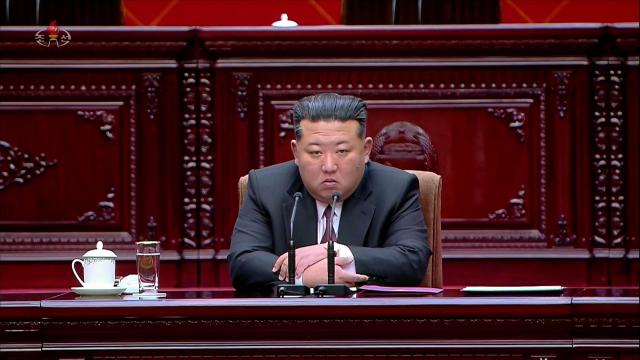
Even so, the direction is clear. North Korea no longer presents unification as a core national goal at the constitutional level, a step that changes a basic premise of inter-Korean relations. Going forward, ties may be framed less as an internal national matter and more as relations between states, potentially reshaping both cooperation and conflict.
The new territorial clause also warrants attention. By codifying its territory, North Korea underscored statehood. However, it did not specifically mention maritime boundaries, including the Northern Limit Line in the Yellow Sea. Some view that omission as an intent to ease tensions, but it is not definitive. In international politics, deliberate ambiguity over boundaries can serve as both a buffer to avoid clashes and a way to preserve room to press claims later. The move can be read as strategic ambiguity that combines tension management with flexibility for future pressure.
The nuclear-related change carries greater weight. By writing nuclear-use authority into the constitution, North Korea elevated nuclear weapons from a military tool to a core element of regime survival. That does not automatically mean nuclear issues are entirely off the table in negotiations; historically, even constitutional provisions have been negotiated when political needs changed. But given North Korea’s past behavior and policy direction, nuclear weapons are more likely to function as a precondition for talks than as a bargaining chip. In effect, they are positioned less as something to trade and more as something that sets the terms of engagement.
The revisions also strengthen the authority of the State Affairs Commission chairman. Naming the post as head of state and concentrating nuclear command authority both simplify the power structure and reinforce personal rule. Externally, it may be presented as a signal of stable governance; internally, it further consolidates power.
Some analysts argue the changes show North Korea pursuing a “normal state” image. But that reading is also limited: a state that constitutionalizes nuclear forces conflicts with widely accepted standards of normalcy in the international community. The approach appears closer to a self-defined normalcy that blends domestic control with external messaging — projecting stability abroad while reinforcing regime legitimacy at home around nuclear capability.
The question now is South Korea’s response, which the article argues should be structural rather than emotional.
First, policy assumptions need to be reset. With North Korea retreating from unification rhetoric, South Korea should strengthen an approach based on practical coexistence, while keeping unification as a long-term vision. The key is separating goals from tools: maintain unification as a strategic objective, but focus near-term policy on managing conflict and sustaining stability.
Second, military deterrence must become more precise. With nuclear forces written into the constitution, deterrence is presented as essential. The article calls for strengthening extended deterrence based on the U.S.-South Korea alliance and upgrading South Korea’s own response capabilities, while recognizing that stronger deterrence can also raise tensions.
Third, mechanisms to manage incidents should be designed as a separate track from deterrence. Deterrence and communication may appear to conflict, but the article argues they should operate in parallel. Military deterrence should be maintained, while hotlines and working-level channels aimed at preventing accidental clashes should be continuously managed, with clear rules for when each policy applies.
Fourth, the article calls for widening diplomatic space. With North Korea stating “protection of national interests” as a guiding principle for external policy, it is likely to make greater use of ties with surrounding major powers. South Korea, it argues, should pursue a multilayered diplomatic strategy alongside U.S.-centered diplomacy, emphasizing leverage to maintain initiative on Korean Peninsula issues.
Finally, the article urges clearer policy priorities. It says it is unrealistic to push every response at once: in a crisis, deterrence should come first; when tensions ease, communication should take priority. Clear criteria for choosing between them are needed to sustain consistency and credibility.
The constitutional revisions are described as a clear signal of change in the order on the Korean Peninsula. What has changed is relatively clear: unification rhetoric has receded, nuclear forces have been institutionalized, and state identity has been redefined. The consequences, the article argues, are more complex.
The article concludes that the priority is not interpretation but response. South Korea, it says, can no longer rely on past assumptions and needs a strategy that recognizes the new reality without being driven by it, arguing that sober assessment and careful choices are essential to managing uncertainty on the peninsula.
* This article has been translated by AI.
Copyright ⓒ Aju Press All rights reserved.