
Journalist

Avidan Kent
-
 South Korea Finalizes 2027 Medical School Enrollment, Adding 490 Seats The Education Ministry said on the 28th it has finalized medical school enrollment quotas for the 2027-2031 academic years without changes from its previously announced plan. For the 2027 academic year, total medical school enrollment will be 3,548, up 490 from 3,058 in the 2024 academic year before the expansion. Kangwon National University and Chungbuk National University will see the largest increases, with 39 additional seats each. The ministry issued a preliminary notice of the quota allocations on March 13 and collected feedback from universities through March 24, then formally notified schools of the quotas on March 26. It accepted objections through April 27. "Some universities submitted opinions and filed objections regarding the preliminary notice of the quota allocations, but the allocation committee decided not to accept them after review," the ministry said. With the quotas finalized, universities will revise their school regulations by May and proceed with steps such as updating their 2027 college admissions implementation plans. 2026-04-28 20:39:19
 -
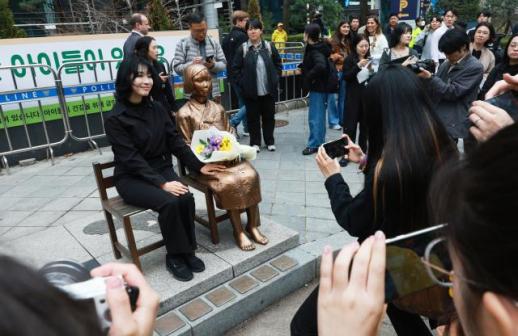 Police to Remove Barrier Around ‘Statue of Peace’ Near Former Japanese Embassy in Seoul Police will remove a barricade surrounding the “Statue of Peace,” a symbol of victims of Japan’s wartime sexual slavery, about six years after it was installed. The barricade outside the former Japanese Embassy in Seoul’s Jongno district is set to come down to coincide with the weekly Wednesday rally on May 6, according to the Jongno Police Station and other officials on April 28. The removal is seen as restoring the area so the public can again approach the statue freely. The barricade was installed in June 2020 at the request of the Korean Council for Justice and Remembrance after concerns were raised that the statue could be damaged during rallies by opposing groups. The organization owns the statue, which is designated and managed as Jongno district’s first public sculpture. The Korean Council for Justice and Remembrance plans to hold an event at the May 6 rally to mark the removal. Sculptor Kim Seo-kyung, who participated in creating the statue, is expected to attend. Police said they will continue order and safety measures after the barricade is removed, including deploying riot police at the site.* This article has been translated by AI. 2026-04-28 20:12:17
 -
 Samsung Biologics Union Begins Partial Strike After Talks Break Down Samsung Biologics’ labor union began a partial strike on the 28th after negotiations with management broke down. About 60 union members in the materials aliquoting unit joined the walkout starting that day. The partial strike is scheduled to run through the 30th. The union has demanded what it calls “setting personnel principles straight” and narrowing wage gaps within the group. Labor and management have held 13 bargaining sessions since their first meeting in December last year but failed to narrow differences. The union said it will move to a full strike next month if there is no progress in talks. The action is the company’s first strike since it was founded in 2011. About 2,000 union members have reportedly indicated they are willing to participate. A court, however, restricted strike activity in final-stage processes such as work to prevent drug deterioration and spoilage, and staff in those departments were excluded from the walkout. Industry observers are watching the dispute closely as it comes while the company is expanding production facilities. They say the outcome could be a key factor in assessing the stability of Samsung Bio’s operations and its ability to manage risk going forward. The company said it is working to minimize disruptions. “We are responding by using available personnel,” a Samsung Biologics official said, adding that the company plans to continue talks to resolve the issue.* This article has been translated by AI. 2026-04-28 19:48:25
 -
 Wednesday Forecast: Big Spring Temperature Swings, Highs Near 20 C Wednesday the 29th will bring generally mild spring weather nationwide, but temperatures will dip in the morning, making it feel chilly. Seoul’s morning low is forecast at 8 C, about 3 degrees lower than the previous day. Other areas are also expected to start in the single digits, keeping conditions cool early. Temperatures will rise sharply during the day, with most regions reaching around 20 C. Central areas will be mostly sunny, while the south and Jeju Island will be mostly cloudy. Daytime highs there are expected to be around 21 C, near seasonal norms or slightly lower. The Seoul metropolitan area and northern Chungcheong Province will see clouds give way to clearer skies, and Gangwon Province will gradually clear after a cloudy start. Inland areas will see a large day-to-night temperature swing of about 15 degrees. The Korea Meteorological Administration urged caution on fire prevention and health as dry weather advisories remain in effect for inland Chungcheong, northern Jeonbuk and inland North Gyeongsang, where conditions are expected to be very dry. Forecast highs include Seoul 20 C, Incheon 19 C, Suwon 19 C, Chuncheon 20 C, Daegu 20 C, Busan 18 C, Ulsan 18 C and Jeju 16 C. Fine dust levels are expected to range from “good” to “moderate” nationwide.* This article has been translated by AI. 2026-04-28 19:36:19
 -
 Google DeepMind CEO Demis Hassabis Meets South Korea’s Top Business Leaders on AI Chips Demis Hassabis, the Google DeepMind co-founder and CEO known as the creator of AlphaGo, has met in quick succession with leaders of major South Korean conglomerates as he seeks closer cooperation on AI semiconductors. The string of visits by global tech chiefs is fueling views that South Korea is emerging as a key hub in the global AI supply chain. According to industry officials on April 28, Samsung Electronics Chairman Lee Jae-yong held a closed-door meeting with Hassabis that afternoon at Samsung’s Seocho office in Seoul. They were reported to have discussed semiconductor cooperation for next-generation AI chip design and ways to expand on-device AI using Google’s Gemini. SK Group Chairman Chey Tae-won also met with Hassabis to discuss cooperation on building AI infrastructure, reports said. Earlier the same day, Hyundai Motor Group Chairman Chung Euisun and LG Group Chairman Koo Kwang-mo also held meetings. The talks were said to have explored collaboration between Google and Korean companies across semiconductors, mobile, telecommunications and robotics. DeepMind is focused on developing artificial general intelligence, or AGI. Google has already moved to place its Gemini model on Samsung smartphones to push on-device AI, and it is applying intelligent life solutions to LG Electronics’ home appliances to broaden user experiences. It is also working with Hyundai Motor Group’s Boston Dynamics to improve AI performance for the next-generation humanoid robot Atlas. Last month, AMD CEO Lisa Su made her first official visit to South Korea since taking the job and met with Samsung Electronics DX division head Roh Tae-moon, among others, to discuss expanding cooperation across the AI mobile and PC ecosystem, including smartphones, PCs and tablets. From AMD’s perspective, Samsung’s advanced manufacturing processes and memory solutions are critical as it seeks to challenge Nvidia’s dominance. In October last year, Nvidia CEO Jensen Huang visited South Korea to reaffirm partnerships with local companies. OpenAI CEO Sam Altman also visited and explored cooperation with South Korea’s semiconductor ecosystem to produce an “OpenAI-dedicated chip.” Industry experts say Korean companies are moving beyond being chip suppliers to becoming key partners in shaping global AI standards. Ahn Ki-hyun, executive director of the Korea Semiconductor Industry Association, said, “As the global competition for AI leadership intensifies, AI business has reached a point where it is impossible without the memory and foundry technologies of Korean companies such as Samsung Electronics and SK hynix.” He added, “Beyond a simple supply relationship, a ‘one-team’ system is strengthening, with partners thinking together from the design stage.”* This article has been translated by AI. 2026-04-28 19:33:22
 -
 People Power Party Nominates Ahn Gyo-jae for Suwon Mayor, Park Tae-kyung for Hwaseong Mayor The People Power Party's Nomination Management Committee on April 28 finalized Ahn Gyo-jae as its candidate for Suwon special city mayor and Park Tae-kyung as its candidate for Hwaseong special city mayor. Committee Chair Park Deok-heum told reporters at the party's central headquarters in Seoul's Yeouido that the committee had completed the vote count for the internal primaries to pick the Suwon and Hwaseong mayoral nominees. Park also outlined the next steps for National Assembly by-elections and rules on vote bonuses and penalties in party primaries. He said the party plans to post a notice on April 29 to accept applications for nominations in additional by-elections that arise, with filings accepted through April 30. He said interviews for applicants will be held May 1, and the committee will move quickly to decide the nomination method and announce candidates. In districts holding primaries, voting will run for two days starting May 3, with final candidates to be announced on May 5. The committee also approved standards for adding or subtracting points in primaries. Park said the party decided to reduce a portion of primary vote shares for candidates who previously served as lawmakers in the same constituency, in an effort to encourage newcomers to enter politics. Those who served three or more terms in the same district would face a 15% deduction in a two-way race and a 10% deduction in races with three or more candidates, he said. Candidates viewed as having sharply low competitiveness after losing three or more times in the same district would face a 30% deduction in a two-way race and a 20% deduction in races with three or more candidates, he added. 2026-04-28 18:39:19
 -
 KOSPI Sets Another Record as Chip Stocks Drive Rally; How Long Can It Last? The KOSPI’s run of record highs shows little sign of slowing, with some market watchers saying the index could even push past 7,000 in short order if the trend holds. The rally has been led by semiconductors, as gains in Samsung Electronics and SK hynix — together accounting for more than 40% of total market value — have amplified the index’s rise. Analysts say how long the rally lasts will largely depend on the semiconductor cycle. Optimists argue that an AI-driven “super cycle” could extend for a prolonged period, supporting further gains. Others warn that if the cycle turns down as it has in the past, the market could face a sharp correction. ◆ Semiconductors power the rally Aju Economy compared the KOSPI and the KRX Semiconductor Index over the past year (April 28, 2025, to April 28, 2026; 244 trading days) and found they moved in the same direction on 191 days, or 78.3% of the period. On April 28, the KOSPI rose 0.86% while the KRX Semiconductor Index fell 0.45%. The link was stronger on up days. Both indexes rose on 132 days, more than double the 59 days when both fell, underscoring how the KOSPI tends to respond when chip stocks gain momentum. Days when the two diverged totaled 49, or 20.1%, including 26 days when the KOSPI rose but semiconductors fell and 23 days when the KOSPI fell but semiconductors rose. There were four days, or 1.7%, when one index was flat at 0.00%. The results highlight the sector’s outsized influence in South Korea’s market, where large chipmakers dominate the top of the market-cap rankings. As of April 28, Samsung Electronics (including preferred shares) accounted for 26% of the market and SK hynix for 17%. ◆ How long will the “super cycle” last? Analysts say the rally’s durability ultimately hinges on chip industry conditions. Since 2000, the semiconductor industry has typically swung between booms and downturns in cycles of three to four years. The most recent downturn was in 2022-2023, when demand for memory chips fell sharply and Samsung Electronics and SK hynix posted large losses. Their share prices were then stuck in the 50,000-won range for Samsung Electronics and the 70,000-won range for SK hynix. The turnaround began in the second half of last year, as the AI boom drove a surge in memory-chip demand and the market entered what is often called a “super cycle.” Research firm Omdia raised its forecast for this year’s semiconductor market growth to more than 60%, projecting rapid expansion in memory. It said demand for high-bandwidth memory, or HBM, is jumping as AI data centers spread, while supply remains tight — creating a market where rising prices, unlike in past cycles, are leading the upturn. Kim Dong-won, head of the research center at KB Securities, said AI data center and cloud companies are actively pursuing three- to five-year long-term supply agreements to secure stable memory supplies. “This trend will strengthen the durability of the semiconductor upcycle,” he said. Still, some warn of a pullback after the recent surge. BNK Investment & Securities said in a report on April 27 that memory conditions appear to be entering a late-cycle phase, raising the possibility that demand could soften. Overseas, Goldman Sachs and others have also voiced concerns about the pace of the short-term run-up. * This article has been translated by AI. 2026-04-28 18:27:21
 -
 Korea to List 2x Leveraged ETFs Tied to Samsung Electronics, SK Hynix as Hong Kong Demand Grows South Korea is set to list 2x leveraged exchange-traded funds tied to Samsung Electronics and SK Hynix by late May, drawing attention to whether money that flowed into Hong Kong-listed products could shift back to the domestic market. According to the Korea Securities Depository, as of April 24 the Hong Kong holdings of South Korean investors ranked the “CSOP SK Hynix Daily 2X Leveraged ETF (XL2CSOPHYNIX)” seventh and the “CSOP Samsung Electronics Daily 2X Leveraged ETF (XL2CSOPSMSN)” 10th among top stocks by custody value. Their custody amounts were tallied at $104.78 million and $74.11 million, respectively, totaling nearly 264 billion won. Both rank and size rose from the end of March, when the two products stood at 10th ($54.95 million) and 11th ($43.45 million). With upbeat expectations for the semiconductor cycle persisting, domestic demand has continued to move into Hong Kong, where single-stock 2x ETFs have been available while such products were not allowed in South Korea. The underlying shares also climbed sharply from April 1 to 24: Samsung Electronics rose 31.28% and SK Hynix gained 51.43%. Over the same period, South Korean investors’ Hong Kong trading was concentrated in the two ETFs. The SK Hynix 2x ETF saw purchases of $40.27 million and sales of $48.96 million, while the Samsung Electronics 2x ETF recorded $23.75 million in buys and $19.36 million in sells. With the domestic launch of single-stock leveraged ETFs approaching on May 22, the financial investment industry is discussing the possibility that demand headed to Hong Kong could return to South Korea. Domestic listings are seen as more convenient because Hong Kong ETFs require converting won into Hong Kong dollars and factoring in currency gains or losses, while domestic ETFs can be traded without separate currency exchange. Tax treatment also differs: overseas-listed ETFs are subject to capital gains tax on trading profits, while trading gains on domestically listed ETFs are effectively not taxed. “One big reason demand moved to Hong Kong was the lack of single-stock leveraged products in South Korea,” a financial investment industry official said. “After domestic listing, the lack of currency-conversion burden and the tax advantages could lead to a shift of funds into domestic ETFs, especially among retail investors.”* This article has been translated by AI. 2026-04-28 18:24:17
 -
 South Korea’s KOSPI Hits Record Close as Market Cap Rises to World No. 8 South Korea’s stock market has overtaken the U.K. to rank eighth globally by market capitalization, driven by a semiconductor rally tied to artificial intelligence. The market’s value has more than doubled in about a year, and analysts say the ranking could rise further as the benchmark KOSPI nears the 7,000 level. <Related article, page 10> According to the Korea Exchange, the KOSPI on April 28 closed up 25.99 points, or 0.39%, at 6,641.02. It set another record high close after doing so the previous session. The index climbed as high as 6,712.73 intraday, briefly topping 6,700. With the rally continuing, total market capitalization for South Korea’s exchanges — KOSPI, KOSDAQ and KONEX combined — reached about 6,116 trillion won (about $4.16 trillion) at the close. That was up 53.4% from 3,986 trillion won on Dec. 30 last year. Bloomberg said South Korea’s market cap, based on closing prices, rose 45% from the start of the year through April 27. That pushed it past the U.K., which rose 3% over the same period to $3.99 trillion, placing South Korea eighth worldwide. As recently as 2024, the U.K. market was about twice the size of South Korea’s, but the gap reversed in a little over a year. The U.S. ranks first at $75.4004 trillion, followed by China (mainland), Japan, Hong Kong, India, Canada and Taiwan. From India in fifth to the U.K. in ninth, markets are clustered around $4 trillion, leaving room for further shifts if South Korean shares keep rising. Bloomberg cited heavy concentration in AI semiconductor-related stocks and policy momentum as key drivers. Samsung Electronics and SK hynix, the top two companies by market value in South Korea, led the rally as global money moved into AI-linked firms. Corporate governance reforms and pro-market policies also supported gains. The two companies account for more than 40% of the KOSPI’s total market capitalization. Major global investment banks and South Korean brokerages have forecast further gains, citing improving earnings at leading companies. Some projections extend beyond 7,000 to as high as 8,000. Hana Securities set a second-half KOSPI upper range of 7,540 to 8,470 depending on scenarios. Goldman Sachs set a 12-month KOSPI target of 8,000, and JPMorgan said it sees room up to 8,500. Japan’s Nomura Securities set a first-half target of up to 8,000. Lee Kyung-min, a researcher at Daishin Securities, said South Korea’s market rose to eighth globally on an intraday basis, adding that as rotation spreads into areas such as robotics and construction and the market enters earnings season, stock-by-stock divergence is becoming more pronounced. 2026-04-28 18:21:19
 -
 Korea Weighs Trading Curbs on Single-Stock Leveraged ETFs for Finance Staff, Civil Servants As South Korea prepares to introduce single-stock leveraged exchange-traded funds, attention is turning to whether financial investment professionals and civil servants will be allowed to trade them. The financial sector is already moving to effectively restrict employee trading, and similar rules are expected for government workers. Although the products are structured as ETFs, they track the price of a single company directly, fueling calls for tighter controls. The Korea Financial Investment Association and other industry bodies said Monday that the sector plans to treat single-stock leveraged ETFs not as conventional ETFs but as products comparable to individual equity securities. That would tighten employee trading rules, likely including mandatory pre-approval of trades, investment limits that do not exceed annual salary, and bans on margin and unsettled credit trading. Measures to curb short-term trading, such as minimum holding periods and limits on the number of trades, are also likely to be included. The association and others say regulation is needed because the products are, in effect, “single stocks wearing an ETF mask.” Traditional ETFs spread risk by holding multiple stocks, while single-stock ETFs’ returns hinge directly on one company’s share price. Leveraged versions are more volatile, raising concerns about conflicts of interest and excessive speculative demand. Similar oversight may be applied to civil servants. The Ministry of Personnel Management is reviewing whether single-stock ETFs should be treated the same as individual shares. Under current rules, civil servants whose stock holdings exceed 30 million won are subject to a job-related review and may be required to sell or place the assets in a blind trust if a conflict of interest is found. There are no separate limits on ETF investing. A ministry official said the agency is reviewing trading rules “in consideration of the characteristics of the leveraged ETF made up of a single stock.” The Financial Supervisory Service is also discussing whether to apply investment restrictions to its own staff. As an agency under the Financial Services Commission that oversees the financial investment industry, it is expected to set separate management standards for single-stock ETFs, given ethics and investment rules that are similar to, or stricter than, those for other civil servants. * This article has been translated by AI. 2026-04-28 18:18:20