

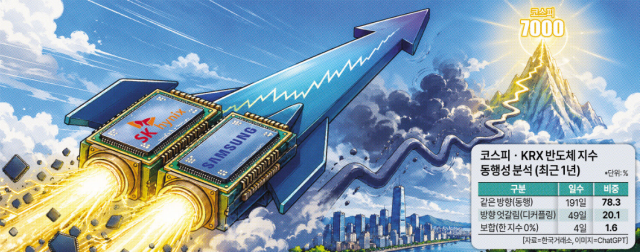
The KOSPI’s run of record highs shows little sign of slowing, with some market watchers saying the index could even push past 7,000 in short order if the trend holds. The rally has been led by semiconductors, as gains in Samsung Electronics and SK hynix — together accounting for more than 40% of total market value — have amplified the index’s rise.
Analysts say how long the rally lasts will largely depend on the semiconductor cycle. Optimists argue that an AI-driven “super cycle” could extend for a prolonged period, supporting further gains. Others warn that if the cycle turns down as it has in the past, the market could face a sharp correction.
◆ Semiconductors power the rally
Aju Economy compared the KOSPI and the KRX Semiconductor Index over the past year (April 28, 2025, to April 28, 2026; 244 trading days) and found they moved in the same direction on 191 days, or 78.3% of the period. On April 28, the KOSPI rose 0.86% while the KRX Semiconductor Index fell 0.45%.
The link was stronger on up days. Both indexes rose on 132 days, more than double the 59 days when both fell, underscoring how the KOSPI tends to respond when chip stocks gain momentum.
Days when the two diverged totaled 49, or 20.1%, including 26 days when the KOSPI rose but semiconductors fell and 23 days when the KOSPI fell but semiconductors rose. There were four days, or 1.7%, when one index was flat at 0.00%.
The results highlight the sector’s outsized influence in South Korea’s market, where large chipmakers dominate the top of the market-cap rankings. As of April 28, Samsung Electronics (including preferred shares) accounted for 26% of the market and SK hynix for 17%.
◆ How long will the “super cycle” last?
Analysts say the rally’s durability ultimately hinges on chip industry conditions. Since 2000, the semiconductor industry has typically swung between booms and downturns in cycles of three to four years. The most recent downturn was in 2022-2023, when demand for memory chips fell sharply and Samsung Electronics and SK hynix posted large losses. Their share prices were then stuck in the 50,000-won range for Samsung Electronics and the 70,000-won range for SK hynix.
The turnaround began in the second half of last year, as the AI boom drove a surge in memory-chip demand and the market entered what is often called a “super cycle.” Research firm Omdia raised its forecast for this year’s semiconductor market growth to more than 60%, projecting rapid expansion in memory. It said demand for high-bandwidth memory, or HBM, is jumping as AI data centers spread, while supply remains tight — creating a market where rising prices, unlike in past cycles, are leading the upturn.
Kim Dong-won, head of the research center at KB Securities, said AI data center and cloud companies are actively pursuing three- to five-year long-term supply agreements to secure stable memory supplies. “This trend will strengthen the durability of the semiconductor upcycle,” he said.
Still, some warn of a pullback after the recent surge. BNK Investment & Securities said in a report on April 27 that memory conditions appear to be entering a late-cycle phase, raising the possibility that demand could soften. Overseas, Goldman Sachs and others have also voiced concerns about the pace of the short-term run-up.
* This article has been translated by AI.
Copyright ⓒ Aju Press All rights reserved.