

Journalist

CGTN
-
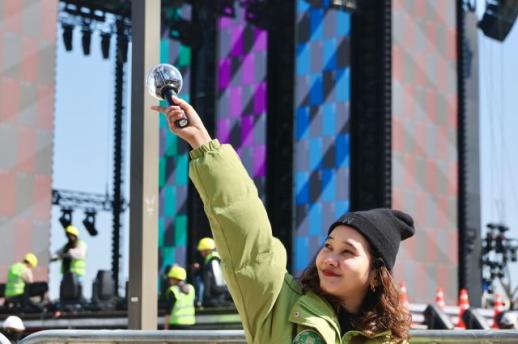 BTS Live D-2: Fans flock to Gwanghwamun ahead of BTS performance SEOUL, March 19 (AJP) - With just two days remaining until BTS's March 21 comeback performance at Gwanghwamun in central Seoul, numerous visitors are already gathering at the venue on Thursday. While workers are busy installing the stage, seating, and lighting at the iconic Seoul square, visitors are already taking photos and observing the construction site. Gwanghwamun Plaza is currently filled with tourists, with temporary walkways installed for safety control, allowing movement only along designated paths. Some fans brought light sticks and took photos in front of the stage that is being set up, enjoying the atmosphere before the global fan-festival kicks off. 2026-03-19 17:42:18
 -
 Asian stocks broadly retreat more than 2%, USD/KRW breaches 1,500 SEOUL, March 19 (AJP) - Korean stocks tumbled Thursday, tracking a broad selloff across Asia, while the won broke past the key 1,500 level against the dollar as surging oil prices and escalating Middle East tensions triggered heavy foreign outflows. The benchmark KOSPI fell 2.7 percent to close at 5,763.22, after briefly touching an intraday low of 5,738.95. The Korean won weakened to 1,500.6 per dollar at the close, breaching the psychological 1,500 threshold as risk-off sentiment intensified and capital outflows accelerated. Foreign investors led the selloff, dumping 1.87 trillion won ($1.25 billion) worth of shares on the KOSPI, while institutions sold an additional 665.9 billion won. Retail investors bought 2.41 trillion won, absorbing the bulk of the selling. The divergence in flows reflected a classic risk-off pattern, with offshore capital exiting aggressively as currency volatility spiked. Technology heavyweights bore the brunt of the decline. Samsung Electronics fell 3.8 percent to 200,500 won, while SK hynix dropped 4.1 percent to 1,013,000 won, tracking weakness in global semiconductor shares. NAVER and Kakao declined 2.7 percent and 2.9 percent, respectively. Cyclical sectors also came under pressure. Hyundai Motor fell 3.3 percent and LG Energy Solution slipped 3.3 percent, as rising oil prices and rate concerns weighed on growth-sensitive stocks. Hybe dropped 3.5 percent to 354,500 won ahead of BTS’s comeback, as broader market risk aversion overshadowed event-driven optimism. The tech-heavy KOSDAQ fell 1.79 percent to 1,143.48. Foreign investors sold 202.6 billion won on the KOSDAQ, while institutions offloaded 262.3 billion won. Retail investors bought 502.1 billion won, mirroring the KOSPI pattern. Losses were broad-based across sectors, with electronics, securities and industrials leading declines as tightening financial conditions and geopolitical risks dampened investor appetite. In contrast, select energy-linked plays rallied. SK Eternix surged 26.1 percent, extending its monthly gain to nearly 95 percent, as investors rotated into renewable energy stocks as a hedge against rising crude prices. Samsung Electro-Mechanics rose 3.34 percent. Construction stocks also outperformed, with Daewoo Engineering & Construction gaining 8.7 percent on expectations of overseas infrastructure and nuclear power projects. Overnight on Wall Street, major indexes fell, with the Dow Jones Industrial Average down 1.6 percent, the S&P 500 losing 1.4 percent and the Nasdaq declining 1.5 percent. The Philadelphia Semiconductor Index slipped 0.5 percent, while Nvidia and ASML fell 0.8 percent and 2.5 percent, respectively. Oil remained the central driver of sentiment. Brent crude surged 6.5 percent to $114.4 per barrel, while West Texas Intermediate rose to $97.3, heightening inflation concerns and reinforcing fears of prolonged supply disruptions tied to attacks on Middle Eastern energy infrastructure. Market volatility spiked, with the VIX jumping 13.8 percent to 25.5, signaling elevated investor anxiety. Across Asia, markets broadly declined under the weight of energy shocks and tightening financial conditions. Japan’s Nikkei 225 plunged 3.4 percent as investors unwound positions ahead of the Vernal Equinox Day holiday. Hong Kong’s Hang Seng fell 2 percent, while China’s Shanghai Composite dropped 1.4 percent. 2026-03-19 17:40:21
 -
 Flowers bloom in Seoul Buddhist temple as vernal equinox nears SEOUL, March 19 (AJP) - Spring flowers bloomed at Bongeunsa Temple in Seoul’s Gangnam District on Thursday, drawing visitors a day ahead of the seasonal marker Chunbun, the vernal equinox. Plum trees with red and white blossoms, and cherry flowers colored the temple grounds, offering a gentle sign of the changing season. Visitors paused to take photos or slowed their steps, enjoying the early spring atmosphere. Chunbun marks the day when daytime and nighttime are of equal length, after which daylight hours gradually become longer than the night. 2026-03-19 17:28:45
 -
 Hanwha Aerospace’s Arion-SMET Unmanned Vehicle Passes South Korean Defense Performance Test Hanwha Aerospace said on the 19th that its multipurpose unmanned vehicle, the Arion-SMET, has completed a Defense Acquisition Program Administration performance verification test as the sole participant. The vehicle is a key asset in the South Korean Army’s future force concept known as “Army Tiger 4.0.” The evaluation, conducted with full-scale equipment from the 3rd for about three weeks, assessed six items including top speed and operating range. The test was designed to compare the performance claims submitted by defense companies. Additional checks were reported to include the military’s view that remote-control distance exceeding the required performance should be compared, and whether any updates had been made to equipment entered in the verification test. Hyundai Rotem, which competed with Hanwha Aerospace for the program, did not take part after raising concerns about the fairness of the evaluation. The Army test and evaluation team previously conducted a five-month purchase trial from September 2024 to February 2025, and all companies’ equipment was judged suitable for combat use. A Hanwha Aerospace official said the company is “faithfully carrying out the project in line with all conditions required by the government,” adding that it will deliver the Arion-SMET, which it said has strong performance, in time to meet the military’s needs.* This article has been translated by AI. 2026-03-19 17:24:07
 -
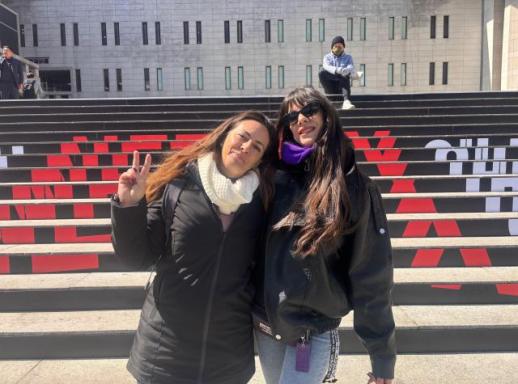 BTS Live D-2: Why ARMY are willing to come - at any cost SEOUL, March 19 (AJP) - Visitors flocking to Seoul from around the world for the BTS comeback concert Saturday are readily paying ever higher prices for flights, accommodation and merchandise, as a measure of the devotion that typifies the BTS fan. Travel costs are surging up to six times their usual levels, fans say. The willingness to absorb the burden reflects more than concert demand, underscoring a deeper dynamic of the BTS-driven “fandom economy,” where spending functions as an expression of loyalty and identity. “They don’t just sell music or tickets. They shape narratives that move people and, increasingly, markets,” said Lambert Zixin Li, professor of Management and Organization at the National University of Singapore. On the ground in Gwanghwamun, the downtown concert venue, overseas fans said rising costs did little to deter them. “I love their songs. The lyrics are so meaningful,” said Christina Coppola from Italy, who traveled with her sister. “They are strong and cool.” For many, the BTS impact runs deep. “They are my motivation for life,” said Desty Konita, a 30-year-old visitor from Indonesia who traveled to Seoul with her four-month-old child. “They work so hard, have no scandals, and remain humble despite their popularity. I really respect that,” she said, adding that she had learned Korean because of BTS. Tan Joo Seng, a professor of strategy and international business at Nanyang Business School, said such attachment reflects the need for meaning in uncertain times. “Being a fan provides individuals with a sense of belonging, identity and shared purpose,” he said. Others pointed to specific songs and long-term fandom as their reason for coming. “I really like V’s solo song ‘Winter Bear,’” said Tanaka Arisa, a 19-year-old from Japan who has followed BTS since high school. Fans in Gwanghwamun said they “had to come” despite higher expenses, viewing the event as a chance to be physically present within a global fandom community. “The scale of BTS’s upcoming concert, with the expected audience of around 260,000, shows how fandom has evolved into a significant economic force,” Tan said. “Superstar fandoms today operate as highly engaged ecosystems that generate value far beyond ticket sales.” According to a 2024 study by Luminate, an entertainment analytics platform, U.S.-based K-pop fans spent 2.4 times more on merchandise in 2023 than general pop fans. Forbes magazine noted that “creators are the new brands,” adding that the relationship between creators and fans is evolving beyond brand loyalty into a meaningful economic community. This shift is often described as the “fandustry,” where fan activity directly drives the success and market value of content. Tan explained that at the core of this system is emotional engagement, noting that modern fandoms are no longer passive audiences but active participants who amplify content, organize communities and sustain demand across digital platforms. This creates what Nanyang Business School professor Tan described as a “multiplier effect,” where each fan interaction generates further economic and cultural impact. The Indonesian fan Desty Konita said that BTS is “number one” in Indonesia and that she promotes the group with her friends. “Even if flight prices are five times higher, it’s still worth it,” Konita said. “It’s even a free concert, and opportunities like this don’t come often.” Some BTS supporters, known as the ARMY, spend up to 50–60 percent of their income on albums, merchandise and related experiences. The economic impact already evident in the data. BTS is estimated to generate around 5.5 trillion won annually, according to the Hyundai Research Institute, accounting for roughly 0.3 percent of South Korea’s GDP. In cities where concerts are held, the events drive spending across airlines, hotels, dining and tourism. The BTS fan app Weverse saw its revenue rise from 31.7 billion won (about $28.3 million) in 2019 to 112.7 billion won in the first half of 2020, accounting for around 38.3 percent of the BTS management company HYBE’s total sales. “Superstars are becoming ‘central banks of attention,’” said Lambert Zixin Li of the National University of Singapore. “When they act or speak, they inject liquidity into specific narratives, rapidly driving demand across products, experiences and even financial assets.” 2026-03-19 17:20:35
 -
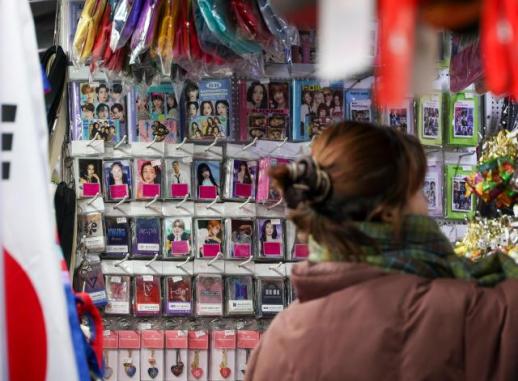 BTS Live D-2: Unofficial BTS goods surge in Seoul challenging brand control SEOUL, March 19 (AJP) - As official BTS merchandise becomes ever more expensive and ever harder to obtain ahead of the group’s comeback concert Saturday, a parallel market is emerging in Seoul and beginning to challenge the limits of brand control. In the city’s popular tourist Myeongdong and Insadong districts, unofficial BTS-themed goods have moved beyond the margins and into plain sight. Street vendors and small retailers openly display banners, printed T-shirts, photo cards, keychains and accessories. Tables stacked with BTS purple-themed items line narrow streets, while racks of printed apparel spill out onto sidewalks, blurring the boundary between formal retail space and street-level commerce. In one shop in Insadong, BTS-logo eco bags were selling for 25,000 won ($17), while metal badges were priced at 10,000 won, offering a snapshot of how unofficial goods are being priced on the ground. The contrast with official distribution is stark. Licensed goods remain limited, often require online access, and are subject to timed releases. For visitors arriving just days before the concert, the unofficial merchandise represents the only practical option. "I don’t mind buying unofficial goods," said Jeniffer Dayton, a 25-year-old visitor from Florida. For such fans, the distinction between approved and unapproved is secondary to participation itself. The ability to take part in a shared moment that is unfolding across the city counts for more. "What matters is our love for BTS,” she said. “These items are more practical, I can actually use them in my daily life, like a lanyard for my keys, unlike some official goods that I mostly keep at home." This shift is beginning to reshape the balance between brand management and on-the-ground consumption. Official merchandise carries legitimacy and scarcity, but the unofficial market operates on speed, proximity and volume, factors that become decisive in a time-sensitive, event-driven setting. "If you look at resale markets like eBay, official light sticks easily goes for over $100," said Sarah Zhong, a 31-year-old visitor from Guangzhou currently living in Washington. "Getting one for under $50 feels like a bargain but it’s usually really hard to get your hands on one." At the same time, the divide remains meaningful within parts of the core fan base, where authenticity continues to carry symbolic weight and ownership of official goods is tied to identity and loyalty. "I still prefer official goods because they feel more authentic," she said. "But if I see something I really like, especially something related to V, I might still buy it." A vendor, who asked not to be named, denied that she made the products. She said she is supplied by manufacturers and does not know if the products are licensed or not. She declined to provide further details. The fragmented supply chain reflects the speed at which the market has scaled up, with goods flowing into tourist-heavy districts in response to surging demand. The result is not simply a coexistence of two markets, but a structural tension. As Seoul transforms into a city-scale stage for BTS, the gap between controlled branding and uncontrolled demand is becoming increasingly visible, raising questions about how much of the fan experience can, or should, be managed. 2026-03-19 17:18:23
 -
 Korea Pavilion at Venice Biennale to Explore ‘Liberation Space’; Han Kang Sculpture Included The theme of the Korea Pavilion at this year’s Venice Biennale, opening in May, is “Liberation Space: Fortress and Nest.” The exhibition revisits the “liberation space” of 1945 to 1948 — the transitional period after Korea’s liberation from Japanese colonial rule and before the establishment of a new state — and extends it as an ongoing question in the present, reexamined through aesthetics. Nobel literature laureate Han Kang is also taking part. Choi Bitna, the artistic director overseeing the Korea Pavilion exhibition, said at a March 19 news conference at the ARKO Art Center in Seoul that Han’s Nobel lecture resonated with her. “As the line ‘Can the past help the present? Can the dead save the living?’ gave an echo, I couldn’t help but ask what role art — or I — can play,” she said. Choi added that the “Dec. 3 illegal martial law incident,” impeachment and a change of government awakened a shared civic awareness among South Koreans about the country’s formation and the development of its democratic system. “I hoped I could do something, with a sense of repaying those who stood in the square for a long time,” she said. The pavilion will be presented anew as a temporary monument for “liberation space,” described as both a site of liberation and an ongoing space for practicing a new concept of sovereignty. Artists Choi Go-eun and Noh Hyeri will present sculptural installations and performance-based works titled “Meridian” and “Bearing,” respectively. Choi said she focused on 1995, when the Korea Pavilion was built. “That was when the Gwangju Biennale was first held and the Korea National University of Arts was established. The demolition of the former Japanese Government-General building also began,” she said. “It was a moment of transition.” The pavilion will also invite fellows from across cultural and social fields, including novelist Han. Han is not expected to attend the exhibition opening, according to the organizers. Noh said Han created a sculpture titled “Funeral,” which will be exhibited alongside her work. “The community not only saved people, it also killed many people. She will speak about that,” Noh said. She added that “Funeral” realizes in sculpture a scene from a dream that became a motif for Han’s novel “I Do Not Bid Farewell.” Two anthologies to be published in place of a catalog will include Han’s writing, including pages 1 and 2 of “I Do Not Bid Farewell.” The Korea Pavilion will also pursue cooperation with the Japan Pavilion, described as the first such collaboration between the only two Asian national pavilions in the Giardini. Hyundai Motor Co. is the exhibition’s official sponsor. Bulgari Korea, the Doosan Yonkang Foundation, Shinhan Bank and individual donors are also providing support. 2026-03-19 17:18:15
 -
 GULF CRISIS: Price pressures and weak won deepen Korea's policy bind SEOUL, March 19 (AJP) - South Korea’s central bank is facing a growing dilemma as potential war-driven price shocks can collide with a weakening currency, tightening the room for monetary policy maneuver. Like the Federal Reserve, the Bank of Korea is widely expected to hold rates steady next month. But how long it can stay on hold will depend on the duration of the Middle East conflict and the scale of its economic fallout — from renewed inflation to rising financial risks. The disruption of the Strait of Hormuz — a vital route for energy and commodities bound for Asia — has already sent oil, shipping and raw material costs sharply higher, feeding directly into Korea’s import-dependent economy. Financial markets are reacting quickly. The dollar surged back above 1,500 won despite verbal intervention by authorities, while bond yields climbed. The 10-year government bond yield rose to 3.693 percent on Thursday, up 8.7 basis points from the previous session and nearly 25 basis points higher than before the conflict began in late February. Global energy prices have led the shock. Brent crude has jumped to above $111 per barrel, up more than 50 percent from pre-conflict levels, while Dubai crude — Korea’s key benchmark — reached $122.84 as of March 17. The surge is cascading through shipping markets. The Baltic Clean Tanker Index has nearly doubled from the start of the year, while daily charter rates for Very Large Crude Carriers have soared from about $30,000 to over $400,000, sharply raising transportation costs for fuel imports. Airlines are already passing through the burden. Asiana Airlines has nearly tripled fuel surcharges on New York routes, underscoring how quickly energy shocks are feeding into consumer costs. Industrial supply chains are also under strain. Disruptions in oil and gas imports are squeezing the production of key inputs such as naphtha and helium — both critical to refining and semiconductor manufacturing. For Korea, where exports hinge on energy-intensive industries, the implications are immediate. A report by the Korea Institute for Industrial Economics & Trade warned that even a three-week disruption in Hormuz could lift manufacturing costs by 5.4 percent. A prolonged blockade could push oil prices to $160 per barrel and drive liquefied natural gas prices up as much as 140 percent. The shock is also spreading to food and agriculture. Urea nitrogen prices — a key fertilizer component — have surged past $600 per ton from $344 at the start of the year, raising the risk of higher food prices in the coming months. “Escalating attacks in the Middle East are creating a global chokepoint for farmers,” said Alexis Maxwell, an agriculture analyst at Bloomberg Intelligence, warning of potential disruptions to fertilizer production. Korea’s vulnerability is structural. The country imports all of its crude oil and relies on Middle Eastern suppliers — particularly Saudi Arabia, the UAE, Qatar, Kuwait and Iraq — for roughly 70 percent of its supply. Until recently, inflation had remained relatively stable around the Bank of Korea’s 2 percent target, helped by softer oil prices. That dynamic is now shifting. “The simultaneous rise in oil prices and the exchange rate is expected to exert significant upward pressure on import prices,” said Lee Moon-hee, head of the BOK’s inflation statistics team. At the same time, financial risks are re-emerging. Household debt has climbed to about 1,852.7 trillion won, with mortgage-backed loans reaching 1,124 trillion won, even as the benchmark rate has remained at 2.5 percent since May last year. Rising market rates are already tightening borrowing conditions. The upper end of five-year fixed mortgage rates at major banks has exceeded 6 percent, with Suhyup Bank charging as high as 7.11 percent — the highest level in more than three years. The Bank of Korea has expressed concern over widening gaps between market rates and its policy rate. “A spread of over 0.6 percentage points between the three-year treasury yield and the benchmark rate is excessive,” Governor Rhee Chang-yong said earlier this year. That divergence is now complicating policy decisions. Cutting rates to support growth risks fueling inflation and weakening the currency further. Holding rates steady — or tightening — could deepen pressure on debt-laden households and the broader economy. If the conflict drags on, economists warn, South Korea could face a classic supply-driven stagflation shock — where slowing growth meets rising prices. The central bank, in effect, is running out of easy options. 2026-03-19 17:18:02
 -
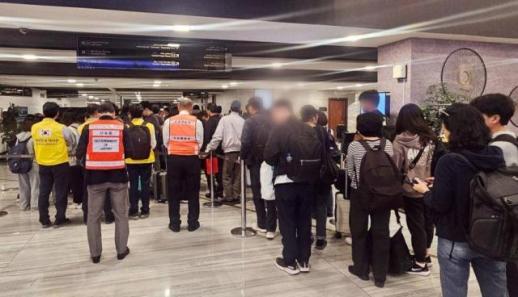 South Korea again urges nationals to leave Iran, Iraq, and Lebanon immediately SEOUL, March 19 (AJP) - The government on Thursday once again urged South Korean nationals in Iran, Iraq and Lebanon to leave immediately. The Ministry of Foreign Affairs said no South Korean casualties have been reported so far, but it remains deeply concerned about the safety of South Koreans still residing in high-risk areas across the Middle East. "We strongly urge all South Koreans and businesspeople in affected areas to leave as soon as possible," said a ministry official. According to the ministry, about 240 South Koreans are currently in Iraq, most of them construction workers employed by South Korean firms. They are coordinating with embassy officials on evacuation plans, while drone attacks targeting the U.S. Embassy in Iraq have continued in recent days. In Lebanon, about 120 South Koreans remain, many of them missionaries, with about half staying in Beirut and the rest in other areas. Concerns are growing as Israel has recently launched ground operations in southern Lebanon and expanded airstrikes in Beirut. South Korean Ambassador to Lebanon Geon Gyu-suk plans to meet South Koreans there later in the day and urge them to leave. In Iran, about 40 South Koreans still remain, most of whom have chosen to stay as they have settled lives there, after two evacuation efforts brought around 30 people home in recent weeks. 2026-03-19 17:17:16
 -
 GULF CRISIS: Hormuz as much insurance chokepoint as energy lifeline SEOUL, March 19 (AJP) - The Strait of Hormuz is not just a chokepoint for global energy flows, but for insurance that is turning pricier every day from the protracted suspension and growing risk. Ships do not pass through Hormuz simply because sea lanes are physically open. They move only when insurers are willing to price and underwrite the risk. That makes U.S. President Donald Trump’s proposal to provide war-risk insurance more than a shipping support measure. It is an attempt to stabilize the commercial logic that keeps oil flowing. In that sense, the emerging blockade is not purely military. It is financial as well — shaped as much by underwriting decisions as by missiles or mines — and increasingly dependent on who controls the information used to assess risk. U.S. President Donald Trump’s proposal to offer war-risk insurance for ships transiting the Strait of Hormuz is being presented as an effort to keep oil and cargo moving. But the move also reveals a deeper reality: in a modern maritime crisis, control over insurance — and over the information used to price danger — can matter almost as much as control over the waterway itself. The Strait of Hormuz is usually described in military terms, as a narrow corridor vulnerable to missiles, drones and naval confrontation. Yet shipping executives and insurers note that trade through the strait depends not only on naval protection but also on whether underwriters are willing to cover the voyage. In that sense, Hormuz is not just a military chokepoint. It is also an insurance chokepoint. That helps explain why Trump’s push matters even if it does not fundamentally remake the market. War-risk insurance is typically underwritten through a network of private insurers and reinsurers, many of them operating through Lloyd’s of London. Premiums are rarely withdrawn outright at the first sign of danger. More often, they are repriced sharply as risks rise, and that repricing can become a powerful barrier to trade. The shift is already visible in the numbers. Hormuz is fast turning into one of the world’s most expensive waterways as war-risk premiums surge multiple times over prewar levels. For some tankers, a single transit now carries insurance costs in the hundreds of thousands — or even millions — of dollars. According to broker Marsh, premiums for war damage coverage in the region have risen from about 0.25 percent of a vessel’s value to as high as 1 to 1.5 percent, with some deals even higher. For tanker operators, the question is no longer just whether a ship can physically pass through the strait, but whether the economics of doing so still make sense. From the perspective of the insurance industry, Trump is stepping into an existing market rather than creating a new one. “Every large loss already needs reinsurance,” a Korean Re executive said. Most vessels transiting Hormuz already rely on some layer of reinsurance from global players. The U.S. plan, in that sense, would sit on top of an existing structure rather than replace it. Still, the proposal matters because insurance is not simply a matter of capital. It is also a matter of confidence. Underwriters price risk based on the information they trust, and the marine insurance market has long relied on London as one of its central benchmarks for judging danger. The issue is not merely whether risk exists, but whether it can still be measured with enough confidence for commerce to continue. That is where the current crisis points to something larger than shipping. Much of the insurance market’s pricing power has historically rested on access to trusted information, whether from commercial intelligence, maritime monitoring or the broader Western security ecosystem. Insurers do not usually gather battlefield intelligence on their own. They inherit risk signals from the system around them. If those signals become less reliable, the implications spread quickly. Premiums rise not only because ships are in more danger, but because the market becomes less certain about how to interpret that danger. In that sense, the Strait of Hormuz is becoming a test not only of naval deterrence but of informational credibility. That, in turn, links the insurance story to a broader geopolitical question: alliance cohesion. Recent political signals have raised questions about the state of transatlantic coordination. U.K. Prime Minister Keir Starmer said Britain was not involved in the initial U.S. strikes on Iran and would not join offensive operations, while officials in London indicated they were not part of final U.S. deliberations. Even without any public breakdown in intelligence cooperation, such signals can feed doubts about whether the benchmarks that underpin global risk pricing still hold. If London is no longer fully aligned with Washington, the informational edge long associated with London-centered underwriting could come under pressure. Seen from Seoul, Trump’s insurance initiative looks more symbolic than transformative. A Korean Re executive said the impact on the global market would likely be limited, perhaps easing premiums slightly at the margin but not changing the basic fact that most vessels are already covered through existing structures. The deeper problem is that no government backstop can fully resolve a crisis of immeasurable risk. Public support can help absorb losses. It cannot by itself restore confidence if the market believes the threat environment is too unstable to price. “In a war, you cannot say with confidence that coverage will remain stable,” the executive said. South Korea is not entirely removed from these dynamics. Samsung Fire & Marine Insurance holds a significant stake in Canopius, a major insurer operating within the Lloyd’s market, making it the only Korean firm with direct exposure to this system. A Samsung Fire & Marine Insurance official said, “We are closely monitoring the current situation, but so far, neither Canopius nor we have received any reports of losses or claims.” What is unfolding in Hormuz, then, is not just a story about ships, missiles or insurance contracts. It is a story about who gets to define risk in a crisis — and how that power can shape the flow of global trade. The waterway remains a geopolitical battleground. But it is also something else: a market test of whether insurers, governments and allies still share the same picture of danger. If they do not, the real disruption may come not only from attacks at sea, but from the quiet recalculations made in underwriting rooms far from the Gulf. 2026-03-19 17:04:30