

Journalist

CGTN
-
 S.Korean fuel prices surge on Hormuz blockade, bypassing standard physical lag SEOUL, March 07 (AJP) - South Korean retail fuel prices have surged immediately following the blockade of the Strait of Hormuz, bypassing the standard two-to-three-week lag typically required for global crude fluctuations to reach domestic pumps. As of Saturday, the national average gasoline price reached 1,871.83 won ($1.39) per liter, up 178.94 won ($0.13) from Feb. 28, according to the Korea National Oil Corp (KNOC). Diesel prices outpaced gasoline, hitting 1,887.38 won per liter, raising concerns over an increase in broader logistics and transportation costs. The rapid hikes follow the escalating conflict involving the U.S., Israel, and Iran, which has disrupted transit through the Strait of Hormuz. South Korea relies on the Middle East for over 70 percent of its crude imports. Local refiners and gas stations attribute the immediate price increases to a preemptive rush to secure inventory amid supply uncertainties. Industry officials maintain that reflecting replacement costs immediately helps mitigate heavier market shocks, arguing that delaying the hikes could result in steeper, sudden price spikes later. The local surge mirrors global market anxieties. West Texas Intermediate (WTI) crude has topped $90 a barrel, with market forecasts warning it could reach $100. Global inflationary pressures are further compounded by U.S. stagflation fears, following a drop of 92,000 non-farm jobs in February and a rise in the unemployment rate to 4.4 percent. In response to domestic supply concerns, KNOC received 2 million barrels of joint-reserve crude from Kuwait at its Ulsan facility on Saturday, with another 2 million barrels from the UAE expected on March 22. South Korea currently holds 102 million barrels in strategic reserves. Meanwhile, the Ministry of Trade, Industry and Energy has launched special inspections into gas stations nationwide to crack down on illegal practices, including hoarding and price gouging. 2026-03-07 16:49:35
 -
 EV slump hits hard: SK On slashes 37 percent of Georgia plant staff SEOUL, March 07 (AJP) - SK Battery America, the U.S. unit of South Korean battery maker SK On, has laid off 37 percent of the workforce at its Georgia plant, citing slowing electric vehicle (EV) sales and a shifting market landscape. The company announced on Saturday that it cut 968 jobs out of its 2,566 employees at the manufacturing facility in Commerce, Georgia. The restructuring comes as the global EV transition loses momentum. The plant, which supplies batteries to automakers including Volkswagen and Hyundai Motor, was severely impacted by Ford Motor's recent decision to cancel production of its F-150 Lightning electric pickup truck. Ford's move follows the Trump administration's rollback of EV tax credits, prompting the U.S. automaker to pivot toward more profitable hybrid and internal combustion engine vehicles. In an emailed statement, SK Battery America called the job cuts a "difficult decision to adjust operations in line with market conditions." The company added that it remains committed to Georgia and to building a robust U.S. supply chain for advanced battery manufacturing. South Korean battery makers are facing broader headwinds as the transition from internal combustion engines to EVs decelerates in major markets like the United States. Despite the setback, parent company SK Innovation is proceeding with a second battery plant in Georgia dedicated to supplying Hyundai Motor, with production scheduled to begin in the first half of this year. Another facility in Tennessee, previously planned as a joint venture with Ford, is slated to open in 2028. A company official indicated that the Tennessee plant may supply both automotive and energy storage system (ESS) batteries. 2026-03-07 15:01:24
 -
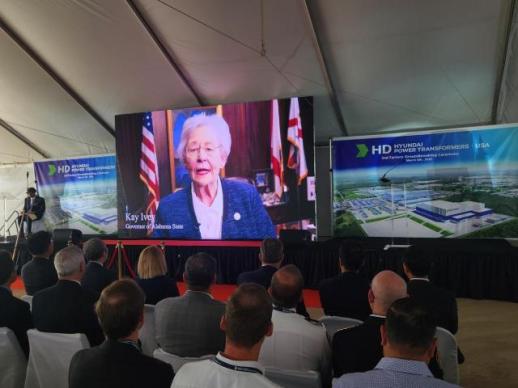 HD Hyundai Electric breaks ground on $200 mln transformer plant in US amid AI boom SEOUL, March 07 (AJP) - South Korea's HD Hyundai Electric has broken ground on a $200 million second transformer manufacturing plant in Alabama to meet surging power grid demand driven by artificial intelligence (AI) infrastructure and a resurgence in U.S. manufacturing. The power equipment maker held a groundbreaking ceremony on Saturday at its North American subsidiary in Montgomery. The new facility, spanning 48,215 square meters, is scheduled for completion in April next year. The expansion will boost the company's ultra-high-voltage transformer production capacity by 50 percent. To expedite delivery for clients such as AI data centers, which increasingly place bulk orders, the expanded facility utilizes an internal railway system that cuts transportation time by more than a week. "Through the establishment of the second plant, we will prepare for the future represented by AI by building and strengthening the U.S. transmission grid," HD Hyundai Vice Chairman Cho Seok said at the ceremony. Demand for power transformers has skyrocketed as tech companies build power-hungry data centers and the Trump administration pushes to bring manufacturing facilities back to the United States. Local politicians, including Alabama Senators Tommy Tuberville and Katie Britt, welcomed the investment via video messages, highlighting the critical role of transformers in energy policy and national security. Amid stricter U.S. immigration enforcement under the current administration, HD Hyundai Electric also emphasized its commitment to local hiring and strict visa compliance. The company plans to add about 140 local workers to its current workforce of roughly 460 once the second plant is completed. "We strictly verify immigration status during hiring and ensure all visiting staff enter with proper visas," said Kim Young-chul, Chief Operating Officer of the Montgomery plant. Since establishing its first Montgomery plant in 2011, the subsidiary's revenue has quadrupled from $100 million in 2017 to approximately $400 million in 2025. The company expects the second plant to generate an additional 200 billion won in annual sales. 2026-03-07 13:42:22
 -
 Korea Oil Groups Pledge Cooperation to Stabilize Pump Prices After U.S. Strike on Iran The Korea Petroleum Association, the Korea Petroleum Distribution Association and the Korea Gas Station Association said March 7 they will actively cooperate to help stabilize domestic fuel prices, which have been surging since the United States attacked Iran. The three groups said they will work together so that spikes in international oil prices are not rapidly passed through to prices at South Korean gas stations. The Korea Petroleum Association said it will join the government’s preemptive response system for energy supply and demand after authorities issued a “attention” level resource security crisis alert for crude oil and gas. The association said it will cooperate to ensure stable domestic supply of petroleum products and to help keep prices steady. The association noted that Singapore gasoline prices, a key benchmark used to calculate domestic prices, have been rising sharply. It warned that if those factors are reflected all at once in domestic prices, the public could face heavier burdens, including higher inflation. It said it will do its best to spread any increases over time at the pump. Domestic refiners said they will continue efforts to stabilize prices, noting that since the Russia-Ukraine war they have absorbed losses when fuel taxes were cut and immediately reflected the reductions at company-run gas stations. They also said they plan to disclose supply prices transparently to help maintain order in the petroleum market. The Korea Petroleum Distribution Association and the Korea Gas Station Association, representing fuel distribution, said they will urge agencies and gas station operators to appropriately reflect price increases during periods of sharp rises while also cooperating to keep supplies stable.* This article has been translated by AI. 2026-03-07 11:33:16
 -
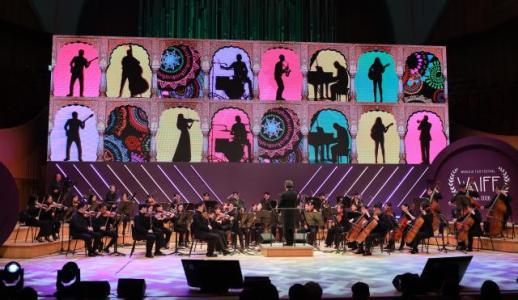 World AI Film Festival Seoul highlights how AI can expand filmmaking SEOUL, March 07 (AJP) - From scripts written with algorithms to films rendered entirely with digital tools, the World AI Film Festival in Seoul offered a glimpse of cinema’s next frontier — one where artificial intelligence works alongside human storytellers rather than replacing them. The festival, founded in Nice, France last year, brought its third edition to Seoul, a city widely seen as a global hub of high technology and the Korean cultural wave. The finale event on Friday at Lotte Concert Hall gathered filmmakers, technology companies, creators and audiences to explore how AI tools are reshaping storytelling and film production. More than 2,000 entries were submitted to this year’s competition, up from 1,500 for the inaugural festival in Nice, reflecting rapidly growing global interest in AI-assisted filmmaking. The concert hall was filled with attendees eager to witness the emerging field of AI cinema. The evening featured a purple-carpet reception, an awards ceremony and live performances, including a celebratory stage by Korean singer Insooni that drew enthusiastic applause from the audience. Several cultural figures also attended the event. Actress Hwang Seok-jeong highlighted how new technologies are opening creative opportunities for storytellers. “Anyone can now express their ideas and stories through visual media,” she said. “Events like this show how storytelling will evolve in the AI era.” The program began with a purple-carpet reception, followed by opening remarks, panel presentations and the awards ceremony. Festival founder Marko Landi said artificial intelligence is helping democratize filmmaking by lowering barriers to entry. “AI gives young creators the opportunity to make films faster and at lower cost,” he said. “One of the major objectives of this festival is to discover new talent, protect their rights and reward their creativity.” During a panel discussion, the Cheif AI Officer at the Blue House Ha Jung-woo emphasized that artificial intelligence should be seen as a creative partner rather than a replacement for filmmakers. “AI is not here to replace human creativity,” he said. “It is a tool that expands what creators can imagine and produce. The future of cinema will come from collaboration between human storytelling and intelligent technology.” Screenwriter David Bendi, who presented the screenplay award, also underscored the enduring importance of storytelling in filmmaking. “A story is the beginning of everything,” he said. “You can have all the tools in the world, but without a powerful story nothing truly happens.” Several awards recognizing AI-assisted filmmaking were presented during the ceremony. Director Kim Won-kyung won the grand prize in the AI short film category for “Known or Unknown.” The excellence award went to director Lim Da-young for “Losing,” a film that explores the emotional tension before saying goodbye to a loved one through the perspective of a mother. The encouragement award was presented to “The Dog, the Octopus and Me,” produced by AI content studio AI Revolution. The whimsical film depicts the unusual coexistence of a human, a dog and an octopus after the sea creature escapes being cooked. Jessie Yang of MiniMax, who announced the Youth Film Award, praised the creativity of emerging filmmakers. “The works submitted by young creators exceeded our expectations and showed remarkable individuality and potential,” she said. Another standout entry, “We Looked Away,” centers on a mysterious door on a mountainside that a village community silently agrees to ignore. Through the villagers’ shared silence, the story explores themes of moral responsibility, collective denial and the choices people make when confronted with uncomfortable truths. Accepting the award, filmmaker WK Kim said he had not expected the recognition. “I flew in from Seogwipo in Jeju this morning hoping to attend the festival,” he said. “I had only used AI as a work tool before, and this was the first time I tried creating content with it.” He added that the experience felt like “the beginning of a second chapter” in his life as a creator. Organizers said the festival illustrates how AI technology is rapidly transforming the filmmaking landscape, opening new opportunities for independent creators while redefining the boundaries of cinematic storytelling. 2026-03-07 11:31:16
 -
 Hanwha Systems to sell 1.7 trillion won stake in Hanwha Ocean for defense, IT investments SEOUL, March 07 (AJP) - South Korea's Hanwha Systems said it will sell a 1.7 trillion won ($1.2 billion) stake in its shipbuilding affiliate Hanwha Ocean to secure funds for strategic investments in the defense and information technology sectors. The company's board on Friday approved the sale of 13.92 million shares, representing a 4.54 percent stake, at 122,100 won per share, based on Thursday's closing price. The transaction will reduce Hanwha Systems' holding in the shipbuilder to 7.03 percent from 11.57 percent. The sale amount accounts for 29.70 percent of the company's total assets and 70.35 percent of its equity capital as of the end of 2024. The shares will be sold via an off-hours block trade scheduled for April 6, with the settlement due on April 8, the company said in a regulatory filing. The deal is structured as a one-year price return swap (PRS) agreement with seven special purpose companies: The Sara First, Felix OS First, Felix OS Second, KIS ON Tenth, KIS Prime Fourth, N2 Glory First, and N2 Glory Second. Under the terms, Hanwha Systems will compensate the buyers if Hanwha Ocean's stock price falls below the benchmark price at the time of settlement. Hanwha Systems plans to use the proceeds to accelerate investments in key projects, including a South Korea-U.S. shipbuilding cooperation initiative known as MASGA (Make American Shipbuilding Great Again). 2026-03-07 10:27:14
 -
 The King's Warden breaks Korean film drought with 10-mln crossing SEOUL, March 07 (AJP) - In the arithmetic of the Korean film industry, there are hits — and then there are “ten-million films.” Crossing the 10-million-admissions threshold in a country of roughly 52 million people bears significance beyond a commercial milestone. It means a film has escaped the gravity of niche audiences and become something closer to a shared national experience. With more than 10 million moviegoers now through theater doors, The King’s Warden has quietly joined that club — becoming the first Korean film to reach the milestone in about two years, after a prolonged blockbuster drought in local cinemas. For director Jang Hang-jun, it marks a breakthrough that took 24 years to arrive. For star Yoo Hae-jin, it represents a different kind of achievement — the fifth time he has been part of a ten-million blockbuster. In an industry increasingly fragmented by streaming platforms and shortened attention cycles, that double milestone says something larger about how Korean audiences still choose their cinema heroes. For much of his career, Jang Hang-jun was known less as a box-office director than as one of Korean television’s most versatile storytellers. He entered the industry in the early 1990s and made his directorial debut with the comedy “Break Out the Lighter” in 2002. The film drew notice for its quirky humor and sharp dialogue but never hinted at blockbuster credentials. The projects that followed — including romantic comedy “Spring Breeze” and sports drama “Battlefield Heroes” — struggled to find audiences. For years afterward, Jang’s filmography thinned. He wrote television dramas such as Sign and The King of Dramas, became a familiar face on talk shows and variety programs, and developed a reputation for quick wit and effortless storytelling. For much of the public, he was better known as the genial television personality — and as the husband of star screenwriter Kim Eun-hee, creator of hit series Signal and Kingdom. The success of The King’s Warden changes that narrative almost overnight. What once looked like a career of diversions now resembles a long apprenticeship in storytelling. Jang’s television instincts — dialogue timing, character warmth and narrative rhythm — became the film’s quiet engine. Critics note that his biggest strength lies not in spectacle but in orchestrating performances. The film’s ensemble — from Yoo Hae-jin’s grounded humor to Yoo Ji-tae’s unexpectedly imposing interpretation of historical power broker Han Myeong-hoe — feels calibrated rather than imposed. In Korean cinema terms, the industry sometimes calls this stage “the director just before becoming a master.” If Jang’s success arrives as a breakthrough, Yoo Hae-jin’s milestone feels more like confirmation. The veteran actor has now appeared in five films that surpassed 10 million admissions, joining a small group of performers who have repeatedly anchored major hits, including The King and the Clown (2005), Veteran (2015), A Taxi Driver (2017), and Exhuma (2024). Few Korean actors have navigated so seamlessly between supporting roles, comic relief and leading performances. He has brought the texture of everyday life into historical epics and genre films alike. In The King’s Warden, Yoo plays village chief Eom Heung-do, the man tasked with guarding the exiled teenage king Danjong. The character is neither hero nor villain — simply a pragmatic villager trying to survive the politics of the Joseon court. Yoo’s performance moves easily between humor and melancholy, embodying the film’s central tone: ordinary humanity in the shadow of history. The film’s success carries broader significance for the industry. In recent years, Korean theaters have struggled to reproduce the blockbuster momentum that once defined the market. Streaming services have fragmented audiences, and mid-budget films often disappear quickly from screens. Against that backdrop, The King’s Warden represents something increasingly rare: a word-of-mouth blockbuster built on emotional trust rather than spectacle. Instead of palace intrigue, the film focuses on a dethroned boy-king living among villagers — a shift that reframes tragedy through intimacy rather than grandeur. The result is a historical drama that families can watch together, bridging generations in a way few modern releases manage. It reminds of the rule of thumb: even in an era dominated by algorithms and streaming platforms, a well-told story can still draw an entire nation to the big screen. 2026-03-07 08:31:18
 -
 Test drive: Renault’s Filante hybrid aims to blend sedan comfort with SUV stability "On a straight road it feels like a sedan, and on rough pavement it feels like an SUV." That was the line that came to mind while driving Renault Korea’s next-generation hybrid model, the Filante. It is clearly an SUV, but it delivered sedan-like comfort and immediate acceleration, while adding upgraded artificial intelligence features aimed at convenience. At a test-drive event on March 4, the Filante was driven about 140 kilometers (87 miles) round trip, from an event site at Yellow Cafe in Gyeongju, North Gyeongsang province, to Nine Hill Cafe in Ulju County, Ulsan, with a passenger. The drive highlighted the vehicle’s power and quietness. The Filante shown at the event was an E-segment flagship crossover featuring an illuminated signature lozenge logo. Renault said it is based on the SUV-platform Grand Koleos body but engineered for sedan-level quietness and ride comfort by technically lowering its center of gravity. At the turnaround point at Nine Hill Cafe, the driver took the wheel. In warm weather, a press of a button followed by the voice command, "Turn on the ventilated seat," prompted the car to respond immediately. The feature is enabled by SK Telecom’s A.Dot Auto voice service, which the company says can remember conversational context and continue answers based on follow-up questions. On the Ulsan expressway, the body felt stable and the accelerator response was quick. The electric motor stepped in rapidly, keeping initial acceleration brisk, with a sense of the chassis holding firm from below. The Filante uses Renault’s Hybrid E-TECH powertrain: a 100-kilowatt drive motor and a 60-kilowatt starter motor paired with a 1.5-liter turbo direct-injection gasoline engine for a maximum 250 horsepower. Renault said a large-capacity lithium-ion battery allows up to 75% of city driving in electric mode. On the winding Unmunsan section, the Filante showed SUV-like stability. It offers multiple drive modes, including Sport, Eco and AI. In Sport mode, responses felt more aggressive; in AI mode, it appeared to adapt to conditions and delivered a steadier feel. Even on rough surfaces, the body stayed composed through corners, maintaining balance. The driver’s seat, finished in Nappa synthetic leather, sits relatively high and provided firm lower-back support for long-distance comfort. Wind and road noise were noticeably reduced. With acoustic glass and an active noise-cancellation system, the cabin did not become uncomfortably loud even at speeds above 110 kph (68 mph), reinforcing the sedan-like quiet. In highway congestion, cruise control proved useful. The Filante includes 34 advanced driver-assistance systems, Renault said, including lane-departure prevention and an emergency steering assist designed to help the vehicle avoid sudden hazards. Returning to Gyeongju on national roads, the word that came to mind was "identity." On straight stretches, it tracked steadily like a sedan, while the cabin remained quiet. A front passenger panoramic screen provided access to the internet and other content, and the radio speaker sound quality was satisfactory. Renault said a karaoke function will be added later through an update.* This article has been translated by AI. 2026-03-07 08:03:34
 -
 Hanmi Pharmaceutical Faces Renewed Governance Fight Ahead of Shareholder Meeting A governance dispute at Hanmi Pharmaceutical has reignited after cracks emerged in a “four-party alliance” formed in the name of stabilizing control of the group. The market is watching the company’s regular shareholders meeting expected later this month as a potential turning point for Hanmi’s governance, with a likely vote battle over whether CEO Park Jae-hyun will be reappointed and how the board will be reshaped. According to the industry on the 7th, the Hanmi Pharmaceutical Group ended a family management-control dispute that had continued from 2024 after Chairwoman Song Young-sook, Hanmi Pharmaceutical Group Vice Chairwoman Lim Ju-hyun, Hanyang Precision Chairman Shin Dong-kuk and private equity firm La Defense Partners joined forces to form the four-party alliance. Centered on Hanmi Science (41.42% stake), the alliance secured a majority of voting rights at Hanmi Pharmaceutical and launched a professional management system. Hanmi Pharmaceutical posted strong results last year, with revenue of 1.5475 trillion won and operating profit of 257.7 billion won, appearing to move into a more stable phase. Tensions surfaced late last year as Shin pressed what the article described as management interference. Shin increased his stake in Hanmi Science to as much as 30% and opposed Park’s reappointment, calling Hanmi Pharmaceutical “a corrupt organization.” Song, however, publicly backed Park, saying, “Major shareholders should not directly intervene in management and should only present a sound direction.” With the alliance’s shareholder agreement on joint voting effectively neutralized, the lines of confrontation have sharpened ahead of the meeting. Attention is focused on the Hanmi Pharmaceutical shareholders meeting expected this month, where Park’s reappointment and a board overhaul are key agenda items. Shin has continued buying shares, raising his overall stake to 29.83%. Song’s side has secured 25.58% of voting rights, including shares held by the Im Seong-gi Foundation. The National Pension Service (6.64% stake) and retail shareholders, who account for about 30%, are also expected to be pivotal. At the center of the dispute is whether to keep the professional management system. Song has stressed governance stability, saying, “Founder Chairman Im Seong-gi also trusted professional managers,” while Shin has countered by pointing to “insufficient internal controls.” If Park wins reappointment, the current board is expected to remain and the professional management system would likely be reinforced. If the proposal fails, directors aligned with Shin could enter the boardroom, and the dispute could drag on. An industry official warned that despite pipeline progress in areas such as obesity and diabetes, management uncertainty could weigh on the stock price and hinder technology transfers, adding that governance risk could hurt global partnerships. The official said the meeting will be watched as either a turning point for Hanmi’s future or the start of a “third round” of the dispute.* This article has been translated by AI. 2026-03-07 06:04:21
 -
 BTS’ Gwanghwamun comeback show set to draw huge crowds and boost Seoul economy BTS’ comeback stage at Seoul’s Gwanghwamun Square is two weeks away, and the city is already bracing for a surge of visitors. The group is set to hold a concert on the 21st to mark the release of its fifth full-length album, “Arirang (ARIRANG).” Retailers and the tourism industry are preparing for fans of the global BTS fandom known as ARMY arriving from around the world, with attention focused on the event’s economic ripple effects. ◇ 15,000 tickets gone in 30 minutes; officials forecast 260,000 people According to the industry on the 6th, general ticket sales for the Gwanghwamun concert — 15,000 seats sold through NOL Ticket last month — sold out in 30 minutes. Police and the Seoul city government estimate about 260,000 people will gather on the day of the show, centered on Gwanghwamun Square where the stage will be installed and extending to Deoksugung’s Daehanmun Gate and the area around Sungnyemun. Fans who failed to get tickets have already been camping near the seating area to get as close as possible, underscoring the intensity on the ground. Nearby lodging has been scarce. Hotels and guesthouses in the area are fully booked, and remaining rooms are being offered at prices several times higher than usual. Nearby shopping districts such as Myeongdong are also promoting BTS-related merchandise as they prepare for an influx of foreign visitors. ◇ Gyeongbokgung to close; Sejong Center cancels shows amid safety concerns The Korea Heritage Service said it will close Gyeongbokgung Palace and the National Palace Museum of Korea on the 21st to prevent safety accidents tied to crowding. The Sejong Center for the Performing Arts also canceled all indoor performances scheduled for that day, including musicals and ballet. BTS members are expected to follow a “king’s road” route — starting at Geunjeongjeon Hall inside Gyeongbokgung, passing the Woldae platform at Gwanghwamun and then taking the stage — a plan that organizers say will be broadcast live worldwide. ◇ KCTI estimates up to 1.2 trillion won per show; Gwanghwamun seen amplifying impact Industry officials expect the concert’s economic impact to reach the trillions of won. The Korea Culture & Tourism Institute has estimated that a single BTS concert in South Korea at a 65,000-seat venue after the end of the COVID-19 pandemic could generate an economic ripple effect ranging from at least 619.7 billion won to as much as 1.2207 trillion won. A research team led by Korea University Business School professor Pyeon Ju-hyeon found the direct and indirect economic impact of BTS’ three-day final concert at Jamsil Olympic Stadium in 2019 totaled about 922.9 billion won. A single concert held at Busan Asiad Main Stadium in 2022 was also assessed to have produced an economic effect approaching 1 trillion won. Some in the culture and tourism industry said the Gwanghwamun show’s reach could be larger because it will be livestreamed worldwide via Netflix and staged at what they called the symbolic heart of the nation’s capital. They said the impact could extend beyond tourism revenue to indirect value such as promoting K-culture and strengthening national branding. * This article has been translated by AI. 2026-03-07 06:03:24