

Journalist

CGTN
-
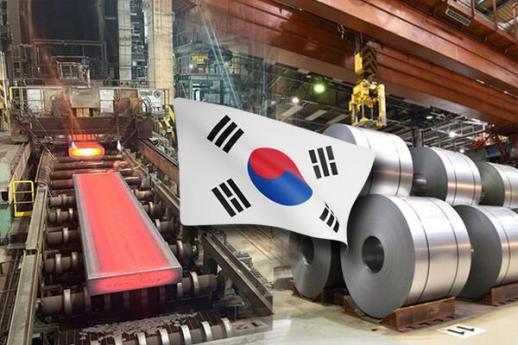 Seoul opts for antidumping duties on Chinese, Japanese steel for industry relief SEOUL, February 24 (AJP) - South Korea's shipbuilders enjoy heyday on robust orders and backlog, but they had limited trickle-down effect on steelmakers at home as they struggled with the flood of cheaper Chinese and Japanese imports. The government stepped in for relief as the industry undergoes stringent cost-saving streamlining to survive a global glut, a protectionist environment and the U.S. 50-percent tariff on steel imports. On Monday, it warned of antidumping duties of up to 33.43 percent on steel imports after a yearlong investigation. The Korea Trade Commission (KTC), which operates under the Ministry of Trade, Industry and Energy, recommended a set of penalty duties to the Minister of Economy and Finance for final approval. The tariffs, ranging from 28.16 percent to 33.43 percent depending on the exporter, will replace provisional duties that have been in force since September 2025. It will hear counterclaims from nine exporters — three Japanese and six Chinese firms — that together accounted for about 81 percent of South Korea's total hot-rolled steel imports over the past three years. Focus on hot-rolled coils The judgment centers on hot-rolled coils (HRC), the foundational building block of the modern steel supply chain. Produced by rolling heated steel slabs at temperatures exceeding 1,000 degrees Celsius, HRC serves as the primary feedstock for downstream products including cold-rolled sheets, galvanized steel, steel pipes and color-coated plates. South Korea's domestic HRC market alone is valued at about 10 trillion won ($6.92 billion) annually. Because HRC is a commodity-grade material with minimal technical differentiation, pricing is the dominant factor in purchasing decisions, making it especially vulnerable to low-cost import competition. Sector downturn deepens The antidumping action comes as South Korea's broader steel sector grapples with its worst downturn in years. Domestic reinforcement bar (rebar) consumption plunged to a 25-year low in 2025, dragged down by a prolonged slump in the construction industry, according to the Korea Iron & Steel Association. Rebar usage shrank 14.4 percent year on year to 6.66 million tons, the lowest since the association began tracking the data in 2000. Local steelmakers, strained by Chinese oversupply, slowing domestic demand and U.S. tariffs, have resorted to restructuring to survive. Hyundai Steel has decided to permanently shut down one production line at its Incheon rebar plant, while Dongkuk Steel halted production at its own Incheon facility due to similar overproduction issues. Earnings under pressure End-year results show that the financial toll has been stark. Dongkuk Steel's full-year 2025 operating profit tumbled 42.1 percent to 59.4 billion won on revenue of 3.2 trillion won. POSCO Holdings saw consolidated operating profit drop 16 percent to 1.83 trillion won as revenue slipped 5 percent to 69.1 trillion won. Hyundai Steel, which filed the original antidumping petition in December 2024, posted 2025 revenue of 22.7 trillion won, down 2.1 percent, though its operating profit rose 37.4 percent to 219.2 billion won, buoyed by lower raw material costs. However, the company posted an earnings shock in the fourth quarter, with revenue of 5.5 trillion won and operating profit of 43.3 billion won, plunging 53.6 percent from the previous quarter and sharply missing market expectations. Price gap narrows The root of the trade remedy lies in a widening price gap. Japanese and Chinese HRC was sold in the Korean market at an average of about 708,000 won per ton in July 2025, roughly 12.8 percent cheaper than comparable domestic products priced at 812,000 won. After stripping out tariffs and logistics costs, exporters' home-market prices were estimated to be 15 to 20 percent below Korean mills' prices. Provisional duties took effect in September 2025, narrowing the price differential to about 5 percent and resulting in import decline. The government projected that domestic HRC shipments could rise by more than 1 million tons, lifting local producers' market share by about 8.9 percentage points. Some analysts say the latest U.S. tariff measures may have a more limited impact than feared. "The steel tariffs were already imposed during Trump's first term under Section 232 of the Trade Expansion Act, which allows the president to impose duties on national security grounds, so the impact is limited," said Park Sung-bong, an analyst at Hana Securities. "The Trump administration is reportedly reviewing a reduction in tariffs on derivative products containing steel and aluminum. If this materializes, exports of those products to the U.S. could recover, which is expected to have a partially positive effect on domestic steel demand." 2026-02-24 14:32:32
 -
 107th National Winter Sports Festival Opens Feb. 25 in Gangwon; Yu Seung-eun, Cha Jun-hwan to Compete The Korean Sport and Olympic Committee said Tuesday it will hold the 107th National Winter Sports Festival, the country’s largest winter sports event, from Feb. 25-28 across Gangwon Special Self-Governing Province. Competition will be held in eight sports: skating, ice hockey, skiing, biathlon, curling, bobsleigh and skeleton, mountaineering, and luge. A total of 4,380 people — 2,797 athletes and 1,583 officials — from 17 cities and provinces will take part across five divisions: under 12, under 15, under 18, university and general. Speedskating (Jan. 12-14) and short-track (Jan. 15-18) were staged as preliminary events. The main competition begins on the opening day, Feb. 25. The opening ceremony is set for 5 p.m. Feb. 25 at Mona Yongpyong Bliss Hill Stay. The committee said the event is expected to carry the momentum of the 2026 Milan-Cortina d’Ampezzo Winter Olympics at home. Competitors are to include Yu Seung-eun, who won bronze in women’s snowboard big air at the Winter Olympics, along with South Korea’s figure skating stars Cha Jun-hwan and Lee Hae-in. Detailed information, including schedules and results, will be provided in real time on the official website. Figure skating will be televised live on KBS N SPORTS, while ice climbing (mountaineering) and luge will be streamed via YouTube on the official site.* This article has been translated by AI. 2026-02-24 14:27:00
 -
 S-Oil Promotes Key Executives Ahead of Shaheen Project Startup S-Oil has reshuffled and promoted executives ahead of the planned January commercial startup of its Shaheen Project, moving key leaders to the forefront to strengthen launch preparations and stabilize early operations. The company on Monday announced promotions for three vice presidents, eight senior managing directors and four managing directors. Many of those promoted lead organizations responsible for Shaheen Project operations. Among the vice president promotions was Lee Jeong-ik, head of the Shaheen Project Headquarters. Promoted to senior managing director were Lee Uk-yong, who leads Shaheen Project operations, and Heo Seong-hun, head of the project technology division. The moves bolster both overall management and the operations and technology lines as the company focuses on stabilizing the project’s operating organization. Also promoted to vice president were Jeong Yeong-gwang, head of the chemical production headquarters, and Lee Geon-myeong, head of the domestic sales headquarters. Promoted to senior managing director were Lee Gyeong-mun, head of the new business division; Lee Jeong-il, head of the central region headquarters; Kim Seung-hu, head of the supply and demand division; Shin Jong-cheol, head of the lubricants sales division; Seo Gyeong-seop, head of the general affairs division; and Shin Bong-su, head of the RFCC1 plant. Promoted to managing director were Ahn Jeong-woo, head of the management planning division; Lee Hyeon-min, head of the southern region headquarters; Yang Hyeon-jun, head of the logistics division; and Kim Hyeon-woo, head of the domestic sales division. The Shaheen Project is a large-scale development in the Onsan National Industrial Complex, with a total investment of 9.258 trillion won on about 880,000 square meters. Construction began in March 2023, with mechanical completion targeted for late June this year. After test runs, the project is scheduled to begin commercial operations in January next year.* This article has been translated by AI. 2026-02-24 14:12:19
 -
 More South Koreans flock to national parks, with Mt. Bukhansan most visited SEOUL, February 24 (AJP) - Some 43.31 million people visited national parks last year, with Mt. Bukhansan seeing the most visitors, according to data released by the Korea National Park Service on Monday. It was a 6.5 percent increase from the previous year and a full recovery from the sharp drop seen during the coronavirus pandemic, when the number of annual visitors fell into the 30 million range from a pre-pandemic high of around 43 to 44 million. The number climbed back above 40 million in 2024 and has remained there since. Mt. Bukhansan was visited by 7.53 million people, up about 540,000 from the previous year, accounting for 17.4 percent of all national park visits. Its steady draw reflects its easy access from the Seoul metropolitan area, along with a diverse range of trails and walking paths. People also headed in large numbers to other major parks. Gyeongju National Park in the southeastern city ranked second with 4.21 million visitors, up 9 percent from a year earlier, largely due to the city's hosting of the Asia-Pacific Economic Cooperation summit last fall. It was followed by Hallyeohaesang National Park with 3.79 million visitors and Jirisan National Park with 3.23 million. The service's chairman, Joo Dae-young, said it will strive to "provide a safe and comfortable environment so that national parks remain a leading natural retreat for the public." 2026-02-24 14:10:03
 -
 OPINION: Another year of Russian aggression against Ukraine SEOUL, February 24 (AJP) - Today, the world marks the fourth year since the start of Russia's large-scale invasion of Ukraine. After four years of war, 2026 must be the year the war comes to an end. The European Union’s view is crystal clear. We want peace in Ukraine, and we want this peace to last. Peace must be just, durable, credible and consistent with international law. Whether aggression is rewarded or rebuffed will either encourage or discourage aggressors in other regions, including the Indo-Pacific. But still today, Russia is intensifying its attacks and targeting and killing civilians every day. Last year was the deadliest for Ukrainian civilians since the full-scale invasion. Russia’s bombing of Ukraine's energy infrastructure has left millions of people facing darkness, cold, and water shortages during the coldest winter since 2022. This must end. Ukrainians continue to demonstrate incredible resilience, and they deserve peace. Since the beginning of the war, the Republic of Korea has been an ally and friend. Last year, at the high-level meeting of the United Nations Security Council on the maintenance of international peace and security on Ukraine, Foreign Minister Cho reaffirmed Korea’s “unwavering commitment to respect for internationally recognized borders, and in particular, to upholding the sovereignty, independence, and territorial integrity of Ukraine”. All UN member states must uphold the UN Charter, as the cornerstone of the international order. How this war ends will further shape the future standing of these principles, already under immense test elsewhere. To compound its disregard for international law and commitments, Russia has engaged also in wide-ranging military cooperation with North Korea. The transfer of ballistic missiles, ammunition, and even troops constitutes a flagrant violation of multiple UN Security Council resolutions, that Russia itself had supported. These transfers not only prolong the war in Ukraine; they also provide North Korea with funds, military experience, and technical insights that contribute to advance its illegal nuclear and ballistic missile programmes and lead to escalatory behaviour. This cooperation undermines the global non-proliferation regime and raises serious security concerns on the Korean Peninsula. At the UN, European countries and other like-minded partners have joined Seoul in condemning these violations of the UN Charter. Just like the Republic of Korea, we, members of the European Union, want peace in Ukraine, and we want this peace to last. Peace must be durable, credible, and consistent with international law, which protects countries large and small — both in Europe and in the Indo-Pacific. The European Union stands fully behind Ukraine and is actively contributing to the US-led peace efforts, in coordination with partners. As discussions continue, the EU’s priorities remain clear. First, any agreement should deliver a just, stable and lasting peace. And it should ensure real security. Second, we must uphold Ukraine's sovereignty. There cannot be a unilateral carving up of a sovereign nation state. Borders cannot be changed by force anywhere in the world. Third, we must secure Ukraine's financial needs, so that it can continue defending itself, be in a position of strength at the negotiation table and rebuild what Russia has destroyed. Since February 2022, the EU has stood united in its unwavering support for Ukraine. We are providing substantial political, economic and military support to Ukraine, while isolating Russia and implementing an ever-widening net of sanctions directed against Russia’s war machine. Most recently, in December 2025, The EU has decided on a loan of €90 billion for 2026 and 2027 for Ukraine. With this support, we want to make sure that Ukraine can bolster its defence on the battlefield; strengthen its defence capabilities for a peace agreement; and keep running basic services, including water, heating and electricity. We have reaffirmed Europe's commitment to the security, defence, and European future of Ukraine. This should serve as a stark reminder to Russia and a message to the world: Europe will always stand with Ukraine. The EU is very grateful to the Republic of Korea for its humanitarian aid for Ukraine. During this extremely difficult winter, Ukraine urgently needs more equipment for the rapid restoration of power, heating, and water supply, as well as air defence. We call on all our partners, including the Republic of Korea, to strengthen their support to Ukraine and contribute to easing the suffering of its people. The implementation of sanctions is also a very important part of what the international community can do for Ukraine. In 2024, the Republic of Korea announced a significant expansion of its export controls against Russia and Belarus. These restrictions are not merely symbolic. They prevent the transfer of many advanced technology items, helping to weaken Russia’s military capabilities, including those that are criminally used to destroy apartment buildings, energy and other civilian infrastructure The principles at stake in Ukraine — sovereignty, territorial integrity, respect for international law — matter to all of us, whether in Europe or the Indo-Pacific. As in the days of the Korean war, the international community must come together to stop the aggression and the suffering. Let us work together so that 2026 is the year Russia abandons its imperialistic goals, ends its unprovoked aggression and engages in a lasting peace in Ukraine. 2026-02-24 13:55:27
 -
 Korea Association for Performing Arts for the Disabled to Hold 2026 D&LU Auditions for Blind Musicians The Korea Association for Performing Arts for the Disabled, led by Chairman Ryu Ji-hoon, said it will hold auditions for its “2026 D&LU (Discover & Level Up) Project,” aimed at building a professional performance pathway for blind musicians. The D&LU Project is a four-step training program: auditions, tailored lesson support, an intensive music academy and a final showcase concert. The association said the goal is to develop self-sustaining professional musicians through structured instruction and stage experience, rather than one-time support. The first-round audition will be based on one free-choice piece, with selections focused on musical potential and room for growth. In the second stage, participants will receive one-on-one lessons with expert instructors, along with theory and practical training. The third-stage music academy will provide intensive training and ensemble programs to strengthen performance readiness. The final-stage showcase will serve as an official stage to share the year’s results with the public. The program is supported by the Ministry of Culture, Sports and Tourism, the Korea Sports Promotion Foundation and the Korea Disability Arts & Culture Center. Applicants must be blind and living in South Korea; there are no limits on age, experience or nationality. Recruitment covers all music fields, including piano, strings, woodwinds, brass, vocal and a cappella. Applications will be accepted from Feb. 12 through 6 p.m. March 6. Performance evaluations are scheduled for 2 p.m. March 12 at the chapel of Hanshin University. Final results are to be announced March 16. A representative of the association called the D&LU Project “a platform to systematically identify blind artists with potential and help them grow into professional performers,” adding, “We look forward to strong participation from musicians with passion and promise.” Details on how to apply and other information are available on the association’s website.* This article has been translated by AI. 2026-02-24 13:51:16
 -
 Panic Duo Lee Juck and Kim Jin-pyo to Hold First Solo Concert in 20 Years Singer Lee Juck and rapper Kim Jin-pyo, the duo known as Panic, will stage a solo concert for the first time in 20 years. According to Music Farm Entertainment on the 24th, Panic will perform “2026 Panic Concert - Panic Is Coming (PANIC IS COMING)” from April 16-19 at the LG Signature Hall of LG Arts Center Seoul in Gangseo-gu, Seoul. Panic debuted in 1995 and released four albums, producing songs including “Snail,” “Left-Handed,” “UFO” and “The Sea in My Old Drawer.” The group built a lasting reputation in Korean pop music with experimental yet widely popular tracks. Ticket sales begin at 4 p.m. on the 25th through the LG Arts Center Seoul website and NOL Ticket. * This article has been translated by AI. 2026-02-24 13:48:17
 -
 EFK Chairman Sohn Kyung-shik Wins Unanimous Fifth Term, Pledges Stronger Business Unity Sohn Kyung-shik has won a fifth term as chairman of the Korea Employers Federation, known as EFK. EFK said it held its 57th annual general meeting on Monday at the Westin Josun Hotel in Seoul and unanimously reappointed Sohn with the backing of its leadership and member companies. Sohn first took the helm in March 2018. With Monday’s vote, he will lead the group for two more years through 2028. EFK has no term-limit rule. EFK’s leadership said Sohn has played a central role over the past eight years on major labor and economic issues, contributing to improvements in the business environment and raising the group’s policy standing. EFK said policy uncertainty around labor issues has grown, including debate over the so-called Yellow Envelope Act — amendments to Articles 2 and 3 of the Trade Union and Labor Relations Adjustment Act — making Sohn’s experience and leadership more necessary. In his opening remarks, Sohn said the government’s push on key policy tasks is expected to accelerate and that discussions of policies that could burden companies may also expand. “I will further strengthen cooperation across the broader business community,” he said. He said EFK would fulfill its responsibility as a representative business group so that corporate views are reflected in policy in a balanced way. He added that, regarding the revised union law set to take effect March 10, EFK will focus on conveying business concerns to the government and National Assembly and on supporting member companies in reasonable collective bargaining. On debate over extending the retirement age, a major labor issue this year, Sohn said he would seek a “win-win” approach that aligns with youth employment through flexible options such as rehiring after retirement. He also pledged continued efforts to push deregulation and tax improvements, expand flexible working hours, spread job- and performance-based pay systems, and establish a prevention-focused industrial safety environment. At the meeting, EFK also reappointed Executive Vice Chairman Lee Dong-geun, 22 non-executive vice chairmen and two auditors, following the chairman’s recommendations. Keum Seok-ho, president of HD Hyundai Heavy Industries, was named a new non-executive vice chairman, and Jin Yong-min, CEO of Seoul City Gas, was appointed a new auditor.* This article has been translated by AI. 2026-02-24 13:28:13
 -
 KOSPI extends rally despite global headwinds and profit-taking SEOUL, February 24 (AJP) - Korean stocks extended their upward momentum Tuesday despite a choppy start, shrugging off overnight losses on Wall Street driven by tariff uncertainty and rising Middle East tensions. Seoul’s benchmark KOSPI advanced 1.42 percent to a fresh all-time high of 5,929.14 as of 11:15 a.m., while the KOSPI 200 gained 1.66 percent to 880.21. Overnight in the United States, the Dow Jones Industrial Average fell 1.7 percent, the Nasdaq dropped 1.1 percent and the S&P 500 declined 1.0 percent, reflecting caution over trade frictions and concerns about AI-driven industry disruption. Despite the pullback, most Asian markets remained resilient. Institutional investors led the rally, piling into large-cap shares as foreign and domestic investment banks raised their targets for the main index. Nomura Securities recently projected the KOSPI could climb to 8,000. Domestic institutions bought more than 1 trillion won worth of shares, offsetting net retail selling of 945.2 billion won. Semiconductor heavyweights remained firm. Samsung Electronics rose 0.7 percent to 194,400 won, while SK hynix advanced 2.1 percent to 971,000 won, sustaining momentum in memory-related stocks. Sector performance was mixed. Telecommunications equipment led gains, climbing 5.8 percent. Hanwha Vision surged 23.9 percent on expectations that its semiconductor equipment subsidiary would benefit from continued high-bandwidth memory investment. CJ ENM also gained 5.75 percent. In contrast, petrochemical shares weakened. Hanwha Solutions fell 2.3 percent amid uncertainty over the government’s upcoming restructuring package for the sector. Risk-off sentiment was evident in commodities. Gold jumped 2.84 percent to $5,225.6 per ounce, while silver climbed 5.13 percent to $86.6, reflecting safe-haven demand following former U.S. President Donald Trump’s renewed deadline to Iran over its nuclear program. In currency markets, the won weakened slightly, with the dollar up 0.5 won to 1,446.5 won. Across Asia, markets were mixed. Hong Kong’s Hang Seng Index fell 1.6 percent, while China’s Shanghai Composite rose 0.7 percent. Japan’s Nikkei 225 added 0.6 percent. 2026-02-24 11:29:41
 -
 Korea's consumer confidence strongest in 3 mo Feb on buoyant stocks and exports SEOUL, Feb. 24 (AJP) — South Korea’s consumer confidence rose to its strongest level in three months in February, buoyed by a robust stock market and resilient exports, central bank data showed Tuesday. According to the Bank of Korea, the composite consumer sentiment index (CCSI) stood at 112.1 in February, up from 110.8 in January and 109.8 in December. A reading above 100 indicates that optimism outweighs pessimism compared with the long-term average. The index measuring perceptions of current economic conditions rose 5 points to 95, while the six-month outlook climbed 4 points to 102, indicating that more consumers expect overall conditions to improve. Employment sentiment also strengthened, with the subindex for job prospects edging up 2 points to 93. Sentiment on prices and housing inflation stabilized. One-year inflation expectations remained unchanged at 2.6 percent, while expectations for interest rates ticked up 1 point to 105. The current living standards index held steady at 96, while the outlook index rose 1 point to 101. The prospective household income index remained at 103, and the expected household spending index was unchanged at 111. Overall, improved assessments of macroeconomic conditions offset stable household income expectations, keeping consumer sentiment firmly in optimistic territory above its long-term average. The prospective interest rates index has risen steadily since November, climbing from 98 to 105 over four months, as higher bond yields and persistent global rate uncertainty led consumers to expect borrowing costs to remain elevated for longer. Perceptions of household savings and debt showed mixed signals. The current household savings CSI rose 1 point to 100, and the savings outlook CSI increased 1 point to 102. In contrast, the current household debt CSI remained unchanged at 99, while the debt outlook CSI edged down 1 point to 96. Expectations for prices and asset values shifted modestly. The overall price level outlook CSI slipped 1 point to 147. The housing price outlook CSI fell sharply by 16 points to 108. The wage outlook CSI was unchanged at 123. Inflation expectations remained broadly stable. Perceived inflation over the past year stood at 2.9 percent, unchanged from January. Expected inflation for the next year held at 2.6 percent, while three-year and five-year ahead expectations were both unchanged at 2.5 percent. Despite a moderation in headline inflation, higher prices for processed foods and seafood helped keep inflation expectations steady. In terms of distribution, the 2–3 percent range accounted for the largest share of responses for one-year ahead inflation expectations at 29.7 percent. The same range was also most cited for three-year ahead expectations at 29.8 percent and five-year ahead expectations at 28.2 percent. Overall, inflation expectations remained anchored, housing price expectations cooled significantly, and household savings sentiment improved slightly, while debt outlook perceptions softened. However, households continued to cite agricultural products and utilities as the main drivers of expected price increases over the next year. 2026-02-24 11:25:46