

Journalist

Chang SeongWon
-
 Lee Jae-myung says South Korea, Vietnam expanding cooperation from infrastructure to future industries Lee Jae-myung said April 22 that South Korea is pursuing broad cooperation with Vietnam, ranging from “hardware” sectors such as logistics, transportation, energy and infrastructure to future industries including science and technology, intellectual property and creative industries. Lee, on a state visit to Vietnam after visiting India, made the remarks in a joint press statement after a summit with To Lam, the Communist Party general secretary and state president. Lee said South Korea is “the best partner” for Vietnam’s vision of becoming a high-income advanced country by 2045. The two leaders said the summit further strengthened cooperation under their “comprehensive strategic partnership.” They said the countries agreed to develop trade and investment ties on a more mutually beneficial basis to meet a goal of $150 billion in trade by 2030. Following is the full text of the South Korea-Vietnam joint press statement: Thank you to General Secretary To Lam and the people of Vietnam for inviting me and our delegation and for your warm welcome. After the launch of South Korea’s new government last year, the general secretary visited South Korea as the first state guest. This time, I am visiting as the first state guest following the launch of Vietnam’s new leadership. I believe this is a special scene that shows how close our relationship is. I am also very pleased to see firsthand Vietnam’s dynamic development under General Secretary To Lam’s leadership. Vietnam is South Korea’s third-largest partner for trade and investment, and South Korea is Vietnam’s largest investor. About 10,000 South Korean companies have entered Vietnam across sectors including petrochemicals, shipbuilding, steel and electronics, building a high level of economic partnership. As the best partner for Vietnam’s vision of becoming a high-income advanced country by 2045, South Korea is pursuing wide-ranging cooperation from logistics, transportation, energy and infrastructure to future industries such as science and technology, intellectual property and creative industries. At today’s talks, we agreed to further strengthen this “comprehensive strategic partnership.” I will outline the main outcomes of the summit. First, to achieve the goal of $150 billion in trade by 2030, we agreed to develop trade and investment cooperation on a more mutually beneficial basis. For the first time, the two countries agreed to mutually export heat-treated processed meat. Based on the memorandum of understanding on cooperation in animal health and quarantine signed this time, we agreed to accelerate cooperation to expand trade in agricultural and livestock products. I again thank General Secretary To Lam for highly valuing the role of our companies in Vietnam and for saying he will actively work to ensure stable and predictable business conditions for them. Second, based on firm mutual trust, we agreed to strengthen strategic cooperation in energy and infrastructure. We shared the view that cooperation is even more necessary amid supply-chain instability stemming from the recent Middle East situation. We agreed to work more closely to strengthen energy security and stabilize supply chains. Tomorrow, a contract will be signed for South Korea to export rail cars for Ho Chi Minh City’s urban railway. I hope the contract contributes to improving Vietnam’s rail infrastructure and leads to expanded cooperation on major transportation and logistics infrastructure projects Vietnam is pursuing. We also agreed to communicate closely so that projects such as new cities and new airports, which Vietnam is pursuing as part of its national development vision, can produce many model cases of bilateral infrastructure cooperation. Third, we agreed to expand cooperation in forward-looking areas including science and technology, climate change and the environment, and culture and education. I expressed support for General Secretary To Lam’s science and technology development policies and said South Korea will actively contribute. Based on the “master plan for cooperation in science, technology and innovation,” we will strengthen cooperation on joint research in semiconductors, secondary batteries and biotechnology, and on support for training research talent. The memorandum of understanding on digital cooperation signed this time will expand cooperation in digital fields such as AI and semiconductors and will also contribute significantly to the expansion of our IT companies into Vietnam. In addition, we signed a memorandum of understanding on water security cooperation to prevent flood damage linked to climate change and to secure water security. We also agreed to work together to strengthen cultural cooperation, including media, with Vietnam, where the outlook for creative industries is bright, and to strengthen Korean-language education in Vietnam. Fourth, we agreed to cooperate closely to ensure stable stays and to enhance the rights and interests of each other’s citizens and multicultural families. Vietnam is the second most visited country in the world for South Koreans, with as many as 4.5 million South Koreans visiting each year. It is also the top country for international marriages involving South Koreans, forming 100,000 multicultural families. It is also the ASEAN country with the largest population of overseas Koreans. General Secretary To Lam said he will support the safety of our citizens visiting Vietnam and help ensure convenient stays for overseas Koreans in Vietnam and second-generation South Korea-Vietnam families. I also promised to continue working to enhance the rights and interests of Vietnamese workers and marriage immigrants in South Korea. Finally, the two leaders also exchanged broad views on ways to promote peace and stability in the region, including the Korean Peninsula. I explained our vision for a Korean Peninsula where North and South coexist peacefully and grow together. General Secretary To Lam highly valued our government’s sincere will to resume dialogue and cooperation and said he will contribute to peace and stability on the Korean Peninsula. Our two countries will also communicate closely and expand cooperation on the international stage, including at the United Nations. Our government will faithfully implement the cooperation measures agreed with General Secretary To Lam today and further develop the comprehensive strategic partnership between our two countries. Once again, I express my deep gratitude for the hospitality of General Secretary To Lam and the people of Vietnam. Thank you. 2026-04-22 21:03:30
 -
 South Korea, Vietnam to Boost Strategic Cooperation; Metro Railcar Export Deal Set The South Korean government said April 22 (local time) it agreed with Vietnam to strengthen strategic cooperation, aiming to raise bilateral trade to $150 billion by 2030. To reach that goal, the two sides said they will expand cooperation across sectors, from logistics, transportation, energy and infrastructure to future industries such as science and technology, intellectual property and creative industries. President Lee Jae-myung, on a state visit to Vietnam after visiting India, made the remarks in a joint press statement after a summit with To Lam, the Communist Party general secretary and state president. “Korea is the best partner for realizing Vietnam’s vision of becoming a high-income advanced country by 2045,” Lee said. Vietnam is South Korea’s third-largest partner for trade and investment, while South Korea is Vietnam’s largest investor, the government said. About 10,000 South Korean companies operate in Vietnam across industries including petrochemicals, shipbuilding, steel and electronics. The two countries agreed for the first time to allow mutual exports of heat-treated processed meat. They also signed a memorandum of understanding on animal health and quarantine cooperation to speed efforts to expand trade in agricultural and livestock products. They also signed MOUs on safety cooperation for food, pharmaceuticals, cosmetics and medical devices, and on deeper cooperation in intellectual property. Citing strong mutual trust, the two sides agreed to strengthen strategic cooperation in energy and infrastructure. Lee said both countries shared the view that supply-chain instability linked to the recent Middle East situation has increased the need for closer cooperation, and agreed to work together to bolster energy security and stabilize supply chains. Lee said a contract is expected to be signed “tomorrow” for South Korea to export railcars for Ho Chi Minh City’s urban railway. He said he hopes the deal will help improve Vietnam’s rail infrastructure and lead to broader cooperation on major transportation and logistics projects Vietnam is pursuing. The leaders also agreed to keep communicating so they can build more model cases of infrastructure cooperation through Vietnam’s new city and new airport projects, which are part of its national development vision. In forward-looking areas such as science and technology, climate change and the environment, and culture and education, the two sides said they will strengthen cooperation based on a “master plan” for science and technology innovation. That includes joint research and support for training research talent in semiconductors, secondary batteries and biotechnology. They also signed a digital cooperation MOU to support South Korean IT companies entering Vietnam, and a water security cooperation MOU aimed at preventing flood damage linked to climate change and securing water security. The two countries said they will also work to expand cultural cooperation, including media, and strengthen Korean-language education in Vietnam. On people-to-people ties, Lee said Vietnam is the second most-visited country for South Koreans, with about 4.5 million visits a year. He also described Vietnam as the top country for international marriages involving South Koreans, with 100,000 multicultural families, and as the largest home to overseas Koreans within ASEAN. Lee pledged continued efforts to improve the rights and interests of Vietnamese workers and marriage immigrants living in South Korea. The two leaders also exchanged views on ways to promote peace and stability in the region, including on the Korean Peninsula. Lee said the two countries will communicate closely and expand cooperation on international stages such as the United Nations, and will further develop their comprehensive strategic partnership. * This article has been translated by AI. 2026-04-22 21:01:10
 -
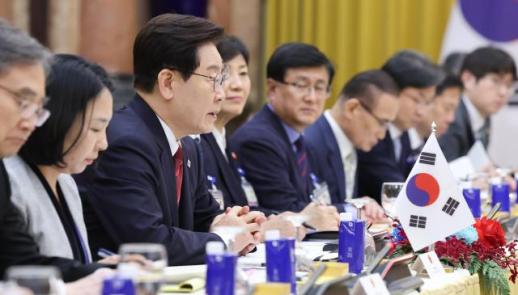 Lee urges shift to higher-quality cooperation with Vietnam; To Lam stresses trust President Lee Jae-myung said April 22 (local time) that South Korea and Vietnam should turn quantitative gains into higher-quality cooperation to build “a sustainable future of shared prosperity” as geopolitical uncertainty rises and global competition for technological leadership intensifies. Speaking at an expanded summit meeting with Vietnam’s Communist Party chief and state president, To Lam, at the Presidential Palace in Hanoi, Lee praised Vietnam for posting “one of the region’s highest economic growth rates” last year and for serving as a key economic engine in ASEAN. Lee called for mutually beneficial cooperation beyond trade and investment, including energy security, transportation and infrastructure, science and technology, and education and culture, and urged both sides to deliver tangible results that people and businesses can feel. Lee said the two countries have built a “top-level partnership” across politics, the economy and people-to-people exchanges in the 34 years since establishing diplomatic relations in 1992. He said about 5 million people travel between the two countries each year and exchanges in culture, education and other areas continue to expand. He said the two nations are among each other’s top three trading partners, and that South Korea is Vietnam’s largest investor. More than 10,000 South Korean companies operate in Vietnam, he said, contributing to both countries’ economic growth and Vietnam’s industrial development. In opening remarks, To Lam said Lee’s visit “most clearly demonstrates” the comprehensive strategic partnership based on high mutual trust, and he congratulated the South Korean government and people on their recent achievements. To Lam said he was impressed by Lee’s governing principles that prioritize coexistence and harmony, respect and trust. He said he believes South Korea will achieve further results under Lee’s leadership and strategic vision and contribute to peace and prosperity in the region and the world. He said the Vietnam-South Korea comprehensive strategic partnership has produced “remarkable achievements” across all fields over 35 years of development, and welcomed that the two sides have worked strategically as close friends who understand each other and as partners that can truly be trusted. To Lam said Vietnam’s party, state and people highly value Lee’s commitment to bilateral ties from his time as Seongnam mayor through his inauguration as president. He said Vietnam is ready for in-depth discussions on ways to strengthen strategic trust, expand practical cooperation and deepen the comprehensive strategic partnership, as well as on regional and international issues of mutual interest. 2026-04-22 21:00:15
 -
 Iran’s Revolutionary Guard Says It Seized 3 Ships in Strait of Hormuz Iran’s Islamic Revolutionary Guard Corps said on April 22 (local time) it seized three vessels in the Strait of Hormuz. The Iranian military has been tightening what it calls an armed blockade of the strait after a second round of U.S.-Iran ceasefire talks collapsed and U.S. President Donald Trump extended the ceasefire deadline until negotiations are concluded. The Guard’s navy said it detained two container ships — the MSC Francesca and the Defaminodas — and took them into Iranian waters, alleging they tried to slip out of the strait without Iranian military authorization. It also claimed the MSC Francesca is linked to Israel and said the two ships repeatedly violated regulations and manipulated their automatic identification system, or AIS. Iran’s Mehr news agency reported that a third container ship, the Euphoria, was also seized by the Guard’s navy as it attempted to pass through the strait. The navy said it would “continuously monitor” any actions that obstruct enforcement of Iran’s declared rules for passage through the strategic waterway or run counter to safe navigation. The Associated Press reported the Guard fired on the three vessels before seizing them. Earlier, the United Kingdom Maritime Trade Operations said that at about 7:55 a.m. a vessel in the Strait of Hormuz was attacked by Guard fast-attack craft. The vessel reported to UKMTO that it had not communicated with the fast-attack craft before being hit, but Iran’s state-run Nour News said the Guard opened fire after the ship ignored military warnings.* This article has been translated by AI. 2026-04-22 20:57:21
 -
 Lee Jae-myung tells Koreans in Vietnam he aims to deepen strategic cooperation President Lee Jae-myung said April 22 (local time) that South Korea will expand cooperation with Vietnam in strategic areas including nuclear power, infrastructure and science and technology innovation, while stepping up coordination on global challenges such as supply chain stability, sustainable growth and climate change. Speaking at a luncheon meeting with Koreans in Vietnam at a hotel in Hanoi during his state visit, Lee said he wants to develop the two countries’ cooperation — already at its highest level — into a more future-oriented and strategic partnership. Lee noted that since diplomatic ties were established in 1992, the two countries have become each other’s third-largest trading partners within a generation. He said Vietnam is South Korea’s largest destination for investment, with about 10,000 South Korean companies operating there. In 2022, marking the 30th anniversary of diplomatic ties, the two countries elevated relations to a comprehensive strategic partnership. Lee said South Korea and Vietnam “have a lot in common,” pointing to bonds across history, culture and the economy. He cited shared experiences of enduring foreign domination, overcoming hardship through their own efforts, and suffering the pain of division and war, adding that both are rooted in a Confucian cultural sphere that fosters close emotional ties. Lee also singled out Kim Sang-sik, head coach of Vietnam’s national soccer team, who attended the luncheon. Noting that soccer is called the “king sport” in Vietnam, Lee joked that would make Kim the “king of kings,” calling it “something to be proud of.” Lee referred to his time as mayor of Seongnam, when he served as owner of Seongnam FC, saying he is currently on trial after being accused of what he described as a “strange” offense while trying to help the club succeed. Turning to the Korean community, Lee said the Korean population in Vietnam has grown to about 200,000, making it the largest Korean community in ASEAN and the world’s fifth-largest. He pledged active support. He said about 100,000 South Korea-Vietnam multicultural families are a valuable foundation that connects the two countries “by blood,” but face difficulties. Lee said the “people-sovereignty government” will closely examine the challenges faced by overseas multicultural families and do its best to resolve them quickly as part of building an inclusive South Korea. After Lee’s remarks, Yang Mo-se, president of the Korean Association in Hanoi, said South Korea and Vietnam are neighbors that share a resilient history of preserving their identity against outside powers and a spiritual foundation in Confucian culture. He asked for the homeland’s warm attention and support so Koreans in Vietnam can act with greater confidence and contribute to South Korea amid the deepening partnership. Three community representatives shared their experiences: Pham Thi Nua, vice chair of the legal and administrative committee of the Vietnam council of the National Unification Advisory Council; Lee Yong-deuk, vice president of the Hanoi Korea-Vietnam Family Association; and Jung Ye-won, president of the Hanoi Korean Students Association. Pham said she was born in Vietnam but has regarded South Korea as her second home since forming a family with her South Korean husband 28 years ago. She said she will continue to do her best to serve as a bridge between the two countries as a “civilian diplomat.” Lee Yong-deuk said there are about 8,000 Korea-Vietnam families in Vietnam, and that 40% of the elementary division at the Korean International School in Hanoi are children of Korea-Vietnam families. He urged support so second-generation children can grow into true leaders linking the two countries. Jung described the students association’s roles, including protecting students’ lives and rights and supporting summit interpretation and overseas voting-site operations. After listening, Lee said the South Korea-Vietnam partnership, built on shared experience of overcoming adversity, is not a coincidence but an inevitable result created by Koreans living in Vietnam. He said that although they live outside South Korea, overseas Koreans often show even greater concern for the homeland, and he pledged continued government support so they can work in a more stable environment. He also said he would consider a system to better reflect overseas Koreans’ views. A cultural performance followed, with the Hanoi Boys and Girls Choir singing the children’s song “Mungge Cloud,” and the Hanoi Traditional Korean Music Research Institute’s “Sori Dongne” presenting an “Arirang” medley.* This article has been translated by AI. 2026-04-22 20:33:22
 -
 Korea to Launch Auto Insurance Discounts for Drivers Joining License-Plate Rationing Auto insurance products offering discounts to drivers who join the vehicle “5-day rotation” program are expected to be launched next month. Officials also said they will decide whether to implement a fourth round of an oil price cap after weighing market impact, global oil prices and the public burden. The Democratic Party, the government and the presidential office said they discussed those steps and other responses to the Middle East situation at a senior meeting held April 22 at the prime minister’s official residence in Samcheong-dong, Seoul. Kang Jun-hyeon, the Democratic Party’s senior spokesperson, said the nonlife insurance industry will roll out “a special rider” next month that discounts auto insurance premiums for drivers who participate in the 5-day rotation, providing benefits to people who voluntarily join energy-saving efforts. He said officials plan to draw up measures within this month to ease crowding on public transportation and broaden participation in energy conservation. He added they will also prepare steps to promote “green consumption,” including boosting tourism during the May holiday period. On the fourth oil price cap, the party, government and presidential office agreed to make a decision after comprehensively considering market effects, international factors and the burden on the public. During the meeting, the Democratic Party asked the government to respond more actively to minimize supply-chain disruptions affecting naphtha and crude oil. The government said it will manage the smooth import of 273 million barrels of crude oil and 2.1 million tons of naphtha that a strategic economic cooperation envoy team secured in Central Asia and the Middle East. It also said it will actively support crude imports through Yanbu Port in Saudi Arabia and proceed with a 670 billion won program, reflected in the supplementary budget, to cover the gap in naphtha import unit costs to support naphtha imports. Of the 26.2 trillion won supplementary budget, the government said it has selected 25 trillion won for management and plans to execute more than 85% of 10.5 trillion won in projects requiring rapid spending in the first half of the year. The party, government and presidential office said they will continue efforts to stabilize domestic supplies of energy and key raw materials amid rapidly shifting Middle East conditions. They also agreed to strengthen on-site inspections to ensure current measures to stabilize supply chains for naphtha, urea solution and syringes operate effectively. * This article has been translated by AI. 2026-04-22 20:21:23
 -
 Unification Ministry Explains Jeong Dong-young’s Mention of Kusong in North Korea Nuclear Remarks The Ministry of Unification said Jeong Dong-young’s recent public mention of Kusong, North Korea, as a location tied to uranium enrichment was based on a broad review of publicly available material, including remarks by the head of the International Atomic Energy Agency and reports by the Institute for Science and International Security. In a reference handout distributed to reporters on Tuesday afternoon, the ministry said Jeong’s mention of “Kusong” was made while citing a keynote speech by IAEA Director General Rafael Grossi on March 2, and was intended to underscore “the seriousness and urgency” of the North Korean nuclear issue. It added that Jeong made a similar point at a ministerial confirmation hearing in July last year, also referring to Kusong as a place where a uranium enrichment facility is believed to be located. The ministry said an ISIS report identified a site near North Korea’s Panghyon Air Base—including the Janggundaesan area and the Panghyon aircraft factory—as the location of a centrifuge development facility. It said many South Korean media outlets cited that report in reporting that a uranium enrichment facility was likely in Kusong, North Pyongan province. The ministry also said a report by the Center for Strategic and International Studies described how claims have repeatedly been raised that the Kusong area is linked to uranium-related nuclear development activity. Jeong told reporters on April 20 that Kusong was mentioned in a CSIS report, but Victor Cha, a CSIS senior official, countered that he had not written such a report. The ministry’s handout appeared aimed at clarifying the basis for Jeong’s remarks. The CSIS report focused on Kusong as a site for high-explosives testing tied to nuclear weapons development, and it did not describe Kusong as a uranium enrichment facility, as Cha said. The ministry said, however, that Kusong was discussed as part of North Korea’s nuclear program infrastructure. The ministry also cited a 2010 report by the U.S. Congressional Research Service that mentioned Kusong as a candidate location for a North Korean highly enriched uranium facility. * This article has been translated by AI. 2026-04-22 19:51:17
 -
 LG Display to Invest 1.106 Trillion Won in New OLED Infrastructure LG Display is moving ahead with a new facility investment worth about 1 trillion won to bolster its organic light-emitting diode, or OLED, technology competitiveness. The company said it disclosed after a board meeting on the 22nd that it will invest 1.106 trillion won in new OLED infrastructure. It said the move is aimed at advancing OLED technology to strengthen its technological edge and growth foundation. The investment period runs from that day through June 30, 2028. LG Display said that following the OLED production facility investment it disclosed in 2025, it will continue upgrading its business structure around OLED with the latest spending. The company said it plans to focus its capabilities on solidifying technology leadership and strengthening future growth engines. * This article has been translated by AI. 2026-04-22 19:30:14
 -
 People Power Party Faces Internal Calls for Jang Dong-hyeok to Step Down Amid U.S. Trip Controversy Two days after returning from a trip to the United States, People Power Party leader Jang Dong-hyeok is still facing controversy, with some in his party continuing to press—directly and indirectly—for his resignation. Jang has sought to shift attention to the South Korea-U.S. alliance, but the party has struggled to unify and focus its efforts ahead of the June 3 nationwide local elections and other contests. In a Facebook post on April 22, Jang wrote that the United States is asking, “Are you coming with us or not?” He added that saying “thank you” in front while saying “xie xie” behind would “wreck” both the economy and national security. The message was widely read as a warning that a misstep in foreign policy amid a rapidly changing international order could cost South Korea on both fronts. Jang also said that during his U.S. visit, American figures asked, “Why is the South Korean government discriminating against U.S. companies, its ally, and trying to align with Chinese companies?” A day earlier, Jang posted that President Lee Jae-myung was effectively preparing to “decide to break up” with the United States. He also uploaded a photo of President Donald Trump that the White House had posted on social media when the United States captured and transferred Venezuelan President Nicolas Maduro. Inside the party, some lawmakers said they do not understand Jang’s overseas push. A first-term lawmaker said it was unclear how the U.S. trip connected to the local elections or how the delegation was chosen, adding that if many in the organization cannot understand it, Jang should explain rather than vaguely saying he cannot discuss it “as a matter of precedent.” Calls for Jang to take responsibility have also surfaced publicly. Kim Jin-tae, the People Power Party’s candidate for Gangwon governor and the incumbent governor, urged Jang to “resolve what you started” when Jang visited Yangyang County on April 22—remarks that could be interpreted as a demand for Jang to step back or resign. Jang responded by deflecting, saying he did not know what Kim meant by the phrase. Compounding the pressure, the Democratic Party has again hinted it could take all National Assembly standing committee posts in the second half of the parliamentary term. Floor leader Han Byung-do said at a resignation news conference the previous day that allocating committee chairmanships is meant to ensure competition and balance, but if chairmanships are used as a tool for political conflict, the allocation itself becomes meaningless. The remarks were seen as signaling that if he wins another term as floor leader, the party would regroup after the parliamentary by-elections and restart what it calls a “working National Assembly.” Critics inside and outside the People Power Party say the “Jang Dong-hyeok leadership” is now beset by both internal strife and external pressure, with neither steady leadership nor party unity in evidence. The party has struggled to manage a string of conservative figures running as independents in Daegu and Busan, and it has not settled internal debate over calls to field no candidate in Busan Buk-gap. With the June 3 local elections and parliamentary by-elections 42 days away, concerns are growing that the party must concentrate its resources on the campaigns. A political source said those working on the ground in the elections are likely “on edge,” adding that the party appears to remain unsettled despite the looming votes.* This article has been translated by AI. 2026-04-22 18:54:23
 -
 Steel, Shipbuilding Labor Disputes Flare Over Direct Hiring and Bonus Standards Steel and shipbuilding companies are taking unusual steps to fix long-standing prime contractor-subcontractor structures, including large-scale direct hiring of partner-firm workers. But discontent on the ground is growing as disputes erupt over how compensation should be set. Industry officials said April 22 that tensions at POSCO have reached an unprecedented level after the company presented detailed guidelines for directly hiring 7,000 workers from partner firms. Under the roadmap, the new hires will be placed in a newly created “Operations Synergy (S)” job category. Pay will be set across seven grades. The plan also includes a 400% bonus and, when the company posts a profit, a management performance bonus of at least 800%. Both unions have voiced strong objections. The subcontractor union says the plan lacks clear standards for years of service, which would be used to calculate bonuses and performance pay. The prime contractor union argues that recognizing subcontractor workers’ experience could disrupt existing promotion order and undermine fairness in personnel decisions. Hyundai Steel’s union is also moving to secure the right to strike, including by applying for mediation at the National Labor Relations Commission, as it demands a special performance bonus at the same level as Hyundai Motor and Kia. Shipbuilding is facing similar friction. Subcontractor unions at shipyards are pressuring management, citing the Yellow Envelope law, to match not only wages but also performance bonuses with those of prime contractor workers. The prime contractor and subcontractor unions at HD Hyundai Heavy Industries (the union’s branch and local chapter under the metalworkers’ union) held a news conference at Ulsan City Hall on April 22, saying the company unilaterally changed the performance-bonus payment date, leaving some subcontractor workers who retired at mandatory retirement age unable to receive it. They demanded immediate payment of unpaid year-end performance bonuses to subcontractor workers. The metalworkers’ union’s Welliv chapter, which represents workers at Hanwha Ocean’s in-house food service contractor, has also requested direct talks with management over performance-bonus payments. Companies say the growing labor-labor conflict is adding to management burdens. They warn that disputes could expand beyond wages and working conditions into business decisions such as new investment, outsourcing operations and organizational restructuring. They also fear that if prime contractor and subcontractor unions demand bargaining at the same time, decision-making will slow, increasing the risk of production disruptions, delivery delays and workplace confusion. Jeong Yeon-seung, a professor of business administration at Dankook University, said protecting workers’ rights is important, but the country must also consider the competitiveness of entire industries, not just individual companies. “As global competition intensifies, strategic industries must grow enough to secure competitiveness for both companies and workers to expect sustainable growth,” he said.* This article has been translated by AI. 2026-04-22 18:50:35