

Journalist

Chang SeongWon
-
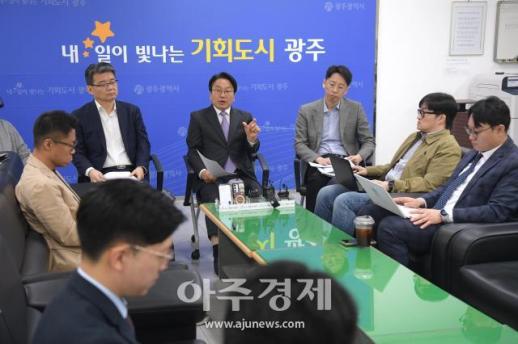 Gwangju Mayor Kang Ki-jung Vows to Wrap Up Remaining Work as City’s ‘Last Mayor’ Kang Ki-jung, mayor of Gwangju, said April 21 that he will work to properly wrap up the city’s remaining tasks as the “last mayor” of Gwangju Metropolitan City. Speaking with reporters over tea at City Hall, Kang said he had recently visited sites across Gwangju and South Jeolla Province and “once again felt the weight of integration.” He said he would closely review city affairs and “firmly bring Gwangju Metropolitan City’s history to a close.” Kang also laid out 10 key tasks he plans to pursue during the remainder of his term. They include a constitutional amendment related to May 18, finalizing subway station names, preparing to launch an integrated special city, and paying relief funds for damage tied to high oil prices. He also cited an AX demonstration valley, pilot operations for self-driving cars, attracting corporate investment, and accelerating preparations to relocate the military airport. Kang said he hopes to share “good news” with residents about a May 18 constitutional amendment alongside next month’s May 18 commemoration ceremony planned at May 18 Democracy Square and the reopening ceremony for the restored former South Jeolla Provincial Office building. He added that, with what he called an important moment approaching ahead of the nation’s first metropolitan-level integration, he would make sure necessary work is not overlooked. * This article has been translated by AI. 2026-04-21 16:42:43
 -
 Jung Won-oh says one-homeowners’ tax break rights must be protected, criticizes Oh Se-hoon Jung Won-oh, the Democratic Party’s Seoul mayoral candidate, writes in the guest book after paying respects at the late President Roh Moo-hyun’s gravesite in Gimhae, South Gyeongsang Province, on April 21. (Yonhap) Jung Won-oh, the Democratic Party’s candidate for Seoul mayor, said April 21 that the current rights of owner-occupiers who own a single home must be protected amid controversy over scrapping the long-term holding special deduction for capital gains tax. Jung also stepped up his criticism of Seoul Mayor Oh Se-hoon, saying Oh was “raising issues that haven’t even been discussed yet” and “stoking conflict.” Jung made the remarks after visiting the gravesite of the late President Roh Moo-hyun in Bongha Village, Gimhae, South Gyeongsang Province, along with Choo Mi-ae, the Democratic Party’s candidate for Gyeonggi governor, and Park Chan-dae, the party’s candidate for Incheon mayor. “If it’s not for speculative purposes, the rights of all one-home households should still be protected,” Jung said. He added that a Seoul mayor’s job is not to fuel conflict and said it was time to “join forces for people’s livelihoods and the interests of citizens.” Citing what he called a crisis stemming from a war in the Middle East, Jung said the government and the Seoul city government should work together, and that repeatedly raising matters not yet under discussion only makes residents anxious. Earlier April 21, Oh appeared on KBS radio and, referring to President Lee Jae-myung’s comments about scrapping the deduction, said that “even if it’s the president speaking,” it is a basic duty of a Seoul mayoral candidate to state an opinion. Oh said Jung had remained silent and added that a candidate “shouldn’t just stay quiet” at such times. The ruling party also sought to draw a line on the issue. Democratic Party member Han Jeong-ae said at a party floor leadership meeting that the government and ruling party have never reviewed abolishing the long-term holding deduction for one-homeowners.* This article has been translated by AI. 2026-04-21 16:40:24
 -
 KOSPI Closes at Record High, Extending Rally Despite Middle East War Concerns South Korea’s benchmark KOSPI surged to a fresh record on the 21st, extending its rally despite the fallout from the war in the Middle East. According to the Korea Exchange, the KOSPI closed up 169.38 points, or 2.72%, at 6,388.47. It also set a new intraday high, surpassing the previous peak of 6,347.41, and topped the prior record close of 6,307.27 set Feb. 26. Foreign investors and institutions led the advance. Foreigners bought a net 1.7472 trillion won worth of shares, while institutions posted net purchases of 796.0 billion won. Buying was concentrated in semiconductors. Samsung Electronics and SK hynix, the No. 1 and No. 2 stocks by market capitalization on the KOSPI, rose 2.1% and 4.97% to close at 219,000 won and 1,224,000 won, respectively. Ahead of its earnings release on the 23rd, SK hynix finished above 1.2 million won for the first time on a closing basis. As the index climbed, margin trading also accelerated. The Korea Financial Investment Association said outstanding credit loans for stock purchases stood at a record 34.2592 trillion won as of the 20th. The total included 23.6256 trillion won on the main board and 10.6336 trillion won on the KOSDAQ, exceeding the previous high of 34.0279 trillion won set April 17. Analysts largely viewed the rally positively but urged investors to stay alert to geopolitical risks. Kim Hak-kyun, head of the research center at Shinyoung Securities, said the rise was part of a global trend and that the Middle East issue was “short-term noise” within an existing uptrend. “There is no evidence that the upward trend has broken,” he said, adding that the case for gains remains intact, citing the semiconductor cycle and “manageable inflation.” Lee Byeong-geon, head of the research center at DB Securities, said flexibility would be needed as external factors evolve. “It’s right to view the market positively because leaders such as semiconductors have not turned down,” he said. “But depending on negotiation outcomes, the beneficiaries and losers could diverge by stock. It is necessary to respond with a portfolio while closely watching external developments.” 2026-04-21 16:39:34
 -
 KOSPI Hits Record High as Foreign Buying Lifts Shares Despite Geopolitical Risks South Korea’s benchmark KOSPI is pushing to fresh records despite uncertainty from geopolitical risks, helped by upbeat calls from global investment banks and heavy foreign buying. Still, a surge in leveraged stock purchases is being cited as a potential source of instability. According to the Korea Exchange, the KOSPI set two records on the 21st, surpassing both its intraday high of 6,347.41 set Feb. 27 and its previous record close of 6,307.27 set Feb. 26. Foreign inflows that have returned in April continued, with overseas investors net buying 1.7523 trillion won worth of shares on the main board, led by semiconductors. Buying has concentrated in chipmakers as profit estimates for the sector have been raised sharply ahead of SK hynix’s earnings report on the 23rd. Global investment banks have also been lifting their targets. Goldman Sachs raised its KOSPI target to 8,000, citing improving results for domestic semiconductors and industrials. Nomura kept its target range at 7,500 to 8,000, saying a semiconductor upcycle could offset macro risks. Even with the broadly positive outlook, some investors worry another sharp pullback like March could return. A key concern is the swelling use of leverage. The Korea Financial Investment Association said outstanding margin loans stood at a record 34.2592 trillion won as of the previous day. Of that, 23.6256 trillion won was on the KOSPI market and 10.6336 trillion won on the Kosdaq market. Analysts said foreign buying tied to improving fundamentals is supportive, but margin debt above 34 trillion won could become a trigger if prices fall. If declines push collateral ratios below required levels, brokerages can force sales, and a wave of liquidations can deepen losses and set off further margin calls. Despite those risks, many in the brokerage industry still expect the rally to continue. Lee Jae-won, an analyst at Yuanta Securities, said external factors such as a possible reclosure of the Strait of Hormuz are weighing on markets but are being viewed as part of efforts to gain leverage in negotiations, while extensions of ceasefire deadlines by the Trump administration are reducing volatility. He added that the KOSPI remains in a “deep value” zone on a price-to-earnings basis, leaving room for further gains even after the latest record. 2026-04-21 16:38:38
 -
 U.S., Iran Signal Second Round of Talks as Truce Deadline Nears The United States and Iran, after days of brinkmanship ahead of a truce deadline, appear closer to a second round of negotiations. In a phone interview with Bloomberg on April 20, U.S. President Donald Trump said the two-week truce with Iran would end "Wednesday (22) evening, Washington time." Asked about extending it, he said the chances were "very small" and said a U.S. naval blockade of Iran would remain in place until an agreement is reached. The U.S. and Iran agreed to the truce on April 7, and it had been widely viewed as running through April 21, though Trump’s remarks were seen as effectively extending the deadline by about a day. Trump also pointed to a possible schedule for talks. He said Vice President JD Vance would depart for Pakistan and that negotiations would begin April 21. Axios reported that Vance was expected to leave for Pakistan no later than the morning of April 21, possibly late on April 20. It said Middle East envoy Steve Witkoff and Jared Kushner, Trump’s son-in-law, were expected to travel with him. The report said Vance had delayed his departure while awaiting Iran’s response, but that a "green light" from Iran’s supreme leader, Mojtaba Khamenei, had been conveyed. Iran has also sent signals suggesting talks could move forward. The Wall Street Journal, citing multiple sources, reported that Iran told mediators it would send a negotiating team to Pakistan on April 21. Reuters, citing a Pakistani source involved in the talks, reported that a second round would be held Wednesday (22). The source said that if an agreement is reached, Trump could attend in person or participate by video. Iran’s government has not officially confirmed sending a delegation. Foreign Ministry spokesman Esmail Baghaei said, "For now, there is no plan for the next negotiation," adding that Iran would not accept deadlines or ultimatums to protect its national interests. Mohammad Bagher Ghalibaf, Iran’s parliament speaker who leads the negotiating team, wrote on X that "we will not accept negotiations conducted under the shadow of threats." Trump, in a phone interview with the conservative radio program "The John Fredericks Show," warned Iran: "They will negotiate, and if they don’t, they will face problems they have never seen before." The first round of talks collapsed without narrowing differences over major issues, including Iran’s abandonment of its nuclear program. On Truth Social, Trump said the nuclear deal now being pursued with Iran would produce a better outcome than the 2015 agreement, the Joint Comprehensive Plan of Action. Under the JCPOA, Iran’s nuclear program was limited in exchange for sanctions relief, and Iran’s highly enriched uranium was moved abroad while stockpiles were sharply capped. Trump later wrote again on Truth Social that "Operation Midnight Hammer" had "completely and totally destroyed" Iran-related nuclear targets and that recovering buried nuclear material would require a long and difficult process. Midnight Hammer was the name of a U.S. operation that struck three Iranian nuclear facilities in June last year. The Wall Street Journal reported that some flexibility is being detected on uranium enrichment. It said mediators are considering an option under which Iran would halt enrichment for a period and later be allowed limited production of low-enriched uranium. Despite the diplomatic activity, tensions remain. Iran sharply criticized the United States for seizing an Iranian-flagged cargo ship and demanded the crew’s release. Iran’s semi-official Tasnim news agency reported that the Foreign Ministry, in a statement, called the action piracy and terrorism and said it was "another clear violation" of the truce and an attack on Iran. The ministry said it would mobilize all capabilities to defend national interests and security and to protect the rights and dignity of the Iranian people, warning that if regional conditions worsen further, the United States would bear full responsibility.* This article has been translated by AI. 2026-04-21 16:37:45
 -
 Park Chan-dae to Officially Enter Incheon Mayoral Race on Tuesday Democratic Party lawmaker Park Chan-dae, the party’s candidate for Incheon mayor, said he will make his official announcement of candidacy on April 22, launching his campaign in earnest. Park told reporters on April 21 after visiting Bongha Village in Gimhae, South Gyeongsang province, and paying respects at the grave of the late President Roh Moo-hyun that he would “make the announcement tomorrow.” It will be his formal entry 49 days after the party finalized its nomination on March 4. Park, a three-term National Assembly member representing Incheon’s Yeonsu A district, said he plans to submit his resignation from the Assembly on April 29. Park also reiterated cooperation among candidates for top local government posts in the capital region. He visited the memorial with Jeong Won-oh, a Seoul mayoral candidate, and Choo Mi-ae, a Gyeonggi governor candidate. The three previously met in front of the National Assembly on April 12 and pledged to coordinate on campaign pledges and policy. “I came to honor the spirit of Roh Moo-hyun once again,” Park said. Citing Roh’s remark that “the last bastion of democracy is the organized power of awake citizens,” Park said candidates for capital-region leadership posts symbolize that spirit. He said campaign staff are “fiercely debating” to develop shared pledges for the capital region, adding that the candidates aim to honor Roh’s goal of building “a world where people live” through local autonomy and decentralization. Park said the capital region’s 26 million residents are “a community of shared destiny,” and vowed to realize Roh’s dream by improving people’s lives and building “a world where people live.”* This article has been translated by AI. 2026-04-21 16:34:02
 -
 Taiwan TV Host Dee Hsu Says She Urged Late Sister Barbie Hsu to Take Japan Trip, Feels Guilty Taiwanese TV personality Dee Hsu (Hsu Hsi-ti) has spoken publicly about her grief after the death of her older sister, the late Hsu Hsi-yuan, known as Barbie Hsu. According to Taiwan media outlets including ETtoday, Hsu said at the taping of a local variety show on Sunday that her sister’s death left “a long period” of emptiness in her life and that she felt so lost she did not even know what she was doing. She said she drank with their mother and talked about her sister, calling those conversations the only way to ease the sadness. Hsu also said she had suggested the trip her sister took before she died. Fighting back tears, she said she was tormented by the thought that the tragedy might not have happened if she had listened to her mother, who opposed the trip at the time. She said her mother tried to comfort her, telling her never to think that way, but that the pain remains. Barbie Hsu was a Taiwanese star who worked as an actor, singer and TV host. She rose to fame in 2001 after starring as the female lead, Shan Cai, in “Meteor Garden,” a drama based on the Japanese manga “Boys Over Flowers.” She married Chinese businessman Wang Xiaofei in 2011, divorced in 2021 and remarried in 2022 to Koo Jun-yup.* This article has been translated by AI. 2026-04-21 16:33:12
 -
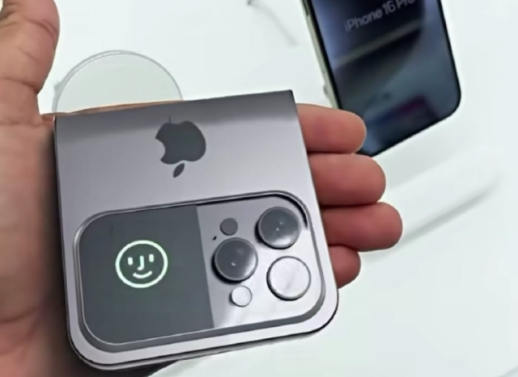 Samsung Display locks in Apple foldable edge over China SEOUL, April 21 (AJP) - South Korea’s premium OLED champion Samsung Display has reasserted itself as Apple Inc.’s primary iPhone panel supplier, staging a decisive comeback against Chinese rivals and tightening its grip on the high-end display market as Apple prepares to enter the foldable era. Samsung Display sharply expanded its share of Apple’s iPhone OLED supply chain in 2025, helped by production setbacks at China’s BOE and a reported three-year exclusive deal to supply panels for Apple’s first foldable iPhone. According to market tracker Omdia, Samsung Display accounted for 56.8 percent of Apple’s iPhone display procurement in 2025, up from 49.1 percent a year earlier. Shipments rose about 15 percent to 141.6 million units from 122.3 million in 2024, widening the gap again with LG Display and BOE after competition had briefly tightened the previous year. The surge translated directly into earnings. Samsung Display posted 9.5 trillion won ($6.6 billion) in fourth-quarter revenue and 2.0 trillion won in operating profit for the October–December period of 2025. For the full year, the display unit reported 29.8 trillion won in revenue and 4.1 trillion won in operating profit. For the first quarter, operating profit is projected at around 1 trillion won—roughly halved from the previous quarter but doubled from a year earlier during the typically slow season of the January–March period. The turnaround was driven in part by a technological inflection point. As Apple expanded the use of low-temperature polycrystalline oxide (LTPO) OLED panels across its latest iPhone lineup to improve power efficiency, BOE struggled to meet Apple’s stringent yield and quality thresholds. The bottleneck effectively pushed the Chinese supplier into a secondary role, allowing Samsung to capture incremental volume while strengthening its pricing power. "Apple’s quality standards are exceptionally high," said Kim Hyun-jae, a professor of electrical and electronic engineering at Yonsei University. "Because the latest LTPO technology is highly difficult and takes time to master, BOE had to step in as a secondary vendor for lower-tier products rather than premium models." Samsung’s lead is now set to deepen further. Industry reports indicate Apple has tapped Samsung Display as the sole OLED supplier for its first foldable iPhone for an initial three-year period—a move that underscores the still-wide gap in foldable panel durability, crease control and yield stability. "Apple initially hesitated to enter the foldable market, but currently, Samsung Display is the only manufacturer capable of producing what they need," Professor Kim noted. "Samsung possesses significant accumulated know-how from producing its own Galaxy Fold series." The reported exclusivity highlights a broader structural divide. While China dominates global LCD capacity, Korea continues to command the premium OLED segment, where margins are higher and technological barriers remain steep. Each time Chinese players narrow the gap in one generation, Korean firms have moved ahead with the next. "For about a decade, observers have warned that China would soon catch up, but the gap is constantly being maintained," Kim added. "While China is number one in overall volume like LCDs, Korea is still number one in the premium products that actually generate profit." To sustain that edge, Samsung Display is accelerating its next manufacturing leap. The company is ramping up the world’s first 8.6-generation OLED production line in Asan, South Chungcheong Province, with mass production targeted this year. The larger substrate size—2,250 by 2,600 millimeters—is expected to lower unit costs and reduce material waste, reinforcing a structural cost advantage that rivals will struggle to replicate. 2026-04-21 16:32:55
 -
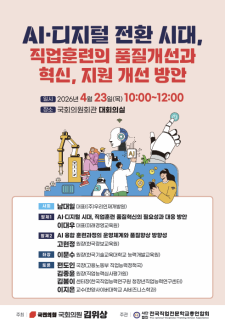 South Korea’s National Assembly to Host Forum on AI-Era Job Training Reform A National Assembly forum will be held to discuss how vocational training should evolve in the AI and digital era. The Korea Federation of Vocational Schools said April 21 it will hold the forum April 23 in the main auditorium of the National Assembly Members’ Office Building under the theme, “Ways to Develop Vocational Training in the AI and Digital Era.” Organizers said the event is intended to share the need to shift the vocational training system amid rapid industrial change and to discuss policy solutions to support employment for young and middle-aged workers and improve training quality. About 400 people are expected to attend, including federation Chairman Song Gwan-ho, heads of vocational schools and officials from related organizations. The forum is hosted by People Power Party lawmaker Kim Wi-sang. It will open at 10 a.m., followed by opening remarks and congratulatory addresses from lawmakers. Two presentations are scheduled. Lee Dae-woo, head of the Future Management Education Institute, will speak on the need for quality innovation in vocational training in the AI and digital era and response measures. Ko Hyeon-jeong, director of the Korea Information Education Institute, will present on operating systems for AI convergence training courses and directions for improving quality. A panel discussion will follow, moderated by Lee Moon-su, director of the Competency Development Education Institute at Korea University of Technology and Education. Panelists are Pyeon Do-in, director general for vocational competency policy at the Ministry of Employment and Labor; Kim Jong-yoon, head of the Vocational Competency Assessment and Evaluation Institute; Kim Bom-i, head of the Youth and Middle-Aged Vocational Competency Research Center at the Korea Research Institute for Vocational Education and Training; and Lee Ji-eun, a professor in the AI Business Department at Hanyang Cyber University. They are expected to discuss revamping training systems to match industrial change, strengthening field-based education and building sustainable support systems. The forum is scheduled to close at 11:50 a.m., concluding a roughly two-hour program. Organizers said they expect the forum to help set new benchmarks for vocational training suited to the AI and digital transition and to serve as a practical venue linking policy and the field.* This article has been translated by AI. 2026-04-21 16:32:21
 -
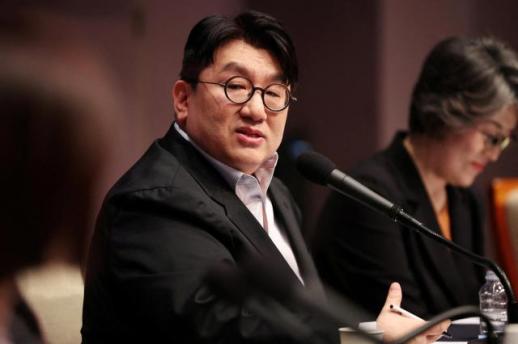 Police seek arrest warrant for HYBE Chairman Bang Si-hyuk over alleged IPO fraud SEOUL, April 21 (AJP) - South Korean police have applied for an arrest warrant for Bang Si-hyuk, chairman of BTS agency HYBE, on allegations that he misled investors ahead of the company’s initial public offering (IPO), authorities said Tuesday. The Seoul Metropolitan Police Agency’s Financial Crimes Investigation Unit said it requested the warrant from the Seoul Southern District Prosecutors’ Office on charges under the Capital Markets Act. The move comes about 16 months after police launched their investigation. Police allege that in 2019, Bang Si-hyuk falsely told investors there were no plans to list HYBE, then known as Big Hit Entertainment, encouraging them to sell their shares to a private equity fund linked to him. The company later went public, with Bang reportedly securing 190 billion won ($130 million) through a prior agreement to receive 30 percent of the fund’s post-listing profits. Under South Korea’s Capital Markets Act, obtaining financial gains through deceptive practices related to financial investment products is prohibited. Violations involving profits exceeding 5 billion won can result in life imprisonment or a minimum of five years in prison. Police began an internal probe in late 2024 before expanding it into a formal investigation in mid-2025, which included raids on the Korea Exchange and HYBE headquarters. Bang was questioned five times between September and November last year, and authorities also froze 156.8 billion won worth of his shares. The investigation drew criticism for its pace after police took no apparent action for more than five months, citing legal reviews. The case also sparked controversy when the U.S. Embassy in Seoul reportedly sent a letter requesting that a travel ban be lifted to allow Bang to attend BTS-related events abroad. Bang has denied any wrongdoing, maintaining that all legal and regulatory requirements were followed during HYBE’s listing. In a statement released through his legal team Tuesday, he said it was “regrettable” that an arrest warrant had been sought despite his cooperation and pledged to “faithfully explain his position in future legal proceedings.” Prosecutors will now decide whether to formally request the warrant from the court. If they do, a hearing to review the warrant typically takes place within two to three days. The development places Bang, HYBE’s largest shareholder and key decision-maker, at a critical juncture as the company closely monitors the outcome. HYBE shares fell 2.35 percent to close at 249,000 won on Tuesday following news of the warrant request. 2026-04-21 16:31:59