

Journalist

Chang SeongWon
-
 South Korean researchers use light and air to make medicine ingredients SEOUL, March 30 (AJP) - A research team in South Korea has developed a way to produce essential pharmaceutical raw materials using only sunlight and ambient air, potentially slashing carbon emissions in the chemical industry. This breakthrough simplifies the manufacturing of complex drugs by replacing traditional, waste-heavy chemical processes with a sustainable loop that relies on natural elements. The Korea Advanced Institute of Science and Technology (KAIST) announced on March 30, 2026, that a team led by Professor Han Sang-woo of the Department of Chemistry successfully combined two different types of catalysts into a single system. The method integrates a solid silver-based catalyst with a liquid organic photocatalyst known as DDQ. In traditional chemical manufacturing, companies often have to choose between catalysts that are precise but disposable and those that are reusable but less efficient. The KAIST team bypassed this trade-off by creating a system where the two catalysts work together to drive reactions that were previously difficult to sustain. The researchers used this hybrid platform to create amines, which serve as the primary building blocks for various medicines. By relying on sunlight and air rather than harsh chemical additives or high-pressure environments, the process produces almost no waste other than water. Existing organic photocatalytic methods often require additional chemicals to reset the catalyst after each use, or they suffer from slow reaction speeds when exposed to oxygen. To solve this, the team designed a circular loop where the byproducts of the reaction naturally reactivate the catalysts. Sunlight provides the energy to start the reaction, while oxygen from the air acts as the agent that "recharges" the catalysts for the next cycle. This allows the system to run continuously without the need for constant chemical intervention. To prevent the two different catalyst types from interfering with each other, the researchers added lithium perchlorate (LiClO4). This additive stabilizes the silver particles and the organic molecules, ensuring the system remains active for longer periods. "This study is the first case of successfully applying inorganic photochemical loop technology to precision organic synthesis," Professor Han Sang-woo said. "By merging the advantages of different catalytic systems, we have made a significant step toward reducing the carbon footprint of the chemical industry." Professor Han Sang-woo noted that the breakthrough provides a new way to manufacture high-value compounds like pharmaceutical ingredients through more sustainable methods. The study, with KAIST researcher Baek Jin-uk as the lead author, appeared in the Journal of the American Chemical Society (JACS) on March 18, 2026. (Reference Information) Journal/Source: Journal of the American Chemical Society Title: Merger of heterogeneous and homogeneous photocatalysis for arene C–H Amination Link/DOI: https://doi.org/10.1021/jacs.5c20824 2026-03-30 16:56:43
 -
 Lee Dong-hwi Balances Acting Immersion and Producer Realities in 'Method Acting' Every production holds countless perspectives. The same place and time can feel different depending on where a director or actor stands. “Choi Song-hui’s B-Cut” looks beyond the “A-cut” on screen to the vivid record of what happened off camera. By weaving interviews with directors and actors, it reconstructs the “B-cut” moments that were often more intense than the finished frame. <Editor’s note> For actor Lee Dong-hwi, “Method Acting” is more than another credit. It is his first report card as a producer: He helped expand a friend’s short-film idea into a feature and took responsibility on set. Like the character who struggles to break out of a “comedy actor” label, Lee said he wanted to become someone who “creates opportunities” and pushed the project to completion. The film began with trust between two friends, actor Lee Gi-hyeok and Lee Dong-hwi. As the short’s job-specific premise was combined with the universal theme of “family,” the story took on the structure of a mainstream feature. “Director Lee Gi-hyeok was preparing another story at first, then decided to turn the short ‘Method Acting’ into a feature because it could be told in a more popular way,” Lee said. “If the short focused on the mood on set, the feature broadened with the keyword of family, in a direction that could draw more universal empathy. I thought it would be easier to play someone close to who I am, but once we started shooting, every day felt like homework. I had to keep adding layers so it wouldn’t look like a documentary or an observational variety show.” Caught between an actor’s immersion and a producer’s need for distance, Lee said he witnessed a chaotic “B-cut” reality. As the boundary between life and performance blurred, he decided he had to stay firmly inside the role. “When I saw Geum-sun’s back, it looked like my real mother, and the emotions rose too much,” he said. “I thought if it got too close to my life, it would be hard to endure. So for parts that didn’t completely overlap with my family’s story, I made them more fictional and approached them that way. In the end, I thought I had to treat it as a role. I had to act the details — an actor being mocked, an actor enduring that mockery and returning to set, and even the moment he becomes a king — so it was a set that gave me a real headache.” A monologue scene as a king in the historical drama “Gyeonghwasuwol” became the point where producer Lee and actor Lee clashed — and then reconciled. Under pressure from a 4 a.m. sunrise and budget constraints, he said he found “the king’s face” in just two takes. “We were in a rush because we were shooting at 4 a.m.,” he said. “The sun was coming up, and there was no time, so it was an anxious situation. We couldn’t do many takes. Since I was participating as a producer, the longer it took, the more the production cost. In the past, as an actor, I would have wanted to shoot more, but as a producer I strongly felt I had to complete the mission within the exact opportunity. After two takes, I looked up and the sun had risen.” Lee said watching actor Ma Dong-seok made him want a life that “gives someone opportunities.” He said he is now preparing a true transformation by portraying a character in harsher circumstances. “Watching Ma Dong-seok, I saw with my own eyes the new opportunities that appear when one person starts something,” Lee said. “I wanted to become that kind of person someday. If I’ve been thinking about what makes a mainstream film work, the story I want to make next is the opposite. A lonelier, harsher story of one person — for me, that kind of work feels like a real transformation.” On screen, Lee’s character obsesses over “method acting.” Off camera, Lee said he kept checking the clock. He held back an actor’s desire for more takes and wrapped the scene in two, weighing time and production costs. More striking than the king’s face in the “A-cut,” he suggested, was the producer’s posture in the moments before sunrise.* This article has been translated by AI. 2026-03-30 16:51:14
 -
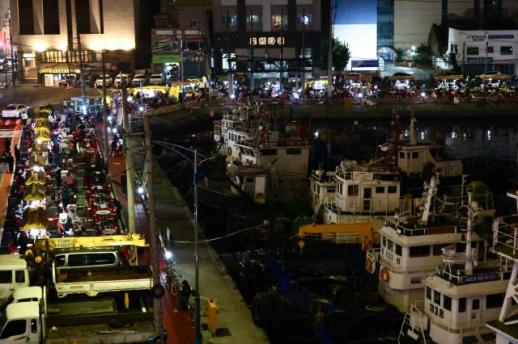 Busan's Yeongdo Island offers delight for palate with taste of sea BUSAN, March 30 (AJP) - Yeongdo, a small coastal island in the southern port city of Busan, South Korea, has long been known for its bountiful seafood. As dusk falls and fishing boats return, street-food tents light up one by one, a daily ritual unchanged for generations that reflects the island's life deeply rooted in the sea. Getting off at Nampo Station leads visitors to the island by crossing the city's iconic Yeongdo Bridge, which glows golden at night and connects Busan's mainland to the small town. Near the waterfront, fishing boats sit moored in the harbor as street-food tents and stalls begin to open for the evening. Once dusk settled, colorful plastic chairs lined the waterfront and grills fired up. Jogaetang, a clam soup, is often served first, a steaming pot filled with scallops, clams, and leeks in a milky, briny broth, the shells opening slowly as it bubbles away. Next up is grilled hagfish, coated in a sweet and savory sauce and topped with sesame seeds. Its chewy but tender texture goes perfectly with beer. For the adventurous, raw octopus is a must-try. Sliced and served with cucumber, green chili, sesame oil, and sesame seeds, the still-lively pieces cling to the chopsticks. Its texture is firm and slippery, with a clean, briny flavor that tastes of the sea. Tables are set with a variety of side dishes, often refilled without even being asked. These tents have long been a hangout where locals gather after work, as well as a spot for visitors who want to soak in the town's atmosphere. 2026-03-30 16:39:57
 -
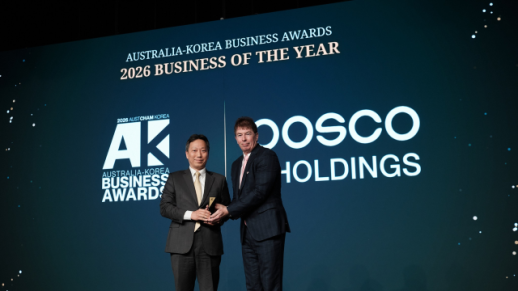 POSCO Holdings named Business of the Year at 2026 Australia–Korea Business Awards SEOUL, March 30 (AJP) - POSCO Holdings was named Business of the Year at the 2026 Australia–Korea Business Awards (AKBA) in Seoul on Friday, according to the Australian Chamber of Commerce in Korea (AustCham Korea). This year’s recognition of POSCO Holdings highlights the company’s long-standing investment in Australia’s resources sector and its growing role in future-facing industries shaping the bilateral partnership, including critical minerals, battery materials, and clean energy supply chains. “At a time of increasing uncertainty in global supply chains, the Australia–Korea economic relationship is taking on renewed strategic importance,” said Ross Gregory, Chaiman of AustCham Korea. The elevation of bilateral ties to a Comprehensive Strategic Partnership in December 2021 reflects this shift, establishing a framework for closer cooperation across strategic, economic, and technological domains. “Within this context, deepening trade, investment, and industrial collaboration between Australia and Korea plays a critical role in reinforcing supply chain resilience and supporting the long-term stability of key industries,” Gregory said. The Australia–Korea Business Awards is a flagship event hosted by AustCham Korea, recognizing companies and individuals that have contributed to trade, investment and industrial cooperation between the two countries. Since 2010, the awards have served as a key platform highlighting the strength of the bilateral economic partnership. Winners are selected based on an evaluation of the achievements and success stories of nominated companies. The ceremony was attended by senior government officials and business leaders from both countries, including Australian Ambassador to Korea Jeff Robinson and the Republic of Korea’s Deputy Minister for Trade Park Jung-sung. Their participation underscores the growing strategic dimension of the Australia–Korea relationship. “Long-standing business cooperation between Korea and Australia is something we see as highly meaningful,” Gregory said. “This year’s awards celebrate the fact that collaboration between the two countries is expanding into a broader range of future industries.” “POSCO Holdings, as this year’s Business of the Year, has helped underpin key industrial supply chains through its investments and partnerships across Australia’s mining and resources sectors,” he said. “These efforts demonstrate how collaboration between our two economies continues to evolve into new sectors,” he added. This year’s awards recognized companies and individuals across a wide range of industries, reflecting the continued expansion of bilateral economic cooperation. While collaboration has traditionally been centered on resources, financial services and technology, it has increasingly diversified into areas such as biotechnology, education, food and beverage, energy transition, healthcare, and tourism. 2026-03-30 16:20:36
 -
 Kim Hyo-joo wins Ford Championship for second straight year, sets new goals after two straight LPGA titles Kim Hyo-joo, who has won two straight LPGA Tour titles, said she has already achieved her season goal of two victories and will set a new target. Kim won the Ford Championship on March 30 (Korean time) at Whirlwind Golf Club in Phoenix, Arizona, finishing at 28-under 260 on the par-72 course. The tournament purse was $2.25 million, and she earned $337,500 (about 510 million won) in prize money. Kim, who won this event last year, captured the Ford Championship for a second consecutive year. At a news conference after the win, Kim said, "I feel so good I can’t even speak. Honestly, I still can’t believe it." She added, "It’s hard for a player to come in as the defending champion, but I brought last week’s good momentum and came to a course where I have good memories, and I’m happy I could win. I want to keep this feeling until tomorrow," she said with a laugh. Kim followed last week’s Founders Cup title with another victory, giving her back-to-back wins on the LPGA Tour. It was the first time she has won multiple times in a single season. Her LPGA Tour career total rose to nine wins, moving her into a tie for sixth among South Korean players in LPGA victories. She also moved into first in CME Globe points (1,268), season earnings ($939,640) and player of the year points (69). "My goal this season was two wins, and I’ve already done that. I think I need to set my goal again," Kim said. "Right now, I’m not thinking about anything. I’ll reset it tomorrow." She said her focus compared with earlier in her career has been playing more aggressively to make more birdies, and that approach has worked over the past two weeks. Kim also beat Nelly Korda of the United States in the final group for a second straight week. "I see and learn a lot playing with Korda. She’s a great player, and I gain a lot from competing with her," Kim said. "I think we both got good results because we pushed each other."* This article has been translated by AI. 2026-03-30 16:15:00
 -
 Cliché or not, BTS "Arirang" rework delivers globally SEOUL, March 30 (AJP) - RM winces. When the first draft of “Body to Body” lands with a bold Arirang sample layered toward the end, the BTS leader isn’t convinced. It feels, he says, almost too obvious — like “mixing bread, pork cutlets and kimchi” into one plate, a blend leaning too heavily on sentiment. Jimin laughs it off. Strange as it sounds, he says, the mix “may taste very good.” J-Hope leans further in: if they’re going to borrow Arirang, why not go all the way? That tension — between subtlety and statement, between global polish and unmistakable roots — sat at the heart of BTS’ return, captured in a Netflix documentary released last Friday. The boys, now men after completing full military service, are shown grappling with a quieter anxiety: how they would be received after a nearly four-year hiatus. With ARIRANG, the K-pop juggernaut doesn’t just stage a comeback. It recalibrates. The idea of Arirang, Korea’s most enduring folk song, emerged during a creative bottleneck as the group camped in Los Angeles for two months, searching for direction. Its weight was immediate. One of the earliest known recordings dates back to 1896, when Korean students at Howard University etched the melody onto a wax cylinder. That moment resurfaces in the album’s animated teaser — those students now mirrored by a global audience listening to BTS sing in Korean more than a century later. Still, the debate lingered. Was it too nationalistic? Too deliberate? Hybe chairman Bang Si-hyuk pushed back. An act like BTS, he reminded them, comes once in decades — and there is no escaping identity. “You’re Korean,” he said, plainly. What emerges is less a nostalgic return than a layered reexamination. If “Body to Body” wears its Arirang sample openly, other tracks take a quieter route. In “Aliens,” RM invokes Kim Gu — the independence-era leader who envisioned Korea as a cultural power rather than a military one — not as a history lesson, but as a question. How would that vision read today? Even musically, tradition is reframed rather than reproduced. Elements of jungmori jangdan are woven into contemporary structures — not quoted, but translated. “Body to Body” itself operates on multiple levels. On the surface, it’s built for the stage — “I need the whole stadium to jump” — a call to collective movement. Beneath that, the imagery expands: bodies gathering, standing together, responding. References to “guns, knives and keyboards” blur physical conflict with digital confrontation, reflecting a world where connection — and tension — unfold both online and off. The song resists a fixed meaning, allowing contradictions to coexist. That duality shapes the album. At its center is the resonant toll of the Bell of King Seongdeok, dividing the record into two halves. The first leans outward — performance-driven, built for crowd response. The second turns inward, lingering in unresolved emotion. Tracks like “Body to Body,” “Hooligan” and “FYA” pulse with repetition and shared energy. Others — “SWIM,” “Merry Go Round,” “NORMAL” — resist resolution, allowing tension to remain. The contrast is deliberate. It traces the gap between performance — and what performance cannot resolve. The timing matters. During BTS’ hiatus, the global music landscape shifted. New acts emerged, and competition within K-pop intensified. Against that backdrop, ARIRANG does not attempt to reclaim old ground. It redraws it. Some critics see the album’s emphasis on Korean identity as a clearer articulation of origin in a global arena. Others view it as selective — a strategic layering rather than a constant thread. Even the visuals reflect that balance: a comeback staged at Gwanghwamun, a performance video filmed at a historic hanok once tied to the founding family of SK Group. Calculated — or simply intentional. On the charts, the response is unequivocal. ARIRANG debuts at No. 1 on the Billboard 200, marking BTS’ seventh chart-topper. The album opens with 641,000 equivalent units — the biggest week for a group in over a decade, including more than half a million in pure sales. For a group returning after years of individual pursuits and an industry that has moved on without them, the heritage-driven pivot appears to have paid off. 2026-03-30 15:55:09
 -
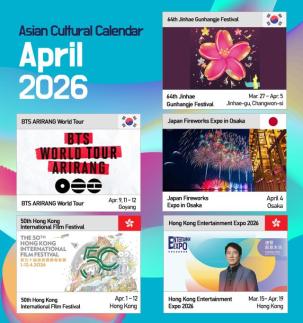 Asian Culture Calendar SEOUL, March 30 (AJP) - South Korea Mar. 27 - Apr. 5 64th Jinhae Gunhangje Festival Apr. 9, 11-12 BTS ARIRANG World Tour Apr. 3 - 7 Yeongdeungpo Yeouido Spring Flower Festival Apr. 4 - 12 Wangin Festa Apr. 30 - May. 6 Seoul Spring Festa Japan Apr. 4 Japan Fireworks Expo in Osaka Mar. 19 - Apr. 19 Nijo Castle Sakura Festival Apr. 1 - 5 Beppu Onsen Festival Apr. 9 - 17 Nagahama Hikiyama Festival Hong Kong Apr. 11 - 30 Global Sources Hong Kong Show Apr. 1 - 12 50th Hong Kong International Film Festival Mar. 15 - Apr. 19 Entertainment Expo 2026 Apr. 17 - 19 Hong Kong Sevens 2026 Singapore Apr. 22 - May. 2 Roald Dahl's THE BFG 2026-03-30 15:42:07
 -
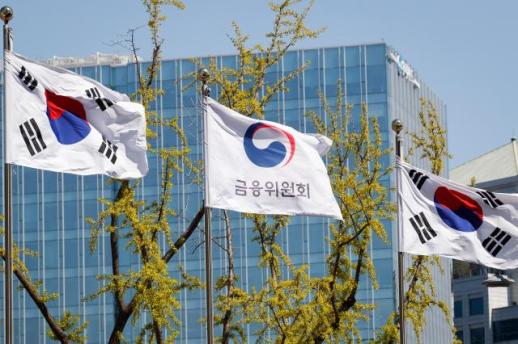 Korea to adopt a new overnight repo benchmark SEOUL, March 30 (AJP) -South Korea will overhaul its benchmark interest rate system, phasing out vulnerable quote-based rates and shifting to a transaction-based standard to prevent manipulation risks and strengthen market credibility. The Financial Services Commission (FSC) finalized the reform plan Monday at a joint meeting with the Bank of Korea (BOK) and the Financial Supervisory Service (FSS), marking one of the most comprehensive changes to the country’s rate-setting framework in decades. At the center of the reform is the transition to the Korea Overnight Financing Repo Rate (KOFR), a risk-free benchmark based on actual overnight repo transactions backed by government securities. Unlike existing quote-based rates, KOFR is calculated from real trades, making it more transparent and resistant to manipulation. The move reflects lessons from the 2012 global LIBOR scandal, when major banks were found to have manipulated benchmark rates used to price trillions of dollars in loans and derivatives. South Korean authorities see structural similarities in their own system, where the Korea Interbank Offered Rate (KORIBOR) is also based on bank-submitted quotes rather than transactions. “If we remain complacent with familiar practices, it could eventually lead to financial accidents,” FSC Vice Chairman Kwon Dae-young said, stressing that maintaining trust in benchmark rates is a core responsibility of the financial sector. Under the plan, banks will in principle stop issuing new KORIBOR-based loans starting in April 2027. Existing loans will remain valid until maturity, but borrowers will be encouraged to switch to alternative benchmarks such as COFIX or bank bond rates when renewing contracts. The CD rate, another widely used benchmark, will also be gradually phased out. Authorities plan to remove its designation as a “key benchmark” under relevant law by the end of 2030, signaling a clear shift away from legacy pricing standards. Both KORIBOR and CD rates have been criticized for relying on limited or non-transactional data, making them vulnerable to distortions and declining in relevance as market structures evolve. The government aims to establish KOFR as the core benchmark across financial markets, from derivatives to bonds and lending. To accelerate adoption, authorities raised the target share of KOFR-based transactions in the Overnight Index Swap (OIS) market to 70 percent by 2030, up from the previous 50 percent goal. In the floating-rate note (FRN) market, banks will aim to issue 50 percent of new products based on KOFR by mid-2031. Policy lenders such as Korea Development Bank and Industrial Bank of Korea will lead the transition by launching a combined 1 trillion won ($730 million) in KOFR-linked loan products in the second half of this year. Authorities also plan to provide incentives, including incorporating KOFR-based activity into central bank operations assessments, to encourage faster market adoption. Officials framed the reform as a preemptive move to strengthen financial infrastructure before risks materialize. Benchmark rates serve as the backbone of financial markets, underpinning loans, bonds and derivatives. When their credibility is compromised, the impact can spread quickly across the entire system, ultimately affecting consumers. The reform also comes amid heightened market volatility linked to geopolitical tensions, reinforcing the urgency of building a more resilient and globally aligned rate system. BOK Deputy Governor Park Jong-woo described the clear timeline for phasing out legacy benchmarks as “a significant milestone” in aligning Korea’s financial markets with global standards. While the transition is expected to take several years, authorities signaled that this marks the beginning — not the end — of broader efforts to modernize Korea’s financial infrastructure. 2026-03-30 15:40:47
 -
 Chicken prices surge as prolonged avian flu cuts supply SEOUL, March 30 (AJP) - Surging chicken prices are putting South Korea's poultry industry on alert. The spread of highly pathogenic avian influenza has cut broiler supplies, while a weaker won has added to feed-cost burdens, increasing pressure for broader price hikes. According to market insiders on Monday, major poultry producers, including Harim, Allpum, and Maniker, have recently raised prices to large retailers by about 5 to 10 percent. The increase comes amid a supply shortage caused by the outbreak of avian influenza, which typically occurs in winter but has persisted into spring this year, leading to larger-than-usual culls. About 440,000 chickens were culled, roughly 3.7 times the 120,000 culled a year earlier, accounting for about 5 percent of the total broiler breeders raised last year (9.22 million). Production costs have also risen, as the ongoing conflict in the Middle East has pushed up the won's exchange rate and driven sharp increases in prices for feed additives including amino acids. According to data from the Korea Institute for Animal Products Quality Evaluation, the average retail price of chicken in the fourth week of March rose to 6,612 won per kilogram, up 10.6 percent from 5,976 won in the first week of January, the highest level this year. Over the same period, the wholesale price climbed 12.9 percent from 3,857 won to 4,353 won. The impact is already being felt in restaurants. Some chicken franchise stores have faced delivery delays and difficulties securing steady supplies. Despite the government repeatedly urging restaurants not to raise prices in order to curb inflation, many say increases will be unavoidable if supply disruptions and cost pressures persist. Some franchises were quick to move, with KFC recently raising prices on about two dozen menu items, reversing its earlier stance that it had no plans to do so. With most signature menu items at major chicken brands priced between 26,000 and 27,000 won, costing almost 30,000 won once delivery fees are included, many consumers are hesitant to place orders. Citing a spike in raw material costs ahead of months of increased outdoor activity, an industry insider said, "If supply instability persists, we will have no choice but to consider raising prices." Meanwhile, the Ministry of Agriculture, Food and Rural Affairs said it plans to import 8 million eggs and gradually distribute them starting this month to respond to expected demand during the summer months. 2026-03-30 15:40:12
 -
 Damien Hirst's first Seoul solo draws crowds in awe SEOUL, March 30 (AJP) - Damien Hirst (b. 1965) is one of the most influential — and controversial — figures in contemporary art. He rose to prominence in the late 1980s as a leading member of the Young British Artists (YBAs), a group known for pushing boundaries with shock, spectacle and conceptual rigor. His works grappling with death and mortality drew strong public interest in Seoul as visitors filled the National Museum of Modern and Contemporary Art, Seoul on a weekday afternoon, where the exhibition “Damien Hirst: Truth Is Not Absolute, Everything Is Possible” is on view. The exhibition, held at MMCA Seoul, feartures around 50 works spanning more than four decades. It is Hirst’s first solo exhibition in Asia and runs from March 20 to June 28. The show traces the artist’s practice from early experimental works to recent paintings. Major series on display include the Natural History series, featuring animals preserved in formaldehyde, spot paintings composed of repeated dots, and installations resembling medicine cabinets. Works such as a shark suspended in formaldehyde, rows of pharmaceutical objects and canvases filled with colored dots explore themes of life and death, desire and consumption. Inside the gallery, visitors are seen engaging with the works in different ways. Some pause to observe the artworks closely, while others take photographs. The coexistence of viewing and recording has become a common sight. This pattern has been observed in recent exhibitions as well. A similar scene appeared during last year’s exhibition of Ron Mueck, which attracted more than 530,000 visitors. Visitors are increasingly choosing their own pace and method of engagement. MMCA has also expanded its “Culture Day” program. Starting in April, MMCA Seoul and Deoksugung will offer free admission every Wednesday from 6 p.m. to 9 p.m. While Hirst’s works continue to address themes of mortality and contemporary society, audiences are engaging with them in varied ways. Some spend time contemplating the works, while others capture them as images. The exhibition reflects a broader shift in museum-going. Visitors from different generations and nationalities share the same space, each experiencing the exhibition differently. The show not only presents Hirst’s works, but also reveals how audiences interact with art today. 2026-03-30 15:32:28