

Journalist

Chang SeongWon
-
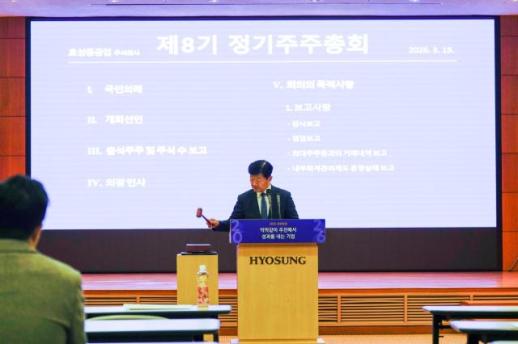 Hanwha Ocean, Hyosung Heavy Industries and Iljin Electric tout North America demand at annual meetings Hanwha Ocean, Hyosung Heavy Industries and Iljin Electric held annual shareholders meetings on March 19, outlining growth plans centered on North America and signaling expectations for more orders. Some agenda items were voted down, however, as the National Pension Service opposed proposals at several meetings, highlighting governance as a variable. Hanwha Ocean held its 26th annual meeting at Geoje Ocean Plaza and approved the reappointment of CEO Kim Hee-cheol as an inside director. Kim, who took office in September 2024, will lead the company for another three years. Kim is credited with driving a turnaround and restructuring after taking the lead on acquiring Philly Shipyard in the United States. The company also said its ability to respond to MASGA, a Korea-U.S. shipbuilding cooperation project, has strengthened. Hanwha Ocean posted an operating profit of 237.9 billion won in 2024, returning to the black. Last year, it reported operating profit of 1.1676 trillion won, up 391% from a year earlier. Kim said the company will focus on renewable energy. Hanwha Ocean created an energy plant division and previously signed an engineering, procurement and construction contract for the Sinan Ui offshore wind project. It is also pursuing construction and deployment of a wind turbine installation vessel. At Hyosung Heavy’s meeting, CEO Woo Tae-hee pointed to expanding demand for power infrastructure and expressed confidence in global growth. With investment rising in data centers and power grids, he said a transformer supply shortage is continuing and related orders are expected to keep increasing. “We strengthened order competitiveness and customer trust and expanded our presence in global markets,” Woo said. “Uncertainty remains this year, including global economic volatility, but we will further strengthen quality standards and production management capabilities and focus on improving the stability of global production bases and supply-chain operations.” Shareholders rejected a proposal to amend the company’s articles of incorporation to revise director qualification requirements. A proposal to appoint outside director Park Jong-bae was also scrapped. The industry attributed the outcome in part to the National Pension Service exercising voting rights under its stewardship code. The report said institutional investors have been more active in exercising shareholder rights as the government emphasizes a “value-up” policy, and the pension fund’s standards have become stricter. The National Pension Service has also voted against director appointments at meetings of Hyosung TNC, Iljin Electric and Lotte Chilsung Beverage. At Iljin Electric, the National Pension Service opposed the reappointment of CEO Yoo Sang-seok as an inside director and the appointment of outside director Cho Woong-ki, but both proposals passed. Iljin Electric will shift from a co-CEO structure under Hwang Soo and Yoo to a single-CEO system led by Yoo. LG Display also held its annual meeting and presented plans to upgrade its business structure and improve profitability. CEO Jeong Cheol-dong said the company will “maximize the results of upgrading our business structure and prepare future growth engines through cost innovation and securing technologies with a competitive edge.” LG Display said it has shifted its business toward organic light-emitting diode displays and posted operating profit of 517 billion won last year, returning to the black for the first time in four years. OLED’s share of sales rose to 61% last year from 32% in 2020, the company said.* This article has been translated by AI. 2026-03-19 18:36:47
 -
 Hyundai Struggles in China as Chinese Automakers Step Up Push Into South Korea Hyundai Motor Co. is again struggling to gain traction in China, with local sales slipping and the company leaning more heavily on exports from its China operations. Chinese automakers, meanwhile, are accelerating efforts to expand sales in South Korea by rolling out new models. According to industry data released Thursday, Beijing Hyundai Motor Co. (BHMC), Hyundai’s China unit, sold 16,535 vehicles in China’s domestic market in January and February, down about 500 from 17,021 a year earlier. The figure is about half the 26,163 vehicles sold in the same period in 2024. Hyundai’s annual sales in China have been falling for years. Sales dropped about 71% to 128,008 last year from 440,177 in 2020. Annual totals were 350,277 in 2021, 250,423 in 2022, 242,000 in 2023 and 125,127 in 2024, continuing a downward trend. Against that backdrop, Hyundai has shifted its China strategy from domestic sales to exports. Exports of vehicles produced in China rose to 66,214 last year from 5,905 in 2020. Of last year’s exports, 16,492 vehicles were shipped to South Korea. With China’s economy slowing and consumer demand weakening, BHMC’s export-focused approach is expected to remain in place for now. As weaker demand is anticipated in China, Chinese automakers are moving in the opposite direction by stepping up their push into South Korea. BYD, marking its 10th year in the Korean market, is preparing to launch its first hybrid model in Korea within the year. Its current lineup in Korea — ATTO 3, SEAL, SEALION 7 and DOLPHIN — consists entirely of battery-electric vehicles. BYD’s sales target for this year is 10,000 vehicles. Polestar, an electric-vehicle brand under China’s Geely Automobile Group, set a target of 4,000 vehicles, up more than 30% from last year. To support that goal, it plans to launch the performance SUV Polestar 3 in the second quarter and the flagship SUV Polestar 5 in the third quarter. It also plans to build 400 chargers at 40 sites nationwide by 2030. Geely’s Zeekr is also making final preparations to enter South Korea, aiming as early as the third quarter with the SUV 7X as its first model. BYD sold 2,304 vehicles in South Korea through February, putting it on pace to surpass its 10,000-unit goal. Polestar, which sold 27 vehicles in January, increased sales to 243 in February. An auto industry official said Chinese companies have strengthened their technological competitiveness after building from their home market.* This article has been translated by AI. 2026-03-19 18:03:20
 -
 Hanwha Ocean to Inject 164.5 Billion Won Into U.S. Subsidiary via Rights Offering Hanwha Ocean is expanding overseas investment by injecting new capital into its U.S. subsidiary. The company said Thursday that its subsidiary Hanwha Ocean USA Holdings decided on a paid-in capital increase worth about 164.5 billion won to secure funds for investment, according to a regulatory filing. The offering will be conducted as a rights issue. Hanwha Ocean, which owns 100% of the unit, will subscribe to all newly issued shares, meaning the parent will provide the funds directly without bringing in outside capital. In the filing, Hanwha Ocean described the move as a decision on a paid-in capital increase to raise investment funds for Hanwha Ocean USA Holdings. Payments will be made in installments through Dec. 31, 2026, depending on business progress.* This article has been translated by AI. 2026-03-19 17:55:28
 -
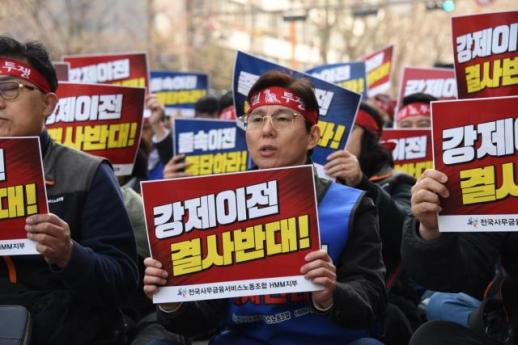 HMM Office Workers Union Calls Busan Headquarters Move Rushed, Plans Rally Near Blue House HMM’s office workers union has continued rallies outside the company’s Yeouido headquarters, reiterating opposition to a planned relocation of the headquarters to Busan. The HMM branch of the National Office and Financial Services Union said it held a second rally March 16, following an all-member rally March 11, calling for a halt to what it described as a rushed move and for guarantees of autonomous management at a private company. According to the industry on March 19, the union’s statement demanded an immediate stop to the relocation, opposition to any forced move, an end to unfair labor practices and protection of management autonomy. Branch chief Jeong Seong-cheol said in remarks that the Ministry of Oceans and Fisheries was pushing the relocation despite knowing there were legal issues, accusing the government of acting irresponsibly. Jeong also criticized the company’s leadership, saying management was staying silent despite recognizing the move’s unfairness and the expected drop in efficiency. He called it an evasion of responsibility and a lack of qualifications, and warned of legal action and accountability if the plan continues. Lee Nam-hyeon, vice chairman of the union, said the relocation could bring economic losses and weaken shipping competitiveness. He disputed the government’s argument that proximity to ports is decisive, saying global shipping hubs such as London and Singapore grew because of “shipping finance,” not ports. He added that HMM needs to maintain close cooperation in Seoul, where finance is developed, to protect its capabilities. The union said it plans a large rally near the Blue House on April 2 and will step up its campaign after the second rally.* This article has been translated by AI. 2026-03-19 17:54:07
 -
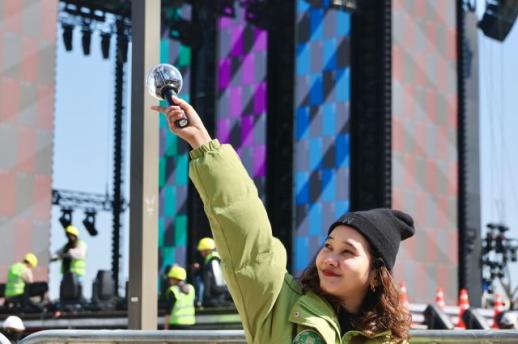 BTS Live D-2: Fans flock to Gwanghwamun ahead of BTS performance SEOUL, March 19 (AJP) - With just two days remaining until BTS's March 21 comeback performance at Gwanghwamun in central Seoul, numerous visitors are already gathering at the venue on Thursday. While workers are busy installing the stage, seating, and lighting at the iconic Seoul square, visitors are already taking photos and observing the construction site. Gwanghwamun Plaza is currently filled with tourists, with temporary walkways installed for safety control, allowing movement only along designated paths. Some fans brought light sticks and took photos in front of the stage that is being set up, enjoying the atmosphere before the global fan-festival kicks off. 2026-03-19 17:42:18
 -
 Asian stocks broadly retreat more than 2%, USD/KRW breaches 1,500 SEOUL, March 19 (AJP) - Korean stocks tumbled Thursday, tracking a broad selloff across Asia, while the won broke past the key 1,500 level against the dollar as surging oil prices and escalating Middle East tensions triggered heavy foreign outflows. The benchmark KOSPI fell 2.7 percent to close at 5,763.22, after briefly touching an intraday low of 5,738.95. The Korean won weakened to 1,500.6 per dollar at the close, breaching the psychological 1,500 threshold as risk-off sentiment intensified and capital outflows accelerated. Foreign investors led the selloff, dumping 1.87 trillion won ($1.25 billion) worth of shares on the KOSPI, while institutions sold an additional 665.9 billion won. Retail investors bought 2.41 trillion won, absorbing the bulk of the selling. The divergence in flows reflected a classic risk-off pattern, with offshore capital exiting aggressively as currency volatility spiked. Technology heavyweights bore the brunt of the decline. Samsung Electronics fell 3.8 percent to 200,500 won, while SK hynix dropped 4.1 percent to 1,013,000 won, tracking weakness in global semiconductor shares. NAVER and Kakao declined 2.7 percent and 2.9 percent, respectively. Cyclical sectors also came under pressure. Hyundai Motor fell 3.3 percent and LG Energy Solution slipped 3.3 percent, as rising oil prices and rate concerns weighed on growth-sensitive stocks. Hybe dropped 3.5 percent to 354,500 won ahead of BTS’s comeback, as broader market risk aversion overshadowed event-driven optimism. The tech-heavy KOSDAQ fell 1.79 percent to 1,143.48. Foreign investors sold 202.6 billion won on the KOSDAQ, while institutions offloaded 262.3 billion won. Retail investors bought 502.1 billion won, mirroring the KOSPI pattern. Losses were broad-based across sectors, with electronics, securities and industrials leading declines as tightening financial conditions and geopolitical risks dampened investor appetite. In contrast, select energy-linked plays rallied. SK Eternix surged 26.1 percent, extending its monthly gain to nearly 95 percent, as investors rotated into renewable energy stocks as a hedge against rising crude prices. Samsung Electro-Mechanics rose 3.34 percent. Construction stocks also outperformed, with Daewoo Engineering & Construction gaining 8.7 percent on expectations of overseas infrastructure and nuclear power projects. Overnight on Wall Street, major indexes fell, with the Dow Jones Industrial Average down 1.6 percent, the S&P 500 losing 1.4 percent and the Nasdaq declining 1.5 percent. The Philadelphia Semiconductor Index slipped 0.5 percent, while Nvidia and ASML fell 0.8 percent and 2.5 percent, respectively. Oil remained the central driver of sentiment. Brent crude surged 6.5 percent to $114.4 per barrel, while West Texas Intermediate rose to $97.3, heightening inflation concerns and reinforcing fears of prolonged supply disruptions tied to attacks on Middle Eastern energy infrastructure. Market volatility spiked, with the VIX jumping 13.8 percent to 25.5, signaling elevated investor anxiety. Across Asia, markets broadly declined under the weight of energy shocks and tightening financial conditions. Japan’s Nikkei 225 plunged 3.4 percent as investors unwound positions ahead of the Vernal Equinox Day holiday. Hong Kong’s Hang Seng fell 2 percent, while China’s Shanghai Composite dropped 1.4 percent. 2026-03-19 17:40:21
 -
 Flowers bloom in Seoul Buddhist temple as vernal equinox nears SEOUL, March 19 (AJP) - Spring flowers bloomed at Bongeunsa Temple in Seoul’s Gangnam District on Thursday, drawing visitors a day ahead of the seasonal marker Chunbun, the vernal equinox. Plum trees with red and white blossoms, and cherry flowers colored the temple grounds, offering a gentle sign of the changing season. Visitors paused to take photos or slowed their steps, enjoying the early spring atmosphere. Chunbun marks the day when daytime and nighttime are of equal length, after which daylight hours gradually become longer than the night. 2026-03-19 17:28:45
 -
 Hanwha Aerospace’s Arion-SMET Unmanned Vehicle Passes South Korean Defense Performance Test Hanwha Aerospace said on the 19th that its multipurpose unmanned vehicle, the Arion-SMET, has completed a Defense Acquisition Program Administration performance verification test as the sole participant. The vehicle is a key asset in the South Korean Army’s future force concept known as “Army Tiger 4.0.” The evaluation, conducted with full-scale equipment from the 3rd for about three weeks, assessed six items including top speed and operating range. The test was designed to compare the performance claims submitted by defense companies. Additional checks were reported to include the military’s view that remote-control distance exceeding the required performance should be compared, and whether any updates had been made to equipment entered in the verification test. Hyundai Rotem, which competed with Hanwha Aerospace for the program, did not take part after raising concerns about the fairness of the evaluation. The Army test and evaluation team previously conducted a five-month purchase trial from September 2024 to February 2025, and all companies’ equipment was judged suitable for combat use. A Hanwha Aerospace official said the company is “faithfully carrying out the project in line with all conditions required by the government,” adding that it will deliver the Arion-SMET, which it said has strong performance, in time to meet the military’s needs.* This article has been translated by AI. 2026-03-19 17:24:07
 -
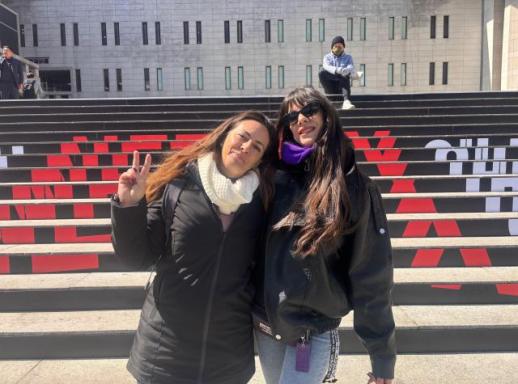 BTS Live D-2: Why ARMY are willing to come - at any cost SEOUL, March 19 (AJP) - Visitors flocking to Seoul from around the world for the BTS comeback concert Saturday are readily paying ever higher prices for flights, accommodation and merchandise, as a measure of the devotion that typifies the BTS fan. Travel costs are surging up to six times their usual levels, fans say. The willingness to absorb the burden reflects more than concert demand, underscoring a deeper dynamic of the BTS-driven “fandom economy,” where spending functions as an expression of loyalty and identity. “They don’t just sell music or tickets. They shape narratives that move people and, increasingly, markets,” said Lambert Zixin Li, professor of Management and Organization at the National University of Singapore. On the ground in Gwanghwamun, the downtown concert venue, overseas fans said rising costs did little to deter them. “I love their songs. The lyrics are so meaningful,” said Christina Coppola from Italy, who traveled with her sister. “They are strong and cool.” For many, the BTS impact runs deep. “They are my motivation for life,” said Desty Konita, a 30-year-old visitor from Indonesia who traveled to Seoul with her four-month-old child. “They work so hard, have no scandals, and remain humble despite their popularity. I really respect that,” she said, adding that she had learned Korean because of BTS. Tan Joo Seng, a professor of strategy and international business at Nanyang Business School, said such attachment reflects the need for meaning in uncertain times. “Being a fan provides individuals with a sense of belonging, identity and shared purpose,” he said. Others pointed to specific songs and long-term fandom as their reason for coming. “I really like V’s solo song ‘Winter Bear,’” said Tanaka Arisa, a 19-year-old from Japan who has followed BTS since high school. Fans in Gwanghwamun said they “had to come” despite higher expenses, viewing the event as a chance to be physically present within a global fandom community. “The scale of BTS’s upcoming concert, with the expected audience of around 260,000, shows how fandom has evolved into a significant economic force,” Tan said. “Superstar fandoms today operate as highly engaged ecosystems that generate value far beyond ticket sales.” According to a 2024 study by Luminate, an entertainment analytics platform, U.S.-based K-pop fans spent 2.4 times more on merchandise in 2023 than general pop fans. Forbes magazine noted that “creators are the new brands,” adding that the relationship between creators and fans is evolving beyond brand loyalty into a meaningful economic community. This shift is often described as the “fandustry,” where fan activity directly drives the success and market value of content. Tan explained that at the core of this system is emotional engagement, noting that modern fandoms are no longer passive audiences but active participants who amplify content, organize communities and sustain demand across digital platforms. This creates what Nanyang Business School professor Tan described as a “multiplier effect,” where each fan interaction generates further economic and cultural impact. The Indonesian fan Desty Konita said that BTS is “number one” in Indonesia and that she promotes the group with her friends. “Even if flight prices are five times higher, it’s still worth it,” Konita said. “It’s even a free concert, and opportunities like this don’t come often.” Some BTS supporters, known as the ARMY, spend up to 50–60 percent of their income on albums, merchandise and related experiences. The economic impact already evident in the data. BTS is estimated to generate around 5.5 trillion won annually, according to the Hyundai Research Institute, accounting for roughly 0.3 percent of South Korea’s GDP. In cities where concerts are held, the events drive spending across airlines, hotels, dining and tourism. The BTS fan app Weverse saw its revenue rise from 31.7 billion won (about $28.3 million) in 2019 to 112.7 billion won in the first half of 2020, accounting for around 38.3 percent of the BTS management company HYBE’s total sales. “Superstars are becoming ‘central banks of attention,’” said Lambert Zixin Li of the National University of Singapore. “When they act or speak, they inject liquidity into specific narratives, rapidly driving demand across products, experiences and even financial assets.” 2026-03-19 17:20:35
 -
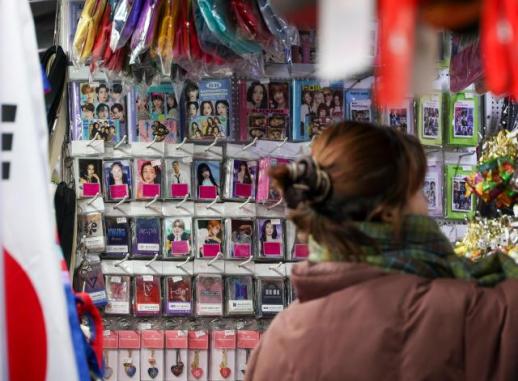 BTS Live D-2: Unofficial BTS goods surge in Seoul challenging brand control SEOUL, March 19 (AJP) - As official BTS merchandise becomes ever more expensive and ever harder to obtain ahead of the group’s comeback concert Saturday, a parallel market is emerging in Seoul and beginning to challenge the limits of brand control. In the city’s popular tourist Myeongdong and Insadong districts, unofficial BTS-themed goods have moved beyond the margins and into plain sight. Street vendors and small retailers openly display banners, printed T-shirts, photo cards, keychains and accessories. Tables stacked with BTS purple-themed items line narrow streets, while racks of printed apparel spill out onto sidewalks, blurring the boundary between formal retail space and street-level commerce. In one shop in Insadong, BTS-logo eco bags were selling for 25,000 won ($17), while metal badges were priced at 10,000 won, offering a snapshot of how unofficial goods are being priced on the ground. The contrast with official distribution is stark. Licensed goods remain limited, often require online access, and are subject to timed releases. For visitors arriving just days before the concert, the unofficial merchandise represents the only practical option. "I don’t mind buying unofficial goods," said Jeniffer Dayton, a 25-year-old visitor from Florida. For such fans, the distinction between approved and unapproved is secondary to participation itself. The ability to take part in a shared moment that is unfolding across the city counts for more. "What matters is our love for BTS,” she said. “These items are more practical, I can actually use them in my daily life, like a lanyard for my keys, unlike some official goods that I mostly keep at home." This shift is beginning to reshape the balance between brand management and on-the-ground consumption. Official merchandise carries legitimacy and scarcity, but the unofficial market operates on speed, proximity and volume, factors that become decisive in a time-sensitive, event-driven setting. "If you look at resale markets like eBay, official light sticks easily goes for over $100," said Sarah Zhong, a 31-year-old visitor from Guangzhou currently living in Washington. "Getting one for under $50 feels like a bargain but it’s usually really hard to get your hands on one." At the same time, the divide remains meaningful within parts of the core fan base, where authenticity continues to carry symbolic weight and ownership of official goods is tied to identity and loyalty. "I still prefer official goods because they feel more authentic," she said. "But if I see something I really like, especially something related to V, I might still buy it." A vendor, who asked not to be named, denied that she made the products. She said she is supplied by manufacturers and does not know if the products are licensed or not. She declined to provide further details. The fragmented supply chain reflects the speed at which the market has scaled up, with goods flowing into tourist-heavy districts in response to surging demand. The result is not simply a coexistence of two markets, but a structural tension. As Seoul transforms into a city-scale stage for BTS, the gap between controlled branding and uncontrolled demand is becoming increasingly visible, raising questions about how much of the fan experience can, or should, be managed. 2026-03-19 17:18:23