

Journalist

Chang SeongWon
-
 ChungjuMan’s Kim Seon-tae launches personal YouTube channel, draws ad buzz in comments Online posts have highlighted a wave of promotional comments tied to the launch of a personal YouTube channel by Kim Seon-tae, known as “ChungjuMan” for running the official YouTube channel of Chungju city in North Chungcheong province. On March 5, multiple online communities circulated posts pointing to comments that appeared to show companies and public institutions boosting the new channel. The posts listed comments from more than 50 companies, including Kyobo Life Insurance, Kia, Lotte Wellfood, Binggrae, Samsung SDS, Samil Pharmaceutical, Speak and YouTube Korea. They also cited participation from more than 20 institutions, including the National Agricultural Museum, the National Institute of Ecology, the National Health Insurance Service, the Ministry of Land, Infrastructure and Transport, and the Republic of Korea Army. In the comments, some wrote, “You said you want to make money, so we came. We’re here to plant a money tree to celebrate your YouTube opening,” and “Looks like there will be a long line of advertisers — should we line up on CatchTable?” Others added, “We heard you want to make money. We’re ready,” “We’ll make sure there are no tax issues all the way to the Blue House,” and “We’ll get in line first. Can we send a transfer?” Kim previously addressed his plans in a video posted March 3 titled “I’m Kim Seon-tae,” saying he “wanted to make more money.” His channel drew attention after surpassing 900,000 subscribers within three days of opening, and many companies have been sending advertising inquiries, according to the report. Some commenters reacting to the posts speculated about potential ad revenue, writing, “How much would the ad fees be if he takes all of that?” and “If you assume 20 to 30 million won per deal, just filming those would come to about 2 billion won in ad pay.” Others wrote, “Even just leaving a comment becomes viral in communities,” and “He quit being a public official to make money — the path is already laid out from the first try.” A separate post on Blind, an anonymous workplace community, showed criticism of Kim’s move. On March 5, a public official posted under the title “Chungju’s Kim Seon-tae is kind of cold,” arguing, “If you’re making a new promotional YouTube, you should bring the people from the same team with you.” The writer added, “With 800,000 subscribers, it becomes a company, and you need staff,” and said that because they were on the same team and appeared in videos together, “there’s some bond, but he’s going out alone.” Another public official responded, “There are a lot of gloomy public officials. They have no ability, but they’re the best at criticizing others.” Kim earned the nickname “ChungjuMan” while handling production and operations for Chungju’s promotional YouTube content, the report said. It also said he submitted a resignation letter to the personnel department on the 13th and then began a long leave. At the time, Kim said, “After 10 years in public service and seven years living as ChungjuMan, I’m now going to say goodbye.” He added, “The fact that someone as lacking as me was lucky enough to succeed was thanks to subscribers’ support.” He also said, “I want to thank the citizens of Chungju who supported me and my colleagues at Chungju City Hall who always showed consideration. The seven years I spent with you were the happiest time of my life. I hope you will continue to love Chungju.”* This article has been translated by AI. 2026-03-05 09:58:02
 -
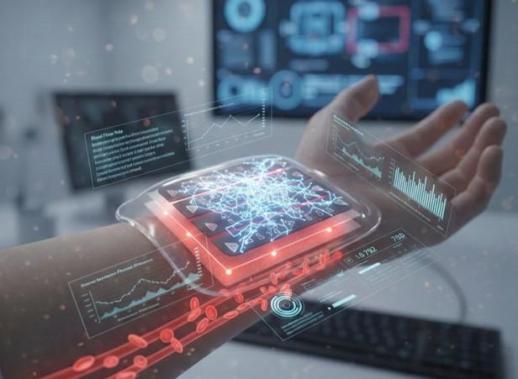 South Korean researchers develop wireless electronic patch for real-time blood flow monitoring SEOUL, March 05 (AJP) - Researchers at South Korea's Advanced Institute of Science and Technology have developed a wireless wearable electronic patch capable of measuring blood flow in real time. The device uses deep learning and multilayer thermal sensing to monitor cardiovascular health without invasive procedures. This technology provides a potential tool for the early detection of cardiovascular diseases and continuous monitoring of patients in clinical settings. Blood flow serves as a critical indicator of cardiovascular health, with fluctuations often signaling conditions such as hypertension, arteriosclerosis, or even physical shock. While Doppler ultrasound is currently the clinical standard for measuring blood flow, its reliance on bulky equipment and trained medical professionals limits its use for continuous daily monitoring. Existing wearable thermal sensors have struggled with accuracy because the depth of blood vessels varies between individuals, distorting the thermal signals used to calculate flow speed. The research team, led by Professor Kwon Kyung-ha of the School of Electrical Engineering at the Korea Advanced Institute of Science and Technology (KAIST), addressed this limitation by creating a multilayer thermal gradient sensing structure. The device features temperature sensors placed at different depths to analyze the three-dimensional movement of heat generated by flowing blood. By integrating a deep learning algorithm, the system can distinguish between the depth of the blood vessel and the actual speed of the blood flow simultaneously. Experimental results showed that the patch can measure blood flow speeds between 1 and 10 millimeters per second with an error margin of less than 0.12 millimeters per second. It also determined blood vessel depths between 1 and 2 millimeters with an accuracy within 0.07 millimeters. When integrated with photoplethysmography (PPG) sensors commonly found in smartwatches, the system reduced blood pressure estimation errors by up to 72.6 percent compared to using PPG sensors alone. This improvement was particularly evident during the Valsalva maneuver, a breathing technique that causes rapid changes in blood pressure. The platform was tested on human subjects through various physiological interventions, including breath-holding, external vascular compression, and cycling. In all scenarios, the blood flow measurements remained consistent with clinical perfusion index standards. The entire system is implemented as a wearable patch with Bluetooth Low Energy (BLE) capabilities, allowing for wireless transmission of biometric data to external devices for real-time analysis. "This technology provides a fundamental platform for more accurate measurement of blood flow and blood pressure," said Professor Kwon Kyung-ha. "By combining this with smartwatches, we can significantly improve the quality of daily health monitoring." The study, led by first author Sim Young-min, a student in the integrated master's and doctoral program, was supported by institutional funding and published in the journal Science Advances on February 6. (Paper information) Journal: Science Advances Title: Deep learning–integrated multilayer thermal gradient sensing platform for real-time blood flow monitoring DOI: https://doi.org/10.1126/sciadv.aea8902 2026-03-05 09:53:12
 -
 Jeju Bank, KT to Build Generative AI Platform in First for Regional Banks Jeju Bank will build a generative artificial intelligence platform, becoming the first regional bank to do so. The bank said Thursday it signed a contract with KT to build the platform and has begun a full-scale AI transition. The project goes beyond adopting new technology, aiming to create an environment in which employees can develop and use AI agents for work. Jeju Bank plans to complete the build in the first half of this year and then expand use in the workplace in stages. The platform will be used for tasks including real-time Q&A based on internal rules, as well as automated drafting of reports and official documents. The bank also plans to roll out AI agents to support key operations, including internal control checks, loan review support and assistance with system development work. Chief Executive Lee Hee-su called the project a key task for realizing Jeju Bank’s new vision, “Digital Jeju 2030.” “As the first regional bank to introduce generative AI into practical work, we will achieve employee-led innovation and provide customers with differentiated financial services,” he said. 2026-03-05 09:45:00
 -
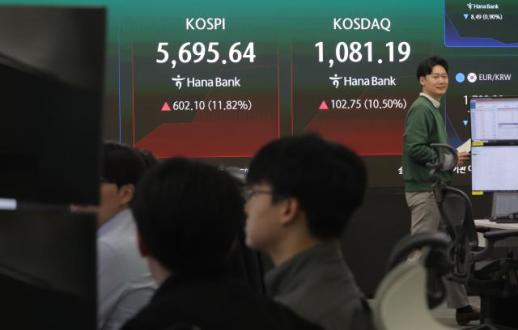 South Korean stocks roar back, up 12% on opening bell SEOUL, March 5 (AJP) – An epic rebound followed an epic downfall for South Korean shares as they opened Thursday 12 percent, instantly erasing the largest-ever collapse of the same scale a day earlier. As of 9:23 a.m., the benchmark KOSPI soared 11.5 percent to 5,684.53, while the tech-heavy KOSDAQ climbed 11.45 percent to 1,090.52. After two consecutive sessions that triggered sell-side sidecars, the opposite sidecar — on the buy side — was activated shortly after the opening bell. Retail and foreign investors piled in in full force, bargain-hunting after the main bourse shed nearly 20 percent over the previous two sessions. Individuals were net buyers of 277.9 billion won ($206 million), while foreigners purchased a net 600.5 billion won. Their buying centered on heavyweight stocks that had become sharply cheaper during the two-day rout. Samsung Electronics surged 13.59 percent to 195,600 won, while SK hynix jumped 15.19 percent to 978,000 won, extending strong gains among semiconductor bellwethers. Automakers also advanced sharply. Hyundai Motor climbed 14.57 percent to 574,000 won, while affiliate Hyundai Mobis rose 9.77 percent to 438,000 won and Kia gained 9.76 percent to 172,000 won. Battery and defense stocks joined the rebound. LG Energy Solution added 8.06 percent to 375,500 won, while Hanwha Aerospace edged up 2.95 percent to 1,362,000 won. Financial shares also rallied, with KB Financial Group rising 10.09 percent to 151,600 won, Shinhan Financial Group gaining 7.66 percent to 95,600 won, and Samsung Life Insurance climbing 8.61 percent to 214,500 won. Market breadth underscored the strength of the rebound. On the main KOSPI board, gainers overwhelmed losers 899 to 20. On the KOSDAQ, 1,660 stocks advanced versus just 59 decliners. The Korean won also strengthened on renewed foreign inflows, with the dollar slipping 2.80 won from overnight to trade at 1,460.70 won. 2026-03-05 09:39:48
 -
 BYD Korea to Provide SEALION 7 SUVs for WDR Symphony Orchestra Korea Tour BYD Korea said Thursday it will provide its midsize SUV, the BYD SEALION 7, as an official courtesy vehicle for the South Korea tour of Germany’s WDR Symphony Orchestra Cologne. The orchestra, with a 79-year history, is regarded as one of Germany’s leading broadcast symphony orchestras, known for a broad repertoire spanning Baroque, Classical and Romantic works as well as 20th- and 21st-century music. The visit is the ensemble’s first in South Korea since 2018, BYD Korea said. The tour begins with a March 5 performance in Busan, then continues to Jinju in South Gyeongsang Province, Gumi in North Gyeongsang Province and Bucheon in Gyeonggi Province, before concluding with a March 11 concert at the Seoul Arts Center in Seoul. During the tour, the SEALION 7 will be provided to the conductor and guest soloists as their courtesy vehicle. BYD Korea said the electric vehicle is designed for quiet operation and stable driving performance. The company said the cabin uses double-laminated glass to help block outside noise, and features headrest-integrated sports seats with heating and ventilation designed for ergonomic support and a stable seating feel. A BYD Korea official said the support is meant to go beyond transportation by accompanying “the artistic journey of world-class artists,” adding that the company will continue cultural collaborations to broaden customer engagement and build trust by showcasing BYD’s brand value and technology. * This article has been translated by AI. 2026-03-05 09:39:21
 -
 Actor Kim Jeong-tae Shares Update on Son Ji-hu, Says His Korean Was Misread as a Disability Actor Kim Jeong-tae has shared an update on his eldest son, Ji-hu, known to viewers by the nickname “Ya-kkung.” A preview for TV Chosun’s “Dad and Me,” Season 3, aired on March 4 and showed Kim appearing on the program. In the clip, Kim said he is the father of two sons and noted that his oldest had previously greeted the public under the nickname Ya-kkung. Kim said his eldest is more comfortable speaking English and has long been interested in other languages. He added that because his son used English, his Korean sounded awkward, leading some to suggest he might have a developmental disability. Ji-hu said, “I don’t have any friends. After getting used to being alone, I felt I didn’t need to make friends anymore.” Kim said, “I don’t know. I didn’t ask in detail. If you talk about it negatively, he’s a character that’s hard to understand.” * This article has been translated by AI. 2026-03-05 09:29:11
 -
 Hanwha Systems to Open Joint R&D Centers With Seoul National, Sungkyunkwan for Defense-Space Chips Hanwha Systems said March 5 that it held ceremonies with Seoul National University and Sungkyunkwan University to establish joint research and development centers to secure design technologies for defense and space semiconductors. The centers will be set up at SNU’s Semiconductor Joint Research Institute and at Sungkyunkwan University’s College of Information and Communication Engineering on its Natural Sciences Campus, the company said. Hanwha Systems and SNU will conduct joint research through 2031 to develop high-frequency semiconductor design technology for communications, it said. The chips are expected to be key components for applications including communications satellites, mobile terminals and unmanned aircraft, supporting high-speed, low-latency, high-performance military communications linking land, sea, air and space domains. Hanwha Systems said it previously won a development project in December for a “transceiver space semiconductor for low-Earth-orbit communications satellites,” one type of communications chip. The transceiver is described as a core component for military LEO satellite communications, designed to reliably transmit and receive satellite signals between ground and space in extreme space environments. With Sungkyunkwan University, Hanwha Systems will jointly develop domestically made, high-power, high-efficiency, wideband semiconductors for radar, the company said. The chips are core components used in radar antennas — the “eyes” of systems such as surface-to-air guided weapons, fighter jets and observation satellites — and are used to generate radio waves and amplify received signals for target search and tracking. The company said the technology could be used broadly, including in multifunction radars applied to Cheongung-II and L-SAM, as well as AESA radars for fighter aircraft and SAR for observation satellites. Hanwha Systems said it plans to build joint research infrastructure with each university and pursue work in stages, from early research and technology acquisition to component commercialization. It also plans longer-term cooperation, including expanded industry-academia exchanges and recruitment of top talent. Defense semiconductors are specialized chips used in advanced weapons systems such as missiles, radar and military communications, requiring far higher reliability and stability than chips for other industries, the company said. Hanwha Systems said it expects the partnerships to help it internalize high-quality domestic defense semiconductor design capabilities quickly and systematically. Hanwha Systems said it aims to strengthen competitiveness in defense semiconductor technology across all stages, from components to integrated systems, and to become a leading company in localizing defense semiconductors in South Korea. “This industry-academia partnership is an important starting point for securing core defense semiconductor technologies stably at home,” a Hanwha Systems official said. “Through sustained R&D and talent development, we will raise self-reliance in key semiconductor technologies for defense and contribute to strengthening South Korea’s defense industry competitiveness.” 2026-03-05 09:28:16
 -
 LIG Nex1 Opens Assembly, Inspection Facility for Fleet-to-Air Missile-II LIG Nex1 said March 5 it held a completion ceremony the previous day at its Gumi House complex for an assembly and inspection facility for the Fleet-to-Air Missile-II. The Fleet-to-Air Missile-II is an air-defense guided weapon intended for installation on South Korea’s next-generation destroyer, known as KDDX, to help protect friendly ships from threats such as enemy aircraft and cruise missiles. LIG Nex1 completed the facility about two years after signing a system development contract for the program with the Defense Acquisition Program Administration in 2024. The company said the new facility will support efforts to complete a high-quality guided weapon that it expects to serve as a key element of friendly ship defense through 2030. LIG Nex1 said it is pursuing what it described as the industry’s first company-led system development project for an air-defense guided weapon. If the project is completed successfully, the company said it expects to strengthen its guided-weapon research and development capabilities. It said it is developing the system with a target localization rate of 90%, and expects the program to contribute to national interests tied to future exports and to shared growth with participating companies. Chief Executive Officer Shin Ik-hyun said the company will seek to help secure next-generation weapon systems, citing its technology and infrastructure across guided weapons for land, sea and air, including ongoing development of long-range air-to-surface and short-range air-to-air missiles, and future long-range air-to-air missiles.* This article has been translated by AI. 2026-03-05 09:27:28
 -
 Young Poong to Review KZ Precision Shareholder Proposals, Plans to Put Legal Items to Vote Young Poong said Thursday it will closely review shareholder proposals submitted by KZ Precision, a related party of Korea Zinc Chairman Choi Yun-beom, ahead of its 75th annual general meeting and plans to place on the agenda any items that comply with relevant laws. The company said it has pursued its own governance reforms and shareholder-value measures, contrary to KZ Precision’s claims. It cited last year’s cancellation of 1,030,500 treasury shares, a 10-for-1 stock split aimed at lowering the entry barrier for small investors, and cash and stock dividends totaling 33.6 billion won. Young Poong also said it has reflected shareholder views in management, including appointing Jeon Young-jun as an outside director who serves on the audit committee after accepting a proposal from ordinary shareholders. Young Poong said it will maintain its shareholder-return stance this year. It plans to cancel all remaining 203,500 treasury shares in the first half, further reducing shares outstanding. The company said the move is intended to enhance shareholder value and reinforce its commitment to responsible management. It also said it will draw up a midterm roadmap for its dividend policy to improve predictability for shareholders and further refine its corporate value-up program. Young Poong said it will also accelerate governance-improvement efforts aimed at raising the corporate value of its key asset, Korea Zinc. The company said it believes Korea Zinc under Choi’s leadership continues to face concerns about potential damage to shareholder value, and it will do its utmost to normalize corporate value through sound governance and protect shareholder interests. Young Poong said it is working to strengthen competitiveness by restoring sales and improving profitability in its core smelting business, while continuing environmental investment to build an eco-friendly smelter. It said it will continue to focus on enhancing shareholder value based on responsible management and transparent decision-making. Separately, Young Poong said it filed a damages lawsuit on March 4 against KZ Precision and its Chairman Choi Chang-gyu and CEO Lee Han-seong, alleging they created the appearance of cross-shareholdings during a management control dispute at Korea Zinc and caused significant losses to Young Poong.* This article has been translated by AI. 2026-03-05 09:21:19
 -
 Kim Jong-un inspects missile tests from new destroyer SEOUL, March 5 (AJP) - North Korean leader Kim Jong-un has visited a shipyard in Nampo for a new destroyer and oversaw the test-firing of strategic cruise missiles from the vessel, state media reported on Thursday. According to the state-run Korean Central News Agency, Kim, accompanied by key military and party officials, conducted a two-day inspection of the 5,000-ton Choe Hyun on Tuesday and Wednesday to "observe its crew members' combat and political training and the shakedown to assess its operational capabilities." Overseeing the test launch of sea-to-surface strategic cruise missiles from the destroyer, Kim Jong-un said it was an "important core element in estimating the operational capabilities of the warship." Praising its sailors for "having achieved successes," Kim was also quoted as saying, "The tests of operational efficiency of the new-type destroyer, a new symbol of our state's sea defense capability, are going smoothly as planned." "Our Navy will have a powerful offensive capability, which is, in effect, a capability for defending ourselves," he added. Kim also inspected another destroyer under construction, which would become the third vessel of the same class as the Choe Hyon, expected to be completed by early October in time for the 81st anniversary of the founding of the country's key ruling organ, the Workers' Party of Korea. He also called for building more warships of the same class or larger each year under the country's new five-year plans, as part of efforts to strengthen its naval power. Launched in April last year, the multipurpose destroyer, named after Choe Hyon, a comrade of regime founder Kim Il-sung during his days as a partisan fighter, is believed to be capable of carrying nuclear weapons. 2026-03-05 09:18:02